I’ve got a confession to make. Despite being an avid reader, I rarely buy books. Almost everything I read, I borrow from the library, from a friend, re-read from our book shelves, or am given as a gift. And I feel bad about this.
This year, I was curious about my reading habits and decided to track my book consumption via Goodreads. My account only reflects the books I’ve read (or at least started) in 2013, mostly because I was lazy and didn’t want to add everything from my entire reading life and then give up on it and eventually abandon my account because I was overwhelmed with the amount of work it had become. But thanks to that laziness, I now I have a discrete data set that I am kind of geeking out over studying as I analyze my buying v. borrowing habits:
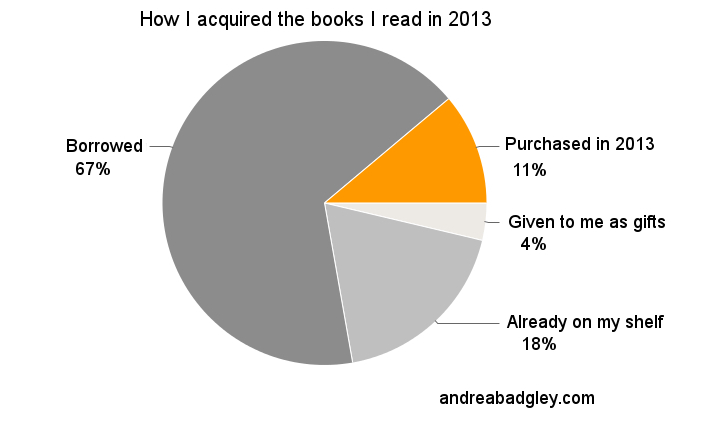
Total books I read (or began): 45
Books I purchased in 2013: 5 (11%)
Books I borrowed from a friend or the library: 30 (67%)
Books I reread from my shelf: 8 (18%)
Books given to me as gifts: 2 (4%)
Of the 45 books I’ve read these past nine months, I have only purchased 5 of them. Three of those were writing books (reference books I wanted to own so that I could, duh, refer to them), one was a favorite novel I already own in hardback and purchased the digital version this year, and only one was a non-reference new title (Flanner O’Connor’s short stories because I know I like her, and I know I won’t read the collection all at once and within a three-week borrowing period). Of the other 40 books I read, two were gifts, eight were already on my shelf, and 30 I borrowed from either the library or a friend.
In other words, I personally only purchased 11% of the material I read this year, and I borrowed a full two-thirds of it: 67%.
Hello, you’re using numbers, and we’re a word crowd, you say. What the hell is your point? you wonder. My point is this: do my material acquirement habits (ie borrowing instead of buying) negatively impact writers and publishers?
Should I feel guilty?
As a writer, I understand and appreciate how much goes into publishing a book. There are first the ideas, which are valuable in and of themselves, and which then must be extracted from the writer’s mind, placed on paper or screen in a comprehensible manner, and crafted into a compelling story with dialog and pacing and fine sentences and characters and setting and plotting and arcs. And all of these things must be good. The work must be researched, and reworked, and re-read, and revised, and revised, and revised. This can take years. And that’s just the author’s portion. Then there are the family members, and the critique groups, and the beta-readers, and the editor, and the agent, and the publishing company, and the imprint, and the digital, um, transmogrifier.
So when I borrow a book from the library instead of sending money to all those people, I do feel guilt. My family is not in a financial position right now for me to have a book budget, and thank God for libraries because we can access literature for free, but I still feel bad that I’m not putting much money where my values are. I expressed my guilty feelings to Rebecca Schinsky, co-host of my favorite podcast, Book Riot, on Twitter one day. In episode 19 of their podcast, she and Jeff O’Neil, both editors at BookRiot.com, had been talking about a brand new ebook subscription service called Oyster. Similar to the Netflix model, Oyster is a pay-by-the month plan for unlimited access to ebook titles (currently for iPhone only), and while it is an amazing price ($9.95 per month) for how much material would be at my fingertips – unlimited, instant access to thousands of titles for less than the price of one ebook – it’s just not in the cards right now. I tweeted to Schinsky that I had no book budget, and as I reader I feel extreme guilt about this, and she wrote back,
No guilt! Readers should read however they can. Readers shouldn’t be shamed for how they get books. (Whether that’s Amazon, libraries, indies, etc.) It’s the industry’s job to adapt, not readers’ job to keep it going.
Yeah, she’s pretty awesome.
Her comment, in addition to relieving most of my guilt, got my wheels turning in another direction entirely: we as readers are the consumers, the customers, the audience without whom there would be no industry. I got to thinking about where I do spend my money, and how. Since we are a single income family of four (I’m a stay-at-home-mom), we are conservative with our spending. We don’t have cable, we have bare bones cell phone plans, we rarely go to movies or dine out, and our clothing budget is precious. When we do spend money, we are careful about how we spend it: on quality. I won’t buy an article of clothing that doesn’t fit me exactly right, that doesn’t make me feel kickass when I wear it. We won’t waste our money on a crappy movie that we’re not all excited about seeing.
And I won’t buy a book unless I know I’m going to like it. Unless I know I’m going to return to it. With music, as consumers we have the option of listening to a song over and over on the radio before deciding if we want to buy it. Likewise, the library provides a means of “listening” to books, of sampling their quality, of trying them on to see if they fit, before making a decision to buy. And if the quality is there – if the author, and the editor, and the publisher have all done their job well – I will buy if the book is too perfect a fit to pass up. When I read The Paris Wife last year, as soon as I turned the final page, the tears still wet on my face, I immediately purchased my own copy with some of my birthday money. Some books are keepers like that. Plus I had to transfer all my notes before my library loan expired.
But when I don’t have the money, and I adore a book, I like to think that maybe my adoration is enough. I recently helped a friend in my critique group, a spunky 74 year old writer, Judith Clarke, take the plunge into blogging. Over coffee, I asked, “What is your goal with your blog?” and she said, “I just want to write.” Then she leaned forward and said, “And I want to be read.”
Artists want their art to be seen. Writers want their words to be read. And money is not the only currency with which to measure the value of their work. In fact, if your goal is to make a lot of money, you’re probably not going to choose art or writing as your career path. I like to think that most artists create because they have to. They have to get this stuff out of them, onto the canvas, into the clay, onto the page.
And though they can’t eat satisfaction, they can’t buy clothes with word-of-mouth adoration, I like to think that I can still help them out even when I have no cash in my wallet.

I like to the think that buying is not the only way for us to show our appreciation for a work of art. I like to think that the contributions of readers, not just in terms of what we spend our money on, what titles we do actually purchase, but also in terms of talking about books, of joining book clubs, of reviewing titles on GoodReads, of discussing our reactions on our blogs, helps a writer out. I like to think that impacting us – by making us think; by sharing a story, a heart, we’d have never known otherwise; by giving us the gift of empathy – feeds a writer’s soul, whether their work was thrust on us by a dazzled friend, or we bought it on a recommendation from our favorite book blog, or we loved it so much we re-read it from our own shelf, or, yes, we borrowed it from the humble library.
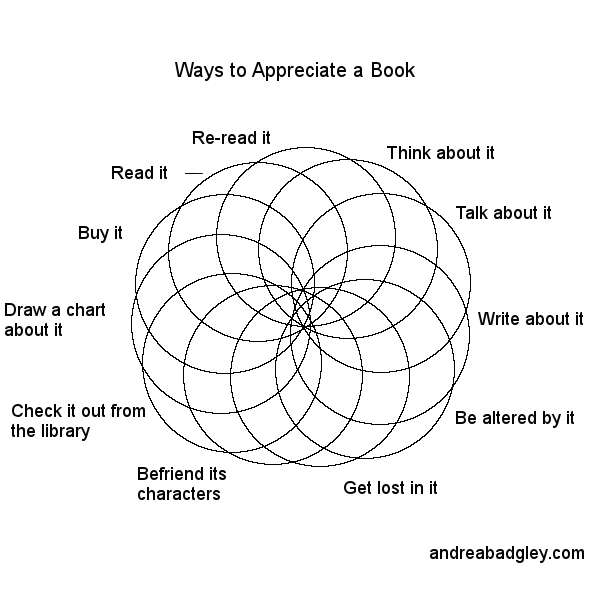
I like to think that any and all of those keep the industry going. That all of those methods of attainment show that readers will read, by whatever means necessary, ensuring that writers will keep writing, and editors will keep editing, and publishers will keep publishing, by whatever means necessary, to keep our hungry hearts filled with stories.

 Butterfly Mind