People in general, and knowledge workers in particular, grow according to the demands they place on themselves… If they demand little of themselves, they will remain stunted. If they demand a good deal of themselves, they will grow to giant stature.
— Peter Drucker, The Effective Executive
I’m spending the morning under a blanket, transcribing underlined passages from professional development books into a notebook I can carry with me in my laptop bag. As our daughter challenges herself to baking a new type of cake, and piping a new type of frosting, this quote from The Effective Executive resonated with me.
Effective executives focus on outward contributions. They gear their efforts to results rather than to work. They start out with the question, “What results are expected of me?” rather than with the work to be done.
— Peter F. Drucker, The Effective Executive
I love checklists. I love organizing. I make to-do lists, I create Trello boards.
I derive supreme satisfaction from striking through tasks I’ve completed.
In other words, I’m really good at organizing the work that needs to be done, executing it to completion, and marking it off my list.
That’s really great, right? Well, yes, but only if that work is useful. While I feel like I’m super productive, I often wonder, To what end? Am I applying myself in a way that best puts my skills to work for what our company is striving to achieve?
At Automattic, the company where I work, we’ve started talking about OKRs — Objectives and Key Results — and when I created my personal OKRs, I had a great list of lots of to-dos: wrangle conference, execute team meetup, publish “Learn to chat” posts, build self-performance reviews into my week.
While I “felt” that all of those things were important, every time I looked at my list, I knew I wasn’t quite getting to the heart of OKRs. I had lots of to-dos — lots of work –but there were no ambitions, no results, other than the completed task. The biggest, and most important question was missing: the Why?
There are no results within the organization. All the results are on the outside.
— Peter F. Drucker, The Effective Executive
All of the things we do at work should be focused on what happens externally as a result of what we do internally. The external result is what our employers pay us to accomplish, and this — the external result — is the Why?
This seems very obvious, now, but it was not obvious to me for a really long time. I work in customer support. Some parts of my job have clear results: chatting with customers via live chat and helping them resolve their support requests has an obvious external result. The customer gets helped and has a positive experience with our products.
But when we get to more internal endeavors — training, building tools, developing new skills — that’s when it’s really important to start thinking about those external results. Like a child, we should always ask, “But why?”
The first practice is to ask what needs to be done. Note that the question is not “What do I want to do?”
— Peter F. Drucker, The Effective Executive
When we are at work, we have jobs to do. If I want to lead a workshop, I need to keep in mind, Why?What is the expected result customers will experience from our support team taking part in this training? Asking that question before preparing the workshop will 1) tell me if there is an actual external result or if it’s just something I think would be fun to do and 2) help me focus the training on our goals instead of simply brain-dumping a bunch of information.
Chapter 3: What Can I Contribute?
The effective executive focuses on contribution. He looks up from his work and outward toward goals. He asks: “What can I contribute that will significantly affect the performance and the results of the institution I serve?”
— Peter F. Drucker, The Effective Executive
In case you can’t tell, I recently read The Effective Executive: The Definitive Guide to Getting the Right Things Done, by Peter F. Drucker. This little book — holy moly. I found myself practically cheering when I got to “Chapter 3: What Can I Contribute?” and everything clicked.
I love my job. I love the company I work with. I want to give Automattic my very best, and this, this question of, What Can I Contribute? has helped me see how I can do that.
I’m working on a new project, and while it’s exciting, and builds on work I’ve done over the past year and a half, it’s also a departure from my normal daily role. To be honest, I was pretty scared about it. The day before our first project powwow, I thought, What was I thinking? What did I just sign up for? What if I don’t do a good job?
But the timing for reading The Effective Executive was perfect: it changed the way I approach my work, and it helped me go into this new adventure prepared.
Effective executives build on strengths… They do not start out with the things they cannot do.
— Peter F. Drucker, The Effective Executive
After reading about external results and outward contributions, when I got to Chapter 3 and read the words “What can I contribute?”, my brain fired, I finally get it! I grabbed a sheet of paper and made a list of the ways I’ve contributed to Automattic over the past year and half. I did this to get an idea of my strengths, and to put away my fears. I then researched the new project and determined what the expected end results are for it, both internally and externally. Finally, I put those lists together to answer, What skills do I bring? What can I contribute to help us us achieve the results we hope to achieve?
When I went into our first project meeting, I was ready. I’ve still got my Trello board and my checklists, but now they are tailored to our end goal, toward outward contribution, and what I can provide to help us get there. They’ve got meaning, they’ve got direction, and they answer the question, “But why?”
I apologize for writing about writing again, but I’m having a moment. A moment of feeling crushed by Friday folders filled with requests – money for the art fundraiser, canned goods for the food drive, volunteer hours for the PTO, donations for the fall festival – and workload stresses for my professor husband, and soccer and swim tournaments, and party planning and gift triage (wish-list management, shopping, ordering, returning) for both kids’ upcoming birthdays smack in the middle of holiday season, and endless requests of “Mom, can I have a pear? Mom can I have a bandaid? Mom will you take me to Target? Mom, can you cut this tag? Mom, what’s for snack? For lunch? For dinner? Mom, can I have a piece of Halloween candy?” all piled on top of all the normal everyday demands of laundry and groceries and cooking and cleaning and ironing and play-date scheduling and initialing homework and driving to sports, and everyone wanting and needing and requesting, including me wanting for myself – I want to write – and I’ve got nothing left to give. To anyone. Anymore.
In the face of this, I’m having a moment. A moment of I can’t do it all. I can’t write and do everything else. I can’t fulfill my role of supporter with any kind of grace while also dedicating fully to my “writing career.” As I develop my skill set and hone my craft, I want to go deeper, but as CEO of the household, I have to pull back. And if I can’t go in all the way, I figure why go in at all.
I was thinking this way, thinking of giving up, thinking “I’m silly for even considering myself a writer, of saying I’m working towards a ‘writing career’ – it’s not a career if nobody’s paying me!” when I heard Angela Duckworth speak in a recent episode of the TED Radio Hour. The episode’s title? Success.
In her talk, Duckworth, who is a recent MacArthur Genius grant recipient, explained that IQ wasn’t a predictor for success in her seventh grade math students. This was curious to her. If IQ couldn’t be used to predict academic success, what could? She began studying other groups – military cadets, rookie teachers, salespeople – asking in every instance, “who is successful here and why?” Over and over again, she discovered “one characteristic emerged as a significant predictor of success and it wasn’t social intelligence, it wasn’t good looks, physical health, and it wasn’t IQ.”
Grit is the disposition to pursue very long-term goals with passion and perseverance. And I want to emphasize the stamina quality of grit. Grit is sticking with things over the long-term and then working very hard at it.
My husband and I have talked about this before, that it seems that talent and aptitude do not guarantee success. Though I feel he has both in spades, when everyone in our families made a big deal about his PhD, he downplayed his talents, claiming the degree was not an indicator of intellect. It merely indicated that he had endured. He had a career goal, and the PhD was required to achieve that goal, and so he just kept going until it was done. He didn’t give up, even when it was really, really hard.
The same was true for me with distance bike rides and triathlons. I’m no athlete. Phys Ed class brought down my GPA in high school. But as a young adult, when I committed to the AIDS Ride, to raising $2000 and riding my bicycle from North Carolina to Washington DC, I didn’t give up. I didn’t complete the 330 miles at the front of the pack, but athlete or not, I started, and I didn’t quit, and so I finished.
And when you start something, and you don’t quit? You finish. You succeed.
I have the same passion for writing as I did for those athletic events, only I don’t have as much time to dedicate as I’d like. I’m chomping at the bit. I want to take it to the next level. I want to write and write and write, I want to spend 3 or 4 hours a day writing, I want to pursue ideas that require concentration and focus, I want to run with it. But I also want to be Mom, and I can’t do them both and do them both well, and that makes it really, really hard. It makes me want to say I can’t run with this, what’s the use, this isn’t working, I am Mom, not writer, I quit.
Grit is living life like it’s a marathon, not a sprint. – Angela Duckworth
I’ve completed an Olympic distance triathlon. I’ve birthed two babies without painkillers. I’ve been a stay at home mom for ten years and have not thrown a child or myself out a window. I can do slow and steady. I can endure.
When host Guy Raz asked about how we might build perseverance, Duckworth replied, “believing that change is possible inclined kids to be grittier.” By knowing that change is possible we can believe that persistence will pay, we can acquire grit, we will recognize that even when failure seems eminent, we can succeed on the other side because failure is not a permanent condition.
I know change is possible. I know that every situation is temporary, including these Mom years, when our kids are young, and they need me. My perceived failure as a writer is not a permanent condition. The moment I’m having? The one I mentioned in the lead of this post? It will pass. In fact, in the time since I began drafting this piece on Saturday morning, and now, as I finish it up on Sunday evening, it already has. Change has already occurred. I no longer feel like quitting. And as for the sprinting? I don’t need to race. I want out of the gate, but I can keep warming up for a while first.
I can do slow and steady. I can endure. One day, maybe ten years from now, maybe fifteen, I will get to the point where I no longer feel the need to put quotes around my “writing career.” I’m gritty, damn it. I will succeed.
How gritty are you? Take Duckworth’s test here to find your grit score.
From the podium, I looked out into an audience of about 60 people. Their eyes focused on me, and from their facial expressions – a smile in the second row, fascination in the fourth – I saw that they were absorbed. Nobody sipped coffee, or coughed. Nobody shifted position. I continued reading.
“The air was heavy, thick with heat and mud. We skirted exposed oyster beds in the shallow water, moving slowly enough that we could hear the oysters snap and pop.”
My mouth was dry, but I was reading better than all of my practice sessions, and I didn’t want to throw my momentum by taking a sip of water. All weekend I tried to suppress my nerves as we cheered our son’s team at a soccer tournament in Charlotte. I did not succeed in hiding my stress from my husband, though, and he asked what was wrong.
“I’m just nervous about my reading on Sunday.” I attempted a smile.
“I wondered,” he said. “You seemed really nonchalant about the whole thing.”
And I was nonchalant. At first. Talking in front of a crowd doesn’t bother me. I used to give informational meetings several times a week in front of total strangers when I worked for The Leukemia & Lymphoma Society. But as the Valley Voices reading approached, and I practiced my piece over and over and over again, finding another fault with each and every read-through, I realized that reading your own work, for which you’ve mined every word, for which you’ve excavated your soul, is a very different thing than giving a sales pitch for your employer. Sharing your own work on a blog already makes you feel vulnerable, even though you get to be secreted away in the privacy of your home when others read it. So to stand in front of a crowd and expose your creation out loud? It makes you feel squishy and naked, with every flabby flaw exposed.
My husband asked, “Why are you so nervous now, when you weren’t before?”
“Because I heard the other writers read at rehearsal, and they were really good.” I studied the cobalt blues in the hotel hallway carpet. “I don’t have any confidence in mine.” I didn’t say it, but I thought, maybe mine was was the only nonfiction submission they received. Maybe that’s how it slipped in.
“You’re just sick of looking at it, and you’re nervous about reading. Don’t beat yourself up.” He hugged me. “It was selected, Andrea. The judges liked it. That’s why you’re there.”
My mouth was parched. Only two pages to go. I felt a little faint. I looked up again and saw the same rapt attention. I had passed the place where I thought the piece sagged, and the audience was still with me. Their silence was electric. I could feel that I was reading well. Thank God. It didn’t suck.
When I finished, I croaked out a small “Thank you,” then sat in my chair, quaking, relieved that I was done. I was able to enjoy the other writers’ work, and was grateful for the beauty in their poetry, and the laughter they surprised out of me with their humor.
After the reading, I was speaking with one of the judges, thanking her for reading all of our work, when a woman tapped my shoulder and told me, “I loved your piece. I was right there with you. I could smell those marshes, and I’ve never been there.”
“Thank you. Thank you so much for telling me that.” I beamed at her.
Later, one of the organizers of the event gave me a big smile and told me I had read well.
“Thank you, Jane! My God, I was so nervous. I couldn’t believe it even made it in.”
“Why not?”
“Because it doesn’t have a point! It’s just pretty. No tension, no drama, no climax.” None of the elements of a successful story.
She looked surprised. “It doesn’t have to have all of that. I was with you on that boat, I was engaged the entire time. I could hear the motor, I could smell the marsh. I experienced that boat ride with you. We all did.”
On the way home, I mulled the problems I had seen in my piece. I painted a picture, yes, but is setting enough without a story? Is “pretty” enough without a punch at the end? I chewed on Jane’s words, “It doesn’t have to have all that.”
And then, I thought about visual art. I pictured nudes reclining, and a still life of golden pears, and how the beauty in well-rendered scenes moves me. I thought about Van Gogh’s oil painting of a café terrace at night. Its rich blues and vibrant yellows, the halos of the stars, the luminescence of light from the cafe spilling onto the dark cobbled street. There is an inherent tension between the welcoming café glow and the inky darkness of night, a drama in the contrasts, if you really want to analyze it. But mostly, I just find the painting pretty. There is a beauty in it that doesn’t need a story. A beauty in it – the contrasts of light and dark, of blue and yellow, a couple walking toward the cafe, a triangle of green fir on the edge of the painting – that is a story.
It occurred to me then that with all the ugliness in the world around us, sometimes, pretty is enough.
The Café Terrace on the Place du Forum, Arles, at Night, c.1888 by Vincent van Gogh
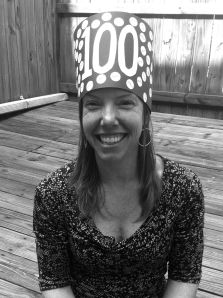
I made a hat. Kindergarten-inspired 100 posts, 100 words hat
This is my 100th blog entry since my first, One last move, in June of 2012. Woohoo! To mark the occasion, I read my previous 99 posts and plucked a favorite word from each. I was fascinated by trends in word choices. For example, I discovered an apparent affinity for gerunds (words ending in -ing) and that I gravitate towards adjectives and adverbs rather than selecting “concretes” – strong nouns and verbs that require no further descriptors. I had to search hard to find nouns and verbs for this list. I aim to improve on that in my next 100 posts.
When our kids were in kindergarten, they made hats like this one on their 100th day of school (only they didn’t write favorite words in the dots.) I always thought they were funny. Also, for my friend who challenged me to write a post of 100 words, check out the word count on that first paragraph.
After doubling our house’s kid population from two to four, and having my husband’s mom and sister here all week, and indulging in our new hobby of cocktail-making every night with them, you would think I’d have plenty of writing material from the past few days. The fact is, though, that the week went by in a blur of whiskey and gin and brownie crumbs. I can make a mean Tom Collins now, and can be counted on for a steady supply of kid yogurt, lemons, limes, and simple syrup in the fridge. But in my saturated state, I succeeded in only two early morning writing days – Monday and Tuesday. I set the alarm for 6 AM on Wednesday, slapped the snooze button several times before finally climbing out of bed at 7, and didn’t even bother to set it Thursday or Friday. I didn’t touch the keyboard except to check our bank account.
Despite my sorry showing this week, I do have good news to share. This morning, after hugging and kissing and crying goodbye to my husband’s family, bundling our kids onto the bus, and starting the first of seven loads of post-guest laundry, I sat down at the computer to check email and found this:
Dear Andrea,
Your piece, “Riding in Boats Through Salt Marshes” has been selected by Jim Minick and Tiffany Trent for inclusion in the spring New River Valley Voices juried reading. Congratulations!
We look forward to hearing your work at the reading on Sunday, April 21, 3 PM at the Blacksburg Public Library. Each reader will have ten minutes in which to share his/her piece, including any introductory comments.
Not a bad way to end a week of not-writing. I want to thank Lesley, my local writing friend and a previous winner in the NRV Valley Voices writing competition, for critiquing “Riding in Boats” and helping me get it ready for submission. Her ideas helped make it a much stronger piece. Thank you Les!
Now, with our new life of kid sports, including an out-of-town soccer tournament the weekend of the reading, all I have to do is figure out how to get back to Blacksburg in time to read. I will keep you posted with details as the reading nears – I hope to see some of my local friends and twitter pals there.
New River Valley Voices is an all-volunteer effort with a twofold mission: to provide NRV writers with a quality forum within which to share their work, and to grow and nurture NRV audiences for the literary arts.


 Butterfly Mind
