I was away from home last week, and my husband and I had our fingers crossed we’d be able to get one more sail in when I returned.
Winds were gusting up to 20 mph today, which would usually keep us home. But the skies were clear and blue, the leaves were bright and orange, and we couldn’t stand to potentially miss our last chance to sail.
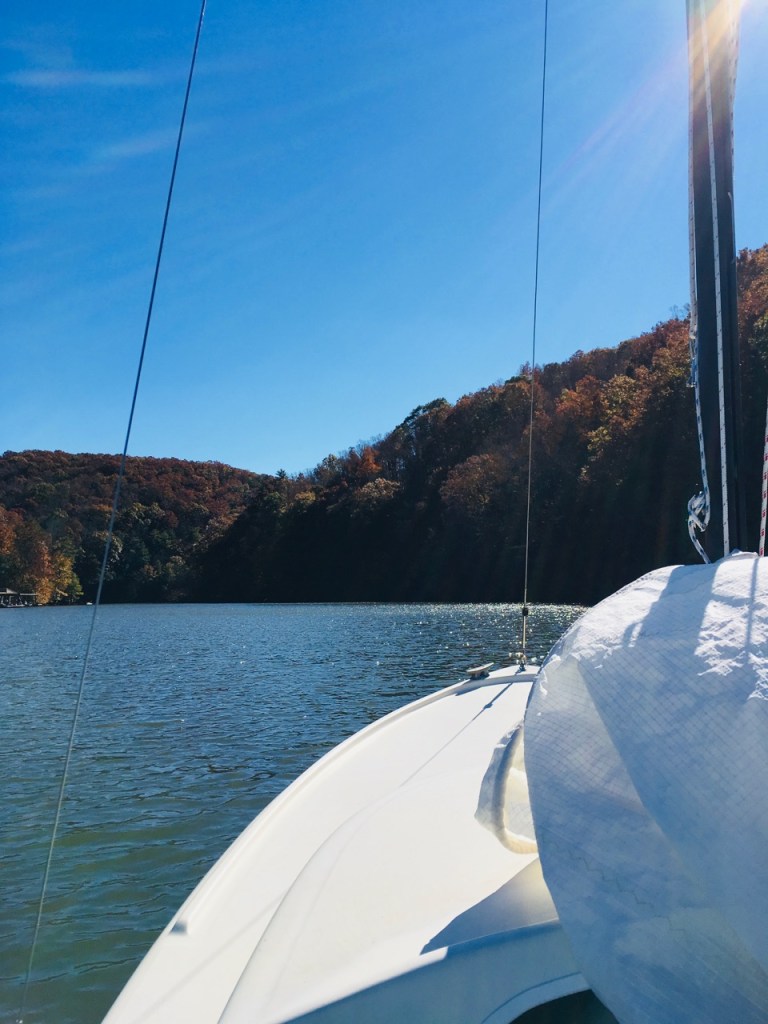
November leaves and sky at Claytor Lake, VirginiaEgretta ready to sail
We decided we’d brave the higher winds by attempting a reef in our sail for the first time. Reefing the sail means you lower it a bit, tuck the extra canvas and tie it to the boom, and ultimately reduce the amount of sail available to catch the wind. Reefing the sail makes it safer to sail in high winds and also makes the boat less tippy in gusts since the top of the sail is closer to the boat and there is less fabric to catch the air.
A spot sheltered from the wind where we could raise the mainsail
Sailing with the reef gave us confidence for sailing in higher winds. By the time we ended our trip, the gusts were scary. The boat tipped far and it was cold out. I was wearing long underwear and wool socks in addition to multiple layers on the top half of my body (tank top, long sleeved shirt, fleece, windbreaker, gloves, fleece earband, wide-brimmed hat), and I was still chilly. I did not relish the possibility of capsizing.
We had a great sail, though. I brought hot cocoa in thermoses, we did not capsize, and now we’ve sailed with a reef and know we can manage the boat in winds we used to think were too strong for us.
I put the kids on an airplane on Wednesday to fly down to Florida and visit their grandparents. Without us.
We’ve never sent them away without us before.
They’re 14 and 12 now, and they were super excited to go on an airplane alone (except for the giant badges they had to wear). As for my husband and I, we took the chance to go sailing. The Support Driven Expo I’ve been working on the past few months had just wrapped up in Portland, and the timing was perfect for us to get away for a couple of days.
Deltaville on the Bay
We found an in-law suite Airbnb — with a dock and a neighborhood boat ramp – in Deltaville, Virginia, about 5 hours away from our home in the Appalachians. On Thursday, we hitched up the boat and headed east.
There’s not a lot in Deltaville, tourism-wise, but there is tremendous access to water. There were half a dozen marinas full of sailboats in this little town where there didn’t appear to be people, and there were canvas shops and sail tailors, and even the maker of our boat’s mainsail, Ullman Sails. We stopped in to get a new length of batten, and picked up some rope too since it was on sale.
There was no wind when we arrived, so we pottered around town and got settled into our Airbnb before starting out in the late afternoon on the water.
There was still no wind. We hoisted the sails and flopped around, then motored a bit to get closer to the mouth of the river where we saw some ripples that looked like they might be wind. We caught a couple of puffs and got a little bit of sailing in before we realized, hmm, in this sleepy little town, restaurants might close at 9pm.
Sailing on the Piankatank River, VA
We were back at the dock and inside the house by 8:30, and yes, everything closed in 30 minutes and was also 15-30 minutes away. We wound up at a pizza place that at least had food that could go in our bellies. The atmosphere left a lot to be the desired, but we didn’t go hungry, so there’s that.
Our second day, though — it was glorious! We had the entire day with nowhere we had to be except on the water.
We motored out of the glassy creek at about 10 am after stocking up on lunch provisions (grapes, Babybel cheeses, corn tortillas, cherry tomatoes, hummus, and baby carrots, plus lots and lots of water). Once again we flopped around before motoring closer to the mouth of the river where we finally caught the wind.
For hours we sailed. We tacked back and forth, on long tacks in steady wind. There was chop and lumpy water and we stayed dry and Egretta handled it beautifully. It’s amazing how different it is — how wonderful it is — to sail in a steady wind that doesn’t change direction or speed and that you could just spend all day on the same tack if there weren’t land in the way.
The water slaps the hull when you’re sailing close hauled, which we were, since you’re sailing into the wind. When there’s chop, you’re cutting through it, and the sound is percussive. It smacks and claps as the boat bumps through the water. The wind is on your face, and it’s cool even when it’s 90 degrees. It feels like you’re going fast because of the wind flying by.
I wanted badly to get out into the Chesapeake. We never did on our trip last year to Wareneck, when we were on Mobjack Bay. And on this trip it was right there, we could see it. So I told Brian I wanted to get out there, like dipping our toes in the Pacific if we were on the west coast. You can’t go that far and not dip your toe in.
We couldn’t be that close to the Chesapeake and not wet the hull in it.
So we kept sailing. Out and out towards the open water. We navigated crab pots, we ate on the water, we hove to and swam, we sailed with stingrays and a sea turtle and listened to the different sounds the water makes against the hull on different tacks.
After a swim near the mouth of the river, we sailed out past both final points of land and were in the open water of the Chesapeake. There were swells and wind and the boat was beautiful and we sailed fast. It was wonderful! The swells were maybe 2-3 feet and we were totally fine in our little 17 foot day sailer.
In the open water of the ChesapeakeSailboats on the Chesapeake
We kept sailing for another 30 minutes or so so that we were good and out in the Bay, then noticed our sunburned legs and also didn’t want to run into the same problem as last night with dinner. We decided we should be home by 5 pm at the very latest, and around 2 or 2:30 we turned around to come back in.
With the wind at our backs, we flew. We surfed the swells. We ran so fast our bubbles streamed behind us. Instead of a slapping sound against the hull, the water gurgled around the rudder as we rushed through it. It swooshed and swirled, a gentle, flowing sound rather than a sharp smack. As we rode the swells, we sounded like waves on a beach, swashing as we coasted down a swell or one snuck up behind us.
We stayed completely dry in the boat, and rather than a boring run back inshore, as we expected to experience on a hot day with the wind at our back (because you usually can’t feel it like when you’re pointed into the wind), it was thrilling. We were riding the water, riding the wind. We were with it, we were part of it. When I looked over the beam, the swells, which had turned to chop, were alongside us, running with us. It was beautiful.
After washing up at home, we dressed for dinner and drove to Merroir, an outdoor oyster restaurant on the Rappahanock River. We ate ceviche and grilled oysters and drank a bottle of cold white wine that we kept in a metal bucket of ice on the table. We were back home and asleep by 8:30pm and slept all the way through until 8 the next morning.
We had one more day of sailing but this post is already long, so I’ll stop with the words and just post the pictures and the 6 second video.
Egretta from the stern
Dolphin 🙂
Dinner on our evening sail
My crew station
On the bow, under the jib
The waters treated us to a double rainbow as we closed out our last Chesapeake trip. On this one, the waters treated us to dolphins swimming alongside our boat and playing in our bow and stern wakes.
March is lioning. Wind howled through the night on March 1st. It shook the house, rattled the windows, scoured the lawn of leftover leaf detritus from winter.
Now, Saturday morning, with a cat on my writing arm, I look out the window and see a red cardinal and tiny house finches perched on the bare branches of the oak, in the slant of morning sun, looking for the feeder we took down so it wouldn’t become a missile in the 60 mph wind gusts. Soft grey doves bob their heads searching for seeds on the ground. The birds twitter and chirp, awaiting their breakfast. It looks warm out there, but it’s not.
A couple of weeks ago, spring teased. For more than a week in February, highs were in the 60s and 70s. I took advantage of the weather. On lunch breaks and between swim meet sessions, I put on my garden gloves and hat, dragged the hose from out front to out back, and grabbed a shovel to dig holes in the new beds I cleared at the top of the hill.
As hopeful as I was that winter was finished, I reluctantly allowed myself the possibility that it was not. I wanted to start transplanting everything I knew I wanted to move: bee balm, Shasta daisies, Rudbeckia; hydrangea, Echinacea, lilac. I really didn’t want any of those to die at my hands because I had moved them too early. So instead I moved a few testers — plants that might not survive anyway (rosemary), and a few that if they did survive, great!, but if not, that’s fine too (mums). I sowed some seeds as well — chamomile, feverfew, Texas bluebonnets I bought on my trip to Arizona with my girlfriends. The packets said to sow when the ground was workable (not frozen) in spring.
I hope the seeds didn’t blow away.
Even though I knew it could get cold again, and the work I did could be destroyed, I’m bummed by the setback. Highs are not in the 70s anymore, and more depressingly, lows are in the 20s for the next week. The wind still gusts as I write, and this is the first weekend in ages that I have free time and had hopes for finally getting into the garden. It’s March! The month I’ve been waiting for! Spring!
It’s supposed to get into the 40s today. I can at least walk the garden looking for frost damage on emerging leaves and flower buds. Tomorrow it will get into the 50s, then drop into the 20s at night. I’m tempted to move the blueberry bushes and maybe a couple other things I want to move around. I’m just not sure if it’s smart to do that when I know temperatures will drop at night (I’m guessing it’s not).
This feels like the longest winter. I have no idea how we survived Minnesota. I’m done with the lion. I’m ready for the lamb.
I’m in the garage, sitting in a camp chair, two wooden boats and a husband behind me, spring rain falling on the garden in front of me. I’ve worked outside for three sunny days, and now that I’m finished and the rain has come, I can’t stand to go inside.
Raindrops on hosta
Rain drips on the weeded mint bed under the stairs. Music plays behind me in the garage, and my husband raps his knuckle on the sailboat in time with the beat. His real work — the work that makes him rich — is with his hands, like mine is with writing and gardening. He’s tinkering with the boat trailer, sanding the sailboat, hammering into the plywood on the wall to hang another tool. I hear the hammer thunk on his wooden work bench when he lays it down; a wrench clangs on the concrete floor.
Droplets cling to the handles of the wheelbarrow, and I am enjoying my rest. I’ve spread mulch on all the beds, I’ve weeded, scattered seeds, watered, planted goldenrod and roses and columbine, transplanted bee balm and bottle brush, pruned forsythia, cleaned leaf litter out of the herbs, filled a vase with mint. My hands feel arthritic, but the garden is beautiful. The redbud blooms magenta, the rosemary has dainty lavender blossoms, our daughter’s columbine is crowned with purple and white flowers, and the roses pop a hot pink. Our neighbor’s dogwood flowers spread open in a spring green, the sky is storm grey, and thunder rumbles over the mountains.
When I was weeding, I got a good look at the ground level of the beds, and among the weeds I found an Echinacea volunteer, and I think the Joe Pye weed might be coming up as well. The wildflower seeds I planted by the mailbox ten days ago are starting to sprout as well. From this point on, I will be able to go out every morning and inspect the garden: what’s sprouting? What’s flowering? How are the seeds we planted? How are the transplants doing?
Joe Pye emerging?
Seedlings by mailbox
Echinacea volunteer
Raindrops on hosta
Mulch pile after all the beds are done
Seeds watered in in front bed
Dogwood flowers
Milkweed coming back
Blueberry flowers
Bottlebrush transplanted to the hill
The sun is out now. It is warm on my bare toes. Rain drops glisten on the bright green grass, and the porch rail is a brilliant white against the stormy sky.
When I returned home after a weeklong trip to Whistler, I was giddy to walk around the garden and find not one monarch butterfly emerging from its chrysalis, but two.
Newly emerged monarch on rueAfter finding those, I of course crawled around in the mulch and dirt to inspect the undersides of leaves. I found three more monarch chrysalises plus a bunch of fat swallowtail caterpillars who will soon be crawling off to metamorphasize as well.
This is SO EXCITING Y’ALL. Here’s a full caterpillar catalog of what I’ve found so far:
Some friends at work are also interested in butterfly gardening, and are looking for host plant ideas. Since we work for a company that makes, ahem, blogging software, my friend naturally asked “Did you do a blog post on what all you planted?” Nudge nudge.
Shockingly, I have not. So here it is! Kris and Liz, this is for you.
The plants
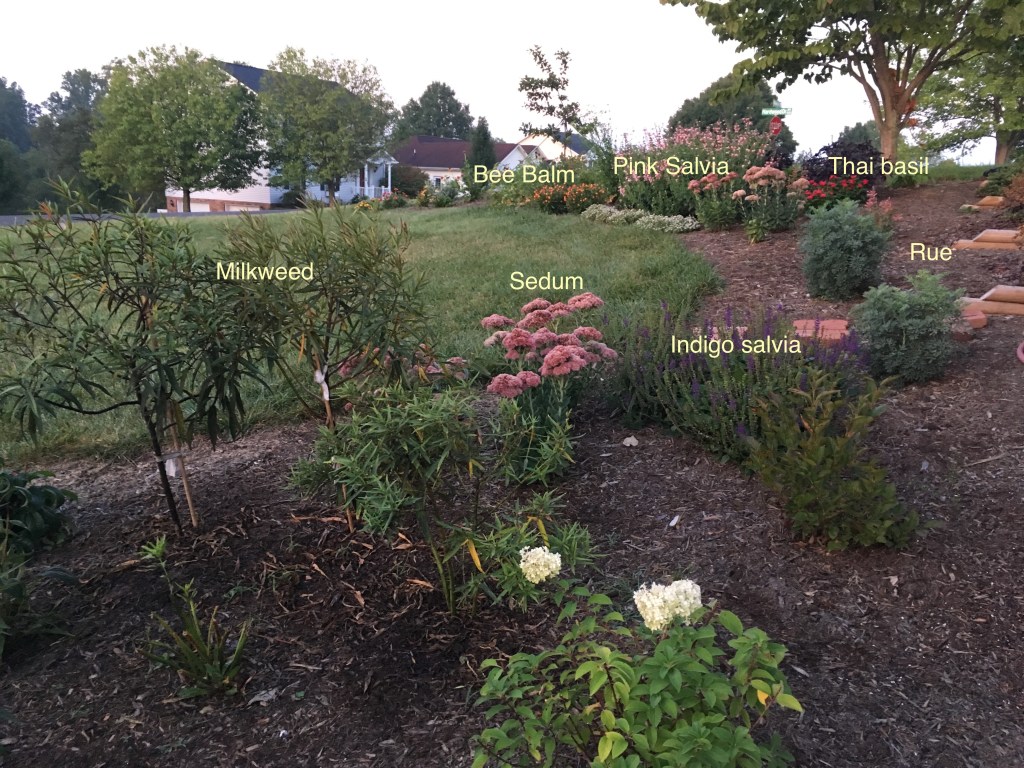
For Mother’s Day, our son gave me Christopher Kline’s book, Butterfly Gardening with Native Plants: How to Attract and Identify Butterflies. Combined with a bunch of online research, experimentation with a butterfly garden in Florida, and talking to bunches of people who garden for butterflies and caterpillars, this book helped me plan a garden that includes both host plants (that caterpillars eat) and nectar plants (that adult butterflies drink from). The most successful plants in our garden are the following:
Host plants
Milkweed (Asclepias): We planted both common milkweed and swamp milkweed. These are by far the most insect-loved plants in the garden. They are constantly covered in various species, including aphids, beetles, and, late in the summer, monarch caterpillars. Milkweed is both a nectar plant and a host plant. We’ve seen adult giant swallowtails and monarchs drinking from its flowers, and have found at least a dozen monarch caterpillars on it. Word of warning: milkweed will get covered in aphids. The caterpillars will still come even when every surface is crawling with aphids, so we kept our milkweed intact even though it’s not very attractive once it has stopped flowering and it’s coated in tiny orange insects.
Rue (Ruta graveolens): This is possibly my favorite addition to the garden. The leaves are a silvery blue-green, the plant stays neat and tidy (it doesn’t get leggy or messy), it can take the heat (and drought) and still look healthy, and the swallowtail caterpillars adore it. As an unexpected bonus, the monarch caterpillars love it for building chrysalises. We’ve found at least 3 chrysalises in the small, shin-high plants.
Butterfly host and nectar plants
Nectar plants
Milkweed: all the butterflies big and small love milkweed.
Indigo salvia: Aside from the milkweed, these purple flower spikes are the most popular in the garden for butterflies to drink from. Bees also love these flowers.
Pink salvia: Okay, maybe these are tied with the indigo salvia for nectar popularity, at least for hummingbirds. I see hummingbirds drinking from these almost every time I sit in the garden.
Bee balm (Monarda): Butterflies and hummingbirds love this as well. Hummingbirds dart between the pink salvia and the bee balm.
Thai basil: I’ve seen some small butterflies and moths (and caterpillars) on these flowers.
Butterfly host and nectar plantsCone flowers: Butterflies always visit these.
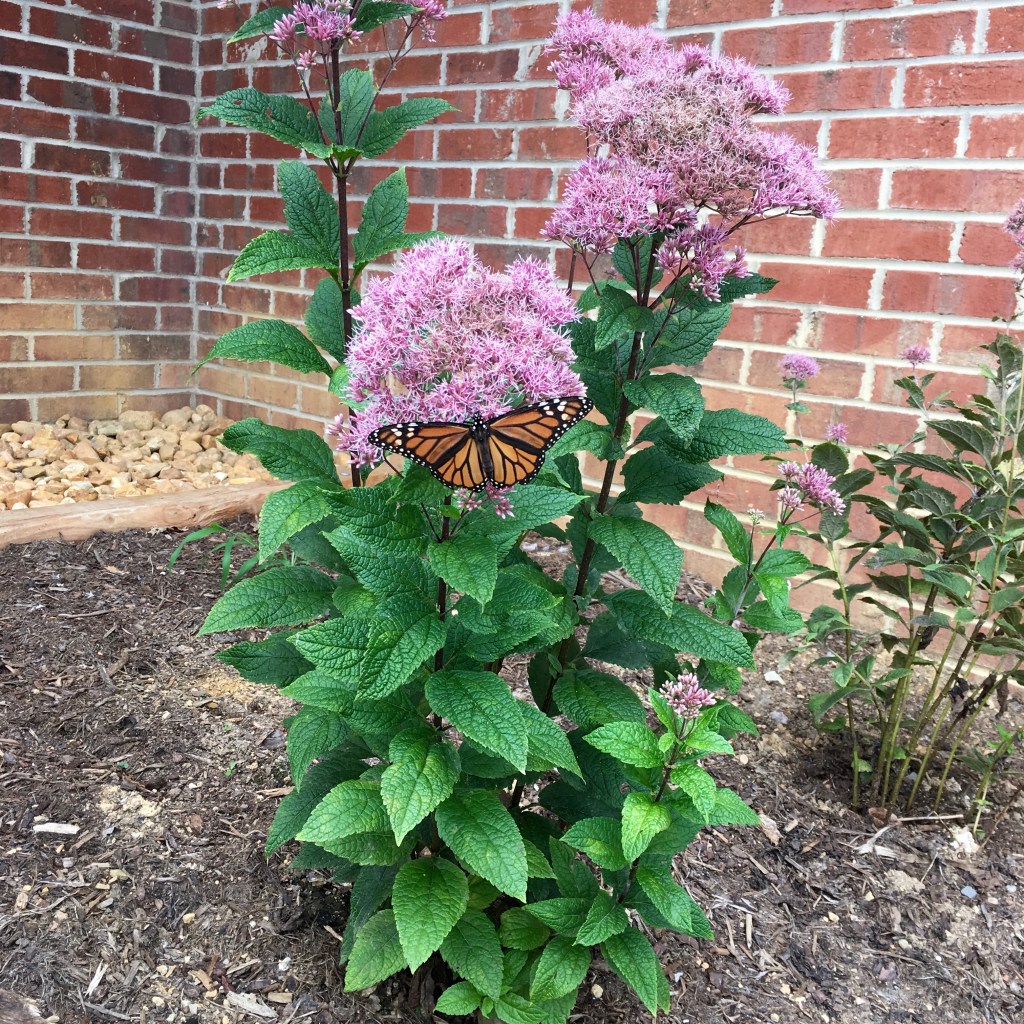
Joe Pye weed: Butterflies love to drink from Joe Pye flowers. Joe Pye weed gets really tall and floppy unless you get the dwarf varieties.
Monarch on Joe Pye weedWe planted some other things that weren’t as awesome as we expected:
Parsley: parsley is a host plant for swallowtails, but the swallowtail caterpillars definitely opted for the rue over the parsley, at least this year. I didn’t find any caterpillars on the parsley, and found at least a dozen on the rue.
I guess the parsley is the only one :-). We have lots of other nectar flowers — brown-eyed Susans, Mexican blanket flowers, some other stuff I can’t remember the names of — but the ones I listed above were definitely the most successful.
If you can identify any of the caterpillars in the catalog, please let me know! I think most of them are probably moths, but I don’t have a good ID book.
Earlier in the year, I wrote multiple times about our different strategies for killing grass to build a flower bed. Since then I’ve blogged pictures from the garden, from reading,writing, butterfly-watching, and blogging under our dogwood tree, and photographs of the butterflies and caterpillars who live in the small ecosystem we helped create.
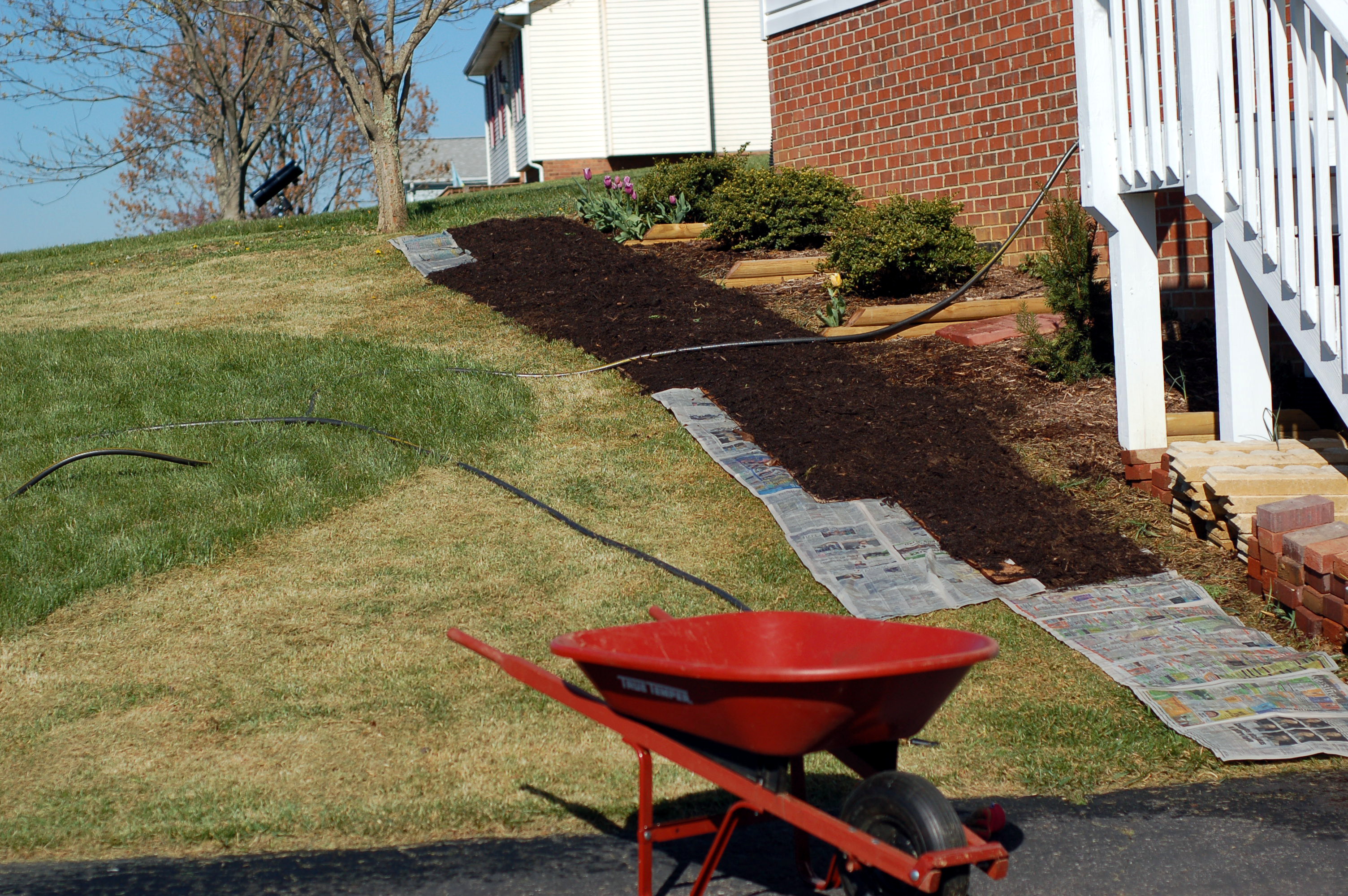
I realized though, that since my April post about building a flower bed, when we were still in the process of killing grass, laying out cardboard, and shoveling mulch, I never brought it back around to show the garden in its full summer glory, with before and after pictures. So here goes (I don’t have before and afters from the same angle, but hopefully you’ll be able to see the difference):
Before:
Building the bed
Now:
Morning flower bed
Monarch on Joe Pye Weed
Basil forest
Flowers in the morning
Monarch caterpillar
Garden in fog
Monarch chrysalis
Caterpillar feet
Monarch on Joe Pye weed
Parsley flowers
Reading under the dogwood
I wanted an herb garden and a butterfly garden, now we have both butterflies and herbs. We’ve made endless batches of pesto and basil gin smashes.
The kids and I check for caterpillars and chrysalises every day. At last count we have about 8 monarch caterpillars and 10 swallowtail caterpillars, and we think we found a monarch chrysalis in progress yesterday in the rue bush. All the work has paid off :-).







 Butterfly Mind