My critique buddy, Lesley, is co-leading a writing workshop in the Blacksburg, Virginia area beginning September 7. If you are a writer or a would-be writer in the New River Valley, please see below for more details.
Writing for the joy of it
Have you always wanted to write but don’t know how to start or sustain your practice? Jenny Zia and Lesley Howard are leading a writing adventure that honors the writing process … to support discovery of your writer’s voice, exploration and development of your stories.
Jump-start: Saturday Sept. 7, 9:30 AM – 4:30 PM Momentum-sustaining sessions: Tuesday Sept. 17, Oct. 1 & Oct. 15, 6:30-8:30 PM The end is the beginning closing session: Saturday Oct. 26, 9:30 AM – 3:30 PM
Jenny Zia and Lesley Howard ground their facilitation of Writing for the joy of it in their combined six-plus decades of daily writing practice, inspired by the philosophies of Julia Cameron, Natalie Goldberg, Anne Lamott, and Priscilla Long, among others.
Jenny and Lesley will provide
* Exercises to generate material
* Practices to sustain your momentum
* Opportunity to share your words, should you so choose.
$100 fee includes muse-nourishing snacks and beverages.
Contact Jenny and Lesley for registration and payment details: joyofwriting04@gmail.com
The town was “between mountains so steep and irrational, they must have blocked most of the sun most of the day.” – Dennis Covington, Salvation on Sand Mountain
I know exactly the types of places Covington means. In our explorations of the Appalachians, my husband and I have been in those steep mountains that obliterate the horizon. You’re stuck down low, in a narrow crack between peaks, where you can’t see over, you can’s see around, and you feel penned in and claustrophobic. The sun seems to set at 2 in the afternoon because the horizon is so high.
The place we hiked this weekend was decidedly not like that.
Stand of firs from Wilburn Ridge on Appalachian Trail, hike to Mt. Rogers from Massie Gap, VA
View from Appalachian Trail along Wilburn Ridge, hike to Mt. Rogers from Massie Gap, VA
Kids on rock outcrop on Wilburn Ridge, Appalachian Trail, hike to Mt. Rogers from Massie Gap, VA
Wild ponies, colt, and view of Appalachians from Wilburn Ridge on AT, hike to Mt. Rogers from Massie Gap, VA
The views we saw on our hike to Mt. Rogers were not from the top of the mountain, they were from all but the top of the mountain. About 7 miles of the 9 mile round trip hike, from the trailhead at Massie Gap to the summit of Mt. Rogers, the trail climbs gently through wide, open meadows, offering spectacular vistas of mountaintop grasslands, marshmallow cloudscapes, stark rock outcrops, and panoramic views of the Appalachians. I felt like we were on the western frontier, that life was full of possibility.
Wild highland ponies along Appalachian trail on hike from Massie Gap to summit of Mt. Rogers, VA
Pink mountain laurel flowers in Massie Gap, along Rhododendron trail to Mt. Rogers, VA
View from Appalachian Trail, from Massie Gap to Mt. Rogers trail, VA
Wild Pony in sunlight along Appalachian Trail on Wilburn Ridge, hike to Mt. Rogers, VA
We originally thought the hike was going to be 11 miles round trip. Though our kids (7 and 9) had hiked Old Rag, a 9 mile hike with lots of technical bouldering, we thought 11 miles might be a little much. We bought them real hiking shoes, just in case, but I was prepared to turn back early with either or both of them so that their Dad could climb to the top of Mt. Rogers. At 5729 feet, it is the highest natural point in the state of Virginia, and I knew he wanted to see it.
When we realized the hike was only 9 miles, I got excited that maybe I’d be able to see it, too. “Hey guys, it’s actually only 9 miles, not 11,” my husband told the kids. “Do you think you’ll want to go to the top, to climb the highest mountain in Virginia?”
“I do!” our son said. Our daughter was less enthusiastic.
“There are ponies along the way…” my husband told her. “And the top is in a forest. A forest filled with Christmas trees…”
That got her. Within ten minutes, his first promise paid off. And continued to pay off. For nearly three miles, we shared the trail and the mountainsides with wild highland ponies.
Wild ponies under trees, Appalachian Trail to Mt. Rogers, VA
Wild ponies from Wilburn Ridge on Appalachian Trail, hike to Mt. Rogers, VA
Wild ponies from Wilburn Ridge on Appalachian Trail, hike to Mt. Rogers, VA
Wild pony from Wilburn Ridge on Appalachian Trail, hike to Mt. Rogers, VA
We stopped so much along the way to take in the views from rocky tops, and to hang out with the ponies, that we made slow progress. The day was perfect – partly cloudy and only 73 degrees – but the sun was hot on our necks, and our son wanted forest. We were surprised when we got to a mile marker and saw we had only hiked 2 miles, so we picked up the pace to get to the top. We passed through Rhododendron gap, a tunnel of rhododendrons that had just bloomed and dropped their petals, and that provided brief shelter in cool, damp shade. Then we were out in the meadows again before turning off onto the Mt. Rogers spur trail to finish the final half mile of climbing.
We ascended in dense forest as we neared the summit, where it was dark and wet and felt like rain forest. The air chilled our skin, and every rotting log, every mound of earth, every tree trunk was covered in emerald moss and peridot ferns. Our arms brushed red spruces and Fraser firs and released the scent of Christmas trees. Our daughter sang Jingle Bells.
New growth – ferns and evergreens along trail on hike to Mt. Rogers, VA
New foxtail growth on evergreen in forest at summit of Mt. Rogers, VA
Fraser firs along trail in forest at summit of Mt. Rogers, VA
Pink rhododendron flowers and fern, Rhododendron Gap, Appalachian Trail, hike to Mt. Rogers from Massie Gap, VA
Green forest at summit of Mt. Rogers, VA
Mushroom, moss, and fir at summit of Mt. Rogers, VA
Nobody turned back, and before we knew it, we were at the top of Virginia. We had hiked a trail unlike any we had ever traveled – wide open to the sky, above the world, sharing the trail with wild ponies – and we all made it. All four of us, hiking companions til the end.
Flatfoot dancers escaping into music at Floyd Country Store Old Time Music jam
As soon as the caller put his bow to the fiddle strings, and the first notes of mountain music sang out in the warm, dry country store, I was a goner. My eyes teared up as feet tapped, and teeth shined, and white-haired heads bobbed in time with Old Time Appalachian music.
My parents are in town, stopping through Virginia to see us as they embark on the great adventure of their lives: an RV journey from their home in Georgia, across the US and Canada, to the wilderness of Alaska. Another rainy day in Blacksburg derailed our plans to take them hiking, to show them the spring green of our Appalachian forests. Rather than stare at each other in the confines of our living room while the rain came down, we decided to escape to a different kind of Appalachia before they drive out of these hills: an open jam session at the Floyd Country Store.
Sunday Old Time music jam at Floyd Country Store
Sitting in a circle in folding chairs on the warm wooden planks were eleven musicians, some newcomers, some old timers, all hunched over their strings, their left hands moving up and down fret boards as they played Turkey in the Straw. Their shoulders shrugged in time as they picked banjos and mandolins, twitched bows across fiddles, strummed guitars (pronounced GIH-tahrs), and as one burly, bearded mountain man thumped an upright bass with a meaty hand. All of the instruments were stringed, but the leather sole of a mandolin player’s shoe slapped time on the floor, an unofficial drum. Throughout the four rows of folding chairs behind the bluegrass circle, feet tapped, heads nodded, and shoulders bumped as the audience seat-danced.
The leader of the jam called out, with his chin clamped to the instrument on his shoulder, and his bow racing across fiddle strings, “The floor is open here in the middle.” He tipped his head to the center of the circle. “If anyone wants to dance, it sure helps us out.” I looked at our daughter and raised my eyebrows, “Do you want to dance?” Her eyes got wide as she licked her ice cream cone and she shook her head. No way.
Happy fiddler at Sunday Old Time Music Jam, Floyd Country Store
The group moved into their next song, which was even more irresistible than the first, and as fiddle bows fluttered, the man from behind the counter, who had served me my coffee, stepped into the circle and began dancing. (It turns out he is local flatfooting champion Rick Sutphin). My mom leaned over and said in my ear, “You’re going to have to learn how to buck dance, Andrea!” A silver haired man with pressed, stiff, indigo jeans stepped in after him and began flat foot dancing as well. My eyes teared up again to see the joy on their faces, to see bliss in the smile of the fiddler in front of me. Wrapped up in this music and this Riverdance type jig is the rich Appalachian history of Celtic immigrants climbing into the mountains to find affordable farming land. The banjos and mandolins and slapping feet tell a story of isolation beat back by coming together for country dances, for fiddling, for celebrating the harvest. The twangy sounds, and the rhythm that moves men to buck dance, preserve a rich history, the pulse of which still beats in this mountain music of Virginia. A history that depended on creating community, on participation, for mountain folk to escape the remoteness of their homes in the hills, and that brought a sense of giddiness and joy on the occasions they came together to put their lives into song. How can you not be moved by that?
Apparently it was easy for our nine year old, who was ready to leave just as the silver haired man collapsed into his seat, panting and grinning, and the group moved into a waltz. Our daughter was captivated, though, as was I. I wanted more.
We left reluctantly, and on our way home we asked our daughter, “Do you think you’d like to play an instrument?” She wanders around the house, the campsite, bopping in her booster seat, singing, clapping, dancing little jigs. I crossed my fingers, begging in my heart for a musician in the family.
She thought a minute as she watched at the wet green mountainsides pass by her window. And then she said, “Yes.” She picked at her jeans. “I want to learn the guitar.”
Floyd Country Store in Floyd County, Virginia
The Floyd Country Store broadcasts The Floyd Radio Show from their Friday Night Jamboree, which features gospel music, skits, and dance bands (previous shows available on podcast). Tickets go on sale no earlier than 4:30 on Fridays. On Saturdays they host a free Americana Afternoon starting at noon, followed by an open mic session at 1:30, and on Sundays from 2 to 4 pm, the Floyd Country Store hosts a jam with a local Old Time or Bluegrass band who leads the jam session. The jam session is free. More information on the On Stage page of their website.
If you are interested in Appalachian Music, I highly recommend the movie (and soundtrack) Songcatcher.
“Oh my God, a lady’s slipper!” I pulled the camera out of my pack as I raced to the side of the road. I crouched down and snapped pictures as our nine year old son giggled.
“I guess Mom likes lady slippers,” he said.
I looked up and saw two more lady’s slippers, and then another one across the street. I zigzagged back and forth and shot 20 frames in the first five minutes of our hike. We hadn’t even made it to the trailhead yet.
Pink Lady’s Slipper on Old Rag Mountain, Shenandoah National Forest, Virginia
Bridge over Broken Back Run at trailhead of Old Rag Mountain, Shenandoah National Park
White wildflowers on Old Rag Mountain, Shenandoah National Park
The forest at the bottom of Old Rag Mountain was lush with the apple green of spring. Every shrub, every tree, had leafed out, and in their newness, no matter the species – oak, birch, maple – the leaves were identical shades of peridot. It was mid May, and we had hit Shenandoah at the peak of spring’s grandeur. Everywhere we looked, the forest floor was sprinkled with wildflowers.
My husband paused on the trail as I shot a close up. He looked out into the sea of green, then at me, photographing yet another tiny detail – a flower, a stone, a mound of moss. “Can you get a picture of the whole forest?”
“Sure,” I said. “It’s kind of hard to get a clear shot, though.” I usually can’t see the forest for the trees.
“I don’t care.” He gazed into the green. “I just like the forest here.”
Spring green forest on Old Rag Mountain, Shenandoah National Park, Virginia
We continued up, and up, and up, stepping over millipedes, pressing our palms to boulders, burying our faces in mountain azaleas to inhale their honeysuckle scent.
“Dad, can we climb this rock?” We had been on the trail for an hour, but we still had a long way to go. The hike was going to be about six miles round trip, which would be the longest distance our kids had ever done. More than that, the final ascent was going to be extremely technical, with lots of bouldering. My husband looked worried. He checked the sky for the thunderclouds that were expected to roll in. The exposed rock scramble at the top would be a treacherous place in a storm.
“I think we should keep moving,” he said. “You guys need to save your energy. This is going to be the hardest hike you’ve ever done.” He checked the sky again. “There are going to be plenty of rocks to climb at the top.”
We had gotten an early start – we woke with the sun and were out of our tent by 6:30 am, boiling water for oatmeal and coffee. At 8 o’clock we were already on Skyline Drive, on our way to the trailhead. So other than the threat of storms, I wasn’t too concerned about time. I hiked at the back and stopped frequently to snap pictures. The diversity on the trail was irresistible, and I wanted to photograph it all.
“Andrea, is it okay if we don’t wait each time you stop? I don’t want to ruin everyone’s fun, but I really think we should get to the top, and then we can take our time on the descent.”
I shot one more closeup then put my camera away, “No, you’re right. I can take pictures on the way down.” I vowed to keep my camera stowed, and started hiking at the front, a little ahead of the family so that if I wanted to stop for a photograph, they could catch up while I shot. Not ten minutes later, I had my camera out again.
“Look at these flowers! They look like bells!” My son, then husband, then daughter hiked by. I passed them a few minutes later when they stopped for water, hiked ahead, then had my camera out again. “Look at all this trillium! There’s a whole hillside of it!”
My son laughed as he passed me. “You’re not doing a very good job of keeping your camera put away, Mom.”
Bell flowers on Old Rag Mountain, Shenandoah National Park, Virginia
Hillside of trillium on Old Rag Mountain, Shenandoah National Park, Virginia
Violet growing out of stone on Old Rag Mountain, Shenandoah National Park, Virginia
When we arrived at (what I now realize is) the famous rock scramble, I was glad for my husband’s prodding. I was blissfully ignorant about the hike – I hadn’t looked at the map or read anything about it – and as we lowered our kids into crevasses and watched them clamber over stones that curved toward a 3000 foot drop, I realized it was probably a good thing that I hadn’t. I would have seen things like this, from the National Park Service website:
Old Rag is Shenandoah’s most popular and most dangerous hike. The number of blogs and websites about this hike attests to its popularity. The number of search and rescue missions each year attests to its danger.
Our seven year old daughter was a natural on the rocks. She found her own hand and foot holds, and her tiredness (read: boredom) from the three mile (so far) hike vanished as she scrambled over gray granite. Our son accepted our help more often, and said it was “a little freaky” as he squeezed between 8 inch cracks in mountain stone, or jumped from one car sized boulder to another. The further we climbed on the stone, the more nervous I got about our descent. Getting up the rocks was hard enough – getting down them could be perilous. My husband and son were concerned about the descent too. Yet we continued to climb.
Rock scramble with view of summit on Old Rag Mountain in Shenandoah National Park
Rock staircase with levitating stone on Old Rag Mountain in Shenandoah National Park
Cool hanging boulder on rock scramble of Old Rag Mountain in Shenandoah National Park
Rock scramble on Old Rag Mountain in Shenandoah National Park
Rock scramble on Old Rag Mountain in Shenandoah National Park
Despite our height (and my nerves), the rock scramble was a grounding experience. I was connected to the earth up there, dependent on it, with my bare hands on rough granite, my hip against a boulder, my heart pressed to stone. When we finally reached the peak, after several false summits, I was exhilarated by the mountain under my feet and the big sky above, by boulders perched at the top of the world, by gentle rain falling from a blue sky. There were no thunderclouds in sight, and we had made it to the top. I surveyed a 360 degree view of the vibrant green of Appalachia in sunlight, an unmarred view of spring’s progression up the mountain sides – a profusion of apple green in the valleys thinning to brown bare branches at 3000 feet. And there wasn’t a building in sight. Just forest and rocks and mountains.
We high-fived the kids, and hugged them, and told them, “You are the coolest kids EVER. Look what you just did!” My husband told them, “You can have as many s’mores as you want tonight. You can eat them til you puke if you want to.” Our son shouted “YEAH!” and jumped from one boulder to another at the top of the mountain, while my heart jumped into my throat.
Boulder on false summit of Old Rag Mountain in Shenandoah National Park
View from summit of Old Rag Mountain in Shenandoah National Park
View from Old Rag Mountain Rock Scramble in Shenandoah National Park
View from Old Rag Mountain in Shenandoa National Park
Their dad and I discussed our options while the kids ate granola bars and the wind whipped our windbreakers against our skin.
“Is there another way off the mountain?” I asked. “That scramble is going to be really tricky on the way back down.” Our son had been pretty freaked out on the descent off of only one rock at Dragon’s Tooth in Blacksburg. There were scores of boulders to navigate here. And to be fair, I wasn’t excited about descending the scramble either.
“There’s another way down, but it’s five miles,” he said. Crap. That would add up to nine miles. Double the distance the kids are accustomed to doing.
“I want to go the long way,” I said.
“Me too,” said our son.
And so we did.
Near the bottom, our daughter took my hand and said, “We saw a lot on this hike today.”
Pink Wild Geranium on Old Rag Mountain in Shenandoah National Park
Dandelion on Old Rag Mountain in Shenandoah National Park
Spring forest with mountain azaleas on Old Rag Mountain in Shenandoah National Park
“Yeah, we saw lady’s slippers, and mountain azaleas, a hillside of trillium, and those wild geraniums you like,” I said. She had one of those tucked into her pig tail.
“And dandelions,” she said. “And a waterfall.”
“And those cute little white flowers, and the violets, and boulders perched on mountain tops, and spring climbing the forest. It’s amazing how pretty it can be when we don’t build all over everything. When we just allow nature to be nature.”
Our son nodded, a happy smile on his face. “I like it when nature is allowed to be nature.” And after nine miles that were supposed to be five, after climbing to an elevation of 3291 feet under his own power, after five hours of hiking, he ran off down the trail.
View of Old Rag Mountain from overlook on Skyline Drive in Shenandoah National ParK
I have officially run out of story ideas. A friend of mine has encouraged me to submit work to the Southern Women‘s Review, and as the deadline approaches, I find myself creatively crippled.
I am a Southern woman, born in the South, raised in the South, and after a few years in the not-South, we have settled down in my motherland and will raise our children in the South. Anything I write, then, is fair game for this journal: “Submissions should be from women who were born in or grew up in the U.S. South; currently live in the U.S. South; or write about the U.S. South.”
But that’s not enough for me, to be a born and bred Southerner and to currently live in the U.S. South. I feel like I should write about the South, about how I never felt like I fit in as a Southerner growing up (I didn’t like sweet tea, for one), but when I moved away and folks sincerely thought the South was like Deliverance, that if they stopped their cars in the southeast they’d risk violent rape by toothless bumpkins, I defended my home against their ignorance and developed a fierce pride for my region. Or I could write about how I didn’t understand the South for so many years of my young life – Southern pride, the clinging to Dixie flags, the continued obsession with the “War between the states” – and how Gone with the Wind (the book, not the movie) explained my heritage and helped me understand Southern culture better than any history class ever could. Or maybe I should write about my experiences as a Southern woman who explored other regions, who has lived in other parts of the country and loved them, but how it still feels like a homecoming to move back to Virginia, even though I’ve never lived here.
Or maybe, I could write about my childhood in the South. About my Grandaddy and Nannie’s farm in Eatonton, Georgia. Where we dug worms from the wet soil of the creek bank, in the shade, by the old mill on their farm, then threaded them, still squirming, on our hooks to catch yellow-bellies in Crooked Creek. Where a trip to the hardware store with Grandaddy, in his old silver Ford pick-up truck with a shiny black steering wheel knob and the shifter on the steering column, was the highlight of our visit when we’d stay a whole week. Where we dug potatoes, and planted carrots in neat rows, and shucked corn and snapped peas under the walnut tree by the tractor shed. Where in the morning I’d say, “Wait Grandaddy! I’m coming with you,” while I hurried to put on my Nannie’s boots to walk through the dewy grass, past the scuppernong vine, and the gourd birdhouses, and the peach orchard, to the compost pile behind the barn. Where Nannie had a plaque on the wall that said “The only way to kill time is to get busy and work it to death.” Nannie, who’d grin and say “Scat!” when we’d sneeze, or “Skin the cat,” when my brother would peel off his sweaty shirt from working in the stagnant middle-Georgia heat. Nannie who worked crossword puzzles, and made cornbread stuffing, and raised three kids while Grandaddy flew bombers in the wars.
Or my mind goes back to Grandma and Grandpa’s house on 6th Street, East Beach, St. Simons Island, Georgia. Grandma with her pretty pastel pillow mints in a crystal dish on the sideboard, with the $2 she left under our pillows when we’d visit, with bottles of Rolaids on every end table, between all the couch cushions, tucked in the cushions of each chartreuse chair, where nowadays someone’s cell phone would fall, and get lost, and be found when the chair suddenly vibrates under someone’s bottom, surprising them so that their eyebrows shoot up and their mouth forms an “O.” Grandma, who introduced me to A Clockwork Orange, her favorite vinyl record, with that strange and wonderful white cover, with a man in a bowler hat and one set of false eyelashes who smiled an enigmatic smile as he emerged, dagger in hand, from a black triangle. Grandma who taught me how to brush my teeth with my finger when I forgot my toothbrush, who had a rosebush by her front door, and who’d give me scissors and a vase when I asked if I could cut pink roses for her. Grandma, who said “You all” instead of “y’all” in her sophisticated, old money, soft Southern drawl.
And Grandpa in his seersucker suit, quiet, always smiling, who’d disappear to his room upstairs, full of light and warm salty air, with a clear view of the dunes, and the wide tan beach, and the distant sound of waves swishing over sand. Grandpa who had a podium up there, with the biggest dictionary you ever saw, and an old black and white TV with a rabbit ear antenna and a knob that you turned with a satisfying click to change the channel. And Grandpa’d come back down with a handheld wooden maze where you’d have to deliver the tiny silver bead from one end to a hole in the other. Or with a wooden puzzle cube that we’d pull apart and spend hours trying to put back together. Grandpa, a career diplomat, who earned his law degree after his three sons had grown up and moved away, who was scorned as a young man by Grandma’s parents (for being poor) until he started working for the State Department, when his now proud mother-in-law began submitting his and Grandma’s travels to the Atlanta Journal’s Society pages. Grandpa, who loved Heavenly Hash ice cream, who smiled and waved at us, the grandkids coloring quietly on the green shag carpet, during the evening hours when Grandma would settle in with her gin and milk to talk politics with her sons and their wives.
But those are just descriptors, right? Childhood memories of an aging Southern woman who has returned to the South. There’s no plot. There’s no story there. So here I sit, wondering what I will write.
Portraiture is possibly my favorite form of photography. Faces show character in every laugh line, every weathered wrinkle, in tan lines left by always-worn sunglasses, in the trickle of sweat through trail dust. In the scraggly beards of men who have walked the woods for weeks.
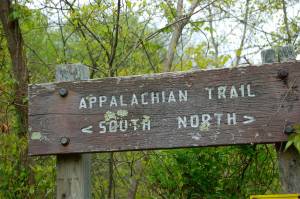
On our drive through Catawba valley, my husband said, “It’s getting close to peak thru-hiker season.” We were headed to Sawtooth Ridge, a portion of the Appalachian Trail between McAfee Knob and Dragon’s Tooth, near our home in Blacksburg, Virginia.
“It is?” I asked, my wheels turning. I had just checked my email and seen that the theme of this week’s WordPress photo challenge was culture, and I thought, oooh, maybe I can cover A.T. culture. Shoot portraits of rugged hikers.
“Yeah, if they left Springer Mountain [Georgia] on March 1, they’d start getting here near the end of April and in May.”
A local friend of ours said she gives away her chocolate snacks when she encounters thru-hikers on the trail. I thought of when my husband was thru-hiking, back when we were boyfriend and girlfriend, and how he would put an entire stick of butter in his ramen noodles at night. “I wish I would have brought more food,” I said.
In the McAfee Knob parking lot, I fingered my camera as large groups of hikers clustered around car trunks and tailgates, stuffing water bottles in daypacks, eating pre-hike sandwiches from Subway, mixing formula in bottles for the baby a dad would carry on his back. I wasn’t brave enough to ask to take their pictures. On the trail, I told myself. I’ll ask hikers on the trail.
We headed south while the crowds headed north towards McAfee Knob. For twenty minutes, we saw no-one. No day hikers. No thru-hikers. The only evidence of humans we found, besides the trail, was a “Home Sweet Home” sign nailed above a squirrel hole. “Kids! Look at this!” I crouched down and snapped shots.
“Do you think a squirrel made that?” Our son asked.
“Or maybe fairies?” said our daughter.
I wondered about whoever had made this miniature sign, who had brought a screwdriver onto the trail to attach it to this little spot. A local day hiker? A Virginia Tech student? Whoever it was, they made me smile with this little surprise in the woods.
We rounded a bend and met a young man and his dog headed north on the trail. The man carried a full pack, with a pair of dusty gray Crocs tied on the side. His hands were red and raw as he gave his dog a treat for sitting obediently as our kids approached.
“Hey, how’s it going?” we said.
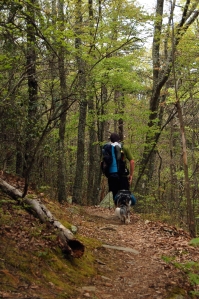
Hiker and his dog on the Appalachian Trail
“Good, good. I just picked this guy up in Pearisburg,” and he pointed at his dog. “I’m trying to train him.” The black and white mottled dog carried his own saddlebag pack and was calm and sweet as he sniffed my hand. His nose was speckled pink and black. The man gave him another treat.
“Well, y’all have a good day!” And he continued north as we continued south. I’m not sure if he was hiking from Georgia to Maine, or if he was just out for a weekend backpacking trip. I did not ask his story, and I did not take his picture, except from the back.
The next hikers we encountered were obviously thru-hikers. We sat on fallen trees in a clearing, munching trail mix and baby carrots, when two women powered through the glade. They carried full packs, wore quick-dry nylon hiking pants in olive green and pewter grey, and their strides were long and purposeful. I wondered where they were from, when they had started, how many miles they were doing that day. Had they mailed boxes to themselves, filled with fresh food supplies, and cash, and lightweight spring clothing? Were they in a hurry to get to a post office and bury their faces in fresh tee-shirts? Clean socks? They said a quick “Hello,” which we returned, and then they were gone. I did not photograph them, or ask them their story. “The next one,” I told myself. “I’ll talk to the next one.”
On our way back to the car, we passed a scruffy young man smoking a cigarette on a slab of rock on the side of the trail. He sat atop a bulging backpack, stuffed full like a giant army-green sausage . He was backpacking, not day hiking. Carrying cigarettes and wearing New Balance sneakers, I didn’t think he was a thru-hiker, but he could have been. I’m sure he had a story. He was lounging, I could have easily asked. But he wore headphones, and I didn’t want to intrude, so I hiked by with a nod and a smile.
By the time we arrived at our car, where five dusty, bearded twenty-something men lay draped over their backpacks, or sat on them as chairs, or propped their backs up against them in the white gravel parking lot, I knew that I would not talk to these hikers, nor photograph their faces. I am fascinated by journalists – by their grit, by their ability to shove in and get the story, by their speed in turning stories out – but I realized on the trail that that is not the stuff I’m made of.
Instead of shooting photographs of “the next one,” or of those prone hikers reclining not 20 yards from our car, I knew I’d bring their images home in my mind, and l’d write their portraits with words. I’d hole up at home, in retreat like many hikers seek, contemplating solitude, and the Appalachian Trail, and a culture that includes those who would nail a tiny sign over a tiny hole, in the wilderness, for smiles they’ll never see, but that they’ll know, quietly.
White daisy-like wildflowers on the Appalachian Trail, VA
Appalachian trail, Sawtooth Ridge near Blacksburg, VA
Pink mountain azaleas in bloom on Appalachian Trail in April, Sawtooth Ridge, VA
Tiny green succlents on Appalachian Trail in spring, Sawtooth Ridge, VA near Blacksburg
View from rock outcrop on Sawtooth Ridge hike near McAfee knob, VA on Appalachian Trail in April
Pink mountain azalea buds on Sawtooth Ridge on Appalachian Trail, VA
Tiny blue feather on Appalachian Trail in April, Sawtooth Ridge, VA
Fern unfurling in spring on Appalachian Trail, Sawtooth Ridge, VA
Lichen covered log and white wildflowers on Appalachian Trail in April, Sawtooth Ridge, VA






 Butterfly Mind