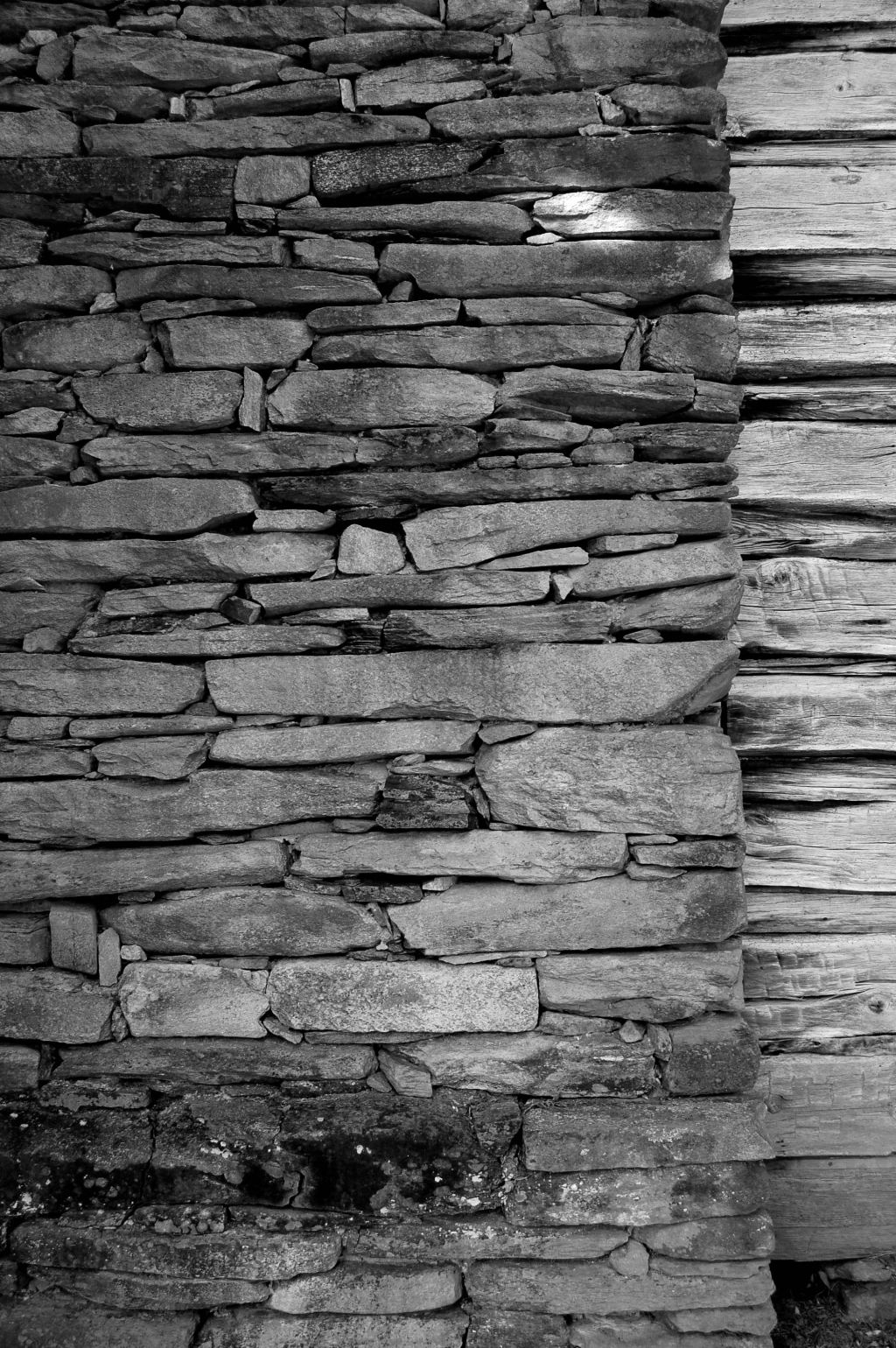
When I hear “dry-stone wall,” the first thing I think of is a wet stone wall: moss-covered with a sparkling trickle of water running down damp cobbles, or the clammy stone walls of a cave.
But a dry-stone wall? Where does that happen?
In sunlight. In fact I have a picture of the stone chimney of a cabin at Mabry Mill on the Blue Ridge Parkway. It’s one of my favorite photographs. I love stone, and I alway want to use the image for social media profiles: my Twitter or Facebook header. But what does an image of a stone wall say about me if I use it as a banner? Other than my love of earth and rock, the photograph does not portray me, so I upload it, preview it, overthink it, then remove it.
I’ll add it as the featured image here instead.
The problem is the hyphen. Why is there a hyphen in “dry-stone” in this prompt? Is dry-stone a thing — is it something different from sun-warmed cobbles, from the smooth uneven structure of a stone chimney?
I cheated. I stopped my timer to look up dry-stone:
adj. 1. (of a wall) made without mortar
Does that mean the stones are pieced together like a jigsaw puzzle? This indentation lays on this protrusion, this jag fits in this cranny? I think it does. The chimney in my image has no mortar.
I see low walls like this in the mountains. I seem to remember one that stretched for miles in Shenendoah, about knee-height, of thousand and thousands of stones pieced together without anything to bind them. Yet the structure was somehow stable, somehow not tumbling to pieces. A masterpiece of irregular parts fitting together to make something regular. A dry-stone wall.
Thank you Dapplegrey for the prompt, “dry-stone wall.”
For the month of November, I will be participating in NaBloPoMo and plan to publish every day of the month. Usually, I will publish a 10-minute free write, initiated by a prompt from my prompt box. Minimal editing. No story. Just thoughts spilling onto the page. Follow along with the tag #NovemberDaily.
 Butterfly Mind
3 responses to “Dry-stone wall”
Beautifully layered with different shapes of stones for a more dramatic feature !
Yes, they are indeed stone walls constructed without mortar. There are many of them here in Scotland where they’re called ‘dry-stane dykes’. It’s a highly skilled job to make one. We had several in our last garden which was on several different levels and each level had a dry-stane boundary and we planted Alpine plants in some of the nooks and crannies in the walls.
One has to consider each stone’s properties when assembling; they cannot be “glued” with cement like modern masons tend to do.