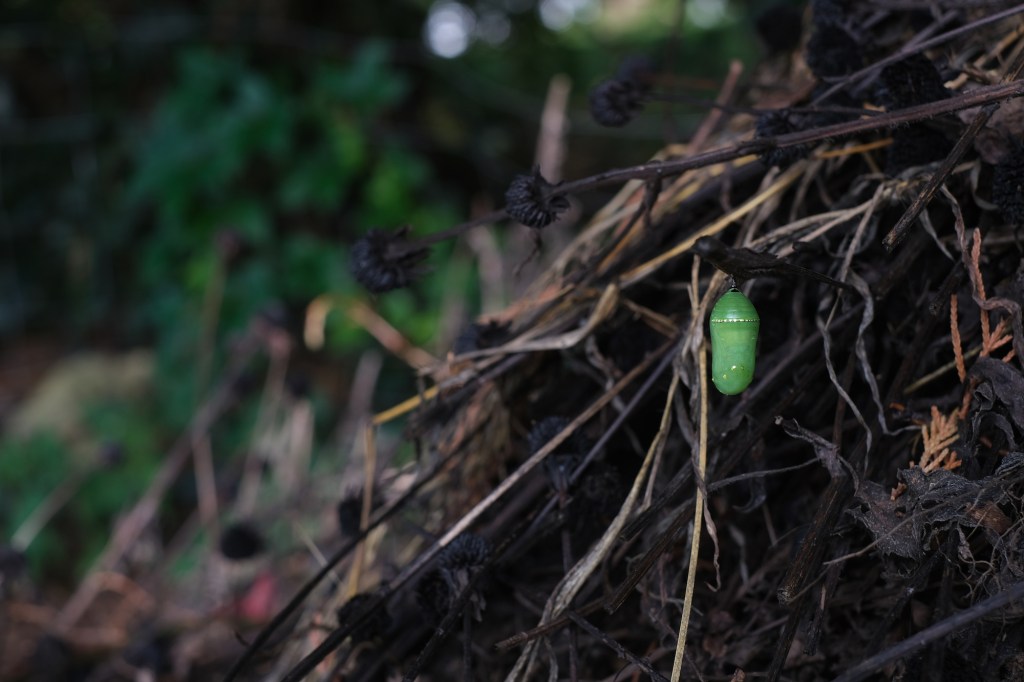
The messier the garden gets with dried out perennials long past the point of being attractive, the more likely I am to find monarch chrysalises in the debris. I mowed earlier this week in the shadows of the late day, and when I pushed the mower past the compost pile, I saw a chrysalis hanging off a desiccated, composting stem. I saw one hanging from the underside of the birdbath bowl. There’s one hanging off an upright post on the stair railing. There were three hanging from tomato cages stored on their sides under the porch stairs.
This time of year, I become desperate to tidy the garden. The beds that were so lush and green in the spring and summer now look ramshackle and abandoned. The once vibrant rudbeckia, with its emerald foliage and sunshine yellow flowers, looks like someone took a blowtorch to its blossoms; black stems stand in a sea of brown-spotted, crispy leaves. The goldenrod is no longer grassy-green and gold, tall, and swaying in the breeze, and the shasta daisies no longer bursts of dazzling white on proud stems. Instead, the two have fallen over, exhausted from reaching for the sun, and are now tangled up together in a thicket of brown brush. The underleaves of the yarrow and lavender are musty silver-black instead of the fresh silver-green of spring, and the Joe Pye weed, which now reaches my shoulders, looks like the remanants of flower stems that have been left in a vase too long: the bottom leaves are rotting, and the stalks a dusty brown.
Once the flowers are done, and their petals curl to crispies, the plants transition to making seeds. It’s not a pretty process. I know this, and yet I struggle every year. I want to cut things back because I can’t stand the mess, but I also want to leave it because the joy of my garden is not just the greenery and pretty flowers, it’s that it surrounds our house with a little wildlife preserve. I garden because I like the birds and the insects, the chipmunks and bunnies and squirrels. I love watching them all, and I am delighted that they come hang out in our yard. The garden is intentionally full of botanicals for butterflies and birds because they’re what’s interesting about plants to me: I don’t want a sterile garden that just has pretty flowers, I want a garden that invites all the creatures.
This time of year, when the garden is its messiest, and every instinct in me screams to clean it up, is harvest time for the birds, and shelter time for the work caterpillars need to do. As soon as I think I can’t take it anymore, and I’m ready to cut it all down, a goldfinch will land on a crunchy echinacea cone and start eating the seeds. It’ll bob there, a burst of happy yellow brightness atop the black stem, and I decide, okay, I can leave the echinacea a little longer. But just the echinacea. Everything else must go.
Then I mow the lawn and see a chrysalis on the compost pile. I remember the chrysalises under the stairs, under the birdbath, in the nepeta and pineapple sage, the rue and the Russian sage last year. I look across the swaths of spent stems and brown withered leaves in the garden, and I know there are likely a dozen chrysalises tucked away in that mess. And I know I won’t cut it back. I can’t bear to. What if I kill a poor caterpillar on its way to becoming a butterfly?
I set today aside to garden and to tidy at least some stuff so I don’t have as much work to do in spring. I can cut some stuff back and still leave plenty for the animals. But wouldn’t you know it, it’s raining. Maybe it’ll ease up and I can take advantage of the hydration to put some stuff in the ground instead of cutting stuff back. I’ve been wanting mums and a couple of shrubs…


2 responses to “Chrysalis in the compost”
I love reading your blog. Your descriptions are wonderful!
That first picture is so beautiful!