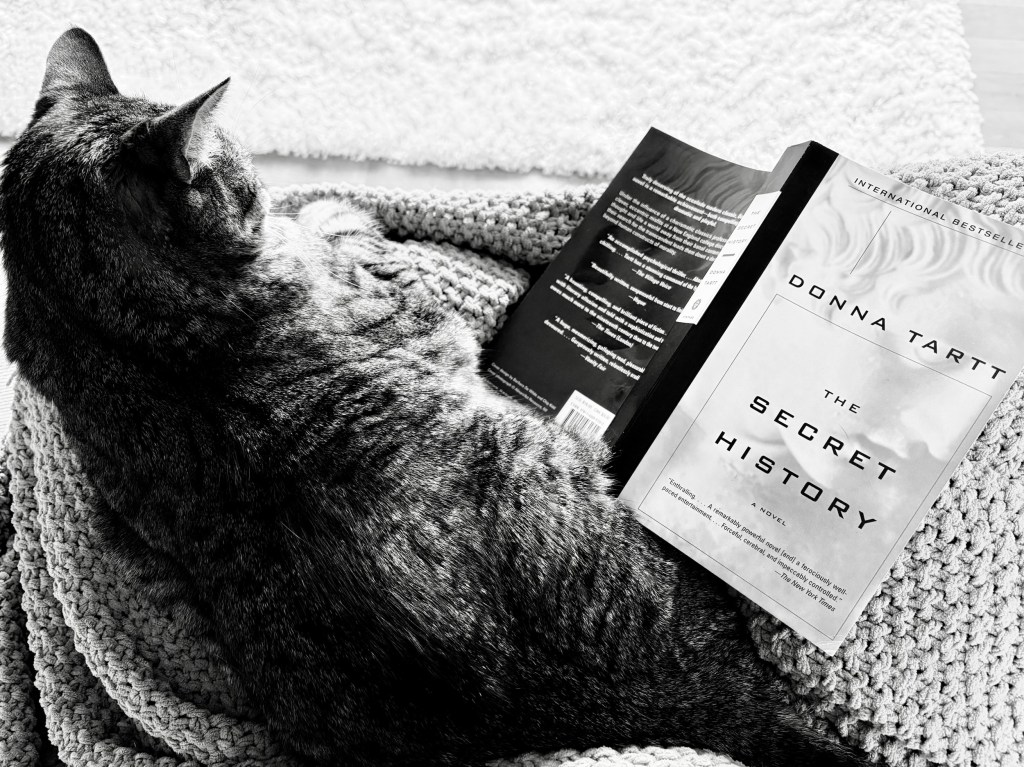
I have a book hangover. This past week, I reread The Secret History by Donna Tartt again. Even though it’s over, I don’t want it to end. The characters are insufferable intellectual snobs. They are not likeable. They drink themselves blind. They murder their friend (and an unsuspecting farmer during their successful Bacchanal).
And yet. I root for them every time I read it. They entertain me. I want to be with them on the page. I — and I’m sure many, or it wouldn’t be such a beloved book — can relate to these seeking college students, though it makes me squirm to say that (I am not murdery!). They’re fascinated by language and books and philosophy, ancient rituals, gods, the mind, belief. They speak Ancient Greek and Latin with each other. They cloister themselves in a world of beauty: the narrator’s fatal flaw is “a morbid longing for the picturesque.” Henry never took the SATs because he had “some kind of aesthetic objection to them.” They’re funny. They understand each other. They are outsiders, and they find belonging together.
In their seeking to go beyond themselves, I recognize the need to release:
“We don’t like to admit it,” said Julian, “but the idea of losing control is one that fascinates controlled people such as ourselves more than almost anything. All truly civilized people — the ancients no less than us — have civilized themselves through the willful repression of the old, animal self.”
I can relate to being locked in loops inside my own head:
“And how did [the Furies] drive people mad? They turned up the volume of the inner monologue, magnified qualities already present to great excess, made people so much themselves that they couldn’t stand it.
Like Richard, the narrator, I am vulnerable to the picturesque, and Tartt’s writing is cinematic, as beautiful an experience as watching Stanley Kubrik’s Barry Lyndon.
It was a beautiful room, not an office at all, and much bigger than it looked from outside — airy and white, with a high ceiling and a breeze fluttering in the starched curtains. In the corner, near a low bookshelf, was a big round table littered with teapots and Greek books, and there were flowers everywhere, roses and carnations and anemones, on his desk, on the table, in the windowsills.
Henry, in coat and tie, waded out to where Francis stood, his trousers rolled to the knee, an old-fashioned banker in a surrealist painting.
I could go on and on. I don’t want my time in this book to end. I considered going straight into The Goldfinch, chain-smoking Tartt, lighting one novel off another. I should probably take a break in between though, and come up for air.


