My mom is beautiful in her laughter – mouth wide-open, teeth shining. She says she married Dad for his sense of humor. She shrugs when you ask about how they met and says, “He made me laugh.”
My mom is beautiful in how much she looks for the good, the bright, the joy, the adventure. She gets excited, like a little kid, about a sunset or an unexpected short line at Disney world.
When my mom was in the hospital after emergency surgery to remove her remaining ovary, parts of her colon, and the tumors that grew on each, large tumors – one the size of a grapefruit (benign) and one smaller (cancer) – when she was shell-shocked from the cancer diagnosis, her gown open in the back, her smile faltering at the indignity of it all, I brushed her silver hair that she would soon be losing. It reflected the hospital lights like a sheaf of shining silk. She sat up and I rubbed lotion into her shoulders and was shocked by the young beauty of her skin – tan, smooth, unwrinkled after fifty-plus years in the sun. Her skin felt supple, pliable, like kidskin. My mom is beautiful.
My mom is beautiful with her newly grown hair, her unwavering smile, her three-years-cancer-free celebrations. Dad took her to The Breakfast Club at Tybee the morning she woke up three-years-cancer-free. For three years they’ve toasted something at the end of each day – a toast to the hummingbird at the feeder, a toast to visiting grandchildren, a toast to Alaska on their cross-country RV trip, a toast to the breath that still enters their bodies. Because my mom is beautiful, and she appreciates what she has.
Happy Mother’s Day, Mom, and happy birthday, Dad!
This was inspired by a Yoko Ono art installation titled “My Mommy is Beautiful.” I visited a local installation last fall.
I remember boiled peanuts; I remember them from the barrier islands of Georgia. On hot Saturdays in summer, my family loaded our boat with beach chairs, coolers, canvas tote bags filled with towels, Doritos, and Mom’s chocolate chip cookies, and we motored off across the rippled brown water of tidal rivers. Crusted salt glittered on the white boat deck, and in the cooler, along with the cold beers and Cokes, there would sometimes be a bag of boiled peanuts. The peanuts, soft like fat tan peas, squirted salty juice when you opened their shells. On the islands there was salt on the boat deck, salt in the rivers, salt on my skin, and salt in the peanuts. And I love salt.
I remember boiled peanuts, and I remember where I ate them. After combing tan sand beaches for olive snail shells, after slapping mosquitoes in the palmetto scrub, live oak, palm tree forest, after trying to stand on our fabric raft in the tidal creeks, I returned to the cooler famished. I pulled out a cold Coke and the ziplock bag of peanuts, I carried them calf deep into the glassy brown creek, I planted my shiny red Coke can in the sand just above where land transitioned to water, and I sat down in the water with the bag of peanuts in my criss-cross-apple-sauce lap. I sat in the salty water in my neon pink one piece and I ate my boiled peanuts.
I remember I grabbed whole handfuls of the sodden peanuts, and I held them underwater: to season them even more. I split the shells by pinching the seam or by slitting them with my fingernail if they didn’t pop when I squeezed, and I sucked those squishy, salty, brown peas out. Sometimes, if it was a three- or four-nutter, I popped the whole thing in my mouth, shell and all, and sucked the salty juices out like sucking the sugary flavoring out of a popsicle. Then I cracked the shell between my molars and ate the soft nuts. A pile of wet shells accumulated on the sand above my Coke can, and I collected them when I finished. Leave only your footprints and all.
Eating salty boiled peanuts in Georgia’s salty tidal waters was one of my favorite childhood rituals, and I think of those marshy creeks every time I eat boiled peanuts now, landlocked in the Appalachian mountains of Virginia. Our children love boiled peanuts – we buy a large steaming styrofoam cup of them at a roadside stand every summer on our road trip to visit grandparents in Georgia and Florida – but our kids have never eaten them the way I did growing up; they’ve never eaten them butt planted in salty water at a tidal creek’s edge, a cold Coke can within arm’s reach in the sand. Our kids love boiled peanuts, and our kids love salt. And I think this summer, on our trip to Georgia, we will give them boiled peanuts on the islands, and I will show them the best place to eat them.
I am seeking guest contributors for my Andrea Reads America site. This is my entry for the first of a series of writing challenges I will be hosting there as I attempt to collect stories from all 50 states. I hope you will consider submitting. For details on the first prompted challenge, please see American Vignette: I remember. A Writing Challenge.
First of all, let me just say that teachers are saints. If you have a child, or even if you don’t, I’d like you to please take a moment to silently applaud the teachers who are taking care of our nation’s children: teaching them history, encouraging manners, spending entire days with rooms full of children who aren’t their own, smiling, clapping, telling our kids they are awesome, dispensing hugs and band aids, and cleaning up barf on charter busses to Jamestown. Every time I am around our children’s teachers, I am in awe of what they do, and I am deeply grateful for them.
This past Monday and Tuesday I chaperoned our son’s fourth grade spring field trip to Jamestown, Colonial Williamsburg, and Yorktown, Virginia. Our son has been excited about this trip since the first week of school when they found out they’d be going. Fourth grade Virginia curriculum includes Virginia history, and in our school and many others, that means a field trip to the places where the United States as we know it began. Our son raised money selling Virginia Diner peanuts, and after many long months of preparing and waiting (and a five-hour bus ride in the rain) we donned ponchos and foul weather gear and stepped out into the drizzle.
Powhaten village, Jamestown settlement, Virginia
Powhatan canoe, Jamestown settlement, Virginia
Replicas of the ships that brought colonists to Jamestown, Virginia
The thing I love most about my job as Mom is doing things like this. Even though I bitch and complain about having to be around all these kids, and how loud it’s going to be, how it’s going to be like herding cats, how we have to be vigilant about keeping the kids away from the river, and constantly counting heads, and looking for the ever-shifting red hood, blue poncho (distinguishable from the other blue ponchos only by the pink soles of the shoes that peek out from the bottom), clear poncho with a blue hoodie underneath, and green raincoat – even though I complain about all of this, the thing is, the kids are actually awesome, and I secretly love every second of it.
My Colonial Williamsburg dream house
My Colonial WIlliamsburg dream garden (Wythe House)
Collections of scholar/scientist George Wythe
I love volunteering in the classroom, I love chaperoning, I love watching our children in their non-home habitats because I learn so much about them when I’m present but not in charge, when I’m standing quietly on the sidelines. In sports I get to see how motivated our kids are, how they interact as a team player, whether they respect and respond to their coaches, how they react to winning or losing. In the classroom I get to observe while our children’s attention is focused on something else; I get to observe the other kids in their class – who are the attentive kids, the class clowns, the sweet ones, the troublemakers?; I get to experience the teacher’s style; I get to see when my son laughs, which lessons engage him, which kids he gravitates towards. I get to see what his days are like so that when I ask him at the end of a school day, “How was your day?” and he says, “Fine,” I am able to accept his introversion with grace because I will have an idea of his experience, will be able to picture his classroom, will know something of his day beyond the one-word answer he gives me.
On field trips I get to experience what they experience, I get to learn what they learn, and most fun of all, I get to witness their unfettered joy at being out in the real world, learning real stuff – stuff that they learned from books and in the classroom but that is so much more exciting when you experience it in real life. In Jamestown I got to see our son’s interest in the Powhatan canoe, the way he scanned it from stern to bow with his eyes, held his hand over the still-warm coals reenactors used to burn a hollow in the tree trunk. In Colonial Williamsburg I got to gently prod him because he was lagging behind, too busy taking pictures in his awe. I got to hear him giggle at the slapstick 18th-Century Grand Medley of Entertainment – the type of theater production Thomas Jefferson might have attended – at the Kimball Theatre. I got to watch him touch the plaque that marked General George Washington’s church pew, I experienced the pride of hearing him explain the Virginia House of Burgesses – the first assembly of elected representatives in our country – to our tour guide, and to seeing him sit on a jury in the Capitol building’s courtroom.
Courthouse – Colonial Williamsburg
The Armory at Colonial Williamsburg
Virginia Capitol building, Colonial Wiliamsburg
George Washington pew plaque in Colonial Williamsburg
The following day, with aching muscles from the cabin’s hard mattress, with no real coffee in my system, with puffy eyes and ratted hair, I got to experience with our son the feel of the Yorktown encampment on a cold, wet, muddy, raw day. I could not imagine being a soldier there, wet and dripping and sleeping on the mucky ground, and I think the day gave the kids a tiny feel of what it might have been like for our Revolutionary War ancestors. Despite the cold and wet, the kids loved the musket demonstration, where the reenactor explained the difference between the match-lit musket of Jamestown and the flintlock musket of Yorktown, and where she showed them how to load and fire the weapon. They gagged and squealed “GROSS!” when our guide demonstrated the surgeon’s tools on volunteer musket-maimed kids, and they grinned as they squeezed into tiny solider tents.
Soldier tents – Yorktown encampment, Virginia
Flintlock musket demonstration, Yorktown encampment, Virginia
Firing a flintlock musket, Yorktown encampment, Virginia
The kids were pretty worn out by the time we stopped at the battlefield, the real Yorktown battlefield, and stood where George Washington stood, on the same ground that General Washington paced and strategized and gave orders from, but their exhaustion did not stop them from shouting out answers when their teacher stood atop a bench with a semi-circle of cannons around her and asked, “What happened here?!”
“The Siege at Yorktown!”
“Who won?”
“We did!”
“Who surrendered?”
“General Cornwallis!”
“Where is Surrender Hill?”
“Redoubts 9 and 10!”
“Well let’s go look at them!”
And she jumped down from the bench and all the kids ran for the hills. We oohed and aahed and paused to take in the panorama, and then the kids were running again, towards the busses and their potato chips, their DSes and their pillows, as we, the parents, dragged our tired feet from the battlefield. We basked in memories from the trip on the long, dry drive home, where our work was done and where our little ones munched candy and worked quietly on their trip journals, watched videos and giggled, and slept the beautiful sleep of children.
Appalachian Trail sign at McAfee Knob parking lot, Blacksburg, VA
Portraiture is possibly my favorite form of photography. Faces show character in every laugh line, every weathered wrinkle, in tan lines left by always-worn sunglasses, in the trickle of sweat through trail dust. In the scraggly beards of men who have walked the woods for weeks.
On our drive through Catawba valley, my husband said, “It’s getting close to peak thru-hiker season.” We were headed to Sawtooth Ridge, a portion of the Appalachian Trail between McAfee Knob and Dragon’s Tooth, near our home in Blacksburg, Virginia.
“It is?” I asked, my wheels turning. I had just checked my email and seen a photography challenge regarding culture, and I thought, oooh, maybe I can cover AT culture. Shoot portraits of rugged hikers.
“Yeah, if they left Springer Mountain [Georgia] on March 1, they’d start getting here near the end of April and in May.”
A local friend of ours said she gives away her chocolate snacks when she encounters thru-hikers on the trail. I thought of when my husband was thru-hiking, back when we were boyfriend and girlfriend, and how he would put an entire stick of butter in his ramen noodles at night. “I wish I would have brought more food,” I said.
In the McAfee Knob parking lot, I fingered my camera as large groups of day-hikers clustered around car trunks and tailgates, stuffing water bottles in daypacks, eating pre-hike sandwiches from Subway, mixing formula in bottles for the baby a dad would carry on his back. I wasn’t brave enough to ask to take their pictures. On the trail, I told myself. I’ll ask hikers on the trail.
We headed south while the crowds headed north towards McAfee Knob. For twenty minutes, we saw no-one. No day hikers. No thru-hikers. The only evidence of humans we found, besides the trail, was a “Home Sweet Home” sign nailed above a squirrel hole. “Kids! Look at this!” I crouched down and snapped shots.
Squirrel hole on Appalachian Trail
“Do you think a squirrel made that?” Our son asked.
“Or maybe fairies?” said our daughter.
I wondered about whoever had made this miniature sign, who had brought a screwdriver onto the trail to attach it to this little spot. A local day hiker? A Virginia Tech student? Whoever it was, they made me smile with this little surprise in the woods.
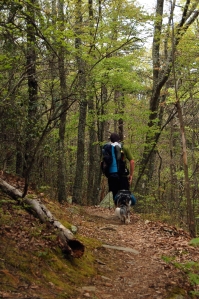
We rounded a bend and met a young man and his dog headed north on the trail. The man carried a full pack, with a pair of dusty gray Crocs tied on the side. His hands were red and raw as he gave his dog a treat for sitting obediently as our kids approached.
“Hey, how’s it going?” we said.
Hiker and his dog on the Appalachian Trail
“Good, good. I just picked this guy up in Pearisburg,” and he pointed at his dog. “I’m trying to train him.” The black and white mottled dog carried his own saddlebag pack and was calm and sweet as he sniffed my hand. His nose was speckled pink and black. The man gave him another treat.
“Well, y’all have a good day!” And he continued north as we continued south. I’m not sure if he was hiking from Georgia to Maine, or if he was just out for a weekend backpacking trip. I did not ask his story, and I did not take his picture, except from the back.
The next hikers we encountered were obviously thru-hikers. My husband and kids and I sat on fallen trees in a clearing, munching trail mix and baby carrots, when two women powered through the glade. They carried full packs, wore quick-dry nylon hiking pants in olive green and pewter grey, and their strides were long and purposeful. I wondered where they were from, when they had started, how many miles they were doing that day. Had they mailed boxes to themselves, filled with fresh food supplies, and cash, and lightweight spring clothing? Were they in a hurry to get to a post office and bury their faces in fresh tee-shirts? Clean socks? They said a quick “Hello,” which we returned, and then they were gone. I did not photograph them, or ask them their story. “The next one,” I told myself. “I’ll talk to the next one.”
On our way back to the car, we passed a scruffy young man smoking a cigarette on a slab of rock by the side of the trail. He sat atop a bulging backpack, stuffed full like a giant army-green sausage. He was backpacking, not day hiking. Carrying cigarettes and wearing New Balance sneakers, he didn’t fit the profile for a thru-hiker, but he could have been. I’m sure he had a story. He was lounging, I could have easily asked for his portrait. But he wore headphones, and I didn’t want to intrude, so I hiked by with a nod and a smile.
By the time we arrived at our car, where five dusty, bearded, twenty-something men lay draped over their backpacks, or sat on them as chairs, or propped their backs against them in the white gravel parking lot, I knew that I would not talk to these hikers either, nor photograph their faces. I am fascinated by journalists – by their grit, by their ability to shove in and get the story, by their speed in turning stories out – but I realized on the trail that that is not the stuff I’m made of.
Instead of shooting photographs of “the next one,” or of those prone hikers reclining not 20 yards from our car, I knew I’d bring their images home in my mind, and l’d write their portraits with words. I’d hole up at home, in retreat like many hikers seek, contemplating solitude, and the Appalachian Trail, and a culture that includes power-hikers, dog-rescuers, smokers, families of four, and those who would nail a tiny sign over a tiny hole, in the wilderness, for smiles they’ll never see, but that they’ll know, quietly.
White daisy-like wildflowers on the Appalachian Trail, VA
Appalachian trail, Sawtooth Ridge near Blacksburg, VA
Pink mountain azaleas in bloom on Appalachian Trail in April, Sawtooth Ridge, VA
Tiny green succlents on Appalachian Trail in spring, Sawtooth Ridge, VA near Blacksburg
View from rock outcrop on Sawtooth Ridge hike near McAfee knob, VA on Appalachian Trail in April
Pink mountain azalea buds on Sawtooth Ridge on Appalachian Trail, VA
Tiny blue feather on Appalachian Trail in April, Sawtooth Ridge, VA
Fern unfurling in spring on Appalachian Trail, Sawtooth Ridge, VA
Lichen covered log and white wildflowers on Appalachian Trail in April, Sawtooth Ridge, VA
(R) Repost – I am away, chaperoning the fourth grade trip to Jamestown, VA. I’ll be on a bus with, corralling, and sleeping in cabins with 60 ten-year olds for 48 straight hours, and am prohibited from drinking alcohol during that time. I know you’re jealous. Anyway, I was rummaging through my archives and saw this post from a year ago today and I thought I’d repost it to herald thru-hiking season in Virginia.
I am a huge fan of the podcast medium. I listen while I clean, while I walk, while I cook, while I dress after my shower. I do not subscribe to print periodicals that run book reviews, I am not a librarian, and I no longer work in a book store, but I am a reader who is interested in what’s going on in the book world, in reading culture, and who loves a well-told story. With limited time to consume print media, but with ample time to listen, I have become an avid fan of podcasts, and my hungry mind devours the bookish and storytelling podcasts below. These shows provide the literary fix I need as a word nerd. I plan special walks or add extra chores to my list when any of these drop new episodes. I hope you enjoy them, too.







 Butterfly Mind