I started reading the US in three books per state in January of 2014, nearly three years ago. I just finished reading Kansas, the 17th of 51 states (and the District of Columbia).
This is going to take a while.
I started reading the US in three books per state in January of 2014, nearly three years ago. I just finished reading Kansas, the 17th of 51 states (and the District of Columbia).
This is going to take a while.
When I returned home after a weeklong trip to Whistler, I was giddy to walk around the garden and find not one monarch butterfly emerging from its chrysalis, but two.

This is SO EXCITING Y’ALL. Here’s a full caterpillar catalog of what I’ve found so far:
Some friends at work are also interested in butterfly gardening, and are looking for host plant ideas. Since we work for a company that makes, ahem, blogging software, my friend naturally asked “Did you do a blog post on what all you planted?” Nudge nudge.
Shockingly, I have not. So here it is! Kris and Liz, this is for you.
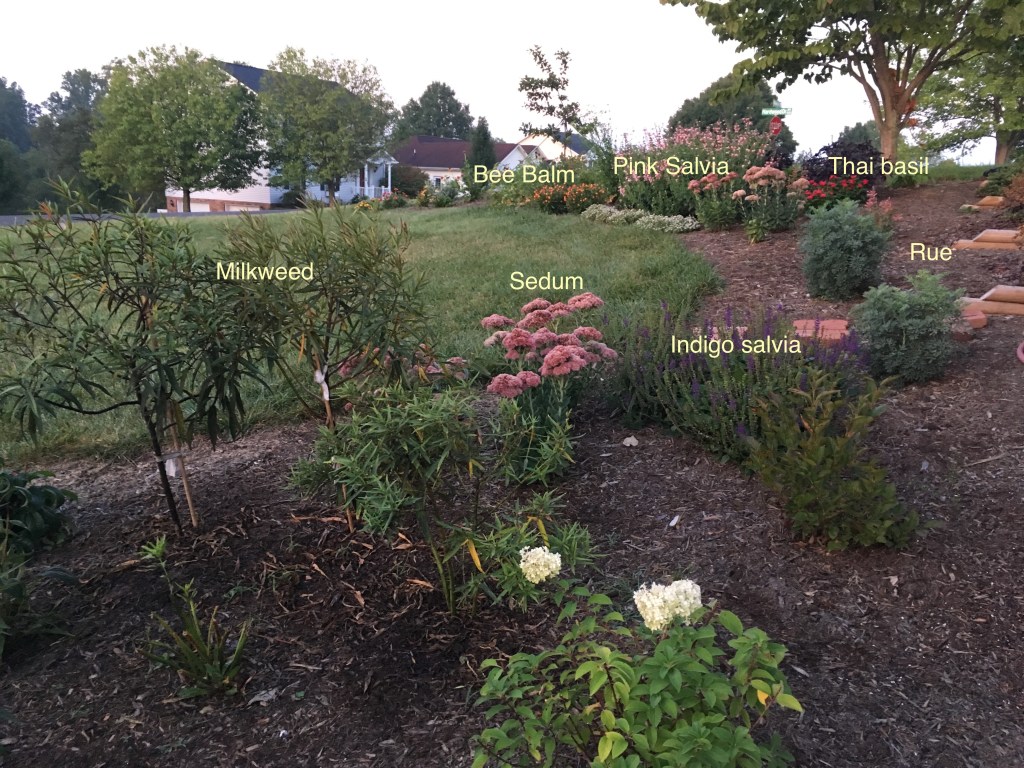
For Mother’s Day, our son gave me Christopher Kline’s book, Butterfly Gardening with Native Plants: How to Attract and Identify Butterflies. Combined with a bunch of online research, experimentation with a butterfly garden in Florida, and talking to bunches of people who garden for butterflies and caterpillars, this book helped me plan a garden that includes both host plants (that caterpillars eat) and nectar plants (that adult butterflies drink from). The most successful plants in our garden are the following:
Milkweed (Asclepias): We planted both common milkweed and swamp milkweed. These are by far the most insect-loved plants in the garden. They are constantly covered in various species, including aphids, beetles, and, late in the summer, monarch caterpillars. Milkweed is both a nectar plant and a host plant. We’ve seen adult giant swallowtails and monarchs drinking from its flowers, and have found at least a dozen monarch caterpillars on it. Word of warning: milkweed will get covered in aphids. The caterpillars will still come even when every surface is crawling with aphids, so we kept our milkweed intact even though it’s not very attractive once it has stopped flowering and it’s coated in tiny orange insects.
Rue (Ruta graveolens): This is possibly my favorite addition to the garden. The leaves are a silvery blue-green, the plant stays neat and tidy (it doesn’t get leggy or messy), it can take the heat (and drought) and still look healthy, and the swallowtail caterpillars adore it. As an unexpected bonus, the monarch caterpillars love it for building chrysalises. We’ve found at least 3 chrysalises in the small, shin-high plants.
Milkweed: all the butterflies big and small love milkweed.
Indigo salvia: Aside from the milkweed, these purple flower spikes are the most popular in the garden for butterflies to drink from. Bees also love these flowers.
Pink salvia: Okay, maybe these are tied with the indigo salvia for nectar popularity, at least for hummingbirds. I see hummingbirds drinking from these almost every time I sit in the garden.
Bee balm (Monarda): Butterflies and hummingbirds love this as well. Hummingbirds dart between the pink salvia and the bee balm.
Thai basil: I’ve seen some small butterflies and moths (and caterpillars) on these flowers.

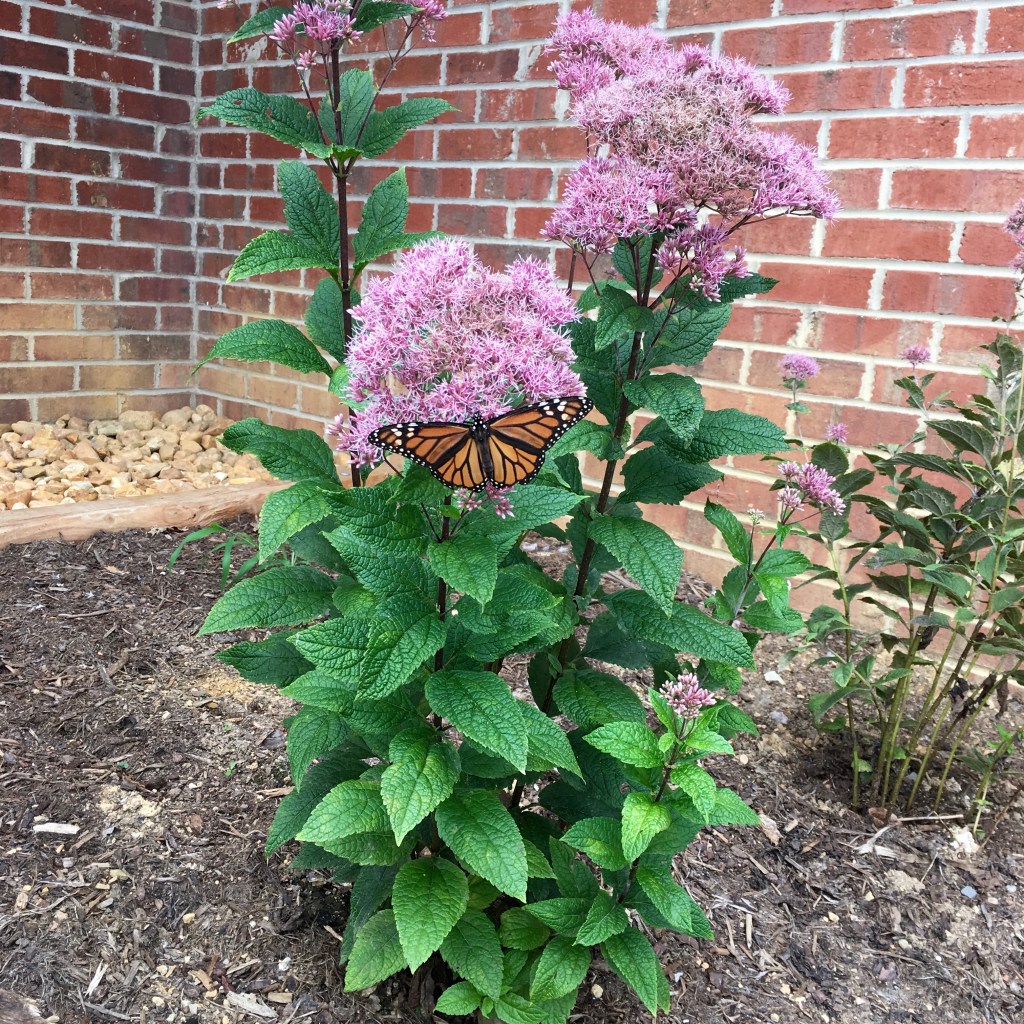
Joe Pye weed: Butterflies love to drink from Joe Pye flowers. Joe Pye weed gets really tall and floppy unless you get the dwarf varieties.
Parsley: parsley is a host plant for swallowtails, but the swallowtail caterpillars definitely opted for the rue over the parsley, at least this year. I didn’t find any caterpillars on the parsley, and found at least a dozen on the rue.
I guess the parsley is the only one :-). We have lots of other nectar flowers — brown-eyed Susans, Mexican blanket flowers, some other stuff I can’t remember the names of — but the ones I listed above were definitely the most successful.
If you can identify any of the caterpillars in the catalog, please let me know! I think most of them are probably moths, but I don’t have a good ID book.
This summer has been brutally hot. The past few times we’ve gone to Claytor Lake to sail, there has been a burning sun and no wind.
This morning, though, it was different. At 7:00 AM, my husband and I swung out of the driveway, pulling our little wooden yawl behind the car. Our coffee swirled in ceramic mugs in the cup holders. We had the windows down and the air conditioning off.
We arrived at the lake so early, there was nobody at the ranger station to collect our launch fee. In the vast parking lot that usually swarms with jet-skis, motor boats, pick-up trucks, glittery trailers to match glittery speedboats, and boaters toting towels and coolers, there was grey mist and stillness. We had the boat ramp to ourselves. In the normally buzzing lot were two empty trailers, zero people, and acres of deserted asphalt.
When we stepped out of the car, we both shivered in the morning air, then grabbed our sweatshirts and pulled them over our heads.

I’m a sucker for autumn. It might be my favorite season. To combine autumn (the best season) with morning (the best time of day) and water (the best place to be) is pretty much heaven to me. It’s cool, it’s quiet, the sounds are gentle, the scents are fresh.
Without boats zipping back and forth, without the buzz of engines and radios, without wakes to tumble our little boat, without the summer activity that usually accompanies a trip to the lake, we were able to glide silently through the water with a light wind in our sail. We made no wake.

We sailed towards a flock of small birds — maybe swallows? — that swooped and swirled within feet of the water’s surface, ignoring us in our quiet approach. We heard the sploosh of fish jumping. We skimmed along, listening to the splish of fresh water against our wooden hull.
I’m not sure I could have asked for a better beginning to autumn, kicking it off with an early morning sail, where not only did we have a gentle breeze and comfortable, overcast skies, but we wore swimsuits, flip flops, and sweatshirts.
Swimsuits. Flip flops. Sweatshirts.
This may be my new favorite combination of clothing.
On my recent trip to Whistler, British Columbia, I attempted to pack minimally. I reduced shoes to 4 pairs — boots, Vans, flip flops, and running shoes — and I left my camera at home.
That last was a big mistake. (As were the running shoes, but we don’t need to talk about that).
I ultimately ended up not going outside very much while in one of the most beautiful places I’ve ever visited. Instead of taking time off to go enjoy the gorgeous mountains and Pacific rain forest, I worked. I know, dumb, right? Now that I see everyone else’s photographs from their hikes, gondola rides, and ziplining, all I can think is, What was I thinking?!
I did go for a brief walk alone on a quest for some fresh air and quiet time, and I was awed by the lushness of the Pacific Northwest. It is beautiful there. I am promising myself now that when we go back next year, I will take my camera as incentive to get myself outside to enjoy it. For now, here are some shots from my phone.


When I was in Canada last week for the Automattic Grand Meetup, our company’s annual meeting, I used a SIM card for data on my phone. A coworker carried one of those little ejector tools in her phone case, so during the week, whenever anyone needed to switch SIM cards, Brie would provide the little key that pops the SIM tray open.
It wasn’t until I was on my flight back to the US from Vancouver that I remembered I needed to switch my SIM card back. Brie wasn’t on my flight, I don’t carry one of the tools with me, and I was 100% certain I did not have a paper clip in my bag. My pen tips would be too fat, and I didn’t have a mechanical pencil either.
I was bored, so I tried to think what else would work. And then I remembered my earrings. I was wearing post earrings, and I wondered if the stem of the earring would fit in the SIM hole.
Can you guess the answer? (see picture).
It’s that time of year again: time for the Automattic Grand Meetup. As a distributed company, with more than 450 employees in 45 countries, we all work from our home offices, coworking spaces, cafes, airports, airplanes, trains, RVs, and family and friends’ homes for 51 weeks of the year. But in this one week in the fall, we all converge in one place to learn and teach together, build new tools, and compress 51 weeks worth of Friday happy hours into 7 days.
This year our GM is in Whistler, British Columbia, and I’m so excited about it, I woke at 3:15, a full hour before my cab was scheduled to pick me up and take me to the airport. My cab driver, after asking where I was headed, said “Oh, Vancouver! I’ve never been there. I hope you’re getting to go for pleasure and you don’t have to go for work.”
I smiled and said, “I’m going for work, but it’s ok because I love my job.”
I’ve heard a lot of people talk about traveling for work, and how it’s exhausting, and at the end of each day they can’t wait to sneak off and get away from their coworkers, and that few people on their business travel like each other or want to hang out together.
That’s definitely not my experience. One of my coworkers describes Automattic business travel as like going to summer camp. That’s the most apt description I’ve heard of what it feels like. My husband and I were talking about taking time off from work to recharge, and he mentioned that I haven’t really taken much — not as much as I could with our open vacation policy, anyway.
“Yeah,” I said, “I haven’t taken a lot of actual vacation, but going on work trips is like vacation for me. They are long days of working and thinking and brainstorming, often from sunup into the deep night, but it feels more like hanging out with friends while also, oh yeah, we’re getting work done.”
One thing I won’t be doing much of on this trip, though, is photography. Despite my post about minimizing, my suitcase was too stuffed with swag for our support team happy hour to be able to fit my camera. I’ll do what I can from my phone, though :-).
 Butterfly Mind