One of my favorite things about living in a college town, now that I am a mom instead of a student, is running errands on a Saturday morning. After a cup of coffee and the paper, I hit the street around 10 or 11 AM, when I’ve been awake for three hours, but the town is just rubbing its eyes after its Friday night revelry. The scenery tickles me with every Saturday morning sojourn.
It’s 10:30 am. On my way home from the grocery store, where I bought popsicles for the kids for the first warm days of spring, I see a beefy young man strolling down the sidewalk in baggy gray sweatpants, flip flops, and no shirt. His chest is bare, not because he just finished up a run – his eyes are crusty (and he’s wearing flip flops) – but because he rolled out of bed cotton-mouthed and hungover, and he needed juice. He’s walking home now, sipping the Snapple he bought at the 7-Eleven. The April sun feels good on his skin, but it hurts his eyes.
Another day, on our way out of town – it’s 11 am and we are taking the kids on a wildflower hike – we drive along fraternity row, where young men move in slow motion under apple-green leaf buds. They lean over slowly, gingerly, on a Saturday morning and pick Friday night’s debris off the grass. On the front lawn of one frat house, a sophomore slouches over his garden tool. He rakes beer cans from last night’s party. A more senior brother stands on the porch, his feet firmly planted as he takes the air. He wears pajama pants and a tee shirt, yet stands tall as he surveys the pear blossoms and supervises the sophomore. He has one hand on his hip. In the other hand he holds a bloody Mary.
My favorite scene, though, unfolds at 10:45 am, as I drive to Goodwill. On my way to drop off outgrown kid clothes, I pass The Waffle House. Five bleary-eyed boys, all in maroon Virginia Tech sweatshirts, lay draped over benches like discarded coats. Last night, when I saw boys like them at Food Lion, when I was buying tissues and milk, and they were loading their carts with cheap beer and chips, their eyes were bright and laughing. Now, they are red-rimmed and suffering. Their heads lean on the brick wall, their arms dangle from burgundy sleeves. The Waffle House is full, and they wait their turn for greasy hangover food.
I smile as I drive by, my eyes clear and my head pain-free, remembering those days.
Portraiture is possibly my favorite form of photography. Faces show character in every laugh line, every weathered wrinkle, in tan lines left by always-worn sunglasses, in the trickle of sweat through trail dust. In the scraggly beards of men who have walked the woods for weeks.
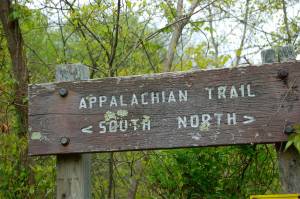
On our drive through Catawba valley, my husband said, “It’s getting close to peak thru-hiker season.” We were headed to Sawtooth Ridge, a portion of the Appalachian Trail between McAfee Knob and Dragon’s Tooth, near our home in Blacksburg, Virginia.
“It is?” I asked, my wheels turning. I had just checked my email and seen that the theme of this week’s WordPress photo challenge was culture, and I thought, oooh, maybe I can cover A.T. culture. Shoot portraits of rugged hikers.
“Yeah, if they left Springer Mountain [Georgia] on March 1, they’d start getting here near the end of April and in May.”
A local friend of ours said she gives away her chocolate snacks when she encounters thru-hikers on the trail. I thought of when my husband was thru-hiking, back when we were boyfriend and girlfriend, and how he would put an entire stick of butter in his ramen noodles at night. “I wish I would have brought more food,” I said.
In the McAfee Knob parking lot, I fingered my camera as large groups of hikers clustered around car trunks and tailgates, stuffing water bottles in daypacks, eating pre-hike sandwiches from Subway, mixing formula in bottles for the baby a dad would carry on his back. I wasn’t brave enough to ask to take their pictures. On the trail, I told myself. I’ll ask hikers on the trail.
We headed south while the crowds headed north towards McAfee Knob. For twenty minutes, we saw no-one. No day hikers. No thru-hikers. The only evidence of humans we found, besides the trail, was a “Home Sweet Home” sign nailed above a squirrel hole. “Kids! Look at this!” I crouched down and snapped shots.
“Do you think a squirrel made that?” Our son asked.
“Or maybe fairies?” said our daughter.
I wondered about whoever had made this miniature sign, who had brought a screwdriver onto the trail to attach it to this little spot. A local day hiker? A Virginia Tech student? Whoever it was, they made me smile with this little surprise in the woods.
We rounded a bend and met a young man and his dog headed north on the trail. The man carried a full pack, with a pair of dusty gray Crocs tied on the side. His hands were red and raw as he gave his dog a treat for sitting obediently as our kids approached.
“Hey, how’s it going?” we said.
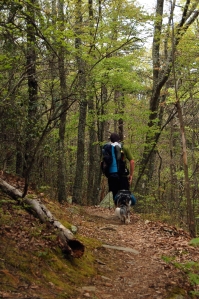
Hiker and his dog on the Appalachian Trail
“Good, good. I just picked this guy up in Pearisburg,” and he pointed at his dog. “I’m trying to train him.” The black and white mottled dog carried his own saddlebag pack and was calm and sweet as he sniffed my hand. His nose was speckled pink and black. The man gave him another treat.
“Well, y’all have a good day!” And he continued north as we continued south. I’m not sure if he was hiking from Georgia to Maine, or if he was just out for a weekend backpacking trip. I did not ask his story, and I did not take his picture, except from the back.
The next hikers we encountered were obviously thru-hikers. We sat on fallen trees in a clearing, munching trail mix and baby carrots, when two women powered through the glade. They carried full packs, wore quick-dry nylon hiking pants in olive green and pewter grey, and their strides were long and purposeful. I wondered where they were from, when they had started, how many miles they were doing that day. Had they mailed boxes to themselves, filled with fresh food supplies, and cash, and lightweight spring clothing? Were they in a hurry to get to a post office and bury their faces in fresh tee-shirts? Clean socks? They said a quick “Hello,” which we returned, and then they were gone. I did not photograph them, or ask them their story. “The next one,” I told myself. “I’ll talk to the next one.”
On our way back to the car, we passed a scruffy young man smoking a cigarette on a slab of rock on the side of the trail. He sat atop a bulging backpack, stuffed full like a giant army-green sausage . He was backpacking, not day hiking. Carrying cigarettes and wearing New Balance sneakers, I didn’t think he was a thru-hiker, but he could have been. I’m sure he had a story. He was lounging, I could have easily asked. But he wore headphones, and I didn’t want to intrude, so I hiked by with a nod and a smile.
By the time we arrived at our car, where five dusty, bearded twenty-something men lay draped over their backpacks, or sat on them as chairs, or propped their backs up against them in the white gravel parking lot, I knew that I would not talk to these hikers, nor photograph their faces. I am fascinated by journalists – by their grit, by their ability to shove in and get the story, by their speed in turning stories out – but I realized on the trail that that is not the stuff I’m made of.
Instead of shooting photographs of “the next one,” or of those prone hikers reclining not 20 yards from our car, I knew I’d bring their images home in my mind, and l’d write their portraits with words. I’d hole up at home, in retreat like many hikers seek, contemplating solitude, and the Appalachian Trail, and a culture that includes those who would nail a tiny sign over a tiny hole, in the wilderness, for smiles they’ll never see, but that they’ll know, quietly.
White daisy-like wildflowers on the Appalachian Trail, VA
Appalachian trail, Sawtooth Ridge near Blacksburg, VA
Pink mountain azaleas in bloom on Appalachian Trail in April, Sawtooth Ridge, VA
Tiny green succlents on Appalachian Trail in spring, Sawtooth Ridge, VA near Blacksburg
View from rock outcrop on Sawtooth Ridge hike near McAfee knob, VA on Appalachian Trail in April
Pink mountain azalea buds on Sawtooth Ridge on Appalachian Trail, VA
Tiny blue feather on Appalachian Trail in April, Sawtooth Ridge, VA
Fern unfurling in spring on Appalachian Trail, Sawtooth Ridge, VA
Lichen covered log and white wildflowers on Appalachian Trail in April, Sawtooth Ridge, VA
Summer, fall, winter. We’ve spent one of each here in the Appalachian mountains of Blacksburg, Virginia. And finally, we get to see spring. We took a walk at the Falls Ridge Preserve on Sunday, a 655 acre plot of land owned and maintained by The Nature Conservancy. It’s only about 15 minutes from our home, with an easy half mile trail packed with a lime kiln, shallow caverns that provided at least an hour of entertainment for our kids, a stream, a waterfall, and of course, wildflowers.
White Anemone Appalachian wildflower at Falls Ridge Nature Preserve
Yellow spicebush flower buds at Falls Ridge
Lime Kiln at Falls Ridge Nature Preserve
Pink anemone flower at Falls Ridge in Appalachia
Buds on a bush in Falls Ridge Nature Conservancy Preserve
Spring fed waterfall at Falls Ridge Nature Conservancy Preserve Blacksburg, VA Appalachia
Funky green Applachian bud (or flower?) at Falls Ridge Nature Preserve
Redbud tree buds at Falls Ridge Nature Preserve
White Trillium wildflower at Falls Ridge Nature Preserve
Buds on a bush in Falls Ridge Nature Preserve in Blacksburg, VA
Spring fed stream at Falls Ridge Preserve Blacksburg, Virginia
I know it is totally cliché to post photographs of spring for an April “Change” photo challenge. While this photo essay does embrace all the conventional themes of spring transition – new life, hope, color, potential – the type of change these photographs signify to me is one of having roots, being established, and consequently, being able to bloom. For the first time in our married life, my husband and I aim to stop wandering. This is unprecedented for us, to stay put in one place, possibly for the rest of our lives. It seems significant somehow, to wrap up our first year with the season of spring, the season of new life, hope, color, and potential. To put down roots while we watch our new world blossom.
Directions to Falls Ridge Preserve from Blacksburg: From South Main Street, just north of 460, turn onto Ellet Rd. (which becomes Cedar Run Rd.). Follow Cedar Run Rd. to the end and turn left on Jennelle Rd. at the railroad tracks. Follow Jennelle to the Food Time store (you’ll pass another Ellet Rd) and turn right on Den Hill Rd. Turn left on North Fork Rd and drive about three miles. On your right you will see a super rickety bridge on your right, with red railings and a sign that says “Use at your own risk.” Turn right and cross that bridge. Cross the railroad tracks and make an immediate left on a dirt/gravel road. Follow about .25 miles and you will see a parking lot on the left. There is a Nature Conservancy Kiosk in the grassy meadow. Follow the meadow to the woods and you will see the caves, kiln, and waterfall.
Last weekend, when the sun finally shone bright after weeks behind steel clouds, and the air was warm enough for short sleeves, our daughter and I waited on the front stoop for Grandma and the cousins to arrive. The sun was like warm honey on our skin, and for the first time since October, I peeled my socks off. I wiggled my naked toes in the yellow light and realized, my toes are out!
“Let’s paint our toenails,” I said. “You want to?”
We sat on the concrete steps and clipped and buffed and listened to the clink of glass polish bottles as we explored the bright pink cosmetic bag of color. I found a red like a Corazon rose, propped my right foot beneath me, and painted new life onto my toenails.
Two days later, winter returned. My toes went back into their socks, their electric happiness hidden, like a surprise party waiting for the honoree to arrive. At the end of the week, our guests departed, bundled against the cold.
When Saturday came around again, so did the sun. We opened the house back up to let another day of warmth inside, and the kids asked to take a walk to the duck pond. After telling them, “In a minute” for about an hour, we finally threw on flip flops and told them to grab their ball. We walked out the door to dark grey clouds looming, shrugged our shoulders, and went anyway.
A huge raindrop splatted on my cheek as we arrived at the pond. Five minutes later, the clouds burst, and I ran under the gazebo with my go-cup of wine. The wind blew rain in sheets across the pond, and when thunder boomed, the kids and their dad ran laughing to the shelter. Our teeth chattered as the temperature dropped, and our son said, “Can we go home now?”
“Uhhhh, I’m not leaving in this.” My husband gestured to the torrents of rain coming down. “You can go if you want.”
Our son took his ball and stepped out into the downpour, and a few seconds later, our daughter followed. Soon they disappeared up the hill towards home, while their dad and I shivered under the gazebo, the wind blowing spray onto us despite the roof over our heads. When it finally seemed to let up, I said, “You wanna make a run for it?”
We walked out into the now light shower, hunching our shoulders against the chill. Thunder boomed, a new deluge began, and we ran in the rain, our squeaky flip-flops splashing, our heads down. My red lacquered toes flashed bright against the wet gray sidewalk.
My husband shouted, “I like your toenails!”
And we smiled at their fun color in the spring rain.
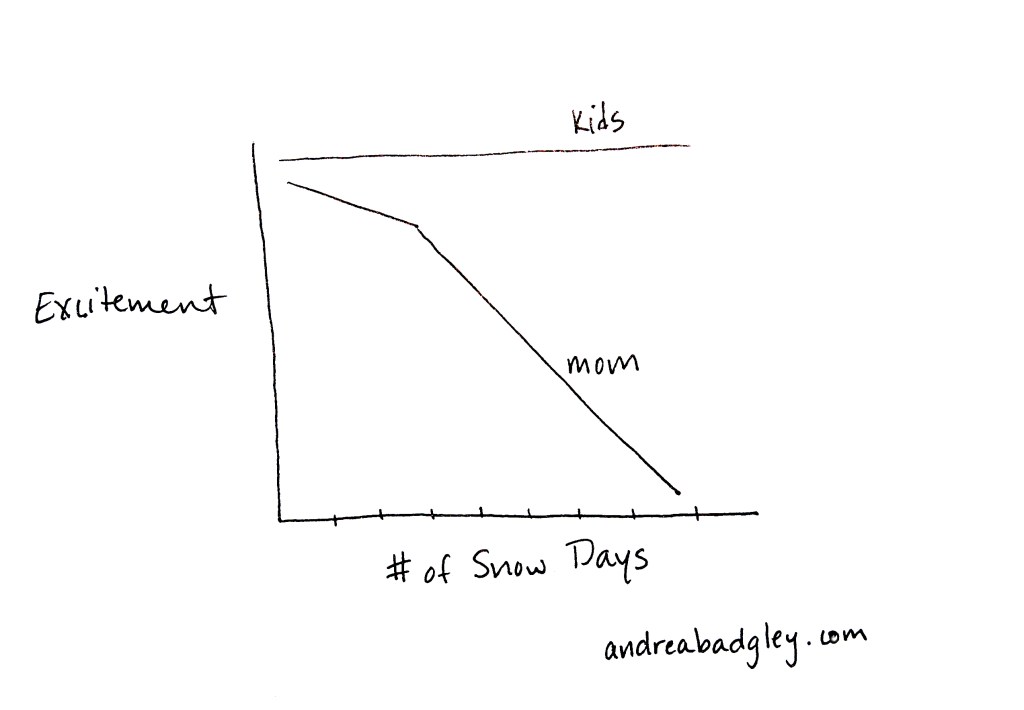
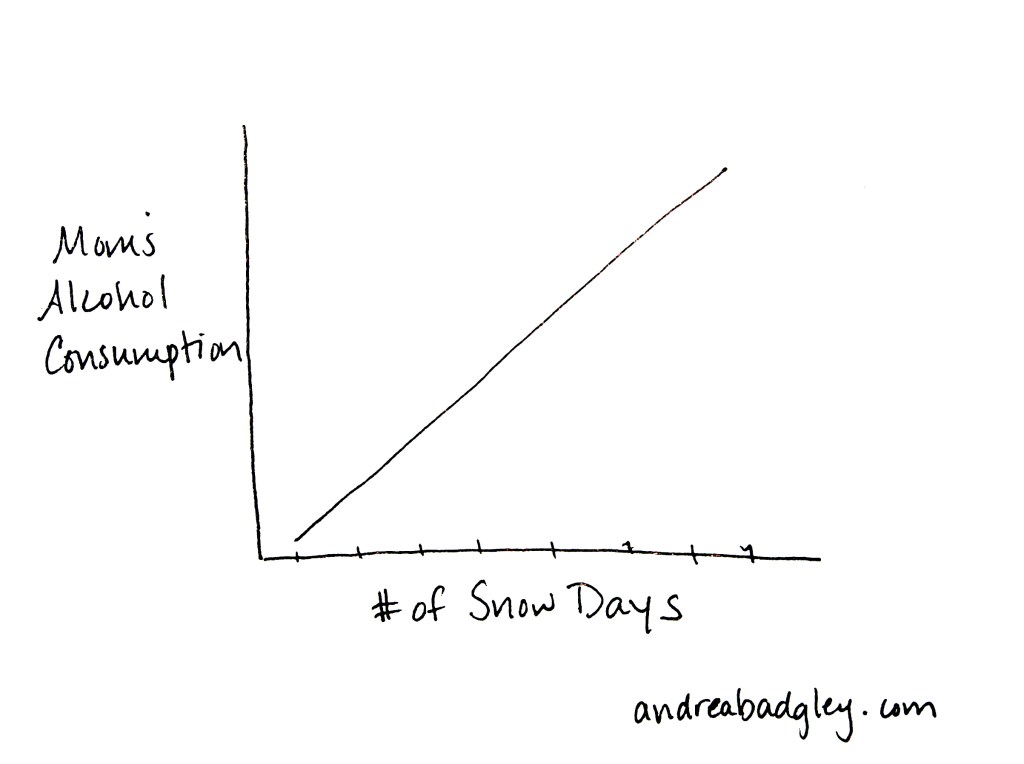
Between “severe weather” days, delayed starts, and early releases, the kids haven’t had a full week of school since winter break.
Spring will be here soon, right?
I prepared this yesterday, giggling to myself, when I thought for sure the kids would have a snow day today. They only got a two hour delay. Now I feel bad, like I jinxed their fun. I’ll make hot cocoa this morning to make up for it.
After three years in Minnesota, I keep wondering when winter will arrive in Blacksburg. It’s January now. Shouldn’t I be warming my mug so its cold, greedy clay won’t suck all the heat from my coffee? Or pulling our down comforter up to my ears rather than kicking it off in the middle of the night? Shouldn’t I be wearing long johns, and furry boots, snow gloves and a knee length down coat?
Shouldn’t I be worried that my eyes will freeze open?
It is a strange sensation, this waiting. I keep checking the forecast, wondering when it’s going to get cold. I will see highs in the 50s, 40s, and even 30s and think, “It’s not here yet.” The bone chilling cold of highs in the single digits, and lows below zero, has not yet come.
It wasn’t until we hiked the Cascades again today, and I heard the constant, deafening roar of rushing water – the river throwing itself against rocks, a billion wet droplets slapping cold stone, torrents surging downstream, moving, moving, always moving – that I thought, hesitantly at first, then with growing glee, maybe this is winter here.
For the sounds we heard in Minnesota, outdoors, in January, were not liquid. January sounds were stiff, crisp. Quiet.
In Minnesota, at first, we thrilled at the foreignness of the deep freeze. It was adventurous! New! I could go grocery shopping and not rush home for fear of the food spoiling!
We reveled in the richness of winter life in the Twin Cities. Snow sculptures, intricate as marble carvings – of viking ships, lions, Tom Sawyer’s fence – endured, larger than life, for days at the state fair grounds, for temperatures didn’t climb high enough to melt them. Ice sculptures of diamond dragons, and crystal palaces, glittered in Rice Park, unafraid of a melting sun. Art shanties, modeled after ice fishing huts, sat merrily, confident in their safety, atop a frozen lake that we walked on. That cars were parked on. That cracked under our feet – a deep, ominous pop – as a pickup truck drove by us on the 15-inch thick ice. The only evidence of the chilling liquid beneath was the darkness we saw as we looked down a fisherman’s hole in the ice.
And the glacial fear in my heart.
Our second winter in St. Paul, I bought a pair of snow shoes. I’d bundle up, as plump with clothing as Randy in A Christmas Story, and crunch into the silent wilderness of Ft. Snelling State Park, located on an island surrounded by the Mississippi and Minnesota Rivers. When the snow was fresh and powdery, my snow shoes wouldn’t even crunch. They’d make more of a “poof” sound with each step. On those days, I’d poof, poof, poof over to the Mississippi River, and I would gaze in wonder at its stillness. For the surface of the mighty Mississippi, in January, was solid. Frozen. There were deer tracks in the snow that had fallen on it.
In Minnesota, I remember the relief, the dissolving, the thawing of my protective shell that came with the first time I would hear water drip outside. It was a beautiful sound, the sound of fat drops of water plopping to the ground. It was a sound full of life, and hope, and warmth after so much brittle cold.
So when we hiked today, and I heard the gushing of water in Little Stony Creek, and I watched its crystal-clear liquid cascade between mossy stones, I realized, this is January. This is our winter now. I relished every splash, every bubble, every sign of fluid. I snapped dozens of photographs of this streaming January water, with renegade droplets freezing like jewels on overhanging leaves, forming icicles that glistened with the full glory of winter’s crystalline beauty.
As we approached the waterfall, and the icicles grew thicker, and the air grew colder, and I had to put my camera away because my fingers were growing numb, I knew that winter will go deeper here. I know temperatures can plummet. I’ve seen pictures of the Cascades frozen over.
But there will also be Januaries like this one, where there are liquid and ice, and you don’t have to form a protective shell to make it through.





 Butterfly Mind