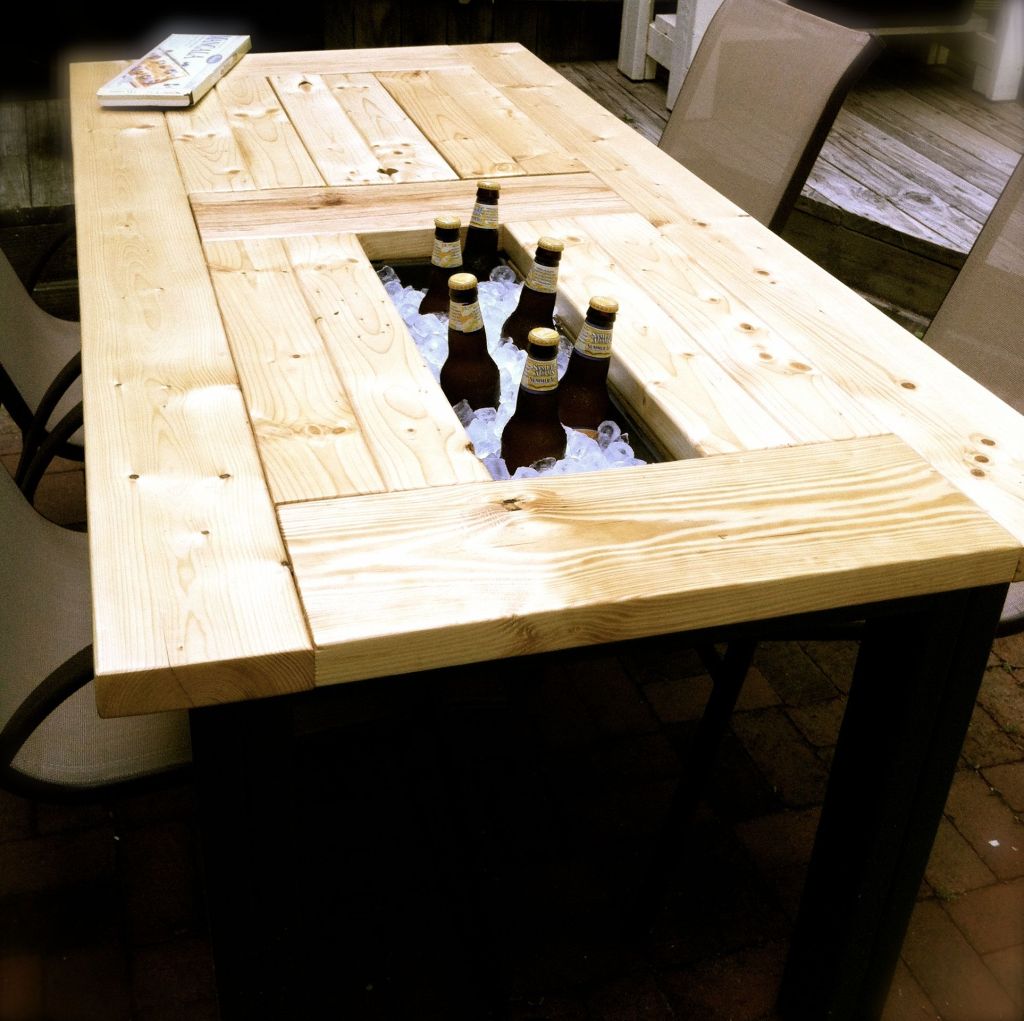
What better container is there than a table that ices your beer? None, that’s what. My husband found plans for this awesomeness over on Ana White’s site and he put it together in a couple of weekends. It makes me happy.

What better container is there than a table that ices your beer? None, that’s what. My husband found plans for this awesomeness over on Ana White’s site and he put it together in a couple of weekends. It makes me happy.
My husband lowered a glass bowl from the top of the refrigerator, peeled back an edge of plastic wrap, and peered in. “Does this look dried out to you?” he asked.
I looked into the bowl he held in the palm of his hand and saw a tan spongy mass. A dry crust was forming around the edges, but in the middle it was moist and bubbling. My nose got too close to the opening in the plastic wrap and I flapped my hand in front of my face. “Hoooo, it’s fermenty,” I said. He pulled it back to his face and inspected it again; he furrowed his eyebrows as he studied it.
A friend recently called me a food Nazi. She meant it in the nicest way possible, as in, “I wish I were more of a food Nazi like Andrea.” I had no idea what she was talking about. I thought she meant towards our kids, but unless I am totally off base, I feel like we are pretty relaxed with our kids’ food choices. We eat pie for breakfast, enjoy treats after lunch and dinner, eat lots of pizza, mac and cheese, and hamburgers, and the kids almost always have a supply of candy on hand. You know, normal stuff. So when my friend said that about me being a food Nazi, I was confused.
“No, I mean the way you make all your own foods,” she said. Ahh, yes. We do make our own pizza and mac and cheese and hamburger patties. “I wish I made our own Nutella and hummus and hamburger buns like you do,” she said.
“Oh,” I said. “We don’t do that because we have some set of strict rules or anything.” And we don’t. My God, if good pre-made food was available for the buying, and we had the money to buy it, I’d totally buy all the stuff we currently make. Making our own food is time-consuming and, frankly, annoying. You’ve got to start with raw ingredients, prep them, cook them, assemble them, and then clean up afterwards. I would love to eliminate all that work and buy food already made. But the fact of the matter is this: I am a food snob.
I like good food, as does my husband. Good food is one of our favorite things. He and I go out once a year for a dinner date, just the two of us, and those dates are some of my fondest life memories. I remember the velvet of bouillabaisse on my palate, the crisp tang of Hendrick’s gin and blue-cheese stuffed olives, the melt of fresh fish on my tongue. We only dine this way once a year, usually for our anniversary, because we splurge big time when we do: as far as I’m concerned, the only way to get really good food, as good as we want it, is to pay the big bucks for it.
Unless we’re going ultra cheap (fast food) and therefore have no expectations, convenience foods at the grocery store or dinner out in a casual restaurant almost always leave us disappointed. We might spend a decent chunk of change on a family dinner – enough to buy a new shirt, say, or replace that ghastly light fixture – and it’s not as good as what we can make at home for a fraction of the cost: pies, pasta, cakes, Tom Collins; hamburger buns, Nutella, salsa, Gin Slings.
If you’re a food snob on a tight budget, consuming fine things means making them for yourself. It means buying dried beans, soaking them, cooking them, cooling them, processing them, washing the Cuisinart by hand. It means squeezing lemons, soaking cherries, simmering simple syrup. It means weighing flour, kneading dough, shaping buns, brushing butter. It means washing tons of dishes.
In other words, it means work. Lots of work. Lots of work that I don’t always want to do. I used to think I loved the kitchen, I used to think I loved preparing foods, I used to think I loved cooking. But when my friend said that about me being a food Nazi I realized it’s not the cooking I enjoy, it’s the eating; cooking is a means to an end. We cook from scratch not because of a health agenda or an environmental agenda but because home made food is good food we can afford, because we can cater to our own palates, because our taste buds are beasts who demand flavor and complexity, heartiness and wholesomeness, real food that is food, not “food” that is chemicals.
Which is why I can’t stop adoring my husband for his latest culinary exploration. When he lowers his glass bowl to inspect and prod, poke and punch, it makes me want to skip around him like a butterfly in our kitchen.
“I’m not sure if this is doing what it’s supposed to do,” my husband said. He pulled The Bread Baker’s Apprentice off the shelf and paged through to the sourdough starter.
I used to make bread for us, but then gluten went out of vogue, and bread’s calorie count is outrageous, and bread-baking is time consuming, and a million other reasons. But the thing is, bread is one of the most beautiful foods there is. It is golden, wholesome, can be savory or sweet, can be eaten as breakfast, lunch, dinner, or snack, a side dish or a main dish, toasted or soft, buttery, drizzled with rosemary olive oil, broiled with cheese, dipped in onion soup, sprinkled with cinnamon and sugar, slathered with jam, smoothed with almond butter and honey, dipped in batter and fried with cinnamon. Bread can be all of these things and more, and store-bought bread is not recognizable to our taste buds as the same crust and crumb we pull warm from our oven. Also: bread is our son’s favorite food.
So after a year without homemade bread, my husband has decided to take over the bread baking.
“Is it done? Do you need to do anything else to it?” I asked after he read the sourdough passage.
He pulled the gooey mass out of the first bowl and placed it in a new bowl. The lump was the size of a sea biscuit. He added flour, kneaded the dough, turned it in the bowl, worked it in his hands. “I need to keep feeding it,” he said.
And so he feeds our beasts.

The Bread Baker’s Apprentice: Mastering the Art of Extraordinary Bread by Peter Reinhart: this is the book I recommend if you want to bake your own bread. If you want to explore whole grain breads, Peter Reinhart’s Whole Grain Breads: New Techniques, Extraordinary Flavor is also excellent.
“Mom, are you taking me to soccer?” Our ten year old son stood in front of my reading chair. He was already dressed for his futsal game, shin guards and all.
I checked my watch. “Uh, yeah.” Fifteen minutes until we needed to leave. “Let me take a quick shower.”
I knew I was pushing it. Fifteen minutes to shower and dress would be crazy fast for me, especially in winter. I usually take 30, and that’s without makeup or blow drying my hair. I ran up the stairs, pep-talking myself. OK. No messing around. No getting lost in the shower. Gotta get to the game. I HAVE to move quickly, I HAVE to get in and get out.
I cranked the faucet to scald, stripped, and jumped in. Focus, Andrea. Wash hair. Wash face. Doing good.
Warm water streamed down my back. My skin turned pink from the heat, just the way I like it. I opened my eyes and watched steam fill the bathroom. Condensation dampened the back of the porcelain toilet, moistened the cardboard tissue box, crept over the mirror ’til I could have drawn a smiley face on the fogged silver glass.
I squirted conditioner on my hand and ran the smooth cream through my hair. I scrubbed my skin with a sudsy washcloth. I closed my eyes and listened. Clack clack, clackity clack as water spattered the plastic tub at my feet. I turned and faced the spray to massage my eyelids. The fan hummed, straining to exhaust the room of its fog, failing as I cranked the water hotter. So warm… The water tenderized my throat. I could stay here forever, especially if I didn’t have to stand up the whole time. Maybe I should take a bath. I could light some candles, relax with a book. I’ll have to wait a little while, though – I’ve probably almost drained the water heater.
I turned and reached for the conditioner bottle. I smiled to myself and thought about fairy forests, the ones you read about in books, where the hero enters the enchanted forest and time distorts. He dances and drinks and makes merry and could get lost in there forever, unaware anymore of the existence of an outside world, of the passing of time. Everything in the forest is the Now. The shower often feels like that to me.
I tipped my head back in the stream and then squeezed extra water from my hair before applying conditioner. My hair felt silky, slick. Wait. Did I already use the conditioner? I looked at the washcloth on its hook. It was wet, not dry. Did I already wash?
Oh shit! The soccer game!
I slammed the water off, ripped open the curtain, clawed through the fog for a towel, and swished it all over me while I ran, dripping, to the closet. Jeans, shirt, belt. Ran to the clock. What time is it? Two minutes. Two minutes left! I pulled wool socks over damp feet, threw on the clothes, dragged a comb through my hair, and checked the clock. One minute to spare!
I raced halfway down the stairs, then slowed to a walk. Pretended I had everything under control. I leaned over the railing and said, “Okay buddy, are you ready to go?”
I’m feeling festive among the jeweled reds of the season. I don’t want to take too much time away from family to write on Christmas (though they are all occupied with other things – new Wii games, a new Samsung tablet, a pre-feast workout), but the colors of the day are inspiring me. Since I gathered greens in the garden this summer, I’ll complete the holiday palette with a collection of crimsons on Christmas:
Merry Christmas everyone!
Did I miss any holiday reds? Please share your favorites in the comments.
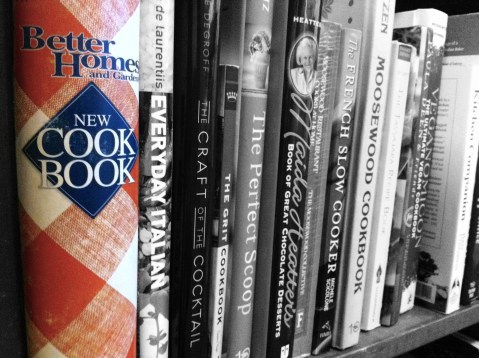
Mom’s red and white checked cookbook was falling apart even when I was a child. Every time she pulled it off the shelf, which was nearly every day, tattered pages would spill out, their binder holes torn, and she’d shove the sheets back in before thumbing to the recipe she wanted. The gingham cover was spattered with brown stains, the once-white checks were now yellowed, and the corners of the book were split and frayed like the corners of a burst couch cushion. She pulled one of my favorite childhood dinners, Chicken Divan, from that cookbook’s pages, along with all of our Christmas confections: fudge, divinity, peanut butter blossoms, and bourbon balls.
When I married, Mom gave me my own copy of that cookbook. The white checks were pristine, like fresh milk, and the red were bright and cheery like cherries. It was one of my first cookbooks, and its gingham cover, like a hopeful picnic cloth, was a happy addition to our kitchen.
Until my mom gave me that cookbook, I didn’t realize how ubiquitous it is. But once I had my own, on my own kitchen shelf, I started noticing it at others’ houses. The shelves of my mother’s generation all held tattered stained copies like Mom’s, pages dog-eared and stuck together, ripped or falling out, while the copies on their daughter’s shelves were fresh, neatly shellacked, and bright red-and-white like mine.
That was fifteen years ago, when my copy was smooth and unblemished, the lone reference in our newlywed kitchen. Now, we have two rows of instructionals, and that red and white checked volume occupies the most accessible spot on the shelves: the top left corner, first of all the cookbooks. The muffin page is spattered with batter, the frosting page is sticky with sugar, and the praline page is building up its own layer of history, including notes on past failures flecked with specks of caramel candy. When my husband craves his mom’s bread stuffing from Thanksgiving, I find it in my book. When I want my mom’s biscuits, I look them up in my book.
It is not the most sophisticated of foodie references. It does not have the name recognition of The Joy of Cooking. But it has the basics, the classics, the food from our childhoods. It is the quiet cookbook that nobody makes a fuss over, but nearly every family owns. And it has that cover, that red and white checked cover, that we all recognize, even if we don’t know the book’s name. That cover that evokes cozy kitchens, and home cooking, and tradition that can be thumbed through the generations, whether on tattered yellow or crisp white pages.
This is my entry for the photo challenge: community, for our community of cookbooks that began with our red and white checked copy of the Better Homes and Gardens New Cook Book.
It is the Sunday after Thanksgiving and everyone is home, in the house, while I write. I’m in the basement at our Ikea secretary, writing 15 minutes on the here and now, in the same spot, every day for 30 days. I hear it may get tedious after a while.
The heater rumbles on. It blows dry air, flaking our skin, chapping our lips. Our son plays his new WiiU behind me. He sits cross-legged on the black futon, staring at the TV screen, a red velveteen throw blanket over his lap.
Morning light shines through the sliding glass door on my left. There are ice chips strewn about the brick patio from the crystal spear the kids found yesterday. They laughed as they threw it down on the red bricks until it shattered into a thousand pieces. The patio furniture my husband made – white Adirondack chairs and a hunter green lemonade table – is covered for winter with a mint green tarp. I swept leaves off the brickwork a couple of weeks ago, and our fenced patio is still relatively leafless. I think the trees have shed the last of their garments.
Inside, at my desk, the heater still blows. I smell lotion and the metallic tang of ball point ink. I hear the soft bloop bleep bloop of Mario Brothers behind me as our son clicks buttons and conquers mushroom worlds. Before I started I told him, “I’m setting a timer for 15 minutes so I can write – I won’t be able to answer questions. If you talk to me while my timer is ticking, I probably won’t respond.” I haven’t written in four days, and I’m twitchy.
“Okay,” he said. “I’ll turn the Wii down so it won’t bother you.”
My composition book, its indigo lines crisp against white paper, is tilted on the honey wood. The lines are the color of my favorite Crayola crayon, midnight blue, which I have not found in any of the dozens of crayon boxes we’ve bought for our daughter over the past six years. I always went straight for that deep, mystic color when I got a new box of crayons. I’m sad they discontinued it.
My phone, encased in a grey and white Otter box, is at the top left corner of my page, acting as my timer. My coffee is next to the phone, getting cold in its too big black mug that lets heat escape in ways my perfect green mug did not. At the top right of my book, the corner pointing away from me, is the once white keyboard of our computer. In this slanting light, which seems to shine pointedly on the contours of grime on the space bar, I can see how badly our keyboard needs cleaning. The 0 on the number pad, the 5, and the 9, all look grungy enough that I feel dirty just looking at them. I might need to wear gloves before I touch them again.
It is late morning on the Monday after Thanksgiving and the house is quiet. Our kids are at school, my husband is at work. The dryer squeaks and rattles, turning over wet clothes. The washing machine fills with water – sqrsshhh, dribble, sqrsshhhh – then rumbles as the tub spins back and forth, water sloshing, agitator agitating.
The light outside is muted. Out the sliding glass door on my left I see a flat overcast sky through the bare limbs of trees. The few paper leaves remaining on branches are still. There is no breeze.
My head feels cool – my hair is still damp from the shower. I have too much to do today. I did not have time to dry it. The wet clumps smell like shampoo – Brilliant Brunette – spicy and clean.
On the walnut filing cabinet to the left of my desk are a stack of notebooks: my journal from France, sepia colored with an antiqued photo of the Eiffel tower; the plastic-covered library copy of Two Old Women, the index card that doubled as a bookmark and favorite quote notepad sticking out from between pages; and my yellow composition book titled “Andrea Reads America.” This is my to-do pile for the day. I must write a synopsis of Two Old Women before it all leaves my head.
On my computer screen are photographs from the streets of Seoul from Cheri Lucas Rowlands’ blog, Writing Through the Fog. A sign outside a Seoul shop says “Free Robot.” My desk is messy – a receipt from Food Lion is stacked on top of the checkbook, reminding me to enter transactions into our budget software; the house phone is tossed on top of them, reminding me to call the property manager in Florida. My yellow notepad reminds me to write my to-do list, and the mouse sits on top of a white business envelope with “Nana and Papa” written in tiny ten-year-old-hand, reminding me to address and stamp our son’s Christmas wish list for his grandparents.
Our desk is the color of honey, with ribbons of dark amber and pitted gouges of blonde. The surface is scratched and has a dribble of wax on it, and the place the mouse rolls over looks speckled and gummy. I run my fingers over the dirty spots that look raised in the slanting light, but the wood is smooth. It does not feel tacky. There are no bumps. The hinges that lift the desk portion of the secretary are dark bronze, a gold black, and are shaped like anime butterflies with semicircle wings.
The keyboard is still grimy.
Six-oh-nine AM. The coffee maker clicks and bubbles behind me. Fluid trickles and steams into a glass carafe. The blinds are closed over the sliding glass door on my left. Vertical slats of fake-brocade cloth in a café au lait color. Only not as rich as the real thing. More of a dull, blah, rental color. It is black on the other side of those blinds. The sun has not yet risen.
My notebook is in shadow. I see my hand’s dark shade move across the page. I’ve turned on the overhead light today, the one attached to the ceiling fan, and it shines behind me. My body blocks the light, throwing the page in front of me into darkness. Our desk faces the wall. Another light – a college-type paper lantern that I think hung in the kids’ room in Tampa when they were babies – hangs from the ceiling on my right. It throws another set of shadows to the left of my moving hand.
The navy cushion underneath me is compressed and hard. It covers the seat of our wooden chair, but it removes little of the discomfort from the unyielding pine board. I’d love a real office chair, with contours and a seat that gives and swivels, and feet that roll.
To my right is a dark waist-high bookshelf. A tiny green statue of Buddha holding an umbrella sits on top, along with a black framed photograph of neon Spartina grass that our friend Dorothy gave us. The green is striking against the black mat and frame. She signed it in white ink: “1/100 Marsh Grass.” She gave us the first print because a story I wrote inspired her.
Also on the shelf are the folded red velveteen throw blanket and a coil pottery bowl I made in high school. The bowl is glazed in red and purple, and it is filled with stones we collected from beaches in Maine. The cobbles are smooth, worn by waves that clanked them against cliffs off the frigid northeast coast.
Here I am again at the desk. Day four. Twenty-six more to go. The shadows are the same as yesterday – it is early and dark, and the light behind me throws my paper into obscurity. My desk is a mess. To-do lists on yellow-lined paper lay scattered, and pens, pencils and scissor handles needle out of a glittery blue cup like sharps shoved into a pin cushion. A binder clip is wrapped in my phone’s white USB cord. My notebook lays open on top of it. Today is cleaning day. I will need to straighten this up to dust.
It is warmer this morning. I’m wearing sweats, and I may need to pull my hair into a pony tail to keep from overheating. The coffee maker just sighed its completion, and the basement room is rich with its dark aroma. When my timer dings I will pour a cup over the teaspoon of sugar and two tablespoons of half and half I measured into the bottom of my earthenware mug.
The blinds are closed next to me. I don’t like having them closed. It makes me feel penned in. But when it’s dark out I don’t liking sitting next to a huge plate of glass with blackness on the other side. A blackness I can’t see into, but anyone out there could see me, hunched over my notebook, illuminated by the blaze of my writing lights.
I can still see the grimy buildup on the keys. I really need to clean that.
As part of my writing group practice I am spending 15 minutes a day for 30 days describing the same space. This practice fits perfectly with this week’s writing challenge: to create snapshots in words instead of with a camera. Transcribing from my journal was a fascinating practice in seeing what I focus on with my descriptive writing, and where there are gaps. There is a lot of room here for senses besides sight.