I wouldn’t say I care that much about domain names (website addresses), but I’m pretty excited about this one. I have a .blog!
My address is now andreabadgley.blog. Squeee! It’s so much more fun than a .com.
I wouldn’t say I care that much about domain names (website addresses), but I’m pretty excited about this one. I have a .blog!
My address is now andreabadgley.blog. Squeee! It’s so much more fun than a .com.
People in general, and knowledge workers in particular, grow according to the demands they place on themselves… If they demand little of themselves, they will remain stunted. If they demand a good deal of themselves, they will grow to giant stature.
— Peter Drucker, The Effective Executive
I’m spending the morning under a blanket, transcribing underlined passages from professional development books into a notebook I can carry with me in my laptop bag. As our daughter challenges herself to baking a new type of cake, and piping a new type of frosting, this quote from The Effective Executive resonated with me.
This week’s SupportDriven writing challenge focuses on tools, and specifically on the tools we use for time and task management. When I moved into a leadership role this summer, my day-to-day work changed significantly, and in any given week I’m trying 2 or 3 different tools to find an effective combination that helps me get the right work done on the deadlines I’ve committed to.
This past month, I think I finally found it. The combination includes prioritization (3 priorities per day), a personal private website using the WordPress P2 theme, and a calendar. I also use several supplemental apps to make super quicks notes that remind me to add things to my TODO lists.
If you have more than three priorities, then you don’t have any.
— Jim Collins, Good to Great
Tools
Prior to about four weeks ago, my daily task lists were long and overwhelming. Each day I’d log in and be faced with an endlist to-do list and I would waste time just trying to figure out, “Where do I begin?” Then, in an internal workshop on doing all the right things, my colleague Brie mentioned that she names 3 priorities to guide her days and weeks.
That idea resonated with me, so I experimented with different ways of implementing it. I respond well to checklists, so I started with various checklist apps including idonethis, any.do, and Wunderlist. I liked aspects of each of them: idonethis has fantastic Alfred integration, any.do is a lightweight and lightning-fast way to remind myself of to-dos from my phone, and Wunderlist allows me to drag to-dos into place in a list so that I can prioritize.
But I really wanted to consolidate my to-dos with my personal mission, my goals, and a list of deadlines so that I could plan for the due dates rather than have them sneak up on me. I also have several recurring items, and I wanted an easy way to copy those recurring checklists and then add items to them depending on the tasks on deck for the week.

Ultimately, after my colleague Amy mentioned she uses a personal P2 as a task manager, I landed on setting up a free, private WordPress.com site using the P2 theme. The site includes all of the components I need to keep me focused on the work I need to do to be effective in my role, with checklists, priorities, goals, and deadlines all in one place. I set up an example site at examplebadgleyp2.wordpress.com if you’d like to see a template for what it looks like in practice.
I still use any.do for when I’m on the go and remember, “Oh, I need to add that to my to-do list,” and I use Trello to track progress on my personal goals.
Tools:
Once I’ve got my priorities for the following week outlined, I add them to my Google Calendar to tell me when to do what. I plug in all one-to-one meetings, team hangouts, town halls, workshops, and other scheduled events. Next I add my lunch hour to make sure I don’t skip food, then I then go through the daily priorities from my P2 and plug priorities into open slots on the calendar.
Any remaining open slots after meetings, lunch, and priorities will remain open. When those times arrive in the week, I fill them with other to-dos and with the million unexpected, unplanned-for things that happen throughout each day that need to be responded to.
At a higher time-management level, I front-load my week with tasks so that I can save Fridays for planning, thinking, and learning. I also tried hard to make at least one day of the week meeting-free so that I could use that day as a flex day when I work on the weekend. As a lead with 8 or 9 one-to-one check-ins per week and two standing hangouts (our team call and a leads call), I was not able to accomplish a totally meeting-free day, but did minimize on a couple of days so that I don’t miss too much if I flex on those days.
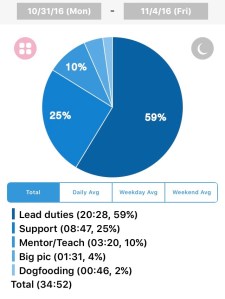
I use the ATracker app on my phone to track my time so that I can look back each week and see where I spent my time. I aim for balance among leading, direct support, big picture planning, teaching, learning, and dogfooding (using our products). If I spent too much or not enough time on certain areas one week, I know to keep an eye on myself the following week to avoid making the same mistake again. Last week I had a pretty good balance; I didn’t focus on learning, but I did do a good job of abstaining from work on my flex day:
Tools
As you can imagine, working with colleagues all over the globe in different time zones — all from their own homes or co-working spaces, who are sleeping when you’re awake and awake when you’re sleeping, who you don’t see in the office every day and don’t have coffee or lunch or beers with, whose laugh you can’t hear or frown you can’t see — requires some creativity when it comest to communicating. At Automattic, we have a mantra: communication is oxygen.
As a result, we communicate a lot. On Slack, which is where we “talk” to each other all day via text, emoji, and GIFs, I’ve sent 114,330 messages since I started my Happiness Engineer trial in July 2014. On P2, I’ve published 822 posts, 2,434 comments, and 287,928 words.
I share these stats because what I love about using text to communicate is that it’s archived and searchable by anyone in the company. Verbal conversations are ephemeral, are subject to memory lapses, and are not searchable by others. With P2 we are able to find where things have been discussed and see, in writing, workarounds, steps, discussions, and decisions, and we can contribute to those conversations whether they were started four minutes or four years ago.
The tools on this list can be used by anyone, not just folks in a distributed workplace, and I encourage you to click through and play!
This is my entry for the Week 2 SupportDriven writing challenge: “Tools: What tools do you use to manage your tasks and time? (can be personal or professional, electronic or non-tech).”
Growing up, I did well in math and science — areas I was told repeatedly I was special to do well in. I felt a sense of rarity, and thought, “If I’m good in these, when others struggle, then this is where I should direct my life.”
By the time I arrived in college, it did not occur to me to study anything other than science. I loved nature, was heartsick about habitat destruction and the seeming disregard and disrespect humans had for our own habitat, and I wanted to pursue a path that would apply my science aptitude to helping the environment.
Many times, the first step to helping is understanding. You must know how a system works, what it needs, and how its needs are not being met in order to help make the system healthy again. So I pursued a degree in ecology, the study of the interactions among living things and their environment.
When I graduated, my first job was out in the woods, as a research assistant on a soils project for the Smithsonian Environmental Research Center. Mostly I just carried 50 lb carboys of water, and I did a little bit of microbial DNA extraction from the soil. I liked being in the forest, but I didn’t find the work rewarding. I didn’t feel like I was doing anything.
From there, I moved to an entomology lab at the University of Maryland in College Park where I crushed Colorado Potato Beetles and extracted their DNA for population genetics research. The more interesting part of my job was that as a research assistant, I fell into the role of mentoring and training undergraduate students, then graduate students, then visiting scientists who wanted to learn the research methods we used in the laboratory. After a year or two, I became the lab manager, shepherding folks through the lab, guiding lab meetings, helping anyone in the lab with any questions they had, and helping them succeed at whatever they were working on.
During that time, I also became an avid cyclist. I participated in the Washington D.C. AIDS Ride, a 3.5-day fundraising ride of 350 miles from North Carolina to D.C. After my first time, I knew how scary it was to be a newbie in the event. It is a huge challenge, and in the months leading up to the event in subsequent years, I volunteered to lead training rides in the D.C. metro area, helping other riders like me get together and support each other in this crazy scary thing we were doing.
Those training rides led me to my next job: Campaign Coordinator for The Leukemia & Lymphoma Society’s Team In Training program. I recruited volunteers to raise money and train for athletic endurance events, I recruited mentors to guide them, I recruited coaches to coach them, and I supported the athletes, mentors, and coaches — all volunteers — in performing the amazing feats they had taken on. Now this, this was my kind of work! My entire job was dedicated to helping people: helping coaches coach, mentors mentor, and volunteer athletes raise money and train so that they could help Leukemia & Lymphoma patients.
Do you see a pattern here? Help the environment. Help people in the lab. Help AIDS Ride cyclists. Help volunteers. Help cancer patients.
I did not yet see this pattern in my life, but as I reflect on the evolution of my career, it seems so obvious: I am a Helper.
When I moved out of the workplace to raise our children, I ran an Etsy business for a few years. For that business, I started a blog. It wasn’t long after I started blogging that I became aware my lifelong love for words. I had always loved reading — my favorite courses in college had been literature courses, and I read every night before bed — but I didn’t realize how much I enjoyed writing.
I soon realized I loved blogging way more than I loved making soap for my business, and I closed my Etsy shop. I got a part-time job at Barnes & Noble doing — guess what? Helping people.
Meanwhile, I started a new blog. This blog. After running my own website previously for my soap business, which I found to be a hassle, I was enamored with how easy it was to just pick a theme and publish on WordPress.com. I adored the Reader where I could follow and find other bloggers. I followed The Daily Post for writing challenges and blogging tips. Soon after I began blogging, the WordPress.com editorial team selected one of my blog posts as an editorial pick.
I became a WordPress.com groupie devotee and a blogging evangelist, especially as rejections for writing submissions piled up on my desk. I wanted to spread the amazing feeling of expressing yourself without having to be approved by the gatekeepers of traditional publishing. I wanted to help everyone who wants to write write. I wanted to help everyone who wants to blog publish.
When helping someone, the first step to helping is understanding. You must know how they work, what they need, and how their needs are not being met in order to help them accomplish what they’d like to do. As a WordPress.com power user, I knew the needs of writers, I knew the system of traditional publishing they were working in, I knew the struggles bloggers faced when they just want to write, when they just want to publish.
So I applied for a job as a Happiness Engineer at Automattic, the makers of WordPress.com. And now, I’m helping writers write, I’m helping bloggers blog. I’m helping democratize publishing. I am tapping into my greatest strength, which is not science or math.
My greatest strength is that I am a Helper. And I’m thrilled that my weird, nature-loving, literature-loving, non-tech, totally unplanned path led me to the career I belong in: Support.
I lead a live chat and email support team at Automattic, and this is my entry for the Week 1 SupportDriven writing challenge: “History: Our history shapes us — what path led you to Support? Was it a planned career? Or did you happen upon it?”
I read fiction this morning. On a Tuesday, on the couch, at 7am, with my smoothie.
I never read fiction in the morning. I read it on the weekends after my chores are done. I read it at night after my day’s work is done. Fiction is a reward: it is my treat for working hard. It is my delayal of gratification.
Usually on a weekday morning with my smoothie, I sit on the couch not with a novel but with my phone, scrolling through communications at work that took place after I signed off the day before, catching up on P2s (internal blog posts), and going through my calendar and to-do list for the day. Then I switch to coffee and start writing for work, whether replying to backscroll on Slack, responding to P2s, or simply saying good morning and hanging out (via text) at the water cooler.
Today with my coffee I’m writing for my own blog. Like reading fiction, blogging is a reward to me. I love days off so I can write for me or for Butterfly Mind, even if only for a few minutes.
So why all these rewards on a Tuesday? I’m working this Saturday and I’m taking a flex day today. While it’s often tricky to work a weekend day, what with soccer games and swim meets and transporting kids and having kid friends over and doing generally anything with the family since weekends are the only occasion we all four have time off together, I love working a weekend day when I can. Weekend work is often quieter and more focused because there are fewer folks online working, but also, weekend work means a flex day during the week.
And I love days off during the week.
I ran by the grocery store after dropping my husband off at work this morning and it was quiet and empty. Going to the grocery store when everyone else is at work is pretty high on the list of why random weekdays off are awesome.
When I take a weekday off, the house is also quiet and empty. The kids don’t need to be driven anywhere, and I can take care of things we are often too busy even on the weekends to get to. I have a stack of doctor bills and FSA paperwork to go through today, which I’m dreading, but at least I’ll have a quiet space to do it in. I’ll also be able to take care of this lawn that’s out of control after Saturday’s rain.
Maybe I’ll even go for a walk outside instead of on my tread desk, and listen to Annie Proulx read on the New Yorker Fiction Podcast.
And during the day, despite whether it’s morning or night, or whether I’ve finished all of my flex day to-dos, I’ll take breaks to write in my journal and read fiction, simply because I can.
If you like the sound of this kind of flexibility in your work, why not join us? We’re hiring.
On my recent trip to Whistler, British Columbia, I attempted to pack minimally. I reduced shoes to 4 pairs — boots, Vans, flip flops, and running shoes — and I left my camera at home.
That last was a big mistake. (As were the running shoes, but we don’t need to talk about that).
I ultimately ended up not going outside very much while in one of the most beautiful places I’ve ever visited. Instead of taking time off to go enjoy the gorgeous mountains and Pacific rain forest, I worked. I know, dumb, right? Now that I see everyone else’s photographs from their hikes, gondola rides, and ziplining, all I can think is, What was I thinking?!
I did go for a brief walk alone on a quest for some fresh air and quiet time, and I was awed by the lushness of the Pacific Northwest. It is beautiful there. I am promising myself now that when we go back next year, I will take my camera as incentive to get myself outside to enjoy it. For now, here are some shots from my phone.


 Butterfly Mind