It’s funny, the word rocks is much harsher to me than the word stones. I don’t know why I seeded my prompt box with rocks when I prefer stones. Rocks are jagged and rough, while stones are smooth and round. Is that true or is that just the way I see them?
When I think of rocks I see dsuty gravel, grey granite shards with glints of quartz or mica, the rocks themselves planed and angular, bumpy with unclean breaks. Triangles protrude from a pile looking jagged and dangerous. Unwelcoming.
Jetties are rocks. Rocks are young. They haven’t been exposed long enough to be worn smooth by weather or water.
Stones, though. Stones are smooth and rounded. Domes of shiny grey on a Maine beach. They are welcoming. They fit in the palm of your hand and are comforting in their age and smoothness. They are old. They have clinked together on the shore for thousands of years. Each time a wave washes over them, then sucks back out to sea, they chink together as they roll with the surf, rubbing bits of each other off, grain by grain, until there are no rough edges left. Despite their hardness, despite their heaviness, they are soft to the touch — soft on the surface like fabric, like velvet or suede when you rub your thumb across their faces. Except they aren’t really soft. They are hard. Sturdy and grounding.
We have stones from Maine scattered around our house. Our daughter uses one as a doorstop. Others lay atop a book shelf in the basement. They comfort me. Pieces of earth. Unglamorous. They aren’t gemstones. They aren’t crystals. They are basic granite stones that have been worn smooth by the passage of time. By existence. Yet in their age and smoothness they are still solid. Still strong.
Chicken and waffles. Golden, salty, and sweet. It sounds delicious, but I have to admit: I’ve never eaten it. I’m not sure if it has always been a popular Southern dish or if it has just recently become trendy, but I hear about chicken and waffles more these days than I ever did growing up in Georgia. Mmmm, now I want chicken and waffles. Crispy fried chicken, juicy and salty, and a thin-crusted cakey waffle with salty butter and sweet syrup. Now I’m hungry.
I wasn’t a fan of a lot of traditional Southern foods. I don’t care about barbeque, I didn’t like Brunswick stew. I never liked sweet tea until I was an adult, and even now I never drink it. I don’t cook my greens in lard or bacon fat, I don’t go crazy for all the insanely fatty dishes that bury the flavor of the foundational vegetable.
The Southern foods I do love, though, are biscuits – flaky and bronzed. The biscuit I had at the donut shop in New Orleans was one of the best foods I have ever put in my mouth. I had caramelized bacon and a fried egg on it, and between the savory sweet crispness of the bacon, and the soft heartiness of the egg, and the buttery crisp-on-the-outside, melt-on-the-inside biscuit, it was groan-inducing. The biscuit was even better than the donut I got, which was praline pecan and would have been remarkable if not for the biscuit.
So I love biscuits. And I love grits. Though I only love grits when they are well-made: thick and rich and creamy, salty, and with a smooth cheese, and then, best of all, dotted with shrimp and maybe a couple of fresh tomato slices. And salt. Did I mention the salt? My God. Yum.
And finally, pecan pie. That’s a Southern dish I will always claim, rich and sweet and bourbon brown, with succulent toasted pecans on top, and the flaky crust that cuts the sweetness, and just a touch of salt, because salt with sweet is the only way to go.
For the month of April, I will be publishing a 10-minute free write each day, initiated by a prompt from my prompt box. Minimal editing. No story. Just thoughts spilling onto the page. Thank you to LRose for the prompt “Cotton swabs.”
I loved the Little House on the Prairie books when I was growing up. I don’t know what the draw to them was, but it was strong. The family unit was intimate, and life was hard but wholesome, simple, and earthy. I loved how real everything was, and how memorable: a piece of candy on Christmas was spectacularly special: it came only once a year and there was no sense of, “Whaaaat? Only an orange and a peppermint stick in my stocking?” Kids in my life get those things every day.
But also there was the prairie in those books. Like Lonesome Dovelater, and O Pioneers!, and any other novel filled with sweeping vistas of golden wheat, or sweet heather, warm and grass-smelling in the sun, the prairie was a place I always fantasized about and romanticized. It represents the wild frontier, the families rough and raw and strong, who planted themselves on land that went on forever without trees or wind break, just flat open land covered in a sea of grass, grassland as far as you can see, and they planted themselves in it and wintered in the bitter cold of winters in sod houses or hand-built log cabins that wind and snow whistled through the cracks of. Winters that I could barely stand in a modern house with solid, double, insulated walls, and plastic-sealed windows.
There were grasshoppers in Little House — a plague of them — and glass windows were an extravagance. There were sod floors and people lived close to the earth, working the land, appreciating every small thing it provided. And they made their own clothes and pies and furniture, and Pa played the fiddle, and they read the Bible.
So when we moved to Minnesota, I wanted to visit the prairie. It was a mythical place to me, wholly unlike the coastal seascape of my childhood. And it was everything I imagined it to be, only better because I could smell it. It smelled of warm grass and wind, of sunshine and dirt, and of ozone as we watched the lightning storm and its black bulk crawl over the vast grassland toward our campsite.
For the month of April, I will be publishing a 10-minute free write each day, initiated by a prompt from my prompt box. Minimal editing. No story. Just thoughts spilling onto the page. Trying to get back into the writing habit.
I was asked in a recent job interview, “What’s a major decision you would like another go on?”
I answered that I wouldn’t change anything. Every choice I’ve made in my life has led me to the point I’m at now. And I like my life now.
“But,” I went on, “If I HAD to choose, I would have studied literature instead of ecology.”
This is a regret I’ve had for a long time, that I missed my chance to dedicate massive amounts of time to consuming and discussing books with smart people who cared.
At 20 I was not self-aware. I didn’t know myself well enough in my college years to study the thing I love most. Reading was like eating to me — it was not optional — and so I was oblivious to the fact that literature was a passion and not a basic necessity.
But, as I said in my interview, my life would have taken a different turn had I chosen the literary path. I would not be married to my husband. I would not have my children. I would not have the dream job I now have.
Thankfully, to stand in for those classes I did not take, there is the New Yorker: Fiction podcast. Hosted by New Yorker fiction editor Deborah Treisman, this podcast highlights the best of the best of the short story. Each month an esteemed writer chooses a story from the archives of The New Yorker, reads it aloud, and then discusses it with editor Deborah Triesman. The discussions help sate the cravings of my literature-degree daydream: Triesman and the reading-writer contemplate what makes it a good story, they examine craftsmanship, they attempt to tease out meaning, and –- most importantly for writers -– their dialogues provide insight into the mind and inclinations of a high-quality fiction editor.
I’ve been binging on New Yorkerpodcast stories lately, re-listening to ones that struck me hard the first time around, and want to share my favorite six with you. I love these not only for the stories themselves, but for the conversations around them as well:
Shirley Jackson’s “The Lottery,” read by A. M. Homes. Aired Nov 12, 2008.
Carson McCullers’s “The Jockey,” read by Karen Russell. Aired Jan 14, 2010.
Raymond Carver’s “Chef’s House,” read by David Means. Aired Oct 15, 2010.
John Cheever’s “The Swimmer,” read by Anne Enright. Aired Feb 17, 2011.
Do you have a thing you daydream about – an ambition, a wish, a thing you’d love to do but you know it will probably never happen? Some people call it a bucket list, I suppose.
I had that thing. I’ve had it since I was about 12, a freckle-faced island girl with a brother who surfed. He listened to the weather radio as he waited for waves, and his room smelled like Sex Wax, and bleached-hair, tanned-skin 16 year-old boys would trample in and out of our house, bare feet on Mexican-tile floors, salty and sandy as they surfed and returned home, surfed and returned home.
If it ever occurred to me that I might learn to surf, I don’t remember it. Surfing resonated with me in some soul-deep way, but surfing was for boys, not for girls. I was intimidated by the scene and didn’t think I had a place in it.
So instead of surfing myself, I sat on the beach and watched. As I grew older, I sat in my convertible Bug and watched. I screened the movie North Shore over and over as a teenage girl, and when I came home from college I sat on the sea wall and watched.
The fascination has always stayed with me, but it wasn’t until I was an adult that I realized I wished I was surfing, not just watching other people surf. Not just watching movies or reading about surfing. By then it was out of my reach, though. Or at least, I always had excuses: there weren’t consistent waves off the nearby Naples shore; the beach was too far in Tampa; we moved to Minnesota; we moved to the mountains.
I think the reality of it was that I was afraid. I knew it would take time to learn, that it would be dicey on the choppy storm waves of the coasts I’ve known. That I would look like an idiot. That I wouldn’t know the etiquette. That I would fight the water instead of flowing with it. That I would fail.
I think I also knew that once I surfed once – once I stood up on a board and rode a wave – I’d want more.
And I was right.
~
Back in September, a week into my new job at Automattic, a colleague mentioned in passing, “Oh, you need to book your flight to Hawaii.”
What?
“Yeah, we’re having a team meetup in Kauai in December.”
Surf swap in Hanalei, Hawaii
Automattic is a distributed company, meaning we don’t work together in a central office but are scattered all over the world. Most of us work from home. As a result, we don’t see each other every day, or even on a weekly or monthly basis. Since Automattic doesn’t incur office space costs, we gather instead at week-long meetups to give ourselves the opportunity to work — and play — together. Generally a meetup consists of two (or more) travel days, four work days, and two days for activities together.
In the activities link, which offered options for horseback riding, tubing, hiking, it was there: surfing. And not only surfing, but surfing lessons. I knew my chance had come. I wouldn’t have to worry about any of my fears because I would have smooth waves, a long board, and instruction. And I wasn’t just going to surf, I was going to surf in Hawaii. My name was the first one on the spreadsheet.
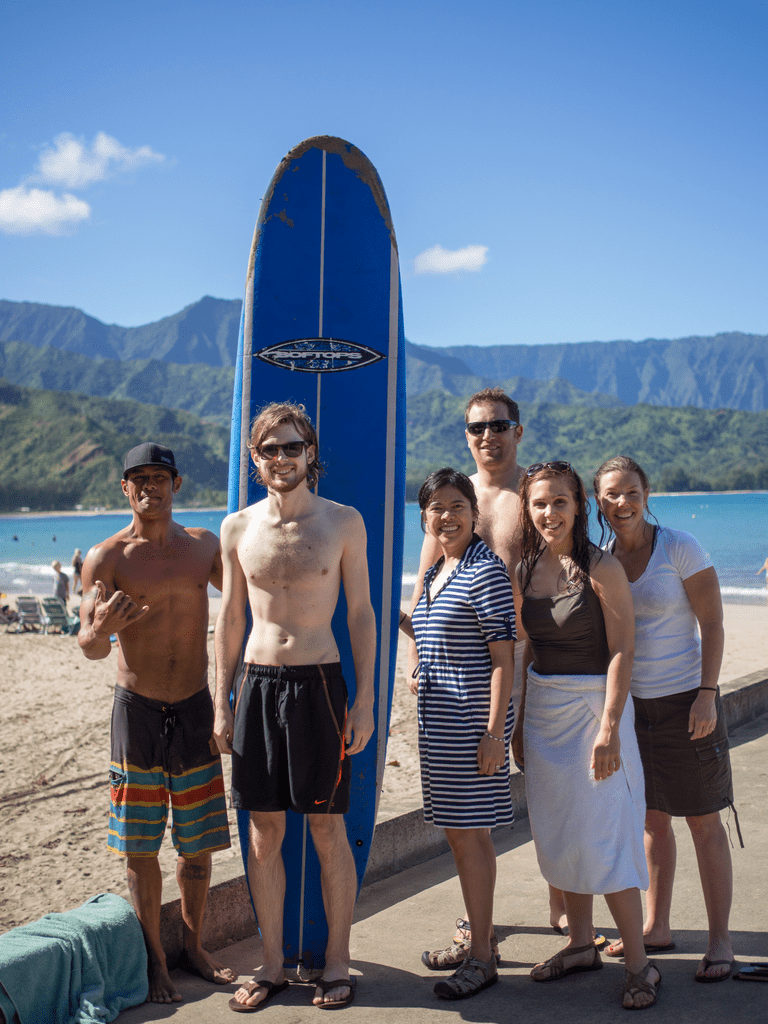
Five of us drove from the south end of Kauai where we were staying to Quicksilver surf shop on the north end, in Hanalei, Hawaii. When we arrived, the shop signed us in, loaned us rashguards, and introduced us to our instructor, Makani, a lean Hawaiian with an easy smile. He said, “I can tell just by looking at you guys that you’re going to be awesome.” He flashed a white grin that made me believe him.
We spent about 10 minutes on dry land, jumping on longboards to check our stance, starting on our bellies to learn how to stand. Our instructor taught us to lay with our feet less than six inches from the board’s tail, to stand with our back foot planted perpendicular to and bisecting the board’s center line, to put weight on our back foot to brake, on our front foot to go faster. After we pushed up onto our knees, then into a kneel, then into a stand two or three times he said, “You guys are pros! Let’s get in the water,” and we drove to the beach.
We surfed in Hanalei Bay, a protected alcove with a curved shoreline, surrounded by lush volcanic mountains, and with perfectly consistent, perfectly dependable, easy, aqua waves.
Makani, whose name means “wind” in Hawaiian, taught us how to tip our longboards over incoming breakers, and once we were out, he instructed us to turn our boards towards the shore and collected the noses at his chest. He watched the sets roll in behind us and would nod at one of us at a time, allow the wave to come up under us, then give us a shove and say, “Stand.”
He didn’t shout, he didn’t stress, he just said, “Stand.” And I stood.
I wiped out on my first wave, but I got enough of a feel of the wave beneath me that I was already hooked. I paddled back to him instantly for another run.
“Lean back when you stand so your nose doesn’t go under,” he said. He watched the swell behind me, turned his shoulder so my board could move past him, gave me a shove and said, “Stand.” I stood and rode the wave all the way to the beach.
I paddled back out to him again. And again. And again. And again. Each time he gave me a more advanced move.
“Paddle four strong strokes. Stand.”
“Don’t kneel this time. Jump straight to your feet when I say stand. Stand.”
“I want you to do a little hop. You’ve got your left foot forward, yeah? Do a quick hop to turn your body 180 degrees so your right foot is forward. Then hop back.” He scanned the swell behind me. “You do that you’ll be surfing in the big leagues. Learn the balance. Keep your center of gravity low. Stand.”
He motioned three of us to paddle over to him at the same time. “I’m going to put you all on this wave together.” We watched the beach as he watched the surf behind us. All three of our boards pointed at him. He shifted his shoulders so he was between two boards. “Stand.”
And we were on a party wave.
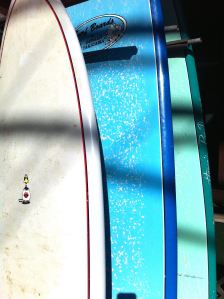
Surfboards in Hanalei, HI
After my 8th or 10th ride, Makani stopped telling me when to stand. I learned the feel of the surge and figured out that I can stand too early and the wave will roll under and give me a ride, but the opposite is not true. If you stand too late you miss out. I practiced the hop on flat water behind the break, when I wasn’t riding a wave but was stable. And again and again I pointed my board at Makani.
I began to worry that maybe I should be trying to catch my own wave. But I wanted more time riding. More time to feel the surge underneath me, to learn balance on liquid, to tap into the energy of the surf. To learn what it feels like to ride a wave so that when I’m on my own, I’ll have those sensations to guide me.
I asked Makani, “Is it okay if I just keep coming to you instead of figuring out how to catch my own wave?”
“Yeah!” he said. “That’s what I’m here for. Now this time, look over your shoulder.”
I looked.
“See that swell coming? When it’s 20 feet away you start paddling. And on this one I want you to do the trick. Do the hop. I know you can do it. Paddle.”
I paddled. I stood. I wiped out.
I paddled out again. I pointed my board at Makani. He watched behind me. “Paddle,” and release.
I paddled. I stood. And somewhere on the ride — I can’t remember if it was as the crest curled beneath me or as I glided into the beach at the end — I did the trick. I hopped. I turned. I hopped and turned back again. And I didn’t wipe out.
We only caught one more wave after that one, and our lessons were over. The tops of my toes and my thighs were shredded from rubbing the board, but I didn’t care. I wanted to keep going. It was perfect. Everything was perfect. I surfed. In Hawaii.
Thank you Store team. Thank you Automattic.
Makani and Automatticians in Hanalei, HI. Photo courtesy of Radford Smith (aka Rads)
In the month of October, I focused a large portion of my extracurricular work time on training new Automatticians and Happiness Engineer trials. We covered tools, tickets, tone – and in every session, a trainee taught me something new.
This is a reason I love to teach. The joy of a student’s discovery is always contagious, and that delights me, but I also love teaching because I learn. Trainees’ questions show me gaps in my approach, our tools, our assumptions, my own knowledge; their strategies show me new thought processes and workflows; their knowledge enlightens me in areas I previously lacked insight.
The student becomes the teacher.
For the month of November I am super excited about another opportunity for this exchange of knowledge: starting Monday November 3, I will be providing support for the Blogging 101: Zero to Hero course. I am giddy for the opportunity. New and experienced bloggers are going to bring a freshness and impart unique perspectives to each other and to those of us helping out. I can’t wait to see how everyone approaches the daily assignments, and I’m eager to help bloggers navigate their WordPress.com dashboards, find themes, fidget with widgets, and press that beautiful blue Publish button.
I’ve been through almost all of the Blogging U courses, and even after several years of blogging, I learned new tricks from the assignments and the community. Now, as a former student, I will (sort of) be a teacher. That’s kind of awesome.
Whether you are new to blogging or are a seasoned pro, these courses are approachable, fun, flexible, and free – did I mention they are free? I encourage you to take advantage of them if you have any interest in blogging, writing, or photography. And if you do decide to sign up, I’ll be there, ready to support you, and ready to learn from you.
Do you want to be a blogging superhero? Register here for Blogging 101 or the brand new Photography 101. Courses begin November 3, 2014.



 Butterfly Mind