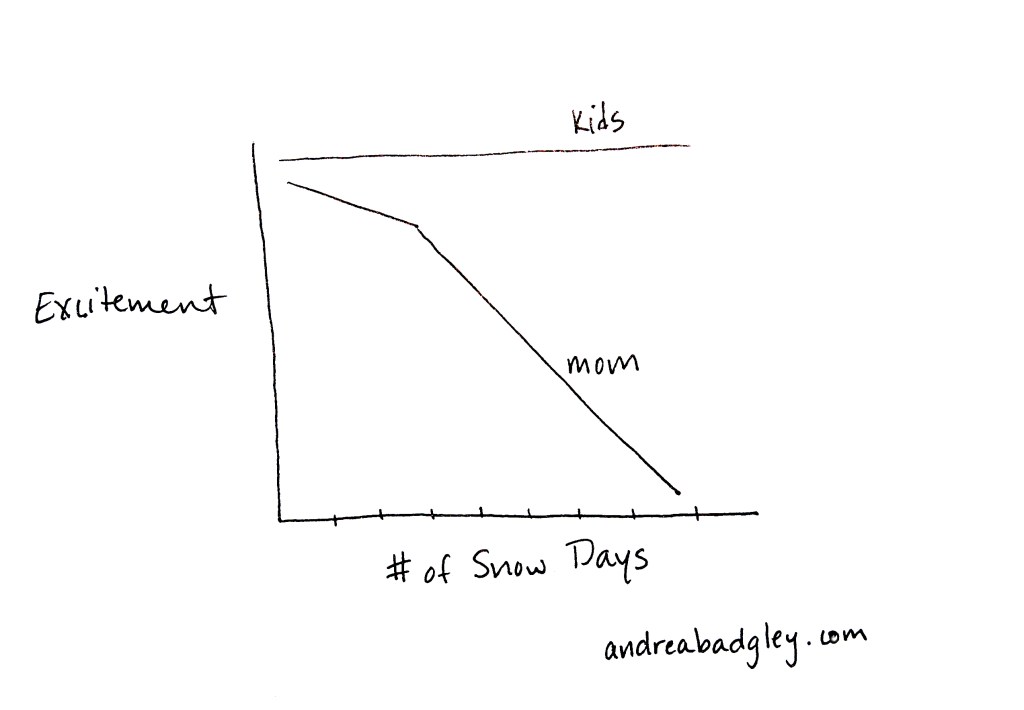
 Today is the fifth consecutive day the kids have been home from school due to snow and bitter cold.
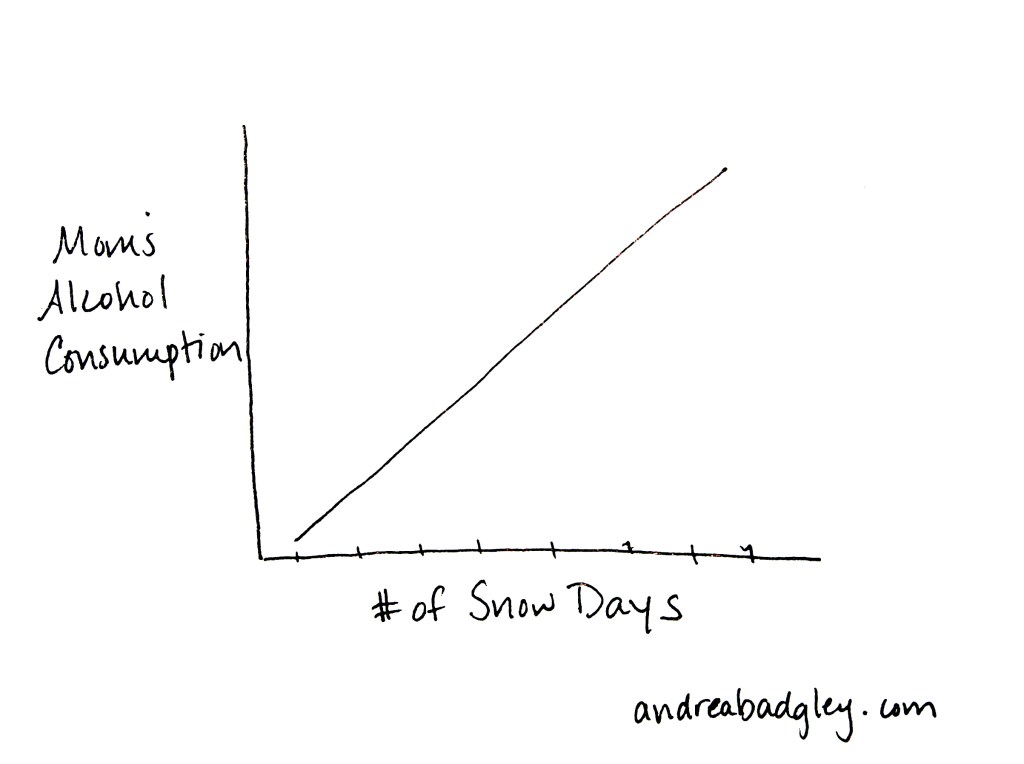 Spring will be here soon, right?
Today is the fifth consecutive day the kids have been home from school due to snow and bitter cold.
Spring will be here soon, right?
Last summer, I had big plans on one of our family camping trips. A friend had told me that as she struggled with raising her teen son, she realized she had never talked to him about values. She demonstrates her values to him through her actions, but a lot of times it’s the things we don’t do that demonstrate a value — not throwing cigarette butts on the ground, not taking frustration out on wait staff — and a decision not to do something is often a silent one; it is not always seen or heard, and so there’s no knowing that a guiding principle motivated non-action.
My friend decided to verbalize her values with her son. To discuss them out loud so he knew there were silent judgment calls going on behind the scenes, and that the choices his mom made were not arbitrary but were motivated by a set of fundamental beliefs. I thought this was a brilliant idea, and I couldn’t wait to talk to our kids about it on our next camping trip.
Sometimes I’m not great at these things.


It was a hot, humid June day and we were at Breaks Interstate Park in the southwest corner of Virginia, where the state butts up against Kentucky. We weren’t impressed with our campground or the park — both were littered with candy wrappers and plastic bottle caps that we griped about and cleaned up — and it was hot enough to wear shorts even at our early morning start. We dripped sweat while we waded through poison ivy our entire 6-hour hike. At some point, we took a wrong turn on the mountain and stirred a nest of sand bees, whose swarm we had to coax our children around to get back on the trail.
We saw all sorts of moisture-loving creatures on the hike, but other than the millipede and fungus highlights, the hike was miserable. It seemed everything was out to get us, and we talked endlessly of poison ivy — how long it takes to start itching, whether the kids will be allergic, can we wash it off, how long do you have before the oils seep into your skin, how much longer is the hike, will there be this much poison ivy the whole way? I wanted off the mountain as much as our kids did: I could handle the poison ivy, the heat, the bees, but I could not handle the incessant questions.


When we got back to the campsite, showered to wash the poison ivy oils away, and were all sitting around in the doldrums of the afternoon — when everyone was too hot and tired to do anything, but was also bored just staring at each other around a not-yet-lit campfire, I thought, aha! Now would be a good time for our talk.
I grabbed my notebook and said, “I know what we can do. I’ve been wanting to talk to y’all about our family values. Do you know what values are?”
My husband is often pained by my cheesy “talks” like this. He tried hard not to roll his eyes. Our 10-year-old son shrugged, and our 8-year-old daughter, ever the pleaser, scrunched her face while she thought, trying to find the answer that would most likely earn her praise. “Things we spend money on?” she finally said.
“Close,” I told her. “Values are the things in our lives that we — value. Things that add depth and richness to our lives. For instance, I value beauty,” I said.
“Me too!” our daughter said.
“I value the beauty in nature and music and literature, and appreciate when people put thought into the aesthetics of a creation, whether a painting or a plate of food.”
I surveyed my family, and while our daughter was eager, my husband and son wondered at the point of this exercise. They are both show-ers, not say-ers.
“So let’s go around the circle and name the things we value,” I said. I looked at our son. He scratched his shin.
“I value pants,” he said.
I rolled my eyes. “Ha. Ha. I’m talking about things that add meaning to our lives. Things we wouldn’t want to live without.”
“I wouldn’t want to live without pants,” my husband said. I sighed.
“Okay,” my son said, and grinned. “Donuts. Donuts add meaning to my life.”
I live in a family of smart asses.
I wrote down donuts on our son’s list, and our daughter said, “Art!”
I scribbled “art.”
“Family,” I said.
“Salt,” said our son.
And on we went, our son finally getting serious about it, as we made our list of values.
Badgley Family Values:
My husband was quiet, and when I ran out of paper without a peep from him, I asked, “What about you?”
He thought a minute. “Pretty much everything everyone else has already mentioned,” he said. “And charity.”
I squeezed “charity” into a small open space on the paper.
“When we get home I’ll post these on the fridge,” I said. “And when we’re bored and can’t think of what to do, or if we need help in making a tough decision, we can check in with this list.” They scratched their ankles.
“Thanks for doing that with me, even if it was painful for you,” I said. I closed my notebook and promptly forgot the whole thing. I never posted the list on the fridge.
Apparently, our children forgot about it too. As I finished writing this post, and wondered how to end it, I asked them, “Do y’all remember that time we talked about values?”
They sat in the living room, their faces blank as they turned their eyes from their books to my face. There were no sparks of recognition. “You know,” I said, “we were camping?”
“Oh yeah,” our son giggled. “I said I valued donuts.” He’s still proud of that response.
“Do you ever think about that talk? Did it have any impact on you?”
Both kids shrugged, “Not really,” and stuck their noses back in books.
As I look back on the year since we had our talk, I realize the kids’ behavior didn’t change after verbalizing our values. The actions they take, and the actions they don’t, have always been consistent: they wear pants, they eat donuts, they are gentle and witty, loving and kind.
As hard as it is for me to believe as a talker, it turns out that some things need not be discussed.
We sat at the dinner table the other night arguing about which one of us is smartest. I don’t remember who started it, but one of us asked, “Who do you think the smartest person in our family is?”
To which we all replied, “I am.” Of course.
Then our 9 year-old daughter said, “Actually, I think Dad’s the smartest.”
“Whaaat?” I said. Traitor.
She had the grace to squirm in her seat. “Why’s Dad the smartest?” I asked.
“Because he’s a scientist and a teacher.”
“So scientists are automatically smarter than everyone else?” I said. Where do we get these ideas? I remember thinking the same thing when I was young.
“Well,” she squirmed some more. “He’s also a teacher,” she said.
“Mom’s a teacher, too,” said our 11 year-old son. My hero. “She teaches people how to WordPress.”
❤
Our daughter teased her older brother. “You need to learn the difference between a noun and a verb.”
I laughed and said, “I think you used that perfectly well, buddy.”
He shrugged and said, “I know how to verb.”
I think I’ve made my choice.
Grandma loved to go to Sunday brunch, and when I was a kid, her favorite brunch spot was Shoney’s. We’d drive over the drawbridge from St. Simons Island to Brunswick, Georgia, and once we had waited in line for a large enough table, all the grown ups would order coffee and tea. My older brother would order the buffet, as would I, though all I ate off it were the French toast or the pancakes.
Grandma, after studying the menu as if she might get something new, would eventually order liver and onions. Every time.
My dad, her son, must have made involuntary gagging faces after a lifetime of hiding liver in napkins, out the window, under the rug, on liver Wednesdays at home, because I finally asked Grandma one time at Shoney’s, “Grandma, do you like liver and onions?”
She flicked her hair, “Of course I do!”
Then she thought a little bit and said, “Well no, not really.”
I knew this. “Then why do you order it every time?”
She looked at me as if even she knew her answer was ridiculous and said, “Because it’s good for you.”
I looked at the congealed brown mass on her plate, smothered in soggy onions, and thought, I doubt that.
Given her utter disregard for her taste buds in honor of her “health,” her reasoning for drinking gin and milk should have come as no surprise to me. But one evening, when she settled into her chartreuse chair, she sat a rocks glass filled with a thin, milky cocktail down on a cork coaster. I had seen her with this strange drink before, and it unsettled me. Milk diluted in any way is offensive, especially to an eight year old, and yet she drank this every night.
Finally, I asked, “Grandma, what is that you’re drinking?”
“Gin and milk,” she said.
Even at my young age, I knew that combination was just wrong. “Why?” I asked.
She looked at her dewy tumbler, the milky liquid even thinner around the ice cubes, and rolled her eyes at the things she did for her health. “Well, I’m on Weight Watchers now.”
I waited for more.
“And on Weight Watchers you have to have a certain amount of milk every day.”
She looked at her sad drink on the end table, polluted with skim milk. She lifted it off the coaster, which had the words “Bottoms Up” printed in thick black ink on it, flicked her bangs out of her eyes, and said, “And I have to have a certain amount of gin every day.” And she tipped the glass into her mouth.

“Hey Mom, are trees living things or living beings?”
Our nine year old son looked into the forest then up at me as we hiked side by side along a gurgling brook. His dad and sister walked a few steps ahead of us. Upstream was the Glade Creek Grist Mill in West Virginia, a rustic wooden building with a pitched roof. Today its wet planks were framed by yellowing autumn trees.


“I guess that depends on what you mean by living being,” I said. “I think of a being as — ” I tried to think of words that would be familiar to him. I failed. “As a sentient being — something that has a soul.” The path was littered in gold, red, and toast brown leaves, and I kicked at a drift with my leather hiking shoe.
“Personally, I think of trees as living beings,” I told him, “but I think a lot of people probably think of them as living things.” Our son looked up the mountain into the dripping forest.
“What’s a soul?” he asked.
I sucked in a big breath. “Oh boy,” I said. Up ahead, our daughter twirled a red maple leaf between her thumb and pointer finger. “Your soul, if you believe in souls, is…” I struggled to find words. “It’s the part of you that makes you you.”
“You mean like your personality?” he asked.
“No, the spirit part. The part that is left after you die,” I said, then immediately knew what was going to come next.
“So like a ghost then!” our daughter said.
This was difficult.
“Not quite.” I searched my brain, trying to find language to describe souls to a seven and a nine year old.
“Your soul is the parts of you that aren’t physical,” my husband told them. “Your feelings, memories, friendships. The emotions you feel. Love.”
Our son tilted his head. “But isn’t all that stuff just your brain?”
I looked up to the trees again, hoping for some help. There was no wind; the trees were not talking.
“Yes, that’s one way to look at it,” I said. We like to give our kids a suite of options when it comes to spirituality and religion, to let them know that there is no hard and fast answer. No agreed upon truth that works for everyone all at the same time, and that they get to choose what they believe. “Some people believe that what Dad and I are describing as spiritual — feelings, intuition, love — is purely physical. A series of chemical reactions in our brains, nothing more.”
He kicked at leaves, thinking. I was still stuck on the soul thing. I wasn’t satisfied that we’d explained what a soul is.
“Remember when we talked about reincarnation?” I asked. The kids had asked about religion several months prior, and I told them I thought there are as many paths to God as there are people on earth. Then, in typical over-informative fashion, I gave them synopses of several religions of the world: Christianity and Judaism, Buddhism and Hinduism, Wicca, and Islam. The concepts of reincarnation and karma resonated with them more than the idea of heaven and hell did.

“Yeah.” He looked up at me. He remembered the reincarnation talk. “Like I could come back as a bug!” This excited him, the idea of coming back as a bug.
“Remember how I said that when you die some people believe you go to heaven or hell, or in the case of reincarnation, you might come back as something else – another person, or maybe a bug?” I said. “The soul is the part of you that would go from one life to the next, that would go into that bug after your body died. It’s the part that would carry everything you learned in each incarnation.” I gestured uselessly to my heart. “The spirit part.”
My brain hurt from the effort of describing this. Soul, sentient, spirit. How do you explain these things? “But reincarnation is just one idea. Brain chemistry is another.”
“So nobody knows the real answer,” our son said. “What happens when we die, whether our feelings are just our brain or part of our soul.”
“Nope. It all depends on what you believe,” I said. “Nobody knows for sure.”
The leaves in the trees rustled a little. Not much, but enough to remind me of our son’s original question.


“I think mostly people think humans have souls, and maybe animals have souls, but I don’t know that a lot of people think of plants as having souls. So most people would probably call trees living things.” I looked up at the green and orange and yellow and red leaves, and the strong trunks with rough or papery or chunky bark, and I saw how all those trees were nestled together as a community on the mountainside, gathering sunlight, being beautiful. I thought about the times that I have felt one with the whispering forest, when there was no doubt in my heart, or mind, or soul that trees are part of the same absolute that I am a part of, that we are kindred.
“Do you ever feel a connection to nature?” I asked our son. “Like, in your heart, a feeling that doesn’t have words, you just feel it when you’re out in the woods or by a stream or something?” It was my last hope, in this “thing” versus “being” discussion, that he would know what I was talking about.
“Yes.” He said this without hesitation, and I knew he would get it now.
“Me too,” I said. “Sometimes when a breeze blows through and the trees sway and their leaves rustle, I feel like they are talking. I don’t know what they are saying, but they are saying something.” I looked up to the forest again. “In their tree language.” Our son giggled. “I feel connected to them somehow, like they have spirits, or souls, or whatever you want to call it.”
“So when I think of trees,” I said, “I think of them as living beings and not just living things.”
Our son’s eyes flared with understanding as he looked up at me. “Yes,” he said. His body relaxed with the contentment of a seeker who has found the answer he sought. “I think you’re exactly right, Mom.”
Yellow is autumn trees to me. Originally published October 17, 2013.
A man without a wife can be lonely in a big black Mercedes, no matter how many readers he has. – Howard Jacobson
Have you ever read a book that just didn’t do it for you, but had one character, one scene, or one line that has stuck with you forever? You’re going through life, feeling sorry for yourself that you don’t have more time to write, and then BAM. You remember a line from a book you had otherwise forgotten, and you thank God you read it?
That’s how it is for me with the line above from Jacobson’s novel, The Finkler Question. The book itself was only okay to me. The characters, meh. Kind of endearing, but kind of annoying, too. The story was not funny in a laugh out loud kind of way, but was witty, in an internal chuckle kind of way.
But that line. I have come back many times to that line. And it made the whole reading worth it.
I met with a fellow writer recently to trade critiques, and our conversation gradually transitioned to where to submit, who pays, who doesn’t, you could pitch it this way for this publication, that way for that journal. She is far more seasoned than I am, and when I asked whether her writing contributes substantially to her family income, she responded, “It doesn’t supplement my husband’s salary, but it pays for my writing studio.” And I was instantly jealous. A writing studio! God, how I’d love a studio. A room of my own, with a window seat, and light on my face, and a door that closes.
But more than that, a designated room would mean that writing was more than a hobby. That it was something serious, that I had time to do, that I wasn’t squeezing into an hour here, a half hour there. I’ve got 17 pieces I have started, then abandoned when it was time to wake the kids up, or volunteer at the school, or shop for groceries, or meet the school bus. By the time I get back to the essays, the mojo is gone. I’m not with the feeling anymore, and I can’t finish.
At these times I get frustrated. I fantasize about having large chunks of time to focus on writing, to research, to finish pieces, to edit, to polish. I go into my head, mulling all those incomplete essays, thoughts for this one jumbling with ideas for that one, and I think, if I were alone, and didn’t have all these responsibilities, I could take care of these. I could get them out, get them done.
A man without a wife can be lonely in a big black Mercedes, no matter how many readers he has.
And then that line from The Finkler Question snaps me back to reality, reminding me what it would really mean, at this stage in our family’s life, if I dedicated that kind of time and mental focus to a life of words. Because that line, regardless of its context within the novel, is about more than the emptiness of fame and fortune, or the loneliness of the writer’s life. It’s about throwing yourself into something so deeply, dedicating so much of your attention to this passion, or job, or hobby, that you risk losing contact, sacrificing closeness, with the most important people in your life.
There will come a time in the not so distant future when our children leave home, and there will be silence where their voices once were. Like the writer in The Finkler Question who lost his wife, I will rattle around in our empty house, with all the time in the world to write, and every room will be a room of my own. I will think of the pies I made with our daughter, of reading The Old Man and the Sea with our son, of answering their questions about sex and bad words, and I will give thanks for that single line in an only okay book. The line that reminded me to take my time, to enjoy my kids. A woman can be lonely in a room of her own, no matter how many readers she has.
 The Finkler Question, by Howard Jacobson. “Winner of the 2010 Man Booker Prize, Jacobson’s wry, devastating novel examines the complexities of identity and belonging, love, and grief through the lens of contemporary Judaism.” (Publishers Weekly)
During the holidays I will be republishing posts from my first couple of years on Butterfly Mind. My site has this fancy new look now, and since I don’t foresee myself writing a lot over the next couple of weeks, I didn’t want the makeover to go to waste. This post was originally published two years ago today, on December 18, 2012.

