In the antique store on the corner of Franklin and Main, among cut glass candy dishes and earthenware moonshine jugs, were rolling pins. Wooden, dinged, well-used. In each room they were stashed in groups of three or four, standing on end in a tin bucket, or displayed like vintage wines on an iron rack. Their handles were worn smooth from a grandmother’s floured grip rolling pie crusts, rolling cookies, pounding nuts to crack them open or crumble them to dust. The pins had history, were golden with the oils and warmth of caring hands.
Or of drudging ones. How many of these were wielded as weapons? How many mothers chased a drunken husband with one, or a naughty child, Mother’s hair wild, curls coming loose from her braid in the hot kitchen where soup bubbled and the steam made her hair sproing?
Looking at these pins, inanimate now, tucked under a harvest table in an antique shop, I saw love and work. I saw fleshy palms and red cheeks, flour poofs and golden pastry. I saw Christmas Eve with shiny copper cookie cutters shaped like stars and candy canes. I saw meat pies and bubbles through slits in the crust. I saw buttery dough with rough edges as strong feminine forearms, muscled like Popeye’s on spinach, rolled, pressed, and turned the smooth sheet. A bosom heaved, and there may have been grunting if the dough was too tough. The pin would clank on the counter, the handles would rattle. Children would sneak corners and pinch edges off, and nibble and giggle while Mom raised the wooden pin, “Don’t you touch that crust!” And she’d try to look mean and menacing, but it was Christmas and she’d break down and start giggling too.
How many stories were in these wooden pins? Were they all from Virginia? Maybe some traveled here from Appalachian Ohio, or West Virginia. Maybe even from Minnesota, like me. Would I feel their history if I touched them? If I bought one and used it – that honey one there, with handles so polished with use they fairly gleamed – would my pies and cookies be enchanted? The pins looked smooth to touch, and they were comforting in their roundness. I could cup my hand around a cylinder and run it down the pin’s length. Would it be cool or warm in this antique shop? Would it tell me a story?
A resolution that came out of my writing workshop was to take an artist’s day out every week. Last week I visited Antiques on Main in Christiansburg, VA where the rolling pins caught my eye and inspired this piece.
Tenth Anniversary Rolling Stone, issue 254, December 17, 1977
Inside cover: reprint of the editor’s letter from the 1967 debut issue of Rolling Stone magazine
Amongst our Southern literature, children’s books, fantasy and sci fi, essays on world religions, and art books, we have a single magazine on our shelves: the Tenth Anniversary issue of Rolling Stone magazine from December 15, 1977. My parents saved it for me through the years because they know I love Annie Leibovitz, and the issue features a fifty page spread of photographs from her first ten years shooting for Rolling Stone. My husband and I have moved the large format issue from Florida to Minnesota to Virginia – for more than seven years, it sat on our shelf – and the time never felt right to open it.
And then came Mad Men. My husband and I are binging on the show right now. (warning: spoilers below!)
Mad Men anyone? Volkswagen ad from 1977 Rolling Stone, issue 254. I’m a Volkswagen fan (my first car was a VW beetle, and my husband and I both drive VWs) so I get tickled every time they show a VW ad on Mad Men.
We’re in season five, when Roger Sterling eats acid with Timothy Leary,
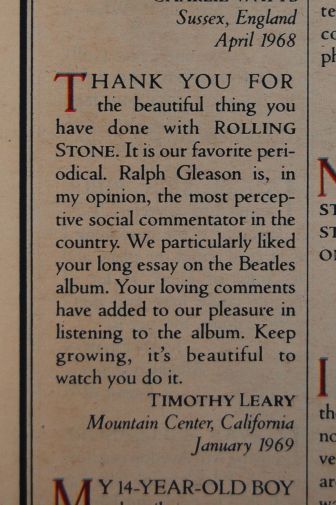
Letter from Timothy Leary to Rolling Stone magazine
the firm tries (unsuccessfully) to sign the Rolling Stones for a campaign,
Keith Richards passed out, photo by Annie Leibovitz in Rolling Stone magazine issue 254, 1977
and the gap between Don Draper and the emerging generation widens as the Beatles grow in popularity, and the youth of the 1960s follow dreams of purpose and fulfillment rather than dreams of indoor plumbing. Last week, we watched an episode that had one of the most powerful uses of music I have ever experienced in a television show (besides the “final five” sequence of Battlestar Gallactica when they played “All Along the Watchtower.” Awesome.). It was a pivotal episode, in which Don was portrayed as no longer a young, hot-shot creative ad exec, but a middle aged man who was losing touch with what is going on with his wife and staff’s generation. His young wife perceived this disconnect, and so on her way to acting lessons, to fulfill her dreams of becoming an actress, she left him with the Beatles Revolver album to help bring him up to speed. He placed it on the turntable, put needle to vinyl, and our living room filled with the entrancing final song of Revolver, “Tomorrow Never Knows.”
The montage was potent as it proceeded through a series of scenes of the younger generation in Don’s life as they followed their bliss – Peggy and Stan smoked weed while they worked, Pete watched a lover slip away, and Megan meditated in her acting class – until Don, disinterested, scratched the needle off the record, our den went silent, and Don walked out of the room to go to bed. To me, It was one of the most brilliant sequences of the show to date, and as listening to (good) music from that era often does, it made me ache with nostalgia for a time I never knew.
The following morning, after I dug through our CDs to find the Revolver album, I saw the Rolling Stone issue on our shelf, and the time finally felt right to look at it. Before I even got to the Annie Leibovitz spread, I was struck by the letters to the editor. Especially the one from angry parents who wrote, “My 14 year old boy subscribes to your magazine, Rolling Stone. On the front cover and inside the magazine were nude pictures of that Lennon man (?) and his ugly girlfriend.”
Reader letters from Joan Didion, George Bush, Joseph Heller
Letter from reader, and response from John and Yoko
Reader letter from angry parents to Rolling Stone magazine
Letters to Rolling Stone from Dan Rather and Woody Allen
I got a chuckle out of that one, but there were also letters from John and Yoko, Timothy Leary, George Bush, Joseph Heller (author of Catch-22), Dan Rather, Woody Allen, and Joan Didion. What blew my mind was not just that they had written letters to a magazine (does that still happen – celebrities writing letters to the editors of rock and roll magazines?), but that they were current at the time the magazine I held in my hand was printed. They were current when “that Lennon man” was alive, and George Bush was director of the CIA, and Joan Didion was pioneering New Journalism, or what we now call creative nonfiction. This physical magazine I pulled off our shelf after watching Mad Men, this printed material, the yellowed pages of which I turned as I sat on the carpet of our finished basement in 2013, it was there in 1977. It was exposed to 1977 air, printed with 1977 ink on 1977 paper, when Jimmy Carter was president, and I was three years old.
The author, Andrea Badgley, 1977ish, on St. Simons Island, GA
What struck me most about the issue, aside from the fact that I was holding a piece of history, was that Rolling Stone was once young. Timothy Leary wrote to the nascent magazine in 1969, “Thank you for the beautiful thing you have done with Rolling Stone… Keep growing, it’s beautiful to watch you do it.” I’ve never known a time when Rolling Stone didn’t exist, and here, this issue of RS on its tenth birthday, was proof that it was once a child. That it was just a baby during the period portrayed by Mad Men. When I read Timothy Leary’s words of encouragement to the young magazine, it hit me that Rolling Stone, at one time, was an emerging journal, like the ones I might submit my writing to today.
I leafed through the Leibovitz spread, with shots we’ve seen a million times of Jerry Garcia lying on his back on a beach; Keith Richards passed out; OJ Simpson in his Buffalo Bills uniform; Salvador Dali ear to ear with Alice Cooper; Mick Jagger and Keith Richards, shirtless and stoned; Brian Wilson in a blue bathrobe, his surfboard under his arm. I thought, this all really happened, and these photos were fresh when this magazine came out.
Jerry Garcia, 1972, “Finally there was marijuana!” photo by Annie Leibovitz
OJ Simpson, 1977, Buffalo Bills uniform, photo by Annie Leibovitz
Linda Ronstadt in red underwear, 1976, photo by Annie Leibovitz
Annie Leibovitz commentary on Linda Ronstadt’s sixty-dollar underwear, 1977 Tenth Anniversary issue (#254) Rolling Stone magazine
Dolly Parton and Arnold Schwarzenegger, 1977?, photo by Annie Leibovitz
Brian Wilson in blue bath robe with surfboard. “Brian seems to be on acid all the time…” photo by Annie Leibovitz
Mick Jagger and Keith Richards, Alice Cooper and Salvador Dali, Rod Stewart and Britt Ekland, Ron Wood with Rod Stewart; 1977 Rolling Stone; photos by Annie Leibovitz
I loved reading commentary from Annie herself about “playing” with her subjects in order to get shots, like when she bought Linda Ronstadt $60 red underwear for a shoot and was scared about how Ronstadt might react, or when she shared her experiences of a subject, like that “Brian [Wilson] seems to be on acid all the time.” You don’t see those notes when one of her iconic photos is used in a nostalgia piece on Jerry Garcia, or you find her portrait of Dali and Alice Cooper on a poster in a head shop.
But my favorite part of the magazine, and not just because we’re watching Mad Men, was the advertising.
Sharp Eye tape player ad, Rolling Stone magazine, 1977
When radio played vinyl – Technics turntable ad, Rolling Stone magazine, 1977
Ad in Rolling Stone for Queen’s “News of the World” album, released October 1977
ad in 1977 Rolling Stone for David Bowie’s “Heroes” album, released 1977
Hobbit and Middle Earth ads in the back of 1977 Rolling Stone magazine
Ad for Discwasher, the “Superior” vinyl record cleaner, 1977 Rolling Stone magazine
There are a couple of cigarette ads (including Vantage and the Marlboro man), a few car ads (Volkswagen rabbit, Toyota Celica, Le Car from Renault), liquor ads (Seagrams 7, Two Finger Tequila, Southern Comfort, and Gordons Gin, complete with 51 gin cocktail recipes), and my favorites, full page pieces for albums that were new at the time, like “‘Boston 2.’ On Epic Records and Tapes,” David Bowie’s “Heroes,” and Queen’s “News of the World,” all new releases in 1977, when this copy of Rolling Stone went to press. The remainder of the issue is full of ads for turntables, cassette players, speakers, headphones, and reel to reel recorders. Even better than the merchandise, though, are the sales pitches, like this one: “Now you can have something in common with FM stations. This Technics turntable.” Because radio stations once played vinyl records. !. I also loved Sharp Eye’s line, “It ends the hit and miss method of finding songs on tape.” Remember those days? When we listened to cassettes and there was no easy way to advance to the next song?
And that final ad, the yellow page with the checklist? We had that record cleaner. I remember when I was young, a 1980s adolescent exploring the music of the 60s and 70s, I’d squirt a drop from that tiny red bottle onto my parents’ vinyl records (Mom had every Beatles album, Dad had all the Rolling Stones) and using the discwasher with the velvety pad and the wooden grip, I’d run with the grain of the records’ grooves, wiping “microdust” with each swipe. The vinyl would shine black when I was done. I’d pluck a dust ball off the turntable’s needle, place the record on the spindle, turn it up loud with the big silver knob, and lie back with my eyes closed, my hands behind my head, to listen to Pink Floyd, or Queen, or any one of the surprises contained inside those mysterious album covers.
On Mad Men, there’s scorn towards the advertising world from the counterculture who consider themselves enlightened, and superior, and anti-establishment. They look down their noses on consumerism and the shallow jingles that ad agencies churn out, favoring the high culture of theater or beat poetry. But I have to say, as I leafed through this Rolling Stone, the ads are what gave me a real glimpse into 1977. Unlike iconic photographs by Annie Leibovitz, or fiction by Hunter S. Thompson, advertising is fleeting. The ads were the details that showed what daily life was like for regular people – what they wore, how they combed their hair, what they were buying that year (discwashers!). Because they are ephemeral (and, we like to think, culturally unimportant), we forget about advertisements as they update to the newest product, the latest campaign. But more than anything else about the issue, when I saw those reel to reel recorders, and all those record players, it was the ads – those snapshots in time – that brought back memories. They are what dated the magazine. It was not only the letters from John and Yoko, or the timeless photographs of ’60s and ’70s rock and roll icons, but also the ads, penned by Mad Men era creative teams, with shallow one-liners and feathered hair, that revealed the culture of 1977.
I am happy to report that I got some revisions done today. Enough, in fact, that I decided to reward myself, not with ice cream or cupcakes, but with search engine terms. Sometimes, when I’m avoiding writing but want to pretend like I’m doing something productive for my blog, I check my stats to see how folks are finding my site. And often, I am rewarded with some pretty hilarious stuff. Hilarious not because someone typed these terms into their search engine (searching for euchre cartoons is perfectly normal. I’ve done it too), but because the search engine pointed them here. To my blog. Where I have actually written about some of these things.
Aside: To those of you searching for information about men and socks (and there are more of you than are listed here), Welcome!
Here are my top ten favorite search engine terms that have brought folks to Butterfly Mind (*asterisked terms indicate subjects I have written about):
10. *Men and their socks
9. *Euchre cartoons
8. *Freaking out I can’t exercise on vacation
7. With his socks on
6. Three or more guys on a couch with socks
5. *Dental drilling agony
4. *I had a facelift and now i have one hell of a headache
3. *My left side mouth is bit numb and drooling
2. *Hibernating bears farts
And (drumroll), the best search term of all, which I did not write about, but was so funny I had to create it (because I couldn’t find a satisfactory result when I Googled the term):
1. Farting goat Venn diagram
So for the person out there who is searching for a farting goat Venn diagram, I’m not sure in what context you were researching farting goats, but after investigating goat farts on the internet, here’s what I’ve got for you:
Because I didn’t know much about farting goats, I have to give credit where credit is due and thank the Homesteading Today livestock forum. Their Farting Goats??? thread informed me of the sneeze/fart combo move (aka the Snart). From that thread I also learned that goats fart and queef when they are “prego” (and “it is disgusting”), goats do pass gas and “freshly burped up cud is just as bad,” and that one homesteader’s horses love “the buck/fart/gallop combo.”
But my favorite line from the thread, the line that wiggled it’s way into my heart and was the ultimate inspiration for the Venn Diagram, was this:
“Little Black usually garbs up a cud, then sneezes and farts at the same time. Then bless his heart, he looks at us like..what?!?!?”
I think I need to hang out with more homesteaders.
“So, have you noticed that irony is super trendy now?” I dealt Phase 10 cards to Amy and my two kids. “‘The Ironic Generation.’ I keep hearing that. What does that even mean? That people want to live off the grid, yet they can’t survive without Facebook and Twitter?”
Amy fanned and arranged the cards in her hand. “It’s a hipster thing.”
“What’s a hipster?” Our son’s big eyes looked up at me.
“Well,” I said, “Every generation – do you know what a generation is?”
“Yeah, it’s like a thousand years or something.”
“Not quite,” Amy and I laughed. “It’s a group of people of a certain age. Like, you and all your friends, and all the kids in elementary school right now are your generation. Daddy and me and Amy and all of our friends are our generation.”
He discarded. “Okaaay.”
“Each generation has a group of, I don’t know,” Rebels? Outsiders? “A subculture that kind of defines the generation. In the 20’s it was flappers.” I played a card and looked across the table at Amy. “When were beatniks?”
“Beatniks were in the 60’s,” she said. “And hippies were the 60’s and 70’s.”
“Punk was the 80’s. And now,” I said, “it’s hipsters.” I peered over my cards at our son to see if he understood. He did not.
“There were tons of hipsters in the Twin Cities,” I told him. “They think they’re really cool. Like, they were cool before cool was cool.” He had no idea what I was talking about. He’s nine.
I played a card and asked my friend, “Do you know how the hipster burned his tongue?”
She raised an eyebrow, waiting for my answer.
“He ate pizza before it was cool.” I giggled hysterically. Our son rolled his eyes.
Amy was more useful to him, describing the hipster look – the skinny jeans, the PBR tee shirts. “And then there are the older hipsters, like Ira Glass and my husband, with the glasses, and the beard, like my husband has.” She moved some cards around in her hand. “Although he had the glasses and the beard before they were a thing.”*
I giggled again, thinking she was making fun of herself, saying that her husband had adopted the hipster look before it was cool. I looked up from my cards to acknowledge her cleverness, but she wasn’t smiling about it. She was laying down her sets, getting ready to go out.
“So, back to irony,” I said. “I’ve always loved irony, but I never know how to explain it. If somebody asked me to define irony, I could give an example, but I couldn’t define it.” I laid down my sets of four and discarded. Amy looked thoughtful, turning her eyes up as if she could look into her brain, rifle through files, and find a definition for ironic.
“Only Hipsters Know Irony,” writing and “art” by J. David Ramsey
“But the irony I know is not anything like that Alanis Morissette song,” I said. “ ‘It’s like 10,000 spoons when all you need is a knife.’ What the hell is that? That’s not ironic. That’s just annoying. Ironic has some sort of, I don’t know,” I gestured toward my heart. “Mystical quality.”
Amy’s eyebrows shot up and she grinned. “Let’s look it up!”
I gave her the dictionary, and she riffled pages while I shuffled cards. Her face turned scowly.
“What the hell?” She said. “Listen to this:
“Ironic. 1. Characterized by or constituting irony. 2. Given to the use of irony.
“That doesn’t tell you anything,” she fumed. “It uses irony in the definition!”
My son arranged his new cards. “It’s your turn Amy.”
“Oh, sorry,” she said, then smiled and stroked the book. “I have this dictionary now, you see,” and she played a card.
“Well, look up irony then,” I said.
She followed the words with her long finger.
“Irony. 1.a. The use of words to express something different from and often opposite to their literal meaning.”
I had had a couple of whiskey sours at this point. “What? That confuses me,” I said, and took another sip. “This is an example of irony to me. I have this friend whose mom was a super fructavore – she loved fruits and veggies and ate them all the time. They were her snacks, her desserts, always a component in her meals. Tons of fiber, you know? Well, she died from colon cancer.” I laid down a card. “That’s ironic.”
“Okay, listen, though. Here’s the third definition of ironic:
“3. Poignantly contrary to what was expected or intended.”
“Poignant! That’s going in my Lexicon.” I jumped up to get my Moleskine. “Poignant is one of my favorite words. It’s like irony – it has this mystical quality,” and I gestured toward my innards again. “It makes me feel.”
“Mom! It’s your turn!”
“Sorry babe.” I played a card and thought of the example of irony I had just told. “My friend’s mom contracting colon cancer after a lifetime of fruit eating is, well, poignantly contrary to what was expected. That’s a perfect definition! That’s the irony I’m talking about. It’s all about the poignancy.”
“You really need to read the usage examples here,” Amy said, pointing at the entry in the dictionary.
I thought about all the young hipsters in the Twin Cities as play went round the the table. I thought about the sad irony that they try desperately to avoid anything mainstream, yet they have become so mainstream they even have a look. Glasses, skinny jeans, fixed gear bicycles. iProducts.
When it was my turn again, I fingered my cards, then hitched up my skinny jeans so I could start the music back up on my iMac. I smirked, “Well, I’ve loved irony for, like, 20 years. Irony spoke to me before it became a ‘thing’.”
And then I laid down my cards and laughed.
Usage Note: The words ironic, irony, and ironically are sometimes used of events and circumstances that might better be described as simply “coincidental” or “improbable,” in that they suggest no particular lessons about human vanity or folly. Thus 78 percent of the Usage Panel rejects the use of ironically in the sentence In 1969 Susie moved from Ithaca to California where she met her husband-to-be, who, ironically, also came from upstate New York. By contrast, 73 percent accepted the sentence Ironically, even as the government was fulminating against American policy, American jeans and videocassettes were the hottest items in the stalls of the market, where the incongruity can be seen as an example of human inconsistency. (The American Heritage College Dictionary)
When I was researching this post, I came across some pretty hilarious stuff. Like the wikiHow article 9 Ways to Be a Hipster. I also found a fascinating opinion piece in the NY Times: How to Live Without Irony by Christy Wampole. Both great reads if you are curious about hipster counterculture.










 Butterfly Mind