Ink. I love the way it feels. I love the way it stains. Ink in different forms changes the way I write. When it’s super liquidy I write messy, but my thoughts can come quickly. When ink is sticky — ball point — my handwriting is nicer, but thoughts are slower. I wonder how that affects my product? I don’t like messy writing. I prefer it neat. But messy writing is quicker and allows for messy thoughts. Which I like.
Squid ink in a paella pan in Spain. A harpist plays in the flat above. The music drifts in from the open balcony. The paella is black from the squid ink. Did it have flavor, the ink? I do not remember. I remember the anchovies. Not anchovies packed into a tiny tin, not anchovies as small as my pinky. Oh wait – those are sardines. Anyway, anchovies from the market in Barcelona. Anchovies with silver skin, charred in the pan. Anchovies with fins and faces, served whole on my plate. Do I use my fork? Joaquim delights in my propriety. Wiggles his oily fingers covered in scales and tender meat. “Like this,” he says, and picks up a silver fish with his fingers, pulls bones from it, pushes white flakes of fresh fish into his mouth. Smiles and tips his head at my plate. Go ahead, he nods. It’s okay.
Ink makes my mind tangible. Thoughts with no form, airy, floating, nothingness, are made permanent on a page in black liquid lines that dry to solid. Indelible. The invisible becomes visible. Nothing becomes something. Gas to solid. Not gas – not anything. Thought is not matter. Ink makes not-matter into matter. There are experiments where thoughts influence matter, right? Something with subatomic particles and thoughts influencing where they move. I could be making that up. If I’m not, which I don’t think I am, what does that make thought? Is thought energy? A force?
I smell rosemary. It makes me think of New Orleans. Of the rosemary hedge on the way to the Thai place. Of Luca’s roasted chicken.
For the month of April, I will be publishing a 10-minute free write each day, initiated by a prompt from my prompt box. Minimal editing. No story. Just thoughts spilling onto the page. Trying to get back into the writing habit.
Marine blue. A wash of green. Navy at depth. Pacific blue off Kauai. Turquoise in Bahamian shallows, where tropical sun penetrates aquamarine. White sand below.
Ocean with galaxies of starfish, shivers of sharks, smacks of jellyfish. With animals as big as houses. With beings who are our kin, warm-blooded, intelligent, playful, zen. I had a dream once that I was a whale. I lay in a field with my pod, and we were not dying. You’d think whales on land would be in their death throes, but the field was irrelevant to our health or well-being. It was a dream.
What I remember from the dream was a state of non-thinking, non-analyzing, non-questioning. I lay in a field, as a whale, with my pod, simply being. I felt the sun. I knew my podmates. I was alive. I had no worry. I was like the TED speaker who had a stroke and lost language, whose mental chatter was silenced. Who in her wordless existence experienced life in the present. Feeling it. Absorbing it. Living it without judgment.
The ocean moves. It is fluid. It is never the same and always the same. On the scale of seconds, it is like snowflakes: each ripple is unique, no cubic inch is filled with the same light, the same particles, the same ctenophore larva, diatoms, coral spawn. On the scale of centuries, the ocean is constant, dependable: tides bulge and recede, hurricanes gather, currents flow like ancient rivers, waters evaporate, condense, rain down. Water always streams downward into the salty basins of the earth. Into the sea.
And blue. Always blue. The ocean is all of the prettiest blues. Aqueous sapphire. Liquid and light.
For the month of April, I will be publishing a 10-minute free write each day, initiated by a prompt from my prompt box. Minimal editing. No story. Just thoughts spilling onto the page. Trying to get back into the writing habit.
Hay bales are my lily pads. I watch the light on them when I run: the angle, the strength, the warmth. Depending on the time of day, the season of year, the color of the sky, the life on the ground, the hay bales look different every day.
Growing up, I made the drive from Savannah to Athens a thousand times with my family. I always loved to see the hay bales in the fields, dotting the hills as if dropped with parachutes from the sky. Plopped wherever the bale happened to have enough hay and the baler strapped it up and abandoned it. There was no order. No pattern to the bales on the hills, but the bales themselves are so tidy. This appealed to me then and it appeals to me now, the tidiness of a bale of hay. Something that swayed in the wind and covered the earth and that I’d never be able to order myself if I were to reap and bundle it – not without wrestling and swearing and scratching blood on my arms – all of this wildness was now bound in a tight, neat package that looked like a tater tot.
It wasn’t until I was an adult and started taking my runs through the fields around here that I started looking at hay bales up close. The swirl of the straw around the core of the bale, the streaks of stalks like highlights in blonde hair. When the sky is blue, and the land is stubbled, and the hay bale lazes in the right slant of light, it shines like gold.
Do they leave the bales as is and just let cows munch on them? No, that can’t be right – they have that green plastic wrap around them. That’s a new thing. They used to be bound with two or three narrow white bands of plastic or twine. Now they are bound by webbing. Someone must collect the bales at some point. No one has collected mine yet, though.
I wanted to watch the hay at sunrise today, but I was too early. The sun did not rise over the mountains and shine on the bales before I needed to get home to pack lunches. I tried. I ran back and forth, watching the morning sun light the hilltops to the west. But the bales were in valleys and I could not wait any longer. All my bales are golden. I want to see them glow pink.
For the month of April, I will be publishing a 10-minute free write each day, initiated by a prompt from my prompt box. Minimal editing. No story. Just thoughts spilling onto the page. Trying to get back into the writing habit.
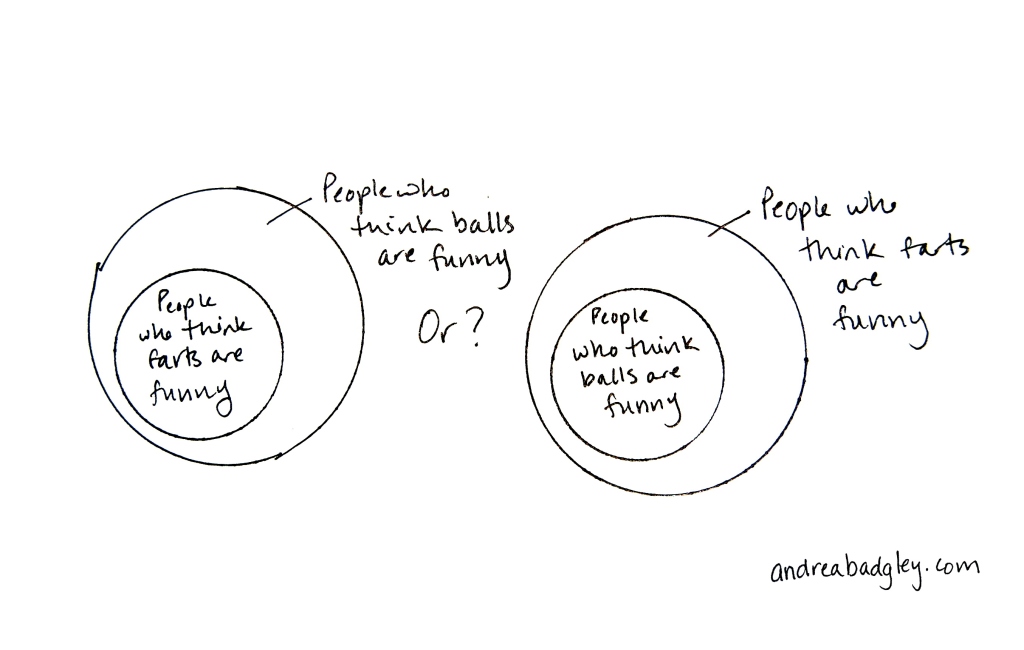
Last holiday season, when I worked at the Barnes & Noble in Minnesota, a clean-cut 30-something man, about my age, approached me at the information desk. His short, sandy hair was neatly trimmed, his face freshly shaved, and he wore a grass-green long-sleeved polo, tucked into khaki chinos. He stepped up to the counter where I stood waiting to help him and said, straight faced, “Yes, I’m looking for a book called ‘Lost Balls.’ “
It had been nine years since I’d worked in the world, having stayed home with our kids until I started this job at the book store. Though I dressed the part in a pale pink button-down shirt and tailored black slacks, light makeup and petite pearl earrings, I wasn’t accustomed to maintaining professionalism. I smiled involuntarily, tucked in a giggle, and said, “I’m sorry, did you say ‘Lost Balls?’ “
“Yes,” he said, squinching his eyebrows and looking somewhat perplexed.
I typed it into BookMaster and tried to school my face, the hilarity growing inside of me as I watched the letters, one by one, fill in the search box. L-O-S-T- -B-A-L-L-S. The corners of my mouth twitched, and my eyes watered, and the more I tried to remain stoic, the harder it became to contain my Beavis and Butthead reaction. Huh huh. He said balls. I stifled a laugh, but my lips cracked into a smile despite myself.
He tilted his head a little, still serious, still knitting his eyebrows. “It’s about golf balls,” he said.
I looked up from the computer screen, straight into his searching eyes, stretched my mouth into a full grin, and said, “It’s still funny.”
P.S. I am in our kids’ elementary school cafeteria, seated in the half moon arrangement of folding chairs as I wait for our son’s 3rd grade concert to begin. Sitting next to me is a small child – maybe three? – farting up a storm. He squirms around in his chair, his butt aimed mostly at me, and I suffocate in a noxious cloud of toddler toots while he jabbers on, oblivious to his killing cloud. It is all I can do not to burst into laughter as I smell this kid’s farts and write about lost balls. (Okay, I did burst into laughter. The kind that you try to keep in, but still it escapes, through snorts and squeaky giggles. Our daughter is looking at me weird, head tilted, eyebrows squinched. Not unlike the man at the book store.)
P.P.S. I added the graphs last minute in response to the WordPress Image vs. Text challenge. That last one really has me thinking. Who is a subset of whom?
I thought I would agonize over what kind of photograph to use for water: should I use the marshes of my Georgia childhood? Or the Gulf waters of our vacation spot on Anna Maria Island? Or maybe the crystal fresh waters of an Appalachian stream, or our trip to Lake Superior when we lived in Minnesota – or maybe the Cascades waterfall that is our children’s favorite hike? I’ve got photographs of those waterfalls from every season – maybe I should go with those.
But despite all the bodies of water I’ve loved in my life, and all the bodies of water I will love when I meet them (geyser pools, Bahamian shores, arctic lakes, glaciers), the image that kept popping into my head when I thought of water was that of giant white cumulus clouds building over the aqua waters of the Gulf of Mexico in summer: the water cycle before my eyes. I can’t get enough of those clouds.
The possiblities are endless for today’s assignment. I had a hard time editing for this one. Photography 101: Water.
“So, have you noticed that irony is super trendy now?” I dealt Phase 10 cards to Amy and my two kids. “‘The Ironic Generation.’ I keep hearing that. What does that even mean? That people want to live off the grid, yet they can’t survive without Facebook and Twitter?”
Amy fanned and arranged the cards in her hand. “It’s a hipster thing.”
“What’s a hipster?” Our son’s big eyes looked up at me.
“Well,” I said, “Every generation – do you know what a generation is?”
“Yeah, it’s like a thousand years or something.”
“Not quite,” Amy and I laughed. “It’s a group of people of a certain age,” I told him. “Like, you and all your friends are your generation. Daddy and me and Amy and all of our friends are our generation.”
He discarded. “Okaaay.”
“Each generation has a group of, I don’t know,” Rebels? Outsiders? “A subculture that kind of defines the generation. In the 20s it was flappers.” I played a card and looked across the table at Amy. “When were beatniks?”
“Beatniks were in the 60s,” she said. “And hippies were the 60s and 70s.”
“Punk was the 80s. And now,” I said, “it’s hipsters.” I peered over my cards at our son to see if he understood. He did not.
“There were tons of hipsters in the Twin Cities,” I told him. “They think they’re really cool. Like, they were cool before cool was cool.” He had no idea what I was talking about. He’s nine.
I played a card and asked my friend, “Do you know how the hipster burned his tongue?”
She raised an eyebrow, waiting for my answer.
“He ate pizza before it was cool.” I giggled hysterically. Our son rolled his eyes.
Amy was more useful to him, describing the hipster look – the skinny jeans, the PBR tee shirts. “And then there are the older hipsters, like Ira Glass and my husband, with the glasses, and the beard, like my husband has,” she said. She moved some cards around in her hand. “Although he had the glasses and the beard before they were a thing.”*
I giggled again, thinking she was making fun of herself, saying that her husband had adopted the hipster look before it was cool. I looked up from my cards to acknowledge her cleverness, but she wasn’t smiling about it. She was laying down her sets, getting ready to go out.
“So, back to irony,” I said. “I’ve always loved irony, but I never know how to explain it. If somebody asked me to define irony, I could give an example, but I couldn’t define it.” I laid down my sets of four and discarded. Amy looked thoughtful, turning her eyes up as if she could look into her brain, rifle through files, and find a definition for ironic.
“Only Hipsters Know Irony,” writing and “art” by J. David Ramsey
“But the irony I know is not anything like that Alanis Morissette song,” I said. “‘It’s like 10,000 spoons when all you need is a knife.’ What the hell is that? That’s not ironic. That’s just annoying. Ironic has some sort of, I don’t know,” I gestured toward my heart. “Mystical quality.”
Amy’s eyebrows shot up and she grinned. “Let’s look it up!”
I gave her the dictionary, and she riffled pages while I shuffled cards. Her face turned scowly.
“What the hell?” She said. “Listen to this:
Ironic. 1. Characterized by or constituting irony. 2. Given to the use of irony.
“That doesn’t tell you anything,” she said. “It uses irony in the definition!”
My son arranged his new cards. “It’s your turn Amy.”
“Oh, sorry,” she said, then smiled and stroked the book. “I have this dictionary now, you see,” and she played a card.
“Well, look up irony then,” I said.
She followed the words with her long finger.
Irony. 1.a. The use of words to express something different from and often opposite to their literal meaning.
I had had a couple of whiskey sours at this point. “What? That confuses me,” I said, and took another sip. “This is an example of irony to me. I have this friend whose mom was a super fructavore – she loved fruits and veggies and ate them all the time. They were her snacks, her desserts, always a component in her meals. Tons of fiber, you know? Well, she died from colon cancer.” I laid down a card. “That’s ironic.”
“Okay, listen, though. Here’s the third definition of ironic”:
3. Poignantly contrary to what was expected or intended.
“Poignant! That’s going in my Lexicon.” I jumped up to get my Moleskine. “Poignant is one of my favorite words. It’s like irony – it has this mystical quality,” and I gestured toward my innards again. “It makes me feel.”
“Mom! It’s your turn!”
“Sorry babe.” I played a card and thought of the example of irony I had just told. “My friend’s mom contracting colon cancer after a lifetime of fruit eating is, well, poignantly contrary to what was expected. That’s a perfect definition! That’s the irony I’m talking about. It’s all about the poignancy.”
“You really need to read the usage examples here,” Amy said, pointing at the entry in the dictionary.
I thought about all the young hipsters in the Twin Cities as play went round the the table. I thought about the sad irony that they try desperately to avoid anything mainstream, yet they have become so mainstream they even have a look. Glasses, skinny jeans, fixed gear bicycles. iProducts.
When it was my turn again, I fingered my cards, then hitched up my skinny jeans so I could start the music back up on my iMac. I smirked, “Well, I’ve loved irony for, like, 20 years. Irony spoke to me before it became a ‘thing’.”
And then I laid down my cards and laughed.
Usage Note: The words ironic, irony, and ironically are sometimes used of events and circumstances that might better be described as simply “coincidental” or “improbable,” in that they suggest no particular lessons about human vanity or folly. Thus 78 percent of the Usage Panel rejects the use of ironically in the sentence In 1969 Susie moved from Ithaca to California where she met her husband-to-be, who, ironically, also came from upstate New York. By contrast, 73 percent accepted the sentence Ironically, even as the government was fulminating against American policy, American jeans and videocassettes were the hottest items in the stalls of the market, where the incongruity can be seen as an example of human inconsistency. (The American Heritage College Dictionary)
When I was researching this post, I came across some pretty hilarious stuff. Like the wikiHow article 9 Ways to Be a Hipster. I also found a fascinating opinion piece in the NY Times: How to Live Without Irony by Christy Wampole. Both great reads if you are curious about hipster subculture.
——-
I originally published this post Februrary 26, 2013. When I saw this week’s writing challenge, Oh, The Irony, I couldn’t resist reposting. I don’t know if hipsters are still a thing, so hopefully this isn’t woefully outdated.