
Clouds are my favorite thing about Florida. They are the part I miss most after living there, and the part I love most when we visit. I thought I’d share some with you here. Enjoy.



Clouds are my favorite thing about Florida. They are the part I miss most after living there, and the part I love most when we visit. I thought I’d share some with you here. Enjoy.
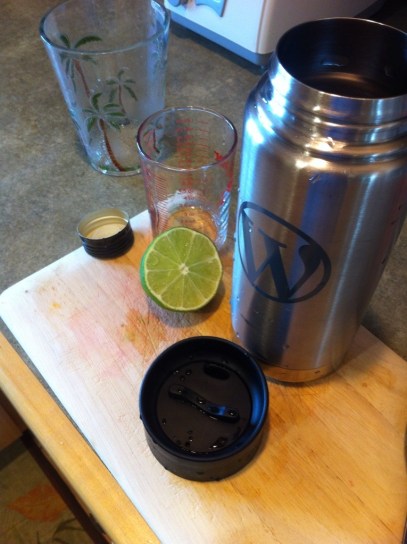
One of my favorite summer cocktails is a rum daiquiri (recipe below). With only three ingredients, it is clean, cold, fresh, and simple. Buy a bottle of rum, a few limes, and some sugar to make simple syrup, and you can make one anywhere you have access to ice.
Or so I thought.
Our first night on vacation I went to make myself one – I had prepped simple syrup earlier in the day and was all ready to go – and I realized I didn’t have a shaker. Cocktails with citrus should be shaken in order to get a fresh bubbly flavor, but you know, vacation rentals don’t always have all the tools you’re used to having at home. I banged around in the cabinets to be sure I couldn’t rig something, then shrugged my shoulders and resigned myself to stirring.
The drink served as a rum, lime, and sugar delivery mechanism, which isn’t all bad, but it tasted flat and I didn’t make another.
The following night my husband and I both wanted daiquiris, but we wanted them to have the zing we craved – the zing you can only get from shaking, not stirring. So I banged around in the cabinets some more, double checked where the wine glasses were stored, triple checked the cupboard with the blender. No cocktail shaker. I wandered back into our bedroom to brainstorm with my husband, and then I saw our solution.
A few months ago I received some WordPress swag after guest hosting a writing challenge on The Daily Post. The box included a tee-shirt, a copy of The Year Without Pants, some stickers, and an insulated Klean Kanteen bottle with a sealable sippy lid (aka “Cafe Cap”). I love this bottle. It keeps my water icy in the summer and my coffee steaming in the winter.
And with a screw top cap that can be mostly closed off, on vacation it serves as our cocktail shaker. I forgot to close off the sippy hole the first shake and I flung sugar-lime-rum everywhere, and when you do close the sippy hole it doesn’t seal perfectly for vigorous shaking, but the minimal drink loss was worth it: the daiquiris were fresh and not flat, shaken and not stirred. Sometimes you have to improvise.
Mix all ingredients in a cocktail shaker (or Klean Kanteen bottle with lid closed) and shake vigorously for ~ 10 seconds. Strain over ice in a rocks glass. Garnish with lime wedge.
*To make simple syrup, heat equal parts water and sugar over medium heat until sugar is dissolved (we use a lot of simple syrup in our house so I usually mix 1 cup sugar and 1 cup water per batch). You do not need to stir constantly, nor do you need to bring it to a boil. Once the sugar is dissolved, remove from heat and allow to cool. If you are in a hurry to use it in drinks, cool it in an ice bath to avoid melting the ice in your drink and watering it down.

I have a close friend, J, who has never met a mirror she didn’t like. When we were teens, and later in college, and her eye caught a reflective surface – a shop window, a car window, a mirror in a mall bathroom – she turned her head this way and that as she looked into it, smoothed an eyebrow, tucked a curl, and watched herself as she continued to talk, completely unselfconscious about her mirror-gazing as she carried on the conversation. We teased her about it then, and we tease her about it now, 25 years later. She laughs at herself when we tease her, then flits her eyes to a mirror and winks at the best friend she sees there.
This past March, at our annual Girls’ Weekend, we talked about mirrors and who among us looks into them. The conversation was spawned in part by J’s mirror-love, but also, at least for me, by a deeper wondering about our comfort with ourselves. J is one of the funniest people I know, and also one of the happiest. At several points in her life, whether on a precipice with a boyfriend or on the verge of a life-changing move, she has shrugged her shoulders and said, “I dunno. I think I could be happy with anyone” in the case of the boyfriend, or “anywhere” in the case of a move. And it’s true. She could.
As we went around the table at Girls’ Weekend, we found that we all have very different relationships with the mirror. J is friendly with them – she sees her favorite person when she looks into one. Others of us use them strictly for pragmatic reasons: check the teeth, blow dry the hair. One of us doesn’t use them at all – says she can’t remember the last time she looked into one. “Not even to brush your teeth?” I asked. “I brush my teeth in the shower,” she said.
And me? It used to be that when I looked in the mirror, the person who looked back at me was a mystery. The image I saw in that silver surface did not match up with the person I knew from the inside. All my life my reflection has caught me off guard. Recently I brushed our daughter’s hair and when my reflection moved in the mirror I did a double-take – Who’s that? Oh. That’s me. The same face that’s been looking back at me for 40 years. Why does she still surprise me? Why do I not connect with her?
I told my girlfriends about this weirdness, about the disconnect between me and my reflection, and after our mirror conversation, inspired by J, I said, “I’m going to start doing mirror work. I’m going to figure this out! I want to be best friends with my reflection too.”
I tried, but still, we were off, my reflection and me. And then, something changed. I got glasses.
Now, I look in the mirror and say Oh! There you are! And I smile. The Andrea that looks back at me – the bookworm, the word nerd – is the Andrea I know from the inside. I just never knew she had glasses.
I see this revelation frequently in fashion, especially on the the TLC makeover show What Not to Wear. Contributors to the show are brought to New York, instructed to dispose of their entire wardrobe, and then taught how to shop for new clothes that fit their personalities and figures. It is always difficult for the women to let go of their former clothing – even if the clothes did not serve them and did not even fit them, those clothes were familiar – but once they let go and start finding clothes that do serve them, that do fit them, the women are transformed. There are often tears when they see themselves in clothes that match their personalities. The women look in the mirror at their new hair, the skirt that flatters their hips, the fun shoes in their favorite color, and they point and they say, “That’s what I always felt like on the inside – now I look like that on the outside.”
That’s how I feel with my new glasses. Now, when my reflection catches me unaware, when I’m vacuuming and I see myself pushing the upright in the wall mirror, I wave or I wink. She and I, we’re on our way to becoming fast friends.
This is my interpretation of finding something, the day 13 assignment for Writing 101. *Edit: added next to last paragraph after initial publication.
Several months ago, I discovered podcasts. The shows made cleaning day tolerable, as I’d prop my phone on counter tops and listen to Jeff and Rebecca talk books while I scrubbed sinks, or Terry Gross interview Stephen King as I swept the kitchen floor. I found the access to new information so exciting, I began listening on other days as well. I’d tuck my phone into the Valley Bank (my bra) and listen while I washed dishes, folded laundry, prepped dinner, or ran errands. Soon, I was listening every day. I knew when my favorite (Book Riot) aired new episodes (Saturday or Sunday if you have the Book Riot app, Monday otherwise), became familiar with formats, got to know hosts.
I checked my phone every morning to see if anything new had posted so I could listen during that day’s chores. It got to where I was listening faster than my podcasts were airing episodes, and I needed new material. About a month ago, I sent out a Twitter plea for podcast ideas. Since then I’ve found some new favorites, and one gem in particular that I am nearly as excited about as Book Riot: The Moth. See below for more details.
Book Riot: As I mentioned, this is my favorite podcast, bar none. The hosts Jeff O’Neal and Rebecca Schinsky are the editors of BookRiot.com (Always Books. Never Boring), and I like hanging out with them. They’re smart and they make me laugh. On the podcast, they don’t just talk about new releases or prize winners or good books that will make your to-be-read pile even more overwhelming (though that does happen), they cover news that is of interest to readers: new technology in the reading world, the latest research on how reading affects empathy or human health, a vibrator that, ahem, enhances your e-reading experience (I’m not kidding.) If you like books and you’re fun and you’re looking for a new podcast, start with Book Riot.
Bookrageous: Bookrageous is like sitting around with friends and talking books. When I listen to this one, I often find myself opening my mouth to chime in, then realizing Josh, Jenn, and Rebecca are not sitting on my bathroom counter. They can’t hear me. It’s just my phone. But its fun to pretend. Bookrageous is up there with Book Riot on the faves list. I listen as soon as a new one airs.
Books on the Nightstand: Hosts Michael Kindness and Ann Kingman, who seem to have read everything and who also work in the publishing industry, give book recommendations and talk about the behind-the-scenes world of the book industry. They are knowledgeable and approachable, and I’ve read several recommendations after hearing their descriptions. I have not been disappointed. Plus Ann loves Pat Conroy, and Prince of Tides is one of my favorite books of all time, so that gives her a special place in my heart. This is another I listen to as soon as it airs.
The Readers: I just found this one a couple of weeks ago, and fell in love with it. The podcast’s tagline is “Book Based Banter,” which captures its charm brilliantly: the hosts are an Englishman and an American, and their exchanges tickle me. I particularly loved episode 85: Your Country in Ten (or Eleven) books, in which they each selected ten books from their home country in an effort to showcase the culture and sense of place of the US and UK. My TBR list grew by 15 books that day.
Literary Disco: I only recently discovered Literary Disco, so I haven’t listened enough to give a full report here. But they talk books, and I like books, so I’ve got them on my list.
The Moth: Y’all. You must listen to this. The Moth is second only to Book Riot as a favorite, and I have to give a huge thank you to my Twitter friend @PhilthePill for recommending it. The Moth is true stories told live on a stage, and the first time I listened, I was so inspired I paused the episode, leaned on my mop, and recorded a 15 minute story of my own onto my phone’s voice recorder. Most stories include comedic elements but they are all powerful narratives told by regular people. I eagerly await every new episode. My favorite story so far is from October 1, Nathan Englander’s “Unhooked,” about Englander’s travels to the Berlin wall just after it has fallen. Give it a listen.
The Truth: The Truth describes itself as “Movies for your ears,” and that’s exactly what it is. Each fictitious story is about 15-20 minutes, and while The Moth is stories performed with a mic on a stage, The Truth stories are recorded in a studio with sound effects and mixing and a script. The stories are very well-written. My favorite piece so far is The Talk (October 13), about three teens who drank too much, and the talk the girl’s father had with one of the two boys she was with as he drives his passed out daughter home. The windshield wipers going in the background make the story for me.
Radiolab: Supported by the National Science Foundation, Radiolab is another favorite of mine. It describes itself as “A show about curiosity. Where sound illuminates ideas, and the boundaries blur between science, philosophy, and human experience.” The hosts, Jad and Robert, take a topic like Bliss, or my personal favorite, Words, and dive into it with stories and scientists and comedy. I love this show.
Fresh Air: Best interviews anywhere, ever. Terry Gross is my hero, and I admit, I have pretended that one day, when I have written an earth-shattering best seller, she will interview me. I have her questions, and my smart, funny answers, all written out in my journal.
This American Life: This is where I first heard David Sedaris. Enough said.
NPRs Pop Culture Happy Hour: My good friend, who is my age (late 30s), somehow always knows what’s going on with the young people (she knew what twerking was, knows all the hip lingo, introduced me to Gangnam Style, which I had never heard of even a year after it was a thing). So I figured I needed some sort of instruction in popular culture in my life. As the blurb on the website says, “NPR’s entertainment and pop culture round-table podcast features spirited discussions of movies, books, television, nostalgia, and — every time — what’s making us happy this week.”
Science: This is the podcast of the journal Science. It can be a bit dry, but sometimes there are fascinating tidbits.
Nature: This is the podcast of the journal Nature. Ditto the Science podcast, but with a British accent.
TED Radio Hour: I’ve only just begun listening to this one, but on the Radio Hour, host Guy Raz curates TED Talks (Technology, Entertainment, Design) around a specific theme and interviews the speakers about the background of their talks. For example, the Turning Points episode included a TED Talk from a man who had received electro-shock therapy.
Freakonomics: Life seen through the lens of economics. My favorite episode so far is The Economist’s Guide to Parenting, which includes some of the best parenting advice I’ve ever heard, and not just from the perspective of economics.
Writing Excuses: I love this one because it’s short and to the point. As their tagline says, “Fifteen minutes long, because you’re in a hurry, and we’re not that smart.” The panelists are a novelist, a fantasy novelist, a cartoonist, and a horror novelist, and they answer listener questions on specific writing topics, then end the show with a prompt. This one is perfect for cleaning up the breakfast dishes when everyone has left the house for work and school.
Narrative Breakdown: Hosted by video director/screenwriter James Monohan and editor Cheryl Klein, this podcast covers creative writing, revision, characters, and really anything a writer might be interested in to improve her craft. This is the podcast I referenced in my Are you a pantser? post on revision techniques back in May.
Lexicon Valley: This is possibly even geekier than the Science and Nature podcasts – the latest episode is titled “Grammar Scolds Unite! Embracing the hand-slapping, prescriptivist schoolmarm in all of us” in which they discuss the disappointing new definition of “literally,” which allows it to mean precisely the opposite of what literally really means. If you understood that sentence, and feel the pain, you will like Lexicon Valley. (Incidentally, Lexicon Valley is the podcast that taught me that dangling prepositions are in fact NOT awful, and inspired my Why is this not headline news?! post).
What about you? Do you have any favorite podcasts?
In the antique store on the corner of Franklin and Main, among cut glass candy dishes and earthenware moonshine jugs, were rolling pins. Wooden, dinged, well-used. In each room they were stashed in groups of three or four, standing on end in a tin bucket, or displayed like vintage wines on an iron rack. Their handles were worn smooth from a grandmother’s floured grip rolling pie crusts, rolling cookies, pounding nuts to crack them open or crumble them to dust. The pins had history, were golden with the oils and warmth of caring hands.
Or of drudging ones. How many of these were wielded as weapons? How many mothers chased a drunken husband with one, or a naughty child, Mother’s hair wild, curls coming loose from her braid in the hot kitchen where soup bubbled and the steam made her hair sproing?
Looking at these pins, inanimate now, tucked under a harvest table in an antique shop, I saw love and work. I saw fleshy palms and red cheeks, flour poofs and golden pastry. I saw Christmas Eve with shiny copper cookie cutters shaped like stars and candy canes. I saw meat pies and bubbles through slits in the crust. I saw buttery dough with rough edges as strong feminine forearms, muscled like Popeye’s on spinach, rolled, pressed, and turned the smooth sheet. A bosom heaved, and there may have been grunting if the dough was too tough. The pin would clank on the counter, the handles would rattle. Children would sneak corners and pinch edges off, and nibble and giggle while Mom raised the wooden pin, “Don’t you touch that crust!” And she’d try to look mean and menacing, but it was Christmas and she’d break down and start giggling too.
How many stories were in these wooden pins? Were they all from Virginia? Maybe some traveled here from Appalachian Ohio, or West Virginia. Maybe even from Minnesota, like me. Would I feel their history if I touched them? If I bought one and used it – that honey one there, with handles so polished with use they fairly gleamed – would my pies and cookies be enchanted? The pins looked smooth to touch, and they were comforting in their roundness. I could cup my hand around a cylinder and run it down the pin’s length. Would it be cool or warm in this antique shop? Would it tell me a story?
A resolution that came out of my writing workshop was to take an artist’s day out every week. Last week I visited Antiques on Main in Christiansburg, VA where the rolling pins caught my eye and inspired this piece.


Amongst our Southern literature, children’s books, fantasy and sci fi, essays on world religions, and art books, we have a single magazine on our shelves: the Tenth Anniversary issue of Rolling Stone magazine from December 15, 1977. My parents saved it for me through the years because they know I love Annie Leibovitz, and the issue features a fifty page spread of photographs from her first ten years shooting for Rolling Stone. My husband and I have moved the large format issue from Florida to Minnesota to Virginia – for more than seven years, it sat on our shelf – and the time never felt right to open it.
And then came Mad Men. My husband and I are binging on the show right now. (warning: spoilers below!)

We’re in season five, when Roger Sterling eats acid with Timothy Leary,
the firm tries (unsuccessfully) to sign the Rolling Stones for a campaign,

and the gap between Don Draper and the emerging generation widens as the Beatles grow in popularity, and the youth of the 1960s follow dreams of purpose and fulfillment rather than dreams of indoor plumbing. Last week, we watched an episode that had one of the most powerful uses of music I have ever experienced in a television show (besides the “final five” sequence of Battlestar Gallactica when they played “All Along the Watchtower.” Awesome.). It was a pivotal episode, in which Don was portrayed as no longer a young, hot-shot creative ad exec, but a middle aged man who was losing touch with what is going on with his wife and staff’s generation. His young wife perceived this disconnect, and so on her way to acting lessons, to fulfill her dreams of becoming an actress, she left him with the Beatles Revolver album to help bring him up to speed. He placed it on the turntable, put needle to vinyl, and our living room filled with the entrancing final song of Revolver, “Tomorrow Never Knows.”
The montage was potent as it proceeded through a series of scenes of the younger generation in Don’s life as they followed their bliss – Peggy and Stan smoked weed while they worked, Pete watched a lover slip away, and Megan meditated in her acting class – until Don, disinterested, scratched the needle off the record, our den went silent, and Don walked out of the room to go to bed. To me, It was one of the most brilliant sequences of the show to date, and as listening to (good) music from that era often does, it made me ache with nostalgia for a time I never knew.
The following morning, after I dug through our CDs to find the Revolver album, I saw the Rolling Stone issue on our shelf, and the time finally felt right to look at it. Before I even got to the Annie Leibovitz spread, I was struck by the letters to the editor. Especially the one from angry parents who wrote, “My 14 year old boy subscribes to your magazine, Rolling Stone. On the front cover and inside the magazine were nude pictures of that Lennon man (?) and his ugly girlfriend.”


I got a chuckle out of that one, but there were also letters from John and Yoko, Timothy Leary, George Bush, Joseph Heller (author of Catch-22), Dan Rather, Woody Allen, and Joan Didion. What blew my mind was not just that they had written letters to a magazine (does that still happen – celebrities writing letters to the editors of rock and roll magazines?), but that they were current at the time the magazine I held in my hand was printed. They were current when “that Lennon man” was alive, and George Bush was director of the CIA, and Joan Didion was pioneering New Journalism, or what we now call creative nonfiction. This physical magazine I pulled off our shelf after watching Mad Men, this printed material, the yellowed pages of which I turned as I sat on the carpet of our finished basement in 2013, it was there in 1977. It was exposed to 1977 air, printed with 1977 ink on 1977 paper, when Jimmy Carter was president, and I was three years old.
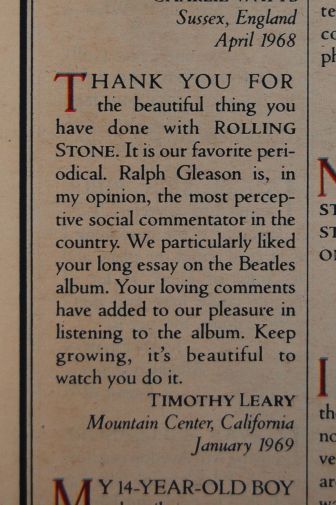
What struck me most about the issue, aside from the fact that I was holding a piece of history, was that Rolling Stone was once young. Timothy Leary wrote to the nascent magazine in 1969, “Thank you for the beautiful thing you have done with Rolling Stone… Keep growing, it’s beautiful to watch you do it.” I’ve never known a time when Rolling Stone didn’t exist, and here, this issue of RS on its tenth birthday, was proof that it was once a child. That it was just a baby during the period portrayed by Mad Men. When I read Timothy Leary’s words of encouragement to the young magazine, it hit me that Rolling Stone, at one time, was an emerging journal, like the ones I might submit my writing to today.
I leafed through the Leibovitz spread, with shots we’ve seen a million times of Jerry Garcia lying on his back on a beach; Keith Richards passed out; OJ Simpson in his Buffalo Bills uniform; Salvador Dali ear to ear with Alice Cooper; Mick Jagger and Keith Richards, shirtless and stoned; Brian Wilson in a blue bathrobe, his surfboard under his arm. I thought, this all really happened, and these photos were fresh when this magazine came out.


I loved reading commentary from Annie herself about “playing” with her subjects in order to get shots, like when she bought Linda Ronstadt $60 red underwear for a shoot and was scared about how Ronstadt might react, or when she shared her experiences of a subject, like that “Brian [Wilson] seems to be on acid all the time.” You don’t see those notes when one of her iconic photos is used in a nostalgia piece on Jerry Garcia, or you find her portrait of Dali and Alice Cooper on a poster in a head shop.
But my favorite part of the magazine, and not just because we’re watching Mad Men, was the advertising.


There are a couple of cigarette ads (including Vantage and the Marlboro man), a few car ads (Volkswagen rabbit, Toyota Celica, Le Car from Renault), liquor ads (Seagrams 7, Two Finger Tequila, Southern Comfort, and Gordons Gin, complete with 51 gin cocktail recipes), and my favorites, full page pieces for albums that were new at the time, like “‘Boston 2.’ On Epic Records and Tapes,” David Bowie’s “Heroes,” and Queen’s “News of the World,” all new releases in 1977, when this copy of Rolling Stone went to press. The remainder of the issue is full of ads for turntables, cassette players, speakers, headphones, and reel to reel recorders. Even better than the merchandise, though, are the sales pitches, like this one: “Now you can have something in common with FM stations. This Technics turntable.” Because radio stations once played vinyl records. !. I also loved Sharp Eye’s line, “It ends the hit and miss method of finding songs on tape.” Remember those days? When we listened to cassettes and there was no easy way to advance to the next song?
And that final ad, the yellow page with the checklist? We had that record cleaner. I remember when I was young, a 1980s adolescent exploring the music of the 60s and 70s, I’d squirt a drop from that tiny red bottle onto my parents’ vinyl records (Mom had every Beatles album, Dad had all the Rolling Stones) and using the discwasher with the velvety pad and the wooden grip, I’d run with the grain of the records’ grooves, wiping “microdust” with each swipe. The vinyl would shine black when I was done. I’d pluck a dust ball off the turntable’s needle, place the record on the spindle, turn it up loud with the big silver knob, and lie back with my eyes closed, my hands behind my head, to listen to Pink Floyd, or Queen, or any one of the surprises contained inside those mysterious album covers.
On Mad Men, there’s scorn towards the advertising world from the counterculture who consider themselves enlightened, and superior, and anti-establishment. They look down their noses on consumerism and the shallow jingles that ad agencies churn out, favoring the high culture of theater or beat poetry. But I have to say, as I leafed through this Rolling Stone, the ads are what gave me a real glimpse into 1977. Unlike iconic photographs by Annie Leibovitz, or fiction by Hunter S. Thompson, advertising is fleeting. The ads were the details that showed what daily life was like for regular people – what they wore, how they combed their hair, what they were buying that year (discwashers!). Because they are ephemeral (and, we like to think, culturally unimportant), we forget about advertisements as they update to the newest product, the latest campaign. But more than anything else about the issue, when I saw those reel to reel recorders, and all those record players, it was the ads – those snapshots in time – that brought back memories. They are what dated the magazine. It was not only the letters from John and Yoko, or the timeless photographs of ’60s and ’70s rock and roll icons, but also the ads, penned by Mad Men era creative teams, with shallow one-liners and feathered hair, that revealed the culture of 1977.

