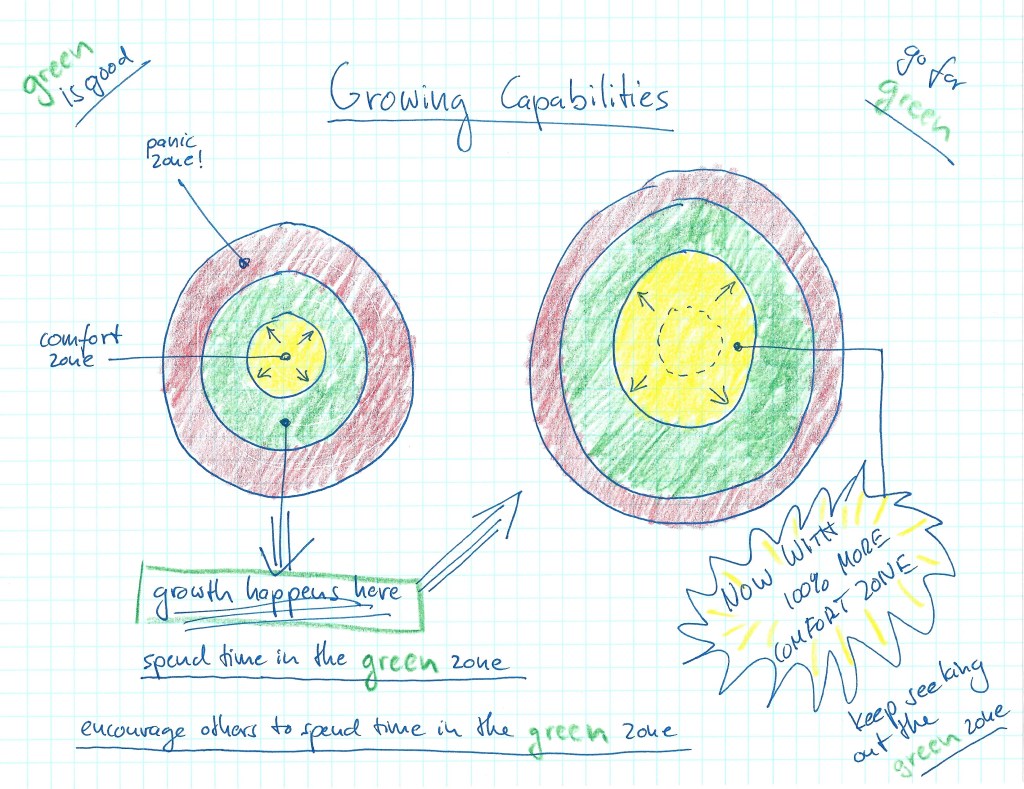
Data scientist Martin Remy once gave a talk about how we can grow our capability. He drew a picture with a small center circle, then another circle around that one, and a third, larger circle that encompassed both. The center circle he colored yellow and named it the comfort zone. The outer ring, he colored red and called it the panic zone. The middle ring, between the comfort zone and the panic zone, he colored green. He named it the growth zone.
Credit: Martin Remy (he has not published this yet but gave me permission to use it. And I quote, “Open source ftw.” Thank you Martin!)
The comfort zone is a place where we know what we’re doing and we’re comfortable doing it. It’s where we feel natural and capable. It is safe. It doesn’t require a lot of effort to occupy the comfort zone; the comfort zone is a place where you can coast. The thing with the comfort zone is that it can be a place of contentment, but it may also be a place of complacency. If you only hang out in your comfort zone, you may feel a sense of stasis. For me, staying inside my comfort zone manifests as a sense of feeling stuck in a rut.
The red panic zone, by contrast, is a place so filled with risk and unknowns that by entering it, there’s a good chance you will careen off the road, crash, and burn. In the panic zone, you are far enough outside your element that have no tools to navigate it; you have no control. You’ll make poor decisions that will be hard to recover from. We should all avoid the panic zone.
The place in between, though — the green place, the place that’s outside our comfort zone but not so far outside that we cannot handle it — is where we grow. It’s where we build on what we do know and are already skilled at, but we push ourselves a little further, into new territory. When we do that, when we push into the growth zone, we add to our knowledge, we add to our confidence, and we make our comfort zone even bigger: we are more capable at more things after we venture into the green growth zone.
In my writing life, writing in my journal is 100% inside the comfort zone. It is the center of the comfort zone: it doesn’t even come close to the edges.
Yesterday I went outside my comfort zone when I published my Writing in 2021 post. It’s one thing to confess fears and attempt to dispute them in the privacy of journal pages, and especially to write cheesy affirmations for yourself. But to publish all that? That’s uncomfortable. There’s nowhere to hide.
Because it was going to be public, though, I analyzed my negative self-talk more thoroughly than I likely would have if I’d just dashed off examples in a journal that I’d never look at again. This meant I was able to find relevant evidence to dispute those stories, and most importantly, to formulate affirmations that address the specific things I worry about. Writing for publication made me really process what I think so I could understand it myself. Only then could I express it clearly to others.
Now it’s out there for me to hold myself accountable and refer back to. If I hadn’t pushed myself to publish that post instead of secreting it away in my journal, I don’t think I’d have gotten to the point of how to move beyond the stories I tell myself, and to identify things I can do differently to change the narrative. I’m in the growth zone! And the thing is, since I’ve pushed myself into this uncomfortable place before, it’s getting easier each time. “Publish embarrassing stuff on blog” is still not in my comfort zone, but it’s now nearer the line between yellow and green, and I understand myself a little better to boot.
I generated a lot of negative self-talk about my writing in 2021. I didn’t blog as much as I wanted to. I didn’t write as much as I wanted to. I don’t know what to write about. I write about the same things over and over again. I write too much about myself. I’m boring. I don’t write anything useful/interesting/thought-provoking/beautiful.
And so on.
In 2021, I also listened to a lot of podcasts about happiness. Because, see first paragraph. I was on the rowing machine at the aquatic center in December when a particular episode on how to squash negative self-talk made me stop rowing to pause the podcast and take notes. The advice I noted was this:
Monitor negative self-talk
Dispute
Affirm
I felt bad again last week about my writing rut. Yesterday, when I wrote my Reading in 2021 post, I thought about my writing in 2021. I remembered the advice from the podcast, and I wondered: what did I actually write in 2021 compared to the stories I tell myself about my writing? Can I dispute my negative self-talk with evidence? And if so, what’s a more positive story I can tell myself?
The first story I tell myself: I didn’t write much
One of the stories I tell myself is that, aside from my journals, I didn’t write much last year. I don’t blog like I did in my early blogging years, before I was, you know, employed full time.
Gathering evidence on “did I write much?” is pretty easy. The first step is to remember that I also write at work. I can grab annual stats* on word counts and posts published for my blog, we have similar stats at work (because I work for the company that makes WordPress.com), and I can calculate how much I wrote by hand during the year based on the number of pages I filled and how many words I average per page. Here’s what I found:
Personal
Professional
Handwritten pages filled 590
Handwritten pages filled 150
Handwritten words 265,000
Handwritten words 54,000
Blog posts 84
Blog posts 647
Published words 34,000
Published words 258,000
Total words written 299,000
Total words written 312,000
Words I wrote in 2021
The evidence shows that it is true I didn’t publish much on my personal blog compared to how much I journaled, but I still published 84 posts, which averages to about 7 per month. That’s not bad considering I work full time, I suppose. The word count of my blog posts is equivalent to the length of a novella.
The evidence also shows that I write a lot for work. Objectively, I would say that 258,000 words qualifies as writing much. For a sense of scale, that’s more words than Moby Dick (206,052) or Crime and Punishment (211,591), though of course, not as much as Lonesome Dove (365,712) or Anna Karenina (349,736) (reference). Sure, some of those work-related posts and words are meeting notes or notices of when I’ll be out of the office, but it’d be too much effort to remove those, and they are relevant for work: they are written communication, which is essential in a distributed workplace.
In total, I wrote approximately 611,000 words in 2021, which is more than the entire Lord of the Rings series (576,459), including The Hobbit.
Affirmation: I write a lot. Even if it’s not high literature or published work, writing is like breathing: I do it without realizing it.
The second story I tell myself: what I write isn’t great
I realize I am comparing the word counts of my personal journals, hobby blog posts, and work-related memos to great works of literature. This is not lost on me. It feeds into the second story I tell myself about my writing, which is that I don’t write the kind of stuff I like to read. What that really means is that is that I’m not an amazing epic writer. I am not a story-teller, I don’t have the imagination to craft narrative arcs, create characters, go deep with ideas and produce great works of art.
I don’t have evidence to dispute this. I especially don’t have evidence to dispute this if I’m comparing what I write to the novels and short stories that awe me. I really have to deal with this one, though, because otherwise I’ll never be happy with what I write.
If I go deeper, and identify what moves me in the art I admire, I think it comes down to three main things: connection (I can relate to what the artist presents and so feel connected to them or to humanity or to something bigger than all of us), awe (that such beauty and creativity exist in the world), and change (the work makes me see or think or act differently after experiencing it).
At a much smaller scale than the great artists I admire, I can look to some of my blog posts or ideas that I’m really proud of and see hints of those three elements in some of them: readers and colleagues will comment or message me that they can relate to what I wrote (thank you, it means so much when this happens ♥️) or that something I wrote was beautiful (I feel like I’ve done something good when this happens ♥️), and at work especially, I’ve written things that did effect change, like suggesting a writing coach program that has since been implemented.
Affirmation:My writing doesn’t have to be great. Sometimes what I write brings goodness to people, and that’s what I really want.
The third story I tell myself: I don’t have ideas
The final story I tell myself is that I don’t have ideas. I don’t know what to write about. I recognized myself in a book I read recently, Miss Iceland. The main character is a “real” writer, who churns out stories and poetry and novels because she is compelled to write: she is so full of ideas, she can’t not write, and everyone wants to publish what she writes.
She is not the character I identified with. Instead, the character I identified with is her poet boyfriend who spends all his time sitting around talking about writing with other would-be writers. When he realizes his girlfriend is a real writer, and comparatively he just wants to be a writer, he says to her:
The truth is I can’t think of anything to write about. I have no ideas. Nothing that’s close to my heart. Do you know what it means to be ordinary?
Audur Ava Ólafsdóttir, Miss Iceland
Ouch. I’ve written variations of those first two sentences dozens of times on my blog or in my journals. I am a cliche.
I know that a lot of what I write is just blathering about nothing, but in the 600,000 words I wrote last year, there are surely ideas, even if accidental. If I look through blog posts, I see some idea-based ones, like the benefits of journaling or how an empty morning feels full.
I think what’s really going on is that I have ideas, but it takes effort to develop those ideas. That I write at all shows I have plenty to write about. Time and mental energy are finite resources, though. If I’m worried about having publishable ideas, I need to remember my professional writing. That’s where the majority of my writing energy goes right now. My writing life at work is rich and satisfying: I outline, I sketch, I develop ideas, I think about structure and audience and outcomes, I draft, I refine, I proofread, I publish.
When I get down about not having ideas, it’s usually related to my personal writing. I need to affirm that I do have ideas, and remind myself that it takes effort to develop ideas. Having ideas and developing ideas is an important distinction. The distinctions puts me in control of how I want to use the time I carve out for my personal writing: I can continue to use all my writing time to free-write and just get stuff out, or I can allocate some of my time to developing ideas.
Affirmation:The fact that I write is evidence that I have ideas. Developing ideas requires effort that I can choose to dedicate if I’d like to. I dedicate considerable energy for publishable work to my professional writing. Also, Miss Iceland is a fictitious character.
What’s next
These issues are not new: I’ve written about them before. I have to remember these affirmations. Also, nothing will change if I don’t change something. I started a list of writing assignments for myself rather than using random prompts that don’t inspire me. I’ll change up my practice and see what happens.
*If you have a blog on WordPress.com and want to check your annual stats on how much you wrote, log into your account and go to wordpress.com/stats/day/annualstats/[yoursiteaddress]. For example, when I’m logged into my account, I can see my stats at wordpress.com/stats/day/annualstats/andreabadgley.blog.
I blogged a few weeks ago about how learning is an exercise in mindfulness. At the time, most of the learning I did was via reading. I consumed information through books; I didn’t do anything. I didn’t practice anything new. I often found my mind wandering as I read to learn, and it didn’t feel mindful at all.
Yesterday, as I began to enjoy my pens and inks again after taking them for granted for a while, and as I grimaced at my chicken-scratch handwriting, I decided I want to improve my penmanship. My fountain pens are pretty. My inks are pretty. I want my handwriting to be pretty, too.
I searched online for handwriting exercises. I searched via Google. I searched via Instagram. Most of the resources I found are worksheets for kids using New American or Zane-Bloser cursive, which I don’t find to be particularly attractive.
Eventually I found an app, Handwriting Secrets, that’s already taught me things I can do to improve my existing handwriting before looking at new ways to form letters. The key to nice handwriting is consistency: consistency not necessarily in the shapes of the letters, but in their height, width, and slant, and consistency in the size of the spaces between words (spaces should be the width of the letter n).
This gave me something to practice in my own writing. I’m terrible at it when I’m trying to neaten my handwriting while also getting thoughts on a page. My slants are all over the place, from upright to to-the-right, the width of my letters vary, and the spaces between my words are more like ww than n. It’s distracting to think about my handwriting while also capturing my thoughts, and I find it hard to do both at the same time. But what excites me is that I can practice in other ways and get to play with my pens and inks in the process. I can transcribe writing that’s already written. I can do handwriting drills. I can copy favorite quotes with fountain pens and flowy ink on thick ivory paper.
This practice is all-consuming when I’m doing it. It requires my full attention, in the present moment. I pay no attention to time. The only thoughts that run through my head are concentrated on the act of making shapes and trying to keep height, width, slant, and spacing consistent. And at the end, I have something pretty to look at, even if it’s nonsense shapes from handwriting drills.
I seem to be having personal problems with calendars and scheduling this week. So much for my 1-day buffer for lining up and editing blog posts. I accidentally published two posts yesterday right on top of each other. One of those – the one about me misreading my calendar — was intended for today, but consistent with the content of the post, I calendared wrong.
I was glad to have an extra day to keep working on that post because I wasn’t sure I was happy with it, then I got a notification that it had published, so so much for that. Good thing I don’t care about whether something is in good shape for publishing.
I guess this is one of those reminders from the universe to not get too comfortable with the control I think I have.
I opened my notebook to find a sticky note to myself: “Free write about the benefits of journaling.” I left it the other day when I read a chapter in the Little, Brown Handbook about journaling and felt a thrum of excitement about what I learned there. Until I read this chapter, I’d felt like journaling is the easy way out for me for writing. It’s comfortable and private and I don’t have to worry about how I write or whether the structure makes sense or if there are too many words. So journaling almost feels like cheating.
And then Little, Brown gave me this:
Indeed, journal keepers often become dependent on the process for the writing practice it gives them, the concentrated thought it encourages, and the connection it fosters between personal, private experience and public information and events.
– H. Ramsey Fowler and Jane E. Aaron, The Little, Brown Handbook
I’ve been transcribing my journals from 20 years ago to digitize them. Random entries here and there describe how I’d get mired in my thoughts and feel overwhelmed by them if I didn’t write. I developed a habit of pouring my thoughts onto paper so they wouldn’t confuse me and wrap in on themselves and make a tangled knot in my brain. I developed a habit I’ve become dependent on.
I became dependent on journaling as a way to sift through my thoughts, to express my feelings, to examine my troubles. Journaling has built a way for me to process the world via the written word. I remember when my brain scared me because it was such a mess in there. It made me feel panicky, and I wish I could go back and give 25 year-old me a hug. I rarely feel those snarls in my brain anymore, and I credit my journal for that. It’s almost like a part of my hygiene routine: I brush my teeth, wash and comb my hair, and journal.
If unsnarling the thoughts in my head was where the benefits of journaling ended, it would be enough. I’m that grateful to it. But it goes deeper than that. Writing doesn’t just untangle the thoughts in my brain to keep things a little smoother in there. Processing my thoughts through a pen helps me connect ideas, dissect thoughts, examine the world and myself. I learn through journaling. I learn about myself and what I think. I grow as a result.
Recently I realized I’ve been telling myself a story that I think may not be true. The story I’ve been telling myself for years is that I don’t have ideas, and specifically that I don’t have ideas to write about. As I read Little, Brown‘s tips for generating writing topics, I realized I have a lot more ideas than I give myself credit for. I need to change the story I tell myself. I do have ideas and thoughts and feelings to write about. I do it every day if I’m not worried about what someone else would think.
Journal writing frees me to just write. Whatever and however I want. It’s liberating because nobody is going to read it. It frees me from the analysis if “Is this clear? How do I say this with fewer words? Am I getting my intention across?”
Instead of stopping to rethink, edit, revise, and interrupt my thoughts like happens when writing for readers, with a journal I can write whatever comes. I can brain dump or heart dump or soul dump, and I can write a thought five different ways if I struggle to articulate it to my satisfaction. It can all go onto the page, I don’t have to stop anything to check and recheck, I can just pour it out in words. After years of journaling I like to spice things up by experimenting with sentences, verbs, exercises, or tips I get from writing books, but even that is just play.
And that leads to the final, unintended benefit of journaling for me. Journaling has built a way for me to process the world via the written word. And what this does is give me practice. I do like to communicate via writing. I do want to actually publish on my blog and write meaningful and useful stuff at work. I’ve been beating myself up that I write secreted away in ink on paper, in my own bubble. That for journaling I don’t need ideas, I can just write. I’ve been telling myself that journaling is the easy way out because I don’t have to think about all the stuff that needs to happen when you’re using words to actually communicate with others.
That’s another story I can now change. Journaling is not a cheat; its ease does not diminish its value. Journaling keeps the machinery oiled. It maintains my writing engine, and that makes it easier to transition to writing for my blog and writing for work. And I love that. So very much.
I have 35 minutes until my food settles enough that I can go for a run. I want to write. I want to write up one of the ideas on my (very short) list of ideas. The list is only three items long. Any one of the items on it would do.
Yet. I can’t make myself start. I look at the list. I journal instead. I read books about writing. I try to think of more ideas. I think, “Maybe I’ll meditate first.” I worry, “I’ll probably get inspired on my run and then I won’t be able to write because I’ll need to start my workday.”
I could just pick an idea and get going on it. Say, okay, I’m going to do this. I’ll set a timer and go. But I know myself. When it comes to writing for pleasure, if I force it, nothing comes out right.
I know procrastination can be good. It gives the mind time to percolate. I’m reading Deep Work right now, and in it there’s a section on the necessity of downtime to be productive. The author advises that some things will come out better if they’re sorted unconsciously rather than consciously. That it’s okay to get your mind going on an idea, then step back. The idea might need a break from direct attention so your brain can make connections quietly behind the scenes.
I tell myself that’s what I’m doing now. I want to write about going from a place of time scarcity to a place of time affluence. I worked with a coach on this and have built habits that have stuck.
Yet, suddenly a textbook for an English composition course is endlessly fascinating, and I’m struck by how much I love to read about writing, and I’ve written two journal entries and transcribed pages from my diary, and I’m thinking about looking up the reference for why it’s good to procrastinate, and I started a notebook of ideas somewhere, I should go find that.