Even at noon in October, the light is beautiful. It shines gold on earth, making the blue sky even bluer.
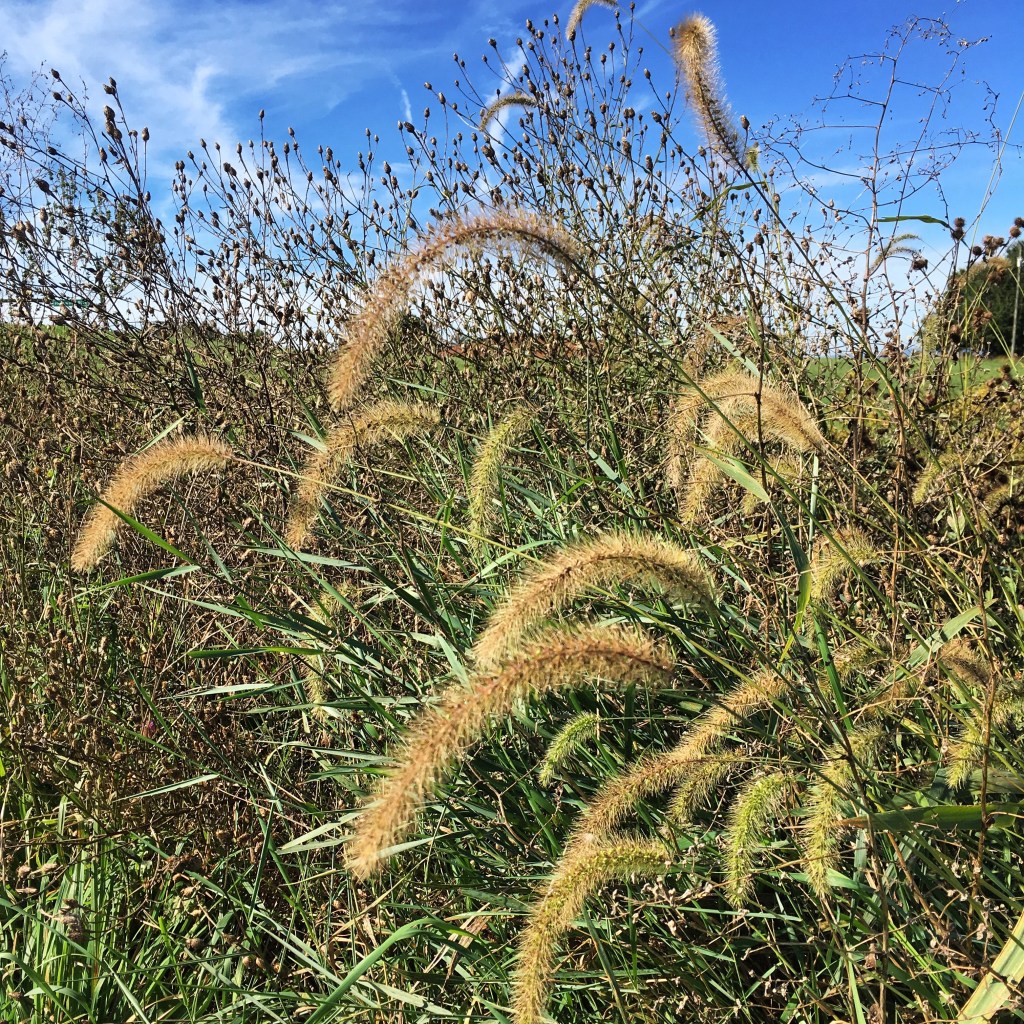
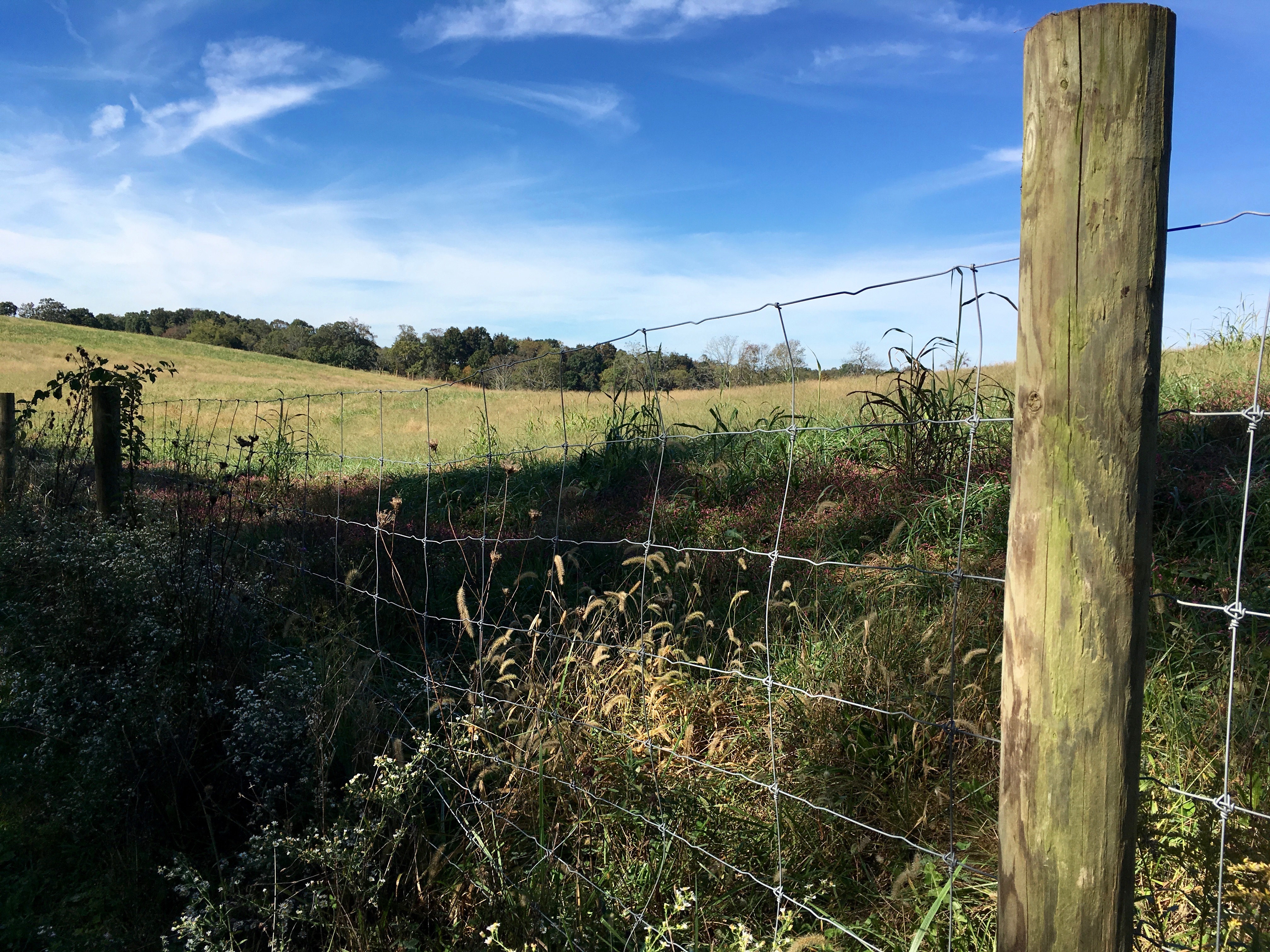
On my flex day yesterday, I walked the path I used to walk every day when we lived at our old house. I listened to the New Yorker Fiction podcast and snapped photographs of October meadows against a cobalt sky.
I read fiction this morning. On a Tuesday, on the couch, at 7am, with my smoothie.
I never read fiction in the morning. I read it on the weekends after my chores are done. I read it at night after my day’s work is done. Fiction is a reward: it is my treat for working hard. It is my delayal of gratification.
Usually on a weekday morning with my smoothie, I sit on the couch not with a novel but with my phone, scrolling through communications at work that took place after I signed off the day before, catching up on P2s (internal blog posts), and going through my calendar and to-do list for the day. Then I switch to coffee and start writing for work, whether replying to backscroll on Slack, responding to P2s, or simply saying good morning and hanging out (via text) at the water cooler.
Today with my coffee I’m writing for my own blog. Like reading fiction, blogging is a reward to me. I love days off so I can write for me or for Butterfly Mind, even if only for a few minutes.
So why all these rewards on a Tuesday? I’m working this Saturday and I’m taking a flex day today. While it’s often tricky to work a weekend day, what with soccer games and swim meets and transporting kids and having kid friends over and doing generally anything with the family since weekends are the only occasion we all four have time off together, I love working a weekend day when I can. Weekend work is often quieter and more focused because there are fewer folks online working, but also, weekend work means a flex day during the week.
And I love days off during the week.
I ran by the grocery store after dropping my husband off at work this morning and it was quiet and empty. Going to the grocery store when everyone else is at work is pretty high on the list of why random weekdays off are awesome.
When I take a weekday off, the house is also quiet and empty. The kids don’t need to be driven anywhere, and I can take care of things we are often too busy even on the weekends to get to. I have a stack of doctor bills and FSA paperwork to go through today, which I’m dreading, but at least I’ll have a quiet space to do it in. I’ll also be able to take care of this lawn that’s out of control after Saturday’s rain.
Maybe I’ll even go for a walk outside instead of on my tread desk, and listen to Annie Proulx read on the New Yorker Fiction Podcast.
And during the day, despite whether it’s morning or night, or whether I’ve finished all of my flex day to-dos, I’ll take breaks to write in my journal and read fiction, simply because I can.
If you like the sound of this kind of flexibility in your work, why not join us? We’re hiring.
The garden is transitioning from summer to fall. The milkweed is mottled and scraggly, the sweet basil is yellowed and setting seeds. The parsley bolted, the Thai basil fell over under its own weight.
It’s time to do some cleanup.
Yesterday it rained all day. It was one of my favorite types of autumn Saturdays: chilly, grey, raw. We spent most of the day running errands. We bought new alarm clocks for the kids, harvest candles for the mantle, pumpkin-pie-scented wax melts to make the house smell autumny, and at the last-minute, mums for the garden.
Our daughter and I spent a good half hour inspecting the different colors of mums, gravitating repeatedly to particular ones (white for our daughter, burgundy for me), thinking about the colors in our garden, looking at pictures of the flower bed on my phone, and brainstorming what we needed to clear out and where we could put our favorite-colored specimens.
Today, the drizzle and pregnant grey are gone. The sun shines bright in a clear blue sky, and raindrops glisten on the green grass. The mums are out there waiting for me. I see our daughter’s white ones in a happy clump where the parsley once was. The wind is chilly right now, though, despite the brilliant sun. I’ll need a jacket and gloves while I work.
For now, I’ve got my slippers on and am sipping coffee from the chair by the window. Leaves shiver on the pear trees across the street, maple branches swing, and coneflowers and salvia nod in the wind. I’ll plant the mums when my cup is empty.
Don’t let anyone tell you words don’t have power. When my husband and I shopped for toilets recently, I could not stop giggling at the language used for selling what we all want most from a toilet: to hide the evidence. More than that, our trip to Home Depot showed me that having a gift with words doesn’t always mean writing novels. You can name paint chips. You can classify laminate flooring.
You can market toilets.
VorMax for maximum vortex flushing
The Optum™ VorMax™ box needs to be read in a booming, between-plays hockey arena voice, with flashing disco lights.
VorMax™ flushing system delivers a POWERFUL stream of water that SCOURS the ENTIRE bowl.
That’s a potent sentence, even without the hockey voice. It conjures images of a high-velocity, unstoppablevortex of clean, clear water extracting everything in its path, like a movie whirlpool that’s so powerful it sucks ships to the bottom of the sea.
I puzzled a bit over the “dirt” word choice for the CleanCurve™ Rim, though. Do people usually have dirt in their toilet bowls? Perhaps that was just thrown in to draw attention away from the more graphic word in the sentence: “buildup.”
A whole bucket of golf balls? In a single flush?
The marketing on this one makes me want to buy the toilet just to try to flush golf balls. It also made me laugh at the cleverness of conveying “ewww” invormation in such a sterile way. Look how white! Look how clean! Look at the sparkle in the “Fight stains with Everclean®” image! Even though it’s not golf balls you’ll be flushing, your toilet can look like this, too.
The next one is my very favorite, though.
AquaPiston: it’s a locomotive in there
This toilet is going to work hard for you. You’re going to open up the tank and it’s going to be like a train locomotive, with pistons pumping, and water sucking, and the toilet bowl flushing with such force it might pull tissues out of the box and down into the vortex if you’re not careful.
I can’t remember which toilet we ultimately ended up buying, but I had a lot of fun shopping for it.
I sure would love to see all the jokes the marketing teams wrote when describing the glories of their toilets.
I started reading the US in three books per state in January of 2014, nearly three years ago. I just finished reading Kansas, the 17th of 51 states (and the District of Columbia).
When I returned home after a weeklong trip to Whistler, I was giddy to walk around the garden and find not one monarch butterfly emerging from its chrysalis, but two.
Newly emerged monarch on rueAfter finding those, I of course crawled around in the mulch and dirt to inspect the undersides of leaves. I found three more monarch chrysalises plus a bunch of fat swallowtail caterpillars who will soon be crawling off to metamorphasize as well.
This is SO EXCITING Y’ALL. Here’s a full caterpillar catalog of what I’ve found so far:
Some friends at work are also interested in butterfly gardening, and are looking for host plant ideas. Since we work for a company that makes, ahem, blogging software, my friend naturally asked “Did you do a blog post on what all you planted?” Nudge nudge.
Shockingly, I have not. So here it is! Kris and Liz, this is for you.
The plants
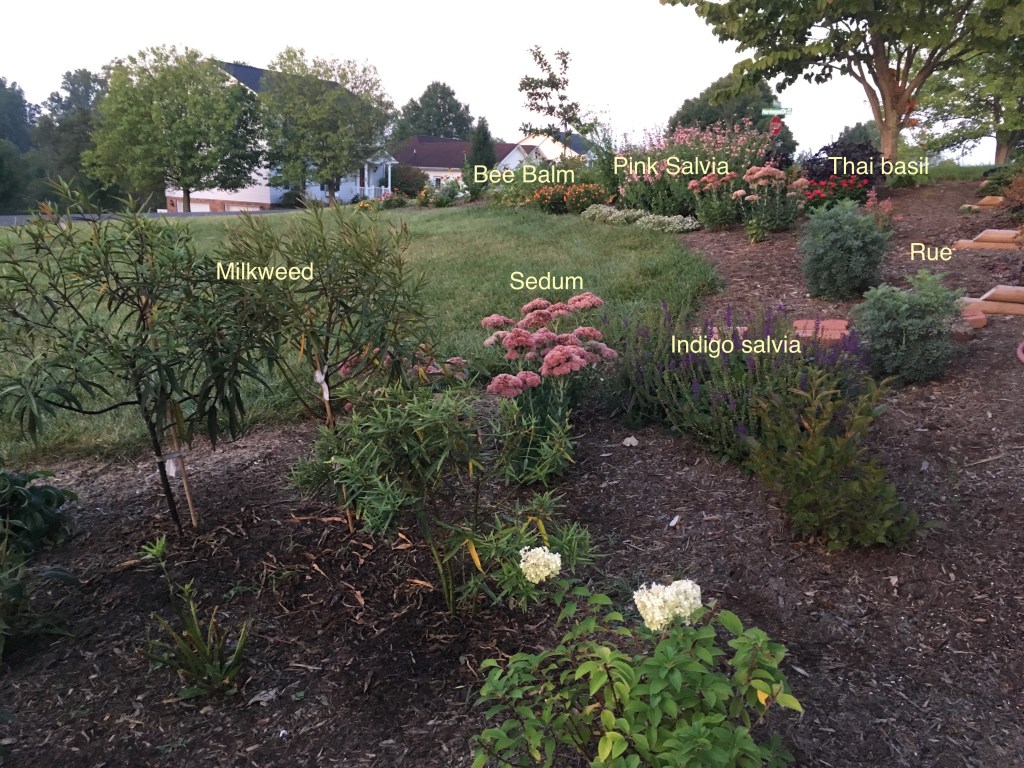
For Mother’s Day, our son gave me Christopher Kline’s book, Butterfly Gardening with Native Plants: How to Attract and Identify Butterflies. Combined with a bunch of online research, experimentation with a butterfly garden in Florida, and talking to bunches of people who garden for butterflies and caterpillars, this book helped me plan a garden that includes both host plants (that caterpillars eat) and nectar plants (that adult butterflies drink from). The most successful plants in our garden are the following:
Host plants
Milkweed (Asclepias): We planted both common milkweed and swamp milkweed. These are by far the most insect-loved plants in the garden. They are constantly covered in various species, including aphids, beetles, and, late in the summer, monarch caterpillars. Milkweed is both a nectar plant and a host plant. We’ve seen adult giant swallowtails and monarchs drinking from its flowers, and have found at least a dozen monarch caterpillars on it. Word of warning: milkweed will get covered in aphids. The caterpillars will still come even when every surface is crawling with aphids, so we kept our milkweed intact even though it’s not very attractive once it has stopped flowering and it’s coated in tiny orange insects.
Rue (Ruta graveolens): This is possibly my favorite addition to the garden. The leaves are a silvery blue-green, the plant stays neat and tidy (it doesn’t get leggy or messy), it can take the heat (and drought) and still look healthy, and the swallowtail caterpillars adore it. As an unexpected bonus, the monarch caterpillars love it for building chrysalises. We’ve found at least 3 chrysalises in the small, shin-high plants.
Butterfly host and nectar plants
Nectar plants
Milkweed: all the butterflies big and small love milkweed.
Indigo salvia: Aside from the milkweed, these purple flower spikes are the most popular in the garden for butterflies to drink from. Bees also love these flowers.
Pink salvia: Okay, maybe these are tied with the indigo salvia for nectar popularity, at least for hummingbirds. I see hummingbirds drinking from these almost every time I sit in the garden.
Bee balm (Monarda): Butterflies and hummingbirds love this as well. Hummingbirds dart between the pink salvia and the bee balm.
Thai basil: I’ve seen some small butterflies and moths (and caterpillars) on these flowers.
Butterfly host and nectar plantsCone flowers: Butterflies always visit these.
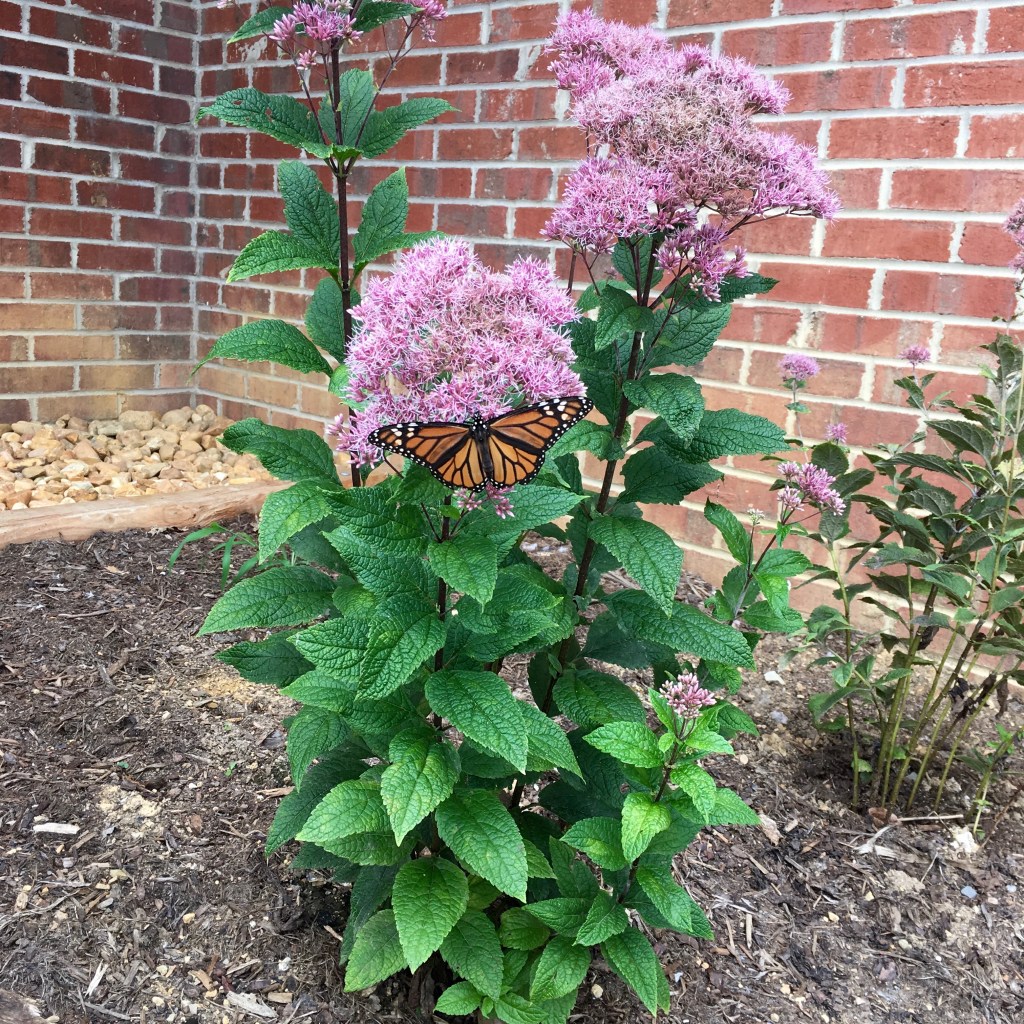
Joe Pye weed: Butterflies love to drink from Joe Pye flowers. Joe Pye weed gets really tall and floppy unless you get the dwarf varieties.
Monarch on Joe Pye weedWe planted some other things that weren’t as awesome as we expected:
Parsley: parsley is a host plant for swallowtails, but the swallowtail caterpillars definitely opted for the rue over the parsley, at least this year. I didn’t find any caterpillars on the parsley, and found at least a dozen on the rue.
I guess the parsley is the only one :-). We have lots of other nectar flowers — brown-eyed Susans, Mexican blanket flowers, some other stuff I can’t remember the names of — but the ones I listed above were definitely the most successful.
If you can identify any of the caterpillars in the catalog, please let me know! I think most of them are probably moths, but I don’t have a good ID book.