I was unloading the dishwasher the other day, and my wedding ring clinked against a glass bowl, making a sound so similar to a sound from childhood that I was transported instantly to a motorboat, zipping through briney rivers, the sun on my face and the wind in my hair. I even caught a whiff of salt air.
I grew up on a tidal creek off the coast of Georgia (on a small “hammock” island just before you get to Tybee Island), and we spent every weekend during the summers out on the boat. My mom was in charge of the beach bag, chairs, towels, snack foods, lunches, and packing the cooler, and my dad was in charge of everything relating to the boat and the dock – fuel, mechanicals, boat and dock maintenance, crab traps, lines, first aid/life jackets, and driving the boat. My brother and I would cast us off, then I’d take my seat in the bow, my head hanging over the side like a dog, and Adam (my brother) would hang out by the steering wheel with my dad. And as we pulled away from the dock, when my dad first put his hand to the stainless steel wheel, his wedding band would clink against it.
Throughout our hundreds of hours on the rivers, the clank of my dad’s ring on that steering wheel was as much a part of the weekend soundscape as the buzz of the motor, and it always, always made me feel safe, and secure, and loved. The sound, because it was made by his wedding band, was an audible reminder of my dad’s love for my mom, and for us, his family. And because it was tied up with my favorite thing on earth (riding around in the boat with my family) the clang of of his ring against the stainless steel wheel captured every good memory, every happy feeling of those childhood summers – the salt smell of the air, the warmth of the sun, the fun of the four of us being together, the freedom of the wind and the water, the thin crust of salt on our skin at the end of the day. Cold Cokes and salty snacks.
So when my wedding band clinked against a glass bowl the other day, that little sound filled me up. I could feel the warmth swelling in my heart til it overflowed. I was there again, as a kid in the boat, with my dad at the wheel. I was safe, and free, with salt air in my nose and the wind in my hair. It made me wonder what small thing, whether a sound, or a scent, will send my kids back to childhood when they’re grown, standing in their kitchen, remembering.
I wrote this in July, 2011 and published it here on June 17, 2012. I wanted to republish it today for Father’s Day. Happy Father’s Day, Dad!
Art Credit: KendyllHillegas on Etsy, Key Lime Pie original illustration
Tart. Tangy. Zesty. Zany. Key Lime Pie: it’s yellow, not green.
You might think if I was going to write about pie in Georgia I’d write about pecan, all sugary and whiskey brown, the pecans a toasty crunch then a succulent give between the teeth, or maybe peach with its sensual slippery melon-colored sweetness. But I’m not. I’m writing about Key Lime because it’s hot and humid outside, and when its hot and humid out and I think of dessert, I think of my Dad fishing in the Gulf Stream and the sunburn and the grill and the chilled pie that followed.
Summer dinners of my coastal Georgia childhood – or at least the summer dinners my mouth still waters for – often consisted of blue crabs we caught in the creek, or fresh shrimp my mom bought from the marina under the bridge. We’d follow those warm seafood meals with ice cream or Pudding in a Cloud (chocolate pudding in a “crust” of Cool Whip), but the best days were when Dad ran the boat 4 hours offshore Savannah to where the water changed from coastal brown to deep ocean blue, dropped a line, and brought home fresh fish. He came home salty in the late afternoon, with a raccoon burn on his face from his sunglasses, and before changing clothes or rinsing the boat he cleaned the fish, scraping scales with a flashing silver knife till they popped off and glistened in the sun.
Dad brought the fish up to Mom in the kitchen where she rubbed the fillets with butter and Paul Prudhomme’s Cajun seasoning while he lit the coals in a kettle grill. He sipped beer while he watched the coals, waiting for them to glow. When they burned till each one formed an even crust of ash he nestled a cast iron skillet into them. An onshore evening breeze rustled the palm fronds and cooled his burned skin, and after a while, the cast iron skillet would begin to glow. Dad tossed the seasoned fillets into the red hot pan and they hissed, blackening within seconds. He pulled them off – moist, succulent fillets encrusted with paprika and cayenne, garlic and thyme.
The fish flaked on our tongues, soft and buttery, crisp and spicy, and on lucky nights, the dinner was followed by Key Lime Pie. There was not better accompaniment for blackened fish than that cold yellow silk pie that zinged your tongue with citrus summer and crunched sugary buttered graham between your teeth. Mom made the pie while Dad bobbed in the ocean, and it chilled while he burned.
I don’t remember now if Dad cleaned up by the time we ate dinner or if he dined with the ocean still encrusted on his skin. I do remember the clean feeling after eating Key Lime Pie, though – that crisp, cool, fresh finish to a hot, salty summer day.
This is my entry for the American Vignette: Pie challenge on Andrea Reads America. I hope you’ll consider submitting. Key Lime Pie recipe follows.
~
Thankfully, Key Lime Pie had a moment in the 80s or 90s and now you can buy Nellie & Joe’s Key Lime Juice nearly anywhere in the US. Or at least on the eastern seaboard. I bought mine at our local Kroger in the mountains in Blacksburg, Virginia. Key Lime Pie is one of the easiest of all pies to make ever. You don’t even have to cook it if you don’t want to – the key lime juice denatures the egg yolks, “cooking” the pie like ceviche. Make it with whipped cream or without, with merengue or without, it’s up to you. I prefer mine neat. Follow the recipe right on the bottle of Nellie & Joes or follow this adaptation from Maida Heatter’s Pies and Tarts:
4 egg yolks
1 14 oz can sweetened condensed milk
1/2 cup Key lime juice
1 9-inch graham cracker crust
You can use an electric mixer, an egg beater, or a wire whisk. Beat the yolks lightly to mix. Add the condensed milk and mix. Gradually add the lime juice, beating or whisking only until mixed.
Pour into the crumb crust. It will make a thin layer; the color will be pale lemon, not green. It will be fluid now, but as it stands a chemical reaction takes place and the filling will become about as firm as a baked custard. Refrigerate overnight.
Or, if you wish [Andrea’s note: this is how I prepare it], bake the filled pie for 10 minutes in a 350 degree oven, then cool and chill.
Whipped cream is optional on this, natives do not use it – restaurants do.
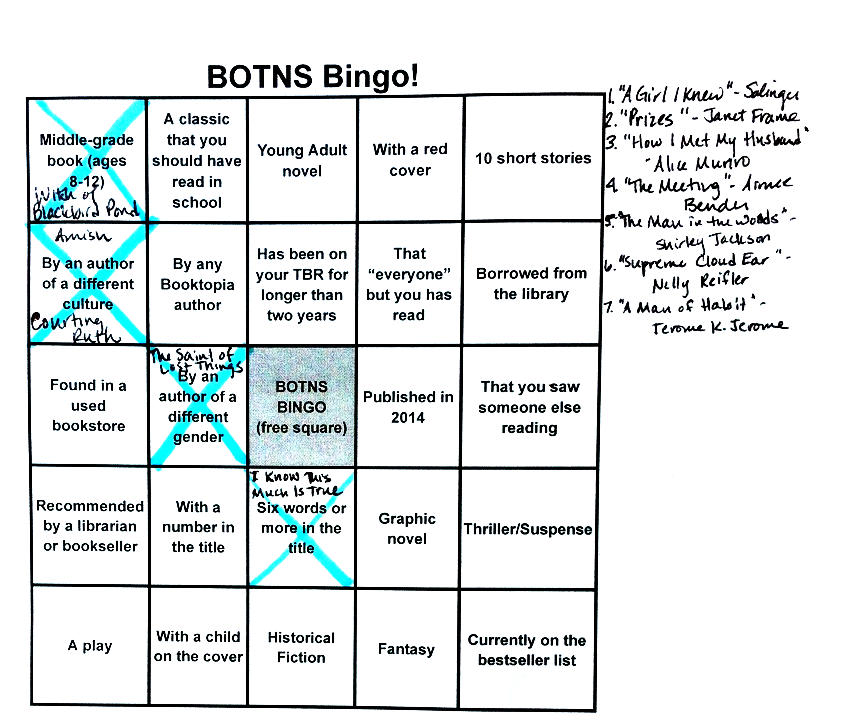
In case there was any question of my coolness, let’s just put that notion to rest: I am currently playing summer book bingo.
But look how awesome that card is!!
As you may or may not know, I am in the midst of an epic reading project. I am reading three books set in each of the 50 US states, plus the District of Columbia, and because diversity of authors and characters is central to the project, my reading this year has expanded into subjects and genres and neighborhoods that I might have otherwise overlooked.
So when I heard Ann Kingman and Michael Kindness talk on their Books On the Nightstand (BOTNS) podcast about how they want to make summer reading fun this year – by designing Beach Blanket Book Bingo card and aiming for a Bingo by Labor Day – I was ALL. OVER. IT. I mean, look at those options! “Currently on the bestseller list,” “that ‘everyone’ but you has read,” “published in 2014.” That last is one I’m particularly excited about. I almost never read brand new books. The wait list at the library is always too long. But the next book I plan to read for Delaware, The Book of Unknown Americans by Cristina Henríquez, was published in 2014 and, get this, I am first on the wait list! It’s killing me to abstain from marking that box with a big blue X. I want to mark it SO BAD. I know I have to wait till I’ve finished the book, though, and I’m just thinking about how good it’s going to feel to squeak my highlighter across that square.
Some folks are attacking their Bingo card with a strategy: they plan to read titles tailored to a specific row on the Bingo card. In the spirit of Bingo as it is played in Bingo halls around the nation, I’m taking a more randomized approach. I’m going to carry on with my reading as I had planned, state by state, Connecticut to Delaware to the District of Columbia, each book a ping pong ball with a BOTNS category stamped on it, and see if I can manage a Bingo before Labor Day. Maybe I can even score a Blackout Bingo – maybe I can fill the whole card.
Do you want to play? Go to BOTNS Bingo! to print out your card; be sure to hit your refresh button to get a fresh card. Then read your books, start marking your boxes, and if you want to follow along with other Book Bingo players, check out the BOTNS Bingo thread on Goodreads.
I just realized I posted my first Butterfly Mind entry two years ago today. We lived in Minnesota at the time and I was supposed to be packing up the house to prepare for our cross-country move. Instead I started a blog. Since then I’ve published more than 250 posts and am still loving every minute of it. Thank you, readers, for making it so much fun to be here. Here’s that debut entry.
My hair drifted around my head like it did when I was a little girl in the bathtub. I’d sink back underwater with my eyes open, tiny bubbles caught in my lashes, and the world would grow quiet but for the tinny gurgle of my escaped breath. My hair would swirl like a drop of food coloring in water. Now, without porcelain barriers, it drifted freely, like a mermaid’s would.
My breath rasped metallic through the regulator, an astronaut breathing underwater – ncuuuuhhh haaaaauuu. Breath and bubbles were the only sounds. The sea was cool on my tanned arms, salty on my sunburned lips, and turquoise blue in the Florida Keys sunshine. Rays of light streamed from the surface when I looked up, like sunbeams through a forest canopy, only instead of being inside an emerald, I was inside an aquamarine.
I was a young woman then – 20 years old I would guess – and after eight years of diving, of adjusting weight belts and vest bladders, I had tweaked my equipment to the point that I could control my buoyancy with my breath. If I sank towards the coral, I filled my lungs and I rose. If I floated toward the surface I exhaled until I sank. “You are cool as a cucumber,” the Jamaican had said on the dive in St. Ann’s Bay. It was the dive where I finally mastered buoyancy, and we had surfaced to the sight of a double rainbow over tropical mountains. A daytime moon hung in the top right of the scene where the sun would go on a child’s drawing.
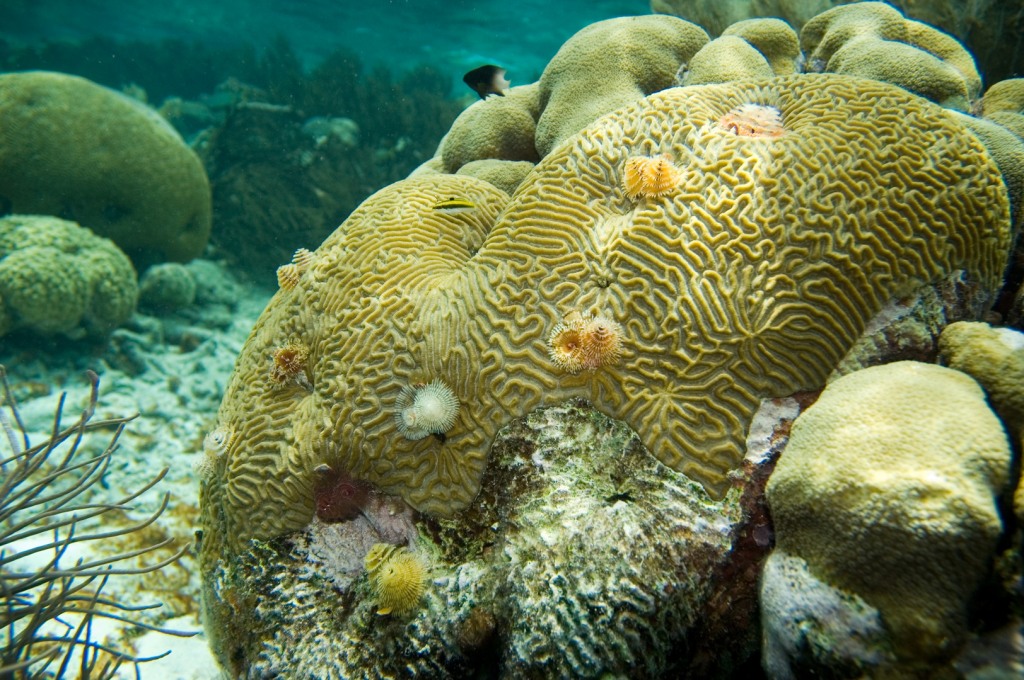
Now, my future husband explored the reef – not unlike when we go to the beach and he walks while I sit – while I floated at a coral boulder and watched the industry of its community. Yellow gobies nipped at the coral, sand blennies popped their heads out of holes then backed back in, a ruffled lime green nudibranch like a tiny lettuce leaf fluttered over the brain coral’s ridges like a two-inch magic carpet. Lobster antennae waved below me like search lights and I sometimes waved my hand just above a feather duster worm to watch it retract into its hole. After a few seconds it would send the tip of a duster out to test for danger then unfold its full feathered fan when the coast was clear.
The salt water puckered my skin, and my fingertips wrinkled like the brain coral. The canned air was cold and dry on the back of my throat and I took the regulator out to push my tongue against my palate, stimulating spit. A Queen angelfish with cobalt-rimmed scales and lemon yellow fins glided by, and later, a boat wake rolled overhead. The wave effect pulled us up and pushed us down, as if the fish and me and my billowing hair bobbed on the surface above instead of swimming 15 feet below.
Then the water calmed again. I saw my future husband hanging upside down, peeking under a ledge where lobsters or maybe a green moray eel peered back. I hovered in the blue liquid world, quiet but for the bubbling of my breath.
This was my work for Writing 101, Day two: “We’re all drawn to certain places. If you had the power to get somewhere — anywhere — where would you go right now? For your twist, focus on building a setting description.”
WordCamp. It wasn’t a camp for writers, or even for word nerds. It was a camp for WordPress wonks, and I loved every second. I must have said ten times, “I feel like I’m on this level,” as I swished my hand parallel to the ground, back and forth at my waist, “And all of you are up here,” and I swished my other hand above my head. “But that’s okay,” I’d say, and I’d smile, and I’d mean it.
I was one of only a handful of writers there, one of a handful of bloggers, and instead of intimidating me, being among all those web designers actually made me feel special. At a writers’ retreat there would be so much opportunity for comparison, for reading someone else’s work and thinking I’ll never be that good, that the thought of a writers’ retreat kind of frightens me. But at WordCamp I didn’t compare myself to these people who write, but in a different language: they write in code.
The rooms, full of creatives, hipster beards and mustaches, fun colorful fingernails and patterned blouses, glasses, web designers, plugin writers, theme developers, who all make beautiful, elegant things only with a different medium from mine, they energized me instead of making me feel less than. I never felt stupid despite how much I did not know. Instead I felt awe, an emotion I predict will appear on the list of core values I plan to construct as soon as I finish this free write.
One of the speakers, Alicia Murray, when she spoke about work life blog balance she posted a slide with a quote from Albert Einstein: a fish is going to feel stupid if it tries to climb a tree (or something like that – find quote) –
Everybody is a genius. But if you judge a fish by its ability to climb a tree, it will live its whole life believing that it is stupid.
– and I could totally relate. She was advising us not to compare, which is a very, very difficult thing to do when I’m surrounded by talented writers. But in a room full of talented code poets, I don’t compare myself. I just thank the internet gods that these poets exist so that they can make us beautiful websites on which we can write our words.
The conference, I should say for all the bloggers who follow me, was not a writing event, and it wasn’t a blogging event either. In fact, it was not a WordPress.com event. It was geared more to the nuts and bolts of designing, developing, and using websites powered by WordPress using WordPress.org (there’s a difference between WordPress.org and WordPress.com, in case you didn’t know). As @Ashevillean tweeted
Wordcamp: NOT a writing event. WordPress-friendly conference for tech professionals: developers, designers, content creators, & more #wcavl
I knew that going in, and I loved that aspect of it, but I just wanted to let all of you know that in case you are considering attending a WordCamp. There were content and beginner tracks, but you need to know ahead of time that the language you hear might be unfamiliar. I used to have a self-hosted website for my soap company, a site that was powered by WordPress.org, and so I was familiar with the language many of the speakers used: plugins, FTP, PHP.
And, with your everyday WordPress.com blogger, very little of that applies.
When we had the self-hosted site I felt like half my time was consumed with managing the website: which plugins to use, which ones had glitches, how to resize my images to fit the theme, who to host the site, how to alter colors, fonts, headers. All by hand. All with very little knowledge. And while we had complete control over the look and functionality of our site, it ate a lot of time I could have spent making soap, or better yet, writing. It was a powerful, robust platform for our e-commerce site, but for blogging, I’m thrilled to use the streamlined WordPress.com and know all that is taken care of. I don’t have to sift through 500 “follow” plugins to find the one that works. If something goes wrong with my site I don’t have to disassemble it and reconstruct, piece by piece to find where the problem was. It’s all there for me and all I have to do is pop in my words.
That being said, I like to know how things work, and I learned a ton this weekend about things I can do within my WordPress.com site to tweak and improve if I so choose, and I understand the back end of a website much better now. I feel empowered by that. On top of sitting in on some great content sessions, I took a refresher on basic CSS so if I want to customize colors or fonts, I can. I learned some SEO tips so I can become more findable when folks are searching for creative nonfiction or literature resources. I learned the basic anatomy of a blog-perfect-story, and how to find balance in my life when I add a job to the mix of blog and family.
And the takeaway I am perhaps most excited about: a link to how to determine my personal core values. Those values will provide guidance as I try to navigate my career path, my blog posts, my writing. Because it’s when you’re writing about what you care about that your voice will come through, and when you have a niche-less (i.e. everything) blog like I do, the thing that holds it all together is not a topic or a product or a theme, it’s the author’s voice. The continuity, the It thing in a flitting, butterfly-minded blog, is the voice. And the way to find and use that voice is to write about your passion, the things you value most. Like family; like words; like nature. Like awe.



 Butterfly Mind