One of the crappy things about being young when you go to college is that you don’t have a clue what you want to do with your life. Not really. You’re 18 years old, still a kid, dedicating four years and tens of thousands of dollars to a path that, eh, it sounded good at the time.
Me, I got my degree in ecology. I liked nature, and wanted to save the coral reefs, and I was good in science. Ecology seemed a natural choice. The courses were interesting when a passionate professor brought the material to life, but when I got home, I resented the textbooks and the equations and the biochem courses that required I actually study. I resented them because they got in the way of my reading.
I should have gotten a clue when the classes I got excited about were my literature courses. When every quarter, if I could squeeze an elective in, I sat with the catalog and my highlighter, devouring ENGL course descriptions and wishing I could sign up for every one.
I don’t know why I didn’t know then. It seems so obvious now. I think my ecology choice was largely influenced by an aptitude for science that seemed special somehow. In high school, I saw classmates struggle with chemistry and algebra, and when those subjects weren’t that hard for me, I thought, “Well, I guess this is my talent. This is what I should do with my life.” And then I’d crack a Stephen King novel and read til 3 in the morning.
Now, as a near-40 woman who left the scientific field years ago (turns out I don’t have the aptitude or stamina for practicing science, only for learning what other scientists have already figured out), I regret I didn’t know myself better when I chose my path. There is a craving in me that is difficult to quell. The courses I would take if I had the chance now! Creative writing, post Civil War American Literature, Creative Nonfiction, African American Fiction, Literary Magazine Editing and Publishing. I want to read and write and discuss and learn, not science, but language and literature. There is so much I do not know, and I feel like I’m spinning around in circles trying to figure out where to begin.
It makes me sad, the groping in the dark, the missed opportunity. Like most college aged kids, I just didn’t know. I didn’t know to take a close look at how I liked to spend my time, what my natural tendencies were, that Should was different from where my heart and mind truly lay. Now, it’s too late for that formal education. We need to be saving for our kids’ college, not another degree for me.
So, here I am, trying to find my way as a writer on my own, spinning around in circles, looking for a spotting point. A direction to look so I won’t get dizzy. A place to focus so I won’t fall down. I’m doing it, in the sense that I’m reading books and writing words on a page. That’s a start, right? But I wish I would have known then, when I still had the chance. When I would have had guidance, and mentoring, and feedback. When I would have had classmates and teachers. When I wouldn’t have been so alone.
Tenth Anniversary Rolling Stone, issue 254, December 17, 1977
Inside cover: reprint of the editor’s letter from the 1967 debut issue of Rolling Stone magazine
Amongst our Southern literature, children’s books, fantasy and sci fi, essays on world religions, and art books, we have a single magazine on our shelves: the Tenth Anniversary issue of Rolling Stone magazine from December 15, 1977. My parents saved it for me through the years because they know I love Annie Leibovitz, and the issue features a fifty page spread of photographs from her first ten years shooting for Rolling Stone. My husband and I have moved the large format issue from Florida to Minnesota to Virginia – for more than seven years, it sat on our shelf – and the time never felt right to open it.
And then came Mad Men. My husband and I are binging on the show right now. (warning: spoilers below!)
Mad Men anyone? Volkswagen ad from 1977 Rolling Stone, issue 254. I’m a Volkswagen fan (my first car was a VW beetle, and my husband and I both drive VWs) so I get tickled every time they show a VW ad on Mad Men.
We’re in season five, when Roger Sterling eats acid with Timothy Leary,
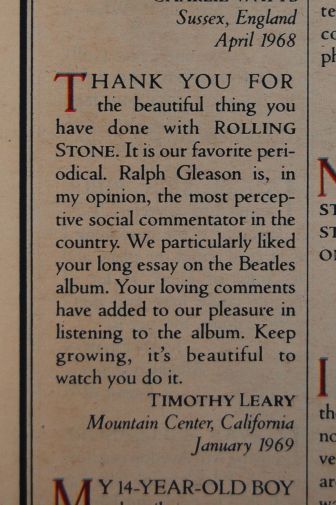
Letter from Timothy Leary to Rolling Stone magazine
the firm tries (unsuccessfully) to sign the Rolling Stones for a campaign,
Keith Richards passed out, photo by Annie Leibovitz in Rolling Stone magazine issue 254, 1977
and the gap between Don Draper and the emerging generation widens as the Beatles grow in popularity, and the youth of the 1960s follow dreams of purpose and fulfillment rather than dreams of indoor plumbing. Last week, we watched an episode that had one of the most powerful uses of music I have ever experienced in a television show (besides the “final five” sequence of Battlestar Gallactica when they played “All Along the Watchtower.” Awesome.). It was a pivotal episode, in which Don was portrayed as no longer a young, hot-shot creative ad exec, but a middle aged man who was losing touch with what is going on with his wife and staff’s generation. His young wife perceived this disconnect, and so on her way to acting lessons, to fulfill her dreams of becoming an actress, she left him with the Beatles Revolver album to help bring him up to speed. He placed it on the turntable, put needle to vinyl, and our living room filled with the entrancing final song of Revolver, “Tomorrow Never Knows.”
The montage was potent as it proceeded through a series of scenes of the younger generation in Don’s life as they followed their bliss – Peggy and Stan smoked weed while they worked, Pete watched a lover slip away, and Megan meditated in her acting class – until Don, disinterested, scratched the needle off the record, our den went silent, and Don walked out of the room to go to bed. To me, It was one of the most brilliant sequences of the show to date, and as listening to (good) music from that era often does, it made me ache with nostalgia for a time I never knew.
The following morning, after I dug through our CDs to find the Revolver album, I saw the Rolling Stone issue on our shelf, and the time finally felt right to look at it. Before I even got to the Annie Leibovitz spread, I was struck by the letters to the editor. Especially the one from angry parents who wrote, “My 14 year old boy subscribes to your magazine, Rolling Stone. On the front cover and inside the magazine were nude pictures of that Lennon man (?) and his ugly girlfriend.”
Reader letters from Joan Didion, George Bush, Joseph Heller
Letter from reader, and response from John and Yoko
Reader letter from angry parents to Rolling Stone magazine
Letters to Rolling Stone from Dan Rather and Woody Allen
I got a chuckle out of that one, but there were also letters from John and Yoko, Timothy Leary, George Bush, Joseph Heller (author of Catch-22), Dan Rather, Woody Allen, and Joan Didion. What blew my mind was not just that they had written letters to a magazine (does that still happen – celebrities writing letters to the editors of rock and roll magazines?), but that they were current at the time the magazine I held in my hand was printed. They were current when “that Lennon man” was alive, and George Bush was director of the CIA, and Joan Didion was pioneering New Journalism, or what we now call creative nonfiction. This physical magazine I pulled off our shelf after watching Mad Men, this printed material, the yellowed pages of which I turned as I sat on the carpet of our finished basement in 2013, it was there in 1977. It was exposed to 1977 air, printed with 1977 ink on 1977 paper, when Jimmy Carter was president, and I was three years old.
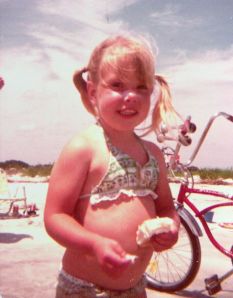
The author, Andrea Badgley, 1977ish, on St. Simons Island, GA
What struck me most about the issue, aside from the fact that I was holding a piece of history, was that Rolling Stone was once young. Timothy Leary wrote to the nascent magazine in 1969, “Thank you for the beautiful thing you have done with Rolling Stone… Keep growing, it’s beautiful to watch you do it.” I’ve never known a time when Rolling Stone didn’t exist, and here, this issue of RS on its tenth birthday, was proof that it was once a child. That it was just a baby during the period portrayed by Mad Men. When I read Timothy Leary’s words of encouragement to the young magazine, it hit me that Rolling Stone, at one time, was an emerging journal, like the ones I might submit my writing to today.
I leafed through the Leibovitz spread, with shots we’ve seen a million times of Jerry Garcia lying on his back on a beach; Keith Richards passed out; OJ Simpson in his Buffalo Bills uniform; Salvador Dali ear to ear with Alice Cooper; Mick Jagger and Keith Richards, shirtless and stoned; Brian Wilson in a blue bathrobe, his surfboard under his arm. I thought, this all really happened, and these photos were fresh when this magazine came out.
Jerry Garcia, 1972, “Finally there was marijuana!” photo by Annie Leibovitz
OJ Simpson, 1977, Buffalo Bills uniform, photo by Annie Leibovitz
Linda Ronstadt in red underwear, 1976, photo by Annie Leibovitz
Annie Leibovitz commentary on Linda Ronstadt’s sixty-dollar underwear, 1977 Tenth Anniversary issue (#254) Rolling Stone magazine
Dolly Parton and Arnold Schwarzenegger, 1977?, photo by Annie Leibovitz
Brian Wilson in blue bath robe with surfboard. “Brian seems to be on acid all the time…” photo by Annie Leibovitz
Mick Jagger and Keith Richards, Alice Cooper and Salvador Dali, Rod Stewart and Britt Ekland, Ron Wood with Rod Stewart; 1977 Rolling Stone; photos by Annie Leibovitz
I loved reading commentary from Annie herself about “playing” with her subjects in order to get shots, like when she bought Linda Ronstadt $60 red underwear for a shoot and was scared about how Ronstadt might react, or when she shared her experiences of a subject, like that “Brian [Wilson] seems to be on acid all the time.” You don’t see those notes when one of her iconic photos is used in a nostalgia piece on Jerry Garcia, or you find her portrait of Dali and Alice Cooper on a poster in a head shop.
But my favorite part of the magazine, and not just because we’re watching Mad Men, was the advertising.
Sharp Eye tape player ad, Rolling Stone magazine, 1977
When radio played vinyl – Technics turntable ad, Rolling Stone magazine, 1977
Ad in Rolling Stone for Queen’s “News of the World” album, released October 1977
ad in 1977 Rolling Stone for David Bowie’s “Heroes” album, released 1977
Hobbit and Middle Earth ads in the back of 1977 Rolling Stone magazine
Ad for Discwasher, the “Superior” vinyl record cleaner, 1977 Rolling Stone magazine
There are a couple of cigarette ads (including Vantage and the Marlboro man), a few car ads (Volkswagen rabbit, Toyota Celica, Le Car from Renault), liquor ads (Seagrams 7, Two Finger Tequila, Southern Comfort, and Gordons Gin, complete with 51 gin cocktail recipes), and my favorites, full page pieces for albums that were new at the time, like “‘Boston 2.’ On Epic Records and Tapes,” David Bowie’s “Heroes,” and Queen’s “News of the World,” all new releases in 1977, when this copy of Rolling Stone went to press. The remainder of the issue is full of ads for turntables, cassette players, speakers, headphones, and reel to reel recorders. Even better than the merchandise, though, are the sales pitches, like this one: “Now you can have something in common with FM stations. This Technics turntable.” Because radio stations once played vinyl records. !. I also loved Sharp Eye’s line, “It ends the hit and miss method of finding songs on tape.” Remember those days? When we listened to cassettes and there was no easy way to advance to the next song?
And that final ad, the yellow page with the checklist? We had that record cleaner. I remember when I was young, a 1980s adolescent exploring the music of the 60s and 70s, I’d squirt a drop from that tiny red bottle onto my parents’ vinyl records (Mom had every Beatles album, Dad had all the Rolling Stones) and using the discwasher with the velvety pad and the wooden grip, I’d run with the grain of the records’ grooves, wiping “microdust” with each swipe. The vinyl would shine black when I was done. I’d pluck a dust ball off the turntable’s needle, place the record on the spindle, turn it up loud with the big silver knob, and lie back with my eyes closed, my hands behind my head, to listen to Pink Floyd, or Queen, or any one of the surprises contained inside those mysterious album covers.
On Mad Men, there’s scorn towards the advertising world from the counterculture who consider themselves enlightened, and superior, and anti-establishment. They look down their noses on consumerism and the shallow jingles that ad agencies churn out, favoring the high culture of theater or beat poetry. But I have to say, as I leafed through this Rolling Stone, the ads are what gave me a real glimpse into 1977. Unlike iconic photographs by Annie Leibovitz, or fiction by Hunter S. Thompson, advertising is fleeting. The ads were the details that showed what daily life was like for regular people – what they wore, how they combed their hair, what they were buying that year (discwashers!). Because they are ephemeral (and, we like to think, culturally unimportant), we forget about advertisements as they update to the newest product, the latest campaign. But more than anything else about the issue, when I saw those reel to reel recorders, and all those record players, it was the ads – those snapshots in time – that brought back memories. They are what dated the magazine. It was not only the letters from John and Yoko, or the timeless photographs of ’60s and ’70s rock and roll icons, but also the ads, penned by Mad Men era creative teams, with shallow one-liners and feathered hair, that revealed the culture of 1977.
When I first started blogging a little more than two years ago, I didn’t know what I was doing. I owned a handmade soap business at the time, and because I love to write, I launched a blog to build my company’s brand. A good friend of mine, Liv Lane, happened to roll out a blogging ecourse around the same time, and I enrolled in her course expecting to learn basics like how to choose a blog host and how to build readership. I did learn those things, and with her guidance I succeeded in building a thriving blog. But more importantly, through simple yet soul-probing queries, Liv helped me find my voice and my self. Once I began Liv’s course, and began digging deep to contemplate and respond to material she presented, I realized I enjoyed my business’ blog, and writing, far more than I enjoyed making and selling soaps (I have since dissolved my soap company).
One of the first simple yet probing queries Liv posed to us was “Why do you blog?” It seems like such an obvious question to ask ourselves, but I can honestly say that when I began blogging, it was not one I ever stopped to consider. And curiously, one I never asked (or answered) when I started my (now-defunct) business. My responses now are almost identical to my 2011 answers to the question of “Why?”
I blog for the comments. Duh. Doesn’t everyone? I like for you to tell me you are here, and I like for you to tell me I’m awesome. Heh heh. Just kidding. I do like to know you are here, though, and I do love when you share your reactions, your thoughts, your feedback. Which leads me to the second reason I blog.
Blogging is a form of communication. When we had our first child, and I chose to stay home with him, let’s just say the transition from workplace to home was a challenge. I need brain stimulation. Pre-kids, I had a very people-oriented, interactive job recruiting and managing participants, mentors, and coaches for The Leukemia & Lymphoma Society’s Team In Training program. Before that I worked in ecology labs, hanging out with fun people and constantly exploring and experimenting to answer questions about the world around us. At home it was just me and our infant son. Not a lot of thoughtful, funny, or stimulating conversations going on there. Blogging, and the dialogue it inspires, helps fulfill my need to communicate with other adults.
I love words. There is nothing quite as satisfying as writing the perfect sentence.
Writing is a free art form. When I first began making soaps, I realized very quickly that if I didn’t start selling them, there was no way I’d be able to afford the supplies I would need to bring all of my ideas into creation. Likewise for painters, potters, jewelers, photographers, scrap-bookers. Most forms of creative expression require materials. Writing requires very little that must be purchased. My composition books cost $0.59, and I could get pens cheap too, if I wanted. As for keyboards, even if you don’t have a computer, you can go to the library and use one for free.
Writing helps me direct my life. It gives me clarity and focus. Selecting a topic, figuring out how to give life to it, finding the right words – all of these guide my thoughts, my attitude, my perspective, and therefore my life, in a direction that I choose. For my previous blog I wrote a post called “Best. Day. Ever.” It was one of my favorite things I’ve ever written. I confess that on that day there were some not so “best day ever” things that happened. But because I was focused on writing about the awesome things that did happen, the negatives didn’t register as being important, and they rolled right off my back. I have no recollection of what they were anymore. The beauty in that day, however, is preserved now forever.
Other writers’ words, voices, choices, and experiences enrich my life, teach me, and help me strive to be my best self. This is the only new response I have added since that original list I made, and as I’ve matured as a writer and a blogger, I realize that this is the real reason I write and share my writing. Even though writing publicly often makes me feel very vulnerable, it is my hope that my words, voice, choices, and experiences may have a similar effect on my readers as other writers have had on me. That something I’ve written will enrich your life, or teach you, or help you strive to be your best self.
I highly recommend Liv’s ecourse, Build a Blog You Truly Love. Along with my husband and my childhood friend, Amy, I credit Liv with helping give me the confidence to put myself out there and write. If you are interested in blogging, and think this might be a fit for you, she is offering the course only one more time. The final session begins September 15, 2013.
“I’m drinking coffee in bed.” That was going to be the first line of my blog post today, a line that I landed on at 3 o’clock AM and then continued with for hours as I lay awake, composing. And the line was going to be true. I was going to drink coffee in bed, which I have never done before, because my husband was going to work out in my writing space (the living room) this morning, because his mom and our nephew are in his workout space, sleeping.
So I lay awake, thinking about what I’d write, propped up in bed with my composition book in my lap, pillows behind my back and smooth sheets over my legs, and my white porcelain cup sitting on a makeshift nightstand of a large stack of books. I imagined the inspiration I’d draw from my new writing position, not just because it would be a novel space, but because it would be private. With a door.
As I wrote, in my head in the dark, without keyboard or pen or paper, I thought of a million other things as well, as people will do when they lay awake at 3AM. I thought of the beans I need to cook today, and wondered if I make a pot of coffee at 6, will it still be fresh when my mother-in-law wakes up? I remembered all the things I need to squeeze in, and attempted to manage everyone’s wishes for the day – the boys want to go to the turtle pond by themselves, our daughter wants to go bowling, I need to cut tags off and launder some back to school clothes, Grandma would like to return and exchange others. The kids want to go to the toy store. Interspersed with those exciting thoughts were regrets about my writing practice, and how far it has fallen these past few weeks. Words crawled through my head like spiders as I lay there, trapping me in their webs, keeping me awake. I haven’t been sweeping them out, and I felt like I was going a little mad, like an injured athlete who cannot train at the level she wants, who paces, restless, waiting for the time when she can get back to it already.
And then I’d come back to “I’m drinking coffee in bed,” and long for the privacy, and think how I’m looking forward to the first day of school like a kid looks forward to Christmas. I counted the days (23) and told myself I can make it.
I didn’t drink my first cup in the sheets this morning, propped against pillows and lifting my cup from a stack of books next to the bed. I’m on the couch instead, composition book in my lap, my legs tucked underneath me and my coffee cup on its regular perch on a small wooden stool. I’m in the living room because my insomnia kept my husband up, too, and now he is catching up on sleep instead of working out. Of the six people in our home, I am the only one awake, so though I am in an open space, without a door, I am still able to sneak a few minutes of privacy.
Soon, life will get back to normal. Soon the kids will be back in school and I will have quiet, and routine, and freedom to listen to my podcasts without worry of listening ears, or constantly drying my hands to hit pause for endless interruptions – “Mommy, can I have a snack? Will you play a game with me? Where are my shorts? Will you cut me a peach?”
Soon I’ll have privacy and the solitude my sanity depends on, without having to hide in my room, drinking coffee in bed. Soon I will be writing again. I’ll get back into my practice and sweep out the words. Soon. 23 days.
My critique buddy, Lesley, is co-leading a writing workshop in the Blacksburg, Virginia area beginning September 7. If you are a writer or a would-be writer in the New River Valley, please see below for more details.
Writing for the joy of it
Have you always wanted to write but don’t know how to start or sustain your practice? Jenny Zia and Lesley Howard are leading a writing adventure that honors the writing process … to support discovery of your writer’s voice, exploration and development of your stories.
Jump-start: Saturday Sept. 7, 9:30 AM – 4:30 PM Momentum-sustaining sessions: Tuesday Sept. 17, Oct. 1 & Oct. 15, 6:30-8:30 PM The end is the beginning closing session: Saturday Oct. 26, 9:30 AM – 3:30 PM
Jenny Zia and Lesley Howard ground their facilitation of Writing for the joy of it in their combined six-plus decades of daily writing practice, inspired by the philosophies of Julia Cameron, Natalie Goldberg, Anne Lamott, and Priscilla Long, among others.
Jenny and Lesley will provide
* Exercises to generate material
* Practices to sustain your momentum
* Opportunity to share your words, should you so choose.
$100 fee includes muse-nourishing snacks and beverages.
Contact Jenny and Lesley for registration and payment details: joyofwriting04@gmail.com
I remember Sahara Moon, and how she’d shrug and say “My parents were hippies” when she told you her name. She grew up in California, on an avocado orchard, and her comfort food wasn’t pizza or mac and cheese. It was brown rice with avocado smashed into it and nutritional yeast sprinkled on top. I remember she had to leave the lab that summer to teach at a camp, and when we talked about summer research projects, she spooned avocados and reminded us she wouldn’t be there. When I finally asked what kind of camp it was, her eyes sparkled as if I’d touched on a little secret and she said “Circus camp.” She grinned, “I teach the trapeze.”
I remember our garden, with the white picket fence, and how the landlord drew us a map of the flowers. He spent thirty minutes showing us the beds he’d dug and where his wife had planted bulbs, pointing and gesturing, absently weeding morning glory vines from the fence as we moved around the perimeter of the yard. He barely went inside with us to show us the house.
I remember I planted basil and arugula. The basil grew dense like thigh-high rain forests, and we made pesto every week. The basil never turned yellow or leggy like it has in other places I’ve tried to grow it (Florida, Minnesota). With the arugula we made a pasta dish with cream and bacon. I can still taste the peppery green, sharp against the savory warmth of the sauce and the succulence of bacon.
I remember Coppi’s, how the walls were covered with old black and white photos of bicycle races in Europe. I remember the clink of cutlery, and the pints of cold beer, and laughing with our friends who brought us there. They introduced us to pear salad with Parmesan and a balsamic reduction, Pizza Bianca, and the Nutella calzone. It seems like a different lifetime, those dinners before children.
I remember the first time I heard David Sedaris. It was summer, 1999, and my husband and I were stuffed in the back of our friends’ car in Washington, DC on our way to see The Blair Witch Project. We listened to Ira Glass announce the next segment on This American Life as Tom hunched over the steering wheel, hunting for a parking spot. He and Laney turned it up when Glass introduced David Sedaris, and we had an NPR driveway moment as Tom parallel parked and we stayed in the car to listen. “You guys have got to hear this,” Tom laughed, and next thing we know, a gay man with a nasally voice is singing the Oscar Mayer bologna song in the voice of Billie Holiday. It seems strange that I would remember, as I do with the Twin Towers and the Challenger explosion, exactly where I was and what I was doing for the seemingly small event of being introduced to an author.
I remember the day we decided to leave Maryland. It was Mother’s Day, 2001. My husband and I were stuck in traffic on the beltway. I think we were trying to get out of town to get to Shenendoah, like everyone else in the DC metro area, and as we sat in the car at a standstill on 495, we decided to call our moms to wish them a happy day. My mom was out on the boat, not sitting in traffic, and my husband’s mom was at the beach. My husband and I looked at each other as we inhaled exhaust, dreaming of boats and beaches, and said, “Let’s get out of here.” We decided then and there to evacuate, without jobs or plans, and when he graduated with his Masters at the end of the year, we broke camp in Maryland and moved our lives to Naples, Florida. We never made it to Shenendoah that day.