Between “severe weather” days, delayed starts, and early releases, the kids haven’t had a full week of school since winter break.
Spring will be here soon, right?
I prepared this yesterday, giggling to myself, when I thought for sure the kids would have a snow day today. They only got a two hour delay. Now I feel bad, like I jinxed their fun. I’ll make hot cocoa this morning to make up for it.
I’ve been cranking along with my New Year’s Resolution to read five memoirs or biographies this year. I started with Swimming To Antarctica: Tales of a Long-Distance Swimmer by Lynne Cox, then listened to Enchantment: The Life of Audrey Hepburn by Donald Spoto. Both were more informative than entertaining, and both felt quietly deceptive, like the authors were holding back the full truth of the subjects’ personalities. The women seemed too perfect. Too nice.
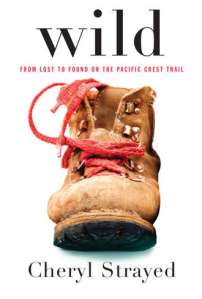
And then I picked up Wild: From Lost to Found on the Pacific Crest Trail, Cheryl Strayed’s memoir of her 1100 mile solo-hike, at age 26, after she had destroyed her marriage with infidelities, dabbled in heroin, and most critically, because her mother had died four years previous and Strayed’s life had been spiraling downward ever since (see: infidelities and heroin).
Unlike the two tame memoirs I read before it, Wild is raw. It is brutally honest. Strayed lays everything on the pages for all the world to read. She doesn’t candy coat herself or present herself as anything other than who she is.
I admit that with a title like Wild, I expected more raving, more lunacy, more squatting and grunting, eating raw meat with a dirt-smeared face and nits in her matted hair. But Strayed’s genius in this book is that she writes wildness in a much more stealthy way, solitary and quiet, like the animals whose eyes glow at her in the darkness before their silent retreat. She gets at the heart of what it meant for her to be wild, not by snarling and howling, but reflectively, by using incisive language that had me scrambling for my Lexicon every few chapters.
And that’s the real reason I loved this book. Strayed uses kickass words – vivid words with spunk, that cut to the quick, that make her experience real and honest. So rather than write a huge long review, I want to share four words I gathered from Cheryl Strayed’s Wild. I collected these words from her pages, and to me they are the distillate of what what Wild is all about:
mox·ie – n. Slang. 1. The ability to face difficulty with spirit and courage. 2. Aggressive energy; initiative. 3. Skill; know-how.
cru·ci·ble – n. 1. A vessel made of a refractory substance such as graphite or porcelain, used for melting and calcining materials at high temperatures. 2. A severe test, as of belief.
grit – n. 4. Informal. Indomitable spirit. Pluck.
pri·mal –adj. 1. Being first in time; original; primeval. 2. Of first importance; primary.
And though I’m not sure if pluck was on her pages, it went into my Lexicon, too, with an asterisked *Cheryl Strayed next to it.
There’s one thing you can be sure of in parenting: as soon as you think you’ve got it all figured out, everything changes. I had finally gotten dinners going in a good rhythm: a rotation of three weeks worth of menus, complete with protein and produce options for all four palates in our family (daughter who loves all vegetables but dislikes meat, son who loves meats but dislikes most vegetables, parents who enjoy more variety than tacos, quesadillas, noodles, and salmon). I even scheduled crock pot meals on Monday and Wednesday when our daughter has swim practice. The kitchen was like a well-oiled machine, cranking out packed lunches and snacks at 7am, with dinner on the table when Dad gets home at 6:30pm.
I have to admit, I totally rocked.
Then we got our son’s soccer schedule: practice Tuesdays and Thursdays, 5:30 to 7pm. Dinner time. Combine that with our daughter’s swim practice? Sports, four nights a week. And we’ve got to figure out how to feed these kids.
As every parent knows, feeding children is a monumentally tiring task (see chart). We no longer have the luxury of simply ordering takeout or fixing ourselves a piece of toast when we’re feeling lazy. Even if we do that for ourselves, we still have to ensure that we provide three balanced meals a day plus two healthy snacks for these little people for whom we are responsible, who wonder after we’ve labored over menus and so considerately included pizza one night, just for them, “what are those green specks in the sauce?”
I used to be a foodie, but now that soccer has jammed the cogs of my kitchen and brought its greased machinery to a screeching halt, I have to say that I am officially done with food. Two crock pot meals a week were good – the kids don’t like slow cooker meals, but I could whip up simple alternatives for them so that my husband and I could enjoy the briskets and stews they turn their noses up at. But separate dinners for the adults and the kids four nights a week? I don’t think I can handle that.
When we lived in Minnesota, most of our friends had at least three children. I would see them all at soccer practice, Mom dropping this son off before taking that one to baseball, while Dad took the daughter to ballet. All of these activities took place after school, of course, and I always wondered, “When do they eat? Where do they eat? What do they eat? ” And the answers, more often than not were on the way home from practice, in the car, and McDonald’s. Of course. How else do you juggle homework, sports, piano lessons, dinner, downtime, and showers in that small span of time between the school bell and bedtime?
The problem with the drive-thru option, aside from the obvious irony of encouraging healthy activities and then feeding our kids grease bombs, is that I like to eat dinner, at the table, with my family at the end of the day. No TV, no electronics, but a set table with real food – a protein, fruits, and veggies – napkins and forks, glasses with ice in them, and each other. I heard a story about this very dilemma yesterday on NPR, Family Dinner: Treasured Tradition or Bygone Ideal?, and I was very sad to hear the chaotic state of the 8-minute meal that Alison Aubry aired as a typical family dinner – iPods, smartphones, kids wandering off from the table. It seems family dinners are going the way of the typewriter and the film camera. We just don’t have the time or energy for them anymore.
I grew up around a table with my family. Because we were seated together, with Mom’s food as the centerpiece, family dinners taught us to “give a meal the respect it deserves,” as Cheryl Mendelson so beautifully put it in Home Comforts. Those meals taught me table manners, the art of mealtime conversation, and to respect and listen to my companions at the table. Because of those meals, I knew how to behave when I went to someone else’s home for dinner – a friend’s house, or Grandma’s, or later in life, a boss’.
So despite my doneness with food, and managing the protein and calorie needs of four hungry athletes, and the varied preferences that generally result in seven different food choices on the dinner table, and budget constraints, and time and schedule constraints, I’m going to give it my best shot to maintain our family dinners. My husband and I have already agreed to treat the family to junk food once a week. We’ll just spread those McDonald’s hamburger wrappers on the table, squirt ketchup on them for our fries, and catch up on each others’ days before tossing all the paper packaging into the trash, without washing a single dish.
The other nights, we’ll have to come up with some quick and easy, protein- and produce-rich meals that can be prepped and served within 15 minutes, after sports and before bedtime. Because though there may be a tremendous amount of chaos leading up to sitting down at the table, once we are seated there, a calmness descends. We come together as a family, sharing food and laughter, worries and fears. We ask and answer questions, and my husband and I are discovering, that ever so gradually, our kids are coming to respect the table, and the food that is laid upon it.
“So, have you noticed that irony is super trendy now?” I dealt Phase 10 cards to Amy and my two kids. “‘The Ironic Generation.’ I keep hearing that. What does that even mean? That people want to live off the grid, yet they can’t survive without Facebook and Twitter?”
Amy fanned and arranged the cards in her hand. “It’s a hipster thing.”
“What’s a hipster?” Our son’s big eyes looked up at me.
“Well,” I said, “Every generation – do you know what a generation is?”
“Yeah, it’s like a thousand years or something.”
“Not quite,” Amy and I laughed. “It’s a group of people of a certain age. Like, you and all your friends, and all the kids in elementary school right now are your generation. Daddy and me and Amy and all of our friends are our generation.”
He discarded. “Okaaay.”
“Each generation has a group of, I don’t know,” Rebels? Outsiders? “A subculture that kind of defines the generation. In the 20’s it was flappers.” I played a card and looked across the table at Amy. “When were beatniks?”
“Beatniks were in the 60’s,” she said. “And hippies were the 60’s and 70’s.”
“Punk was the 80’s. And now,” I said, “it’s hipsters.” I peered over my cards at our son to see if he understood. He did not.
“There were tons of hipsters in the Twin Cities,” I told him. “They think they’re really cool. Like, they were cool before cool was cool.” He had no idea what I was talking about. He’s nine.
I played a card and asked my friend, “Do you know how the hipster burned his tongue?”
She raised an eyebrow, waiting for my answer.
“He ate pizza before it was cool.” I giggled hysterically. Our son rolled his eyes.
Amy was more useful to him, describing the hipster look – the skinny jeans, the PBR tee shirts. “And then there are the older hipsters, like Ira Glass and my husband, with the glasses, and the beard, like my husband has.” She moved some cards around in her hand. “Although he had the glasses and the beard before they were a thing.”*
I giggled again, thinking she was making fun of herself, saying that her husband had adopted the hipster look before it was cool. I looked up from my cards to acknowledge her cleverness, but she wasn’t smiling about it. She was laying down her sets, getting ready to go out.
“So, back to irony,” I said. “I’ve always loved irony, but I never know how to explain it. If somebody asked me to define irony, I could give an example, but I couldn’t define it.” I laid down my sets of four and discarded. Amy looked thoughtful, turning her eyes up as if she could look into her brain, rifle through files, and find a definition for ironic.
“Only Hipsters Know Irony,” writing and “art” by J. David Ramsey
“But the irony I know is not anything like that Alanis Morissette song,” I said. “ ‘It’s like 10,000 spoons when all you need is a knife.’ What the hell is that? That’s not ironic. That’s just annoying. Ironic has some sort of, I don’t know,” I gestured toward my heart. “Mystical quality.”
Amy’s eyebrows shot up and she grinned. “Let’s look it up!”
I gave her the dictionary, and she riffled pages while I shuffled cards. Her face turned scowly.
“What the hell?” She said. “Listen to this:
“Ironic. 1. Characterized by or constituting irony. 2. Given to the use of irony.
“That doesn’t tell you anything,” she fumed. “It uses irony in the definition!”
My son arranged his new cards. “It’s your turn Amy.”
“Oh, sorry,” she said, then smiled and stroked the book. “I have this dictionary now, you see,” and she played a card.
“Well, look up irony then,” I said.
She followed the words with her long finger.
“Irony. 1.a. The use of words to express something different from and often opposite to their literal meaning.”
I had had a couple of whiskey sours at this point. “What? That confuses me,” I said, and took another sip. “This is an example of irony to me. I have this friend whose mom was a super fructavore – she loved fruits and veggies and ate them all the time. They were her snacks, her desserts, always a component in her meals. Tons of fiber, you know? Well, she died from colon cancer.” I laid down a card. “That’s ironic.”
“Okay, listen, though. Here’s the third definition of ironic:
“3. Poignantly contrary to what was expected or intended.”
“Poignant! That’s going in my Lexicon.” I jumped up to get my Moleskine. “Poignant is one of my favorite words. It’s like irony – it has this mystical quality,” and I gestured toward my innards again. “It makes me feel.”
“Mom! It’s your turn!”
“Sorry babe.” I played a card and thought of the example of irony I had just told. “My friend’s mom contracting colon cancer after a lifetime of fruit eating is, well, poignantly contrary to what was expected. That’s a perfect definition! That’s the irony I’m talking about. It’s all about the poignancy.”
“You really need to read the usage examples here,” Amy said, pointing at the entry in the dictionary.
I thought about all the young hipsters in the Twin Cities as play went round the the table. I thought about the sad irony that they try desperately to avoid anything mainstream, yet they have become so mainstream they even have a look. Glasses, skinny jeans, fixed gear bicycles. iProducts.
When it was my turn again, I fingered my cards, then hitched up my skinny jeans so I could start the music back up on my iMac. I smirked, “Well, I’ve loved irony for, like, 20 years. Irony spoke to me before it became a ‘thing’.”
And then I laid down my cards and laughed.
Usage Note: The words ironic, irony, and ironically are sometimes used of events and circumstances that might better be described as simply “coincidental” or “improbable,” in that they suggest no particular lessons about human vanity or folly. Thus 78 percent of the Usage Panel rejects the use of ironically in the sentence In 1969 Susie moved from Ithaca to California where she met her husband-to-be, who, ironically, also came from upstate New York. By contrast, 73 percent accepted the sentence Ironically, even as the government was fulminating against American policy, American jeans and videocassettes were the hottest items in the stalls of the market, where the incongruity can be seen as an example of human inconsistency. (The American Heritage College Dictionary)
When I was researching this post, I came across some pretty hilarious stuff. Like the wikiHow article 9 Ways to Be a Hipster. I also found a fascinating opinion piece in the NY Times: How to Live Without Irony by Christy Wampole. Both great reads if you are curious about hipster counterculture.
After our son’s doctor pronounced him perfect at his seven year checkup, she said, “We don’t need to see him again for a long while. These next few are the golden years of childhood.”
She tipped her head toward our boy, “They become much more independent over the next few years – pouring their own milk, picking out their own clothes – yet, they are still innocent and childlike, and they want very much to please you and their teachers. They ask a lot of questions, and they want to learn, and,” she smiled, “you get to see the emergence of their unique personalities.”
And you can have real conversations with them. You can tell them, “Fix yourself an Eggo!” on Saturday morning while you sleep in. And when your son is nine, his jokes progress from nonsensical knock-knocks to a nuanced sophistication of timing and subtlety that surprise his dad into laughter and leave you saying, “Huh?”
But most importantly, you can begin to teach them cards.
I wasn’t much of a card player growing up. I loved gin and rummy for the first few hands, and then I’d get bored with them. My husband played poker on and off for several years, but I never participated. That was his man-night-out thing. I couldn’t relate to the depth of his card love until we spent Thanksgiving with his family in Chicago a few years ago.
Over the few days we were there, amongst all his aunts and uncles and cousins, and Grandma Janet drinking appletinis, and my aunt-in-law and uncle-in-law and me making emergency brownies at ten at night when we got hungry for baked goods, there were, as soon as the first beer cap was popped, the first gin and tonic poured, the first wine bottle uncorked, at all hours of the evening and late into the night, three card tables going. At the highest table, two steps up from the living room and four steps up from the den, Grandma Janet and rotations of three aunts and uncles played bridge. At the other two tables, lower in elevation (and in status) the rest of us played Euchre, our drinks leaving wet rings on the card tables. Euchre is an intricate card game for exactly four players, with trumps and bowers and tricks and strategy, and teams where communication with your teammate is prohibited, yet, unless you declare, “I’m going alone,” you are dependent on your partner to win.
In other words, an insanely fun game. I was hooked immediately. And now that our kids are in these golden years of childhood, it is time to train them up for Euchre.
When our children were younger, I think my husband’s soul died a little bit every time he had to play Go Fish or Old Maid or War. But the kids know how to hold their cards now. I remember that was a huge first step, one that I took for granted until I saw their tiny starfish hands struggle with fanning the cards so they could see the suits and numbers. There would always be a clump of four cards stuck together, then one sticking way up, a snaggletooth in an already jagged row. Diamonds and spades would tumble to the floor when our son let go with one hand to pull out a heart to play.
Those days are over now, as are, my husband hopes, our days of Go Fish. While I was away last weekend, he taught them Go Boom, where one person leads a card, and the other players have to follow the card that is led, either by suit or by number. Kind of like UNO. Whoever wins the trick gets to lead next, with the ultimate goal of being the first person to get rid of all your cards. Go Boom taught the kids some of the language of Euchre – “lead,” “trick,” “suit” – and about card ranks, leading, following leads, and most importantly, the strategy of how to lead.
They ate it up like candy. Like ice cream. Like apple pie with candy and ice cream on top.
So this week, while our daughter was at a playdate, I taught our son a no-trump version of Whist. After one hand of basic leading and following, where an 8 of clubs beats a 2 of clubs, he said, “There’s not much to this, is there?” I smiled and stepped it up to Knock-Out Whist, a kid’s Whist that introduces trump cards. I told him, “Okay, if I lead with the Ace of diamonds, you have to play a diamond. If you don’t have a diamond, you can play trump and take my ace. Even if your trump is as low as a 2, you beat my ace and win the trick. That’s what trump means – it beats anything but a higher trump. You got it?”
His eyes gleamed. “Yes. What do I do if I don’t have a diamond or trump?”
“Just throw away your crappiest card,” I said.
He played beautifully, like his father. And he beat me. Twice.
“Oh, you’re going to like Euchre,” I told him.
He looked up at me. “Can you bet money in Euchre?”
Later that night, we taught Knock-Out Whist to his sister. In addition to teaching trump, I figured it was time to throw in dealing etiquette as well. “Do NOT count the cards when someone else is dealing. It’s really annoying. Also, deal first to the person on your left.” I laser-eyed our daughter. “Not to yourself.”
When we were unclear on one of the rules, my husband pulled out his 700 page Hoyle’s guide to “popular games of skill and chance” to sort it out. He lay on his side on the couch, flipping through til he found the section on card games.
“Ha!” He crooked his mouth into a side smile. “No wonder I like Euchre. All these other game descriptions are half a page long. But Euchre -” He licked his finger and started thumbing pages. “Euchre is 1, 2, 3, 4, 5, 6. Six pages of instructions.” He smiled a full smile, his eyes gleaming like our golden-aged son’s, and dove into the rules of Whist.
This is the book we’ve used to find age-appropriate card games to play with our kids. You can play dozens of games with a simple pack of cards, so if your family (i.e. you or your partner) is sick of all the same old board games, I recommend this as a jumping-off point. The rules aren’t super clear for some of the games (which is why we had to dig further into Hoyle for Whist rules), but it’s a great place for ideas.
Last holiday season, when I worked at the Barnes & Noble in Minnesota, a clean-cut 30-something man, about my age, approached me at the information desk. His short, sandy hair was neatly trimmed, his face freshly shaved, and he wore a grass-green long-sleeved polo, tucked into khaki chinos. He stepped up to the counter where I stood waiting to help him and said, straight faced, “Yes, I’m looking for a book called ‘Lost Balls.’ “
It had been nine years since I’d worked in the world, having stayed home with our kids until I started this job at the book store. Though I dressed the part in a pale pink button-down shirt and tailored black slacks, light makeup and petite pearl earrings, I wasn’t accustomed to maintaining professionalism. I smiled involuntarily, tucked in a giggle, and said, “I’m sorry, did you say ‘Lost Balls?’ “
“Yes,” he said, squinching his eyebrows and looking somewhat perplexed.
I typed it into BookMaster and tried to school my face, the hilarity growing inside of me as I watched the letters, one by one, fill in the search box. L-O-S-T- -B-A-L-L-S. The corners of my mouth twitched, and my eyes watered, and the more I tried to remain stoic, the harder it became to contain my Beavis and Butthead reaction. Huh huh. He said balls. I stifled a laugh, but my lips cracked into a sly smile despite myself.
He tilted his head a little, still serious, still knitting his eyebrows. “It’s about golf balls,” he said.
I looked up from the computer screen, straight into his searching eyes, stretched my mouth into a full grin, and said, “It’s still funny.”
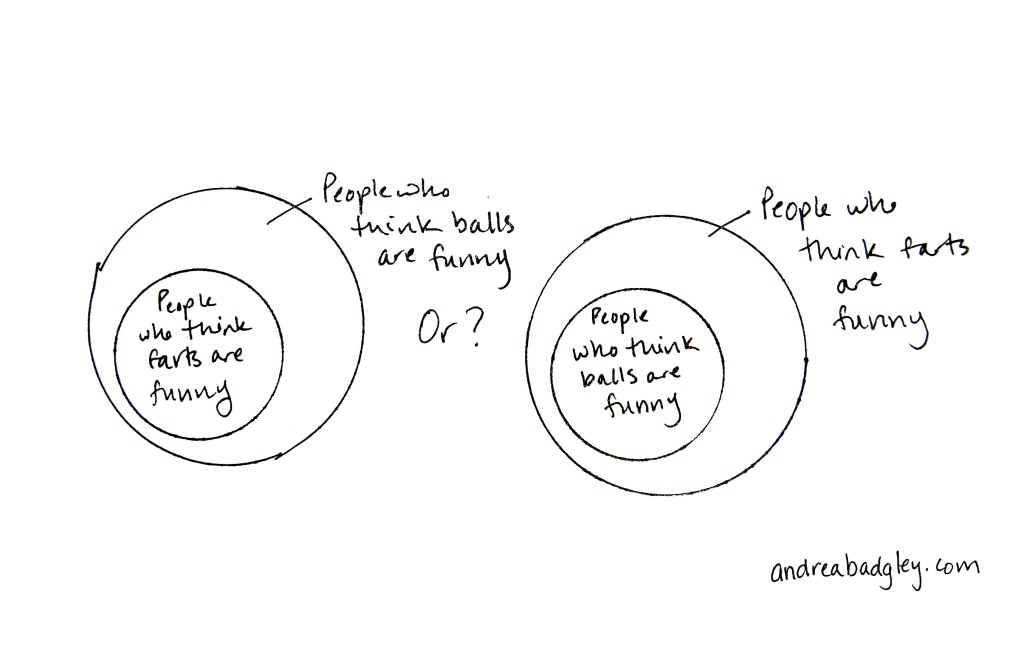
P.S. I am in our kids’ elementary school cafeteria, seated in the half moon arrangement of folding chairs as I wait for our son’s 3rd grade concert to begin. Sitting next to me is a small child – maybe three? – farting up a storm. He squirms around in his chair, his butt aimed mostly at me, and I suffocate in a noxious cloud of toddler toots while he jabbers on, oblivious to his killing cloud. It is all I can do not to burst into laughter as I smell this kid’s farts and write about lost balls. (Okay, I did burst into laughter. The kind that you try to keep in, but still it escapes, through snorts and squeaky giggles. Our daughter is looking at me weird, head tilted, eyebrows squinched. Not unlike the man at the book store.)
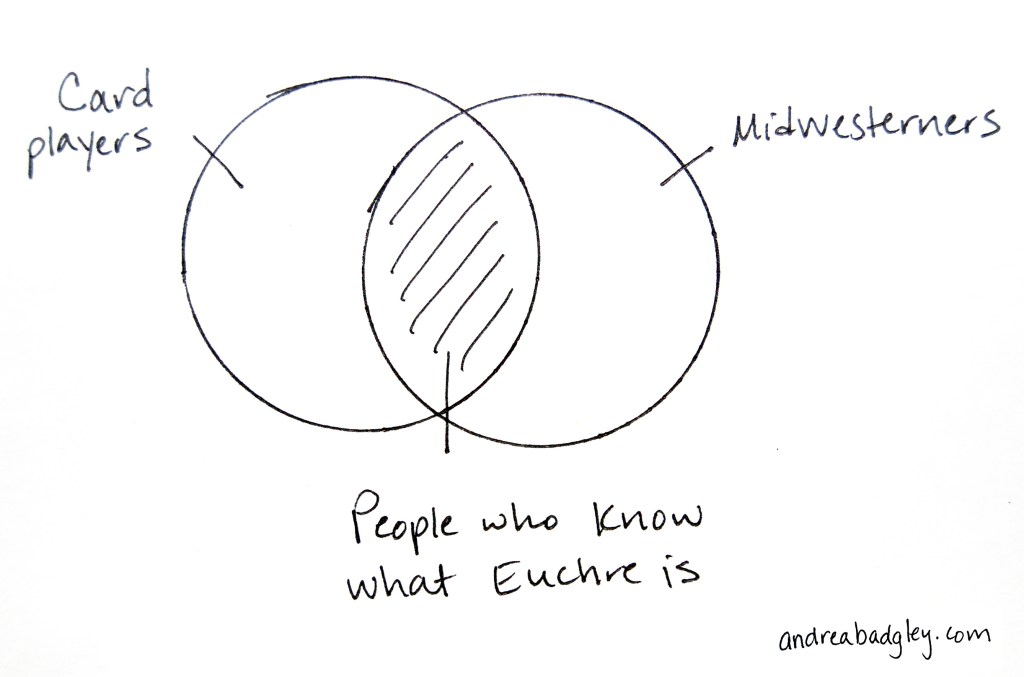
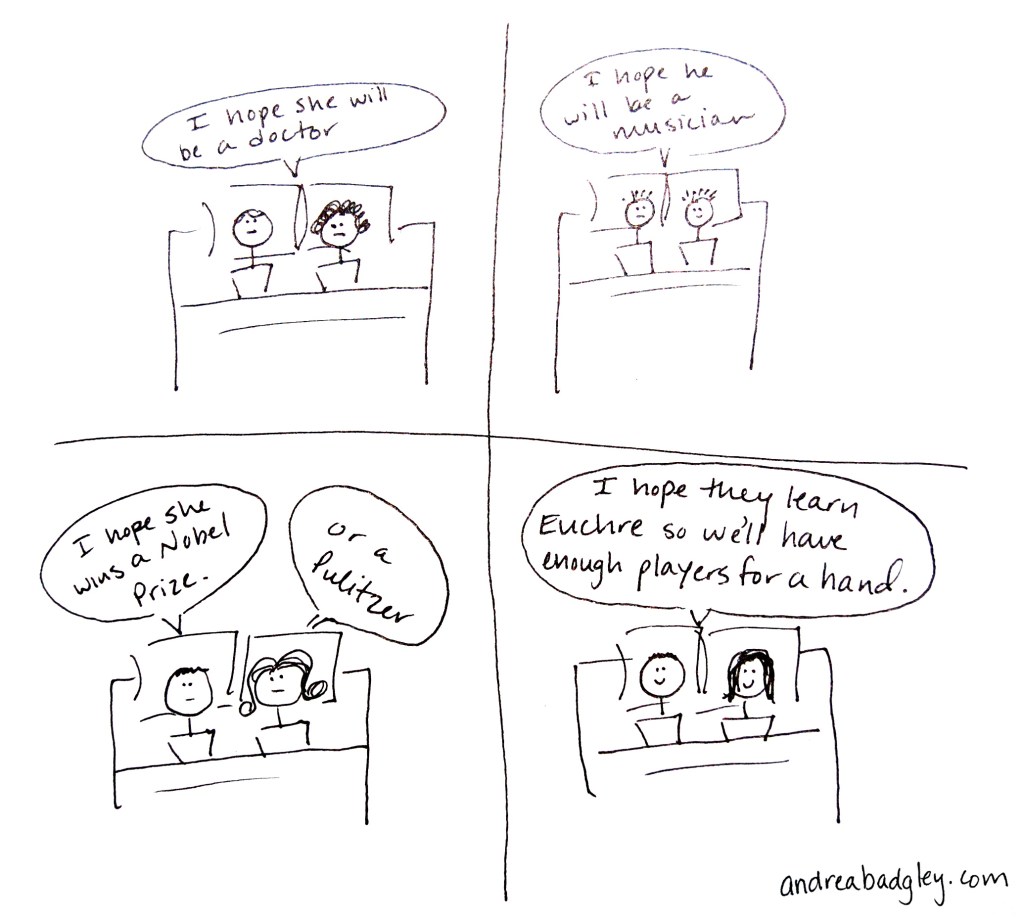
P.P.S. I added the graphs last minute in response to the WordPress Image vs. Text challenge. That last one really has me thinking. Who is a subset of whom?
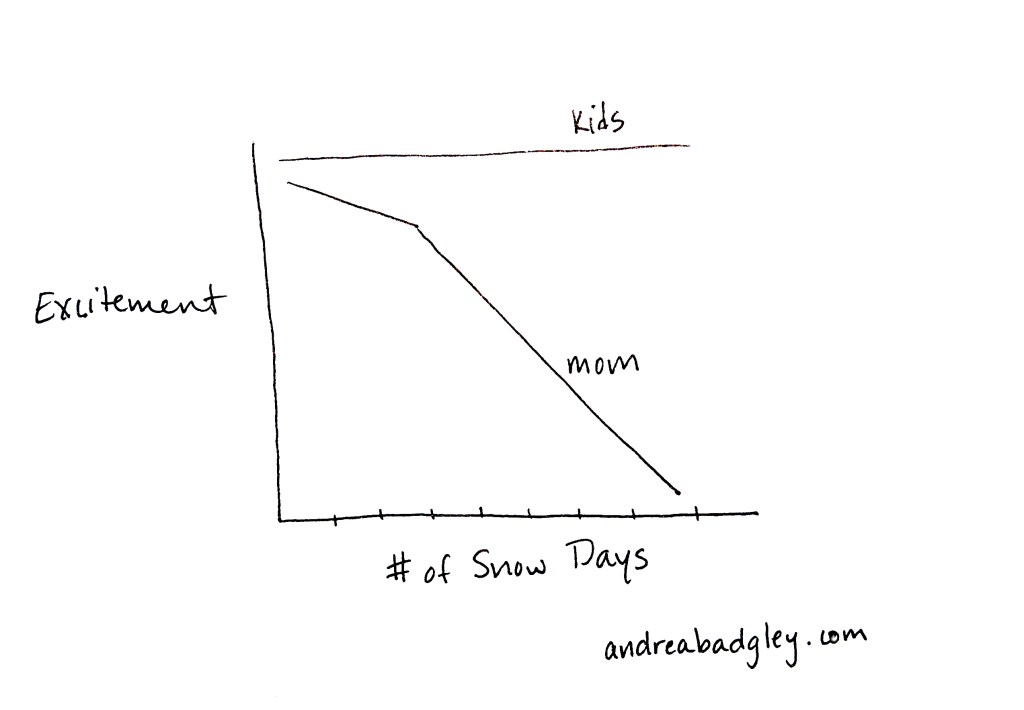 Between “severe weather” days, delayed starts, and early releases, the kids haven’t had a full week of school since winter break.
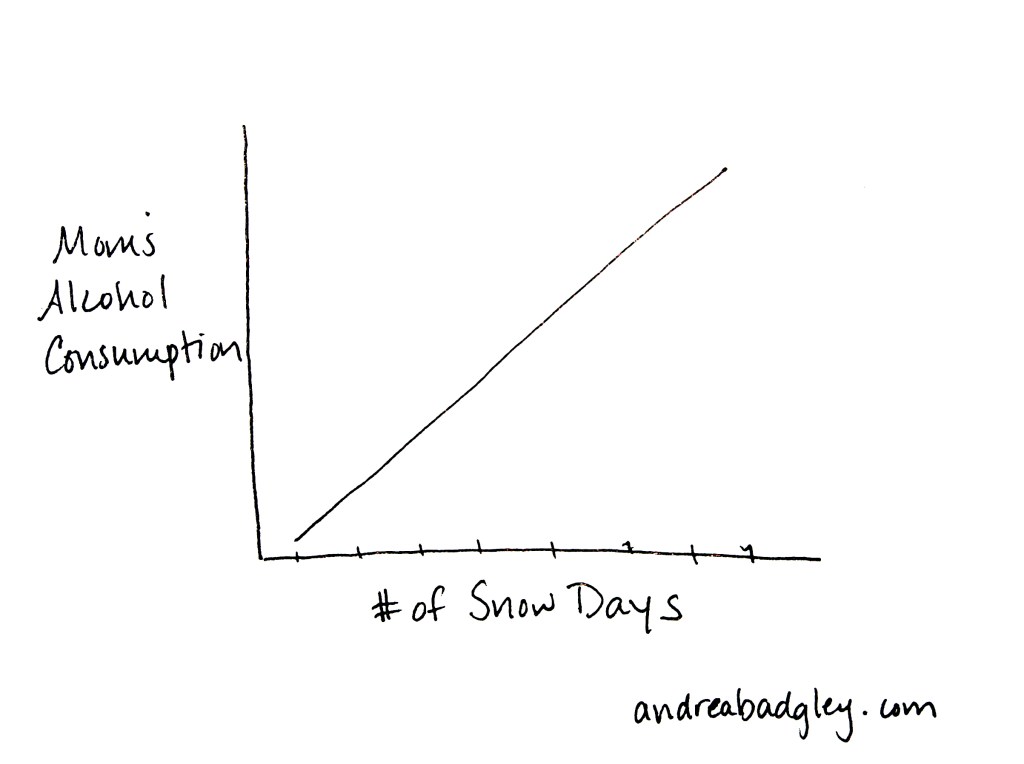 Spring will be here soon, right?