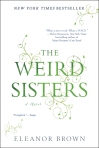
“Oh, please. He’s not dead,” Cordy replied, and then, butterfly-minded, poked our father with her heel and changed the subject. – Eleanor Brown
Okay, so I lied about counting pages. I’ve frantically counted pages in two recent books I’ve read, not because I was slogging through them, wondering when they’d ever be over, but because I was so into them, I never wanted them to end. The first was The Paris Wife, which I borrowed as an e-book from the library. I highlighted so many passages in it (more than 40) that I bought it ten minutes after I read the final page. I needed to own that book. Plus, I had to transfer all of my highlights before my loan expired from the library.
The second book was The Weird Sisters, which I just finished reading for the second time in less than a year. Why? For the line above. For the adjective that is the namesake of my blog. In this quick, minor line, in one adjective, I found permission to be who I am. As I’ve written about ad nauseum, I’ve struggled for a long time with my identity. I tend to blow with the wind, immersing myself in interests, hobbies, subjects til I’ve learned as much as my attention span will permit, and then moving on to the next interest/hobby/subject. After making a couple of quilts, and recognizing I didn’t have the precision for quilting, or knitting a few hats and realizing I didn’t have the patience for knitting, or working in ecology labs and realizing I don’t have the analytical and mathematical mind for scientific research, or any number of other dabblings (soap-making, jewelry-making, photography, nutrition, organic living), I was feeling pretty bad about my inability to commit. I’d beat myself up that I couldn’t seem to stick with one thing long enough to become truly skilled, instead flitting from one new interest to another.
But when I read that line about Cordelia, my favorite of the three Shakespearian-named weird sisters – the bread-baking crunchy hippie wanderer, the loveable one, the one I wanted to hang out and laugh with, the one who flits – I think I may have actually gasped. Butterfly-minded! What an elegant descriptor! An adjective more sophisticated than “flighty,” more likable than “fickle,” more beautiful than “generalist.” An adjective calmer than “restless.” The perfect word to make someone who flits feel good and light and loveable for being so changeable.
Wake butterfly – it’s late, we’ve miles to go together. – Basho
I am with you, Basho, awakening to life. – me
The Day 8 prompt for Robert Lee Brewer’s Poem A Day challenge was “write back to a dead poet.” I knew instantly that I would write to Basho, the only dead poet whose works I know, the haiku poet who helped turn my mid-life crisis into a mid-life awakening.
The year before our final relocation was an extremely trying one. We’d been on the move for 15 years, unsettled and with stress in our hearts. We were in our late 30s, with two kids, not knowing where we would end up, or how we would pay for our career decisions, numbly going through the motions of life, waiting for whatever would happen next. I grappled with an identity crisis – what the hell was I doing with my life? What in life matters to me? Who do I want to be when I grow up? Who am I now? I was lost, and despite its relative mildness, that Minnesota winter was a punishing one.
And then came Basho. I’m not sure I how I found him. When I re-read Elegance of the Hedgehog recently, I noticed that he appears briefly there. Or maybe I just found him after my poet friend, Greg Watson, showed me his own poems, and the world of poetry was opened to me. Poetry had never spoken to me before, but Greg’s did.
I remember a slow day at the book store, working the back registers, and, those registers being near the poetry section and all, I wandered over and browsed. I had already bought Greg’s book, and I wanted more. More of something that would make me feel. I remember specifically looking for haiku, though I don’t remember why. I pulled all the haiku, including a slim volume calledOn Love and Barley – Haiku of Basho. None of the others did a whole lot for me, but Basho’s tiny book? I devoured it, itching to mark it up with my pen, to draw stars next to my favorites, like
Spring rain – under trees a crystal stream.
(Basho)
It says so much, and with so few words. Each word is vital, evocative. And all together, they paint a moving picture, and make a burbling sound, and smell like wet forest, and taste cold on your tongue. When I arrived at the haiku at the top of this post – Wake butterfly – it’s late, we’ve miles to go together. – I counted the money in my wallet and I bought the book.
For several weeks, I read and re-read Basho’s haiku. I didn’t read the introduction, I didn’t read analysis, I didn’t try to write my own. His words were timeless, and weightless, sensitive, and in harmony with nature, and they tugged me gently toward truths that resonated with me, that I felt in my core. Art can do this to you. His poetry was gentle, encouraged me to take it slow, and through his haiku, I remembered the wonder I feel in the woods, by a stream, lying on a sun-warmed stone. Watching leaves fall, standing side by side with my husband, silent and at peace. I felt the deep and simple beauty in Basho’s haiku as it nudged me, quietly, awake.
It wasn’t until the kids and I were about to make our trip across country that a haiku rose out of me. Since then, I read somewhere that when writing, “each haiku should be a thousand times on the tongue.” And I think that first haiku of mine took nearly that many tries. I knew the image in my mind, the feeling I wanted to convey, of my transition from crisis to awakening, of the kids and me packing up our lives on a great adventure, an ending and a beginning, with no idea what was in store for us. But the words! As a verbose writer, it required great discipline to distill my idea into something so spare – six words, three lines, two pieces of punctuation:
Summer highway – butterflies in the wind. (me)
And so I began to rewrite my life. Once that haiku delivered itself, I learned more about the haiku form, and many more followed. The practice of plucking basic words became a form of meditation for me. With haiku, I am present. I am alive. I take a notebook outside, or in the case of Haiku from the road I have one in the passenger seat, and I am part of the beauty of the world. Selecting words requires care and deliberation, a respect for the light, the leaves, the droplets of water. I want very much to capture their lightness, and the lightness they make me feel, and each moment of that aware observation results in an awakening, and peace in my soul.
It turns out that Basho was a renaissance man in the world of haiku, reviving a rigid art form by breaking the rules, which is probably why his poems resonate so much with me and feel so fresh, even after 400 years. He concentrated on evoking a lightness (karumi) with his haiku, and a sense of solitary contentedness (sabi), and an appreciation for the commonplace (wabi). Those were his rules: karumi, sabi, and wabi. Not the syllabic rules we usually think of with haiku (three lines – 5/7/5 syllables). Basho considered the 17-syllable constraint to be too binding, resulting in artificial, forced poetry, and he focused instead on a freer form of traditional haiku structure: two elements – a condition (usually a natural, ordinary event) and a perception, a quiet “realization of a profoundly felt truth”¹ – separated by a break, either a “cutting” word or a mark of punctuation.
What I felt in his haiku, and what turned my life around, were those quiet realizations of profoundly felt truths. Truth: my core values include beauty, serenity, art, the natural world. Truth: these things make me feel, very deeply. Truth: Ditto language. Truth: despite stress, troubles, worries, a rock is a rock, a tree is a tree, there is beauty in the world, and we can find solace in that. Truth: it makes me happy to think of myself like a butterfly.
I’m still a complete amateur when it comes to writing haiku. But for once, I’m not concerned about being imperfect. I love the process, and the joy it brings me to practice. I am learning who I am and what is important to me.
But best of all, I am awake.
¹Basho. (1985). On Love and Barley – Haiku of Basho (L. Stryk, Trans.). London: Penguin Group.
I had a basal cell carcinoma removed from my scalp yesterday. No need to freak out – though basal cells are cancerous, they only grow locally and do not spread to other parts of your body. But after having a suspected melanoma and two basal cells removed in the past two years, plus multiple biopsies at every six month dermatology appointment, I’m beginning to feel a little bit like Swiss cheese.
With my freckled skin and a family history of melanoma, I’m a poster child for skin cancer. Thank God skin cancer is a treatable one. Treatable with slicing and dicing, but treatable nonetheless. Still, I always dread the phone call with the biopsy results. I’m super squeamish, and every time I go to the dermatologist I have to confess, embarrassed, that I’m prone to fainting. Just for a biopsy. So if the biopsy comes back positive, that means real surgery with blood and stitches and grisly wounds.
Sure enough, this thing on my scalp, right on the crown of my head, was a carcinoma and had to be removed. Because of its location, and because of its size (more than 1 cm in diameter), I had to see a plastic surgeon.
The surgeon, thankfully, was hilarious. Well, he was hilarious to someone like me who thinks it’s funny when blood is dripping down your face and your surgeon says, “If these patients didn’t have to be alive they wouldn’t bleed so stinkin’ much!” When I told him my obligatory, “I’m prone to fainting, so I should probably be as reclined as possible” speech, he waved his hand, pshawed me, and said, “We have at least 2 people faint around here per week. We’ll take care of you.”
They laid me down face first, just in case, and for better access to the carcinoma. He parted my hair to look at the BCC (as he called it when he dictated my case to his tape recorder) and exclaimed, “Whoa! That’s a big one!” Then he pushed the skin together, like when you’ve packed a suitcase too full and you have to squeeze it as tight as possible so you can get the zipper to go.
“The scalp skin doesn’t have much play, but I think I can do this without a graft.”
“Whatever it takes. Let’s just get it over with,” I said.
So he began. We talked while he worked, my eyes shut tight so I wouldn’t see the puddle of blood on the floor. Somehow we got on the subject of books (shocking), and re-reading books. I’m a re-reader. He is not. But he does have a friend who, every decade, re-reads – you’ll never guess – Moby Dick! So of course I had to tell him that I finally read Moby Dick this summer. He couldn’t remember if he had ever finished it.
As he was stitching me up, he pulled my skin so tight I could feel my eyes stretching. I realized, hey, this guy’s a plastic surgeon, and I said, “Wow, it feels like I’m getting one of those – what’s it called when you stretch your skin to pull the wrinkles out?”
“A face-lift!”
Yeah, that’s it. I got a free face-lift yesterday. I checked the mirror this morning, and sure enough, my crow’s feet are gone. But I have one hell of a headache.
I quit my job. I lasted, what, six weeks? My heart just wasn’t in it anymore. And I can’t tell you how thrilled I am for that.
My first nine years at home were rocky ones. Motherhood did not come as naturally to me as I thought it would when I was pregnant with our first child. I focused entirely on preparing for childbirth, thinking that would be the hard part. But after our son arrived, and I moved from out in the world to inside the walls of our home, I found that mothering was not, in fact, intuitive. I had no idea what to do with a colicky baby whom I could not comfort, stuck inside that house alone with no adult companionship, no escape from the endless feeding, and diapering, and failed attempts at soothing. Nobody to joke around with, to bounce ideas off of, to talk about the makeover I just watched on the Style network while I nursed our baby for the 14th time that day. Just crying and puking and not-sleeping. I was accustomed to success, to laughing with adults, inspiring them to do big things – run marathons, raise thousands of dollars for the Leukemia Society. I was used to getting raises, and pats on the back, and “You rock!” So when our son continued to cry despite all the love and affection and wanting to help him more than anything I have ever wanted did not work, I felt like a failure.
And that was how I began my life as a mother – feeling like a failure. Since this was my new identity – being a stay at home mom – this did not bode well for my self confidence. Every time someone’s eyes would glaze over when they asked what I did, and I said, “I’m a stay-at-home mom,” or when a neighbor said “That’s all you do?” it was just more evidence that my choice to stay home was a poor one, and according to everyone else, what I did was easy, and boring, and not as valuable as actually working, like every other intelligent, interesting, modern woman does.
I tried to put on a brave face, but I was in constant inner turmoil, struggling to reconcile my drive to do more, to be more, to preserve some identity besides “Mom” with my deep desire, and my choice, to stay home with our kids. When our son was three, I launched a soap business, thinking I could bring in some money and stay home. At first it was great – friends and customers and fellow Etsy sellers validated me, the business grew every year, and I felt like I was doing something big and cool and “look what I did!” But ultimately, it consumed me. The success was hollow because, I’m ashamed to admit, I emotionally abandoned my family for work that didn’t pay and for strangers who told me I was awesome.
When I finally realized this, when our family was at a breaking point of too much stress for too little money, I decided last year to close my business and take my first job outside the home in eight years. I got a part time job at a Barnes & Noble within walking distance of our home, and I began bringing home a paycheck. I loved every minute there, partially for the paycheck, but moreso because I was finally able to get out and be me. I could laugh and be irreverent and swear and talk about books and be around 20-somethings, and contemporaries, and elders – all book lovers – and nothing I did, not one thing, reflected on or affected our kids. I didn’t have to worry that if I said “shit” some kid’s mom might not let their kid come over anymore (that never happened – just one of those constant “what-ifs” that plagued me), or that a parent might be horrified by a bawdy joke I made, or that our kids might be ostracized because my spiritual leanings were unconventional.
Working there was a much-needed release after eight years at home. It gave me an outlet for my adult personality, and interacting with my coworkers and with customers also reminded me who I am – an intelligent, interesting, modern woman. Once I felt that again, once I knew that in my heart, I did not need the job anymore.
So when I started working again here in Virginia, with a new shift in a new store, and conflicting work schedules necessitated childcare unexpectedly at 7:00 in the morning, or one of our kids would need to stay home sick, or I had to clock out early in order to rush home to meet the bus, I gladly kissed the job goodbye. We’ve learned how to live skinny after nine years on a single salary, and my tiny paycheck was not worth the stress that my job was causing.
More importantly, after the gift of several months with no job to go to, no business to run, just lazy summer days with our smart, funny kids who tell me, “You’re the best mom ever,” with my husband who makes me feel appreciated for who I am and what I do, I finally realized how awesome they think I am, and I no longer felt like a failure. After years of grappling with the “do I work or do I stay home?” question, I finally know my choice.
We had friends over last weekend, a couple with a 15 month old baby. The wife and I were talking about what we do, and she had taken a year off with her baby and is back at work now. Home life was not for her, but she seemed conflicted about that. When I told her my story – the story I’ve told here, of my own struggle, laughing when I told her it only took me nine years to figure it out – she looked at me and said, “So you’ve found peace, then.”
And I stopped, not having looked at it that way. There was an easing in my heart and in my stomach, and I felt the truth of her statement. “Yes,” I said. “I have found peace.”
Violet hills at gloaming –
my shoulders shiver
bare branches rattle
extracting words,
plucking butterflies
from a stream
black crow perches
on a bone white branch
watching
ruffled lichens,
like green ravioli,
bloom on wet stone
a curled leaf hangs
from its barren brown twig-
a bat, sleeping
sun shines
through naked trees,
wintry patterns of light
at the bus stop,
my breath in white clouds
my nose a red cherry
I thought I was participating in Robert Lee Brewer’s November Poem a Day challenge, but when I sat down to write this little note, reading the guidelines so I could describe the challenge to you, I realized I wasn’t following the rules. Whoopsie. There are prompts each day you’re supposed to follow for the challenge. Oh well. Here are some unprompted haiku-a-day for the first week of November.
Yesterday was our eight year old son’s special day*, where he got to pick a meal and a family activity for the day. Knowing his tendency towards lounging all day in PJs, I bribed him. I told him, “If you pick an active family activity, like, I dunno, hiking Dragon’s Tooth, I’ll make cinnamon rolls for breakfast.” Lucky for us, his sweet tooth pulls more weight than his lazy bones.
We’ve taken our kids on several hikes around Blacksburg, and they always love the first third of the trail. Then it all looks the same to them, and the boredom sets in, and they begin asking for snacks, telling us their legs hurt, wondering, “Are we almost at the top? Are we almost done?” Neither of us care about pushing our kids to be any certain way except the way that they are – we won’t push them to be scientists just because their dad is, or pastry chefs just because I like donuts and cupcakes and croissants – but we really, really, really do hope that they will enjoy and appreciate the outdoors. So we try to make it fun for them, taking them to waterfalls, pointing out cool spider webs, oohing and ahhing over golden leaves, showing them boulders they can climb. Playing 20 questions if it comes to that.
And most importantly, finding new trails that will keep them excited about the woods.
When I hiked Dragons’ Tooth with two girl friends a couple of weeks ago, a 2.4 mile trail (4.8 round trip) that involves nearly a mile of scrabbling over rocks, I knew the kids would love it. Their most recent hike was a really steep 2.3 mile hike (Angel’s Rest) with great views at the top and a beautiful trail to boot, but after a demanding 4.6 mile round trip, I think they were done with hiking for a while. We knew we had to pull out the big guns to get them excited again, so I showed our son photographs from the Dragon’s Tooth. Pictures of metal ladder rungs bolted into rocks, shots of sheer rock faces with the white blazes of the Appalachian Trail painted on them, photos of trail that was nothing but jagged ledges of stone. And the prize at the end of the hike? The Dragon’s Tooth itself – a massive sheet of rock, jutting 35 feet out of the ground like an ancient snarled tooth. That, and trail mix with M&Ms.
Our kids ran a good portion of the first half of the trail. They could not wait to get to the rocky part. And once we hit the boulders, and the sheer faces marked with the AT’s white blazes, and the rocky ledges, our kids may as well have been at Disney World. They were high as kites scrambling over those rocks, picking their own paths, hopping from boulder to boulder, then sprinting up the steep trail to the next technical patch. Our son declared, at least four times, “Dragon’s Tooth is the Best Hike Ever!”
The best part for me, though, was not just how much the kids loved the rocks (though that helped). It was the conversation. The morning was grey and raw, we had the trail to ourselves, and everything looked different than our normal hikes – more mysterious because of the mist and the dampness. On our way up, I pointed out some pink leaves that were still hanging on – papery ovals quivering in the deserted forest, ready to fall at any moment – and our son observed them, trying to pinpoint their exact color, when he finally proclaimed that they were peach. Not the darker orange color of peach flesh, but the delicate pinkish orange of their skin. He was specific about this.
When I exclaimed over lichens, plump and green like I had never seen them before – they were the same shape as the dessicated lichen discs we often see, and I wondered if they were those same black lichens, only hydrated – our daughter said, “They look like those noodles I like – the ones stuffed with chicken and cheese? Ravioli! They look like green ravioli.” And indeed, that was exactly what they looked like. I jotted this down for a future haiku.
On our descent, after both kids had climbed partway up the Dragon’s Tooth (our daughter wanted to climb higher, our son said he would never climb the tooth itself again – getting down off of it was too “freaky”) and after the four of us had eaten nearly two pounds of trail mix, the kids were subdued. They loved the rocky parts on the descent, but they were quieter as they scaled them. Once we were back down to the regular old hiking trail, we feared the tiredness and boredom would set in.
So we talked about farts. For probably 15 minutes. We talked about animals farting in the woods, and our son asked why we never smell them. So we said, “You can’t smell their farts if they’re not even around. Have you seen any animals today?”
“Yeah, chipmunks.”
“Well, chipmunks are pretty small. We probably wouldn’t be able to smell them anyway if they farted.”
Meanwhile, our son explored a hole in a tree, sticking his head inside to see what he could see.
“Be careful,” I said. “A chipmunk might stick his butt out and fart on you.”
And then we talked about chipmunk farts and what they probably sound like (a short pffft or bzzt, according to Dad). We talked about a bear’s fart after hibernation, and how godawful it would smell after being held in for three months. To which our son replied, “I fart in my sleep, why wouldn’t a bear?” Yes, this is true. We talked about bird farts, and how we can’t smell them because they’d be even tinier than chipmunk farts, and besides, birds are dainty and would fart high in the sky, where nobody would ever know.
And so on.
After the fart conversation died, I slowed down with our daughter and held her hand while we strolled through the leaf litter. She told me, “I know what function means now.”
“Oh yeah? What’s it mean?”
“It’s the job something does. Like on a plant, the seed’s function is to grow a new plant. The stem’s function is to hold up the plant and bring water to its different parts. The leaves’ function is to make food, and the flower’s function is to make seeds.”
And then she told me about the life cycle of a plant, all the while warming my big hand with her little one, impressing me with her first grade knowledge of botany. I thought I’d stump her when I asked what part of a plant a pine needle might be, but after thinking about it a minute, she answered “I think it’s a leaf because it comes off of the stem.” Right-o, Smart Tart.
We ambled our way back to the parking lot, glad we had hit the trail early, because now the lot was full. I smiled to myself. After hearing our son say somewhere along the way, “I love those peach leaves, and the little baby pine trees, and the ravioli on the rocks. Basically, I just love all the things that nature makes,” I had to agree with him that Dragon’s Tooth was the Best Hike Ever.
The Dragon’s Tooth, Catawba, VA
Peach leaves
Ravioli Lichens
Ladder rungs on AT
Rocky trail
Dragon’s Tooth in the clouds
*We instituted Special Days last year after feeling bad for dragging the kids around on errands, or feeling like we could never all agree on what to do on a Saturday afternoon. So now, we rotate. Each weekend, one of us gets a special day. On a person’s special day, in addition to getting to choose the brunch menu, a special dinner, or a dessert on their day, the special person also gets to choose a family activity. This motivates my husband and me to set aside a chore-free, errand-free time for the four of us to hang out, and it has been a huge hit with the kids. They’ve had a lot of fun trying new foods, going to the antique car show for Dad, going to the conservatory for me, and especially, not having to go to Home Depot or the shoe store when it’s their turn to be special. I highly recommend it.