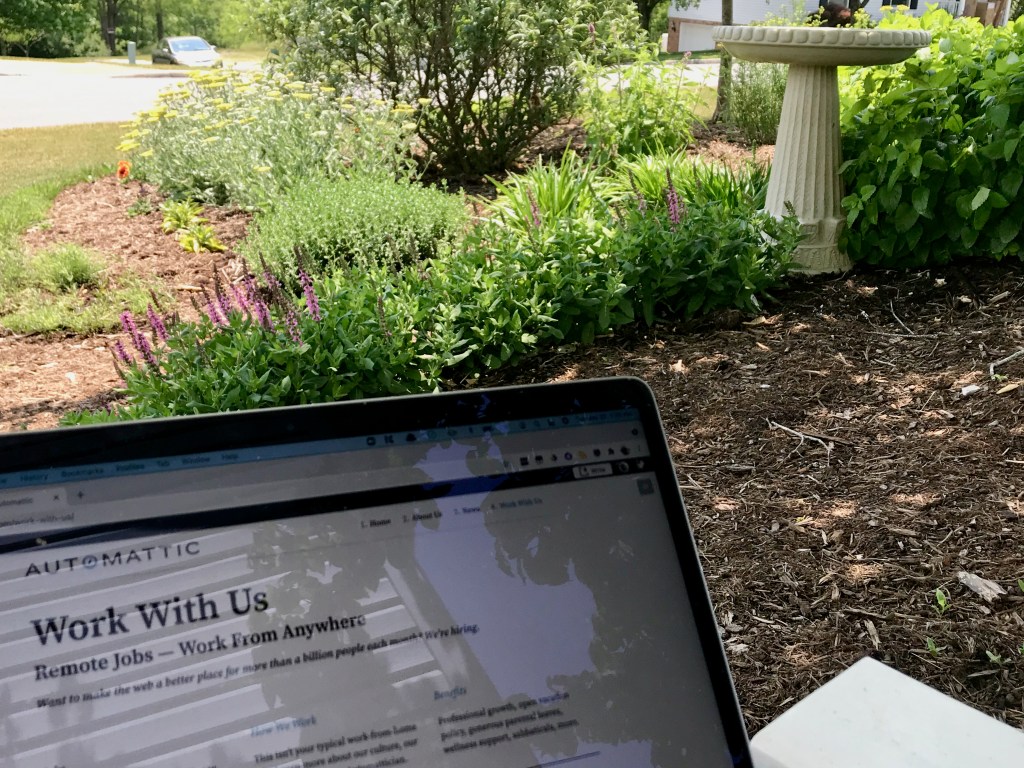
I’m under the canopy of my dogwood tree, which is thick with green leaves. It’s cool here in the shade. Fat lavender buds sway next to me in the wind. A purple finch drinks from the bird bath, which I refreshed with clean water a few minutes ago. Birds twitter, and the warm scent of roses drifts on the breeze.
I like this office space.
My garden office.
Shown on screen: Want to make the web a better place for more than a billion people each month? We’re hiring at Automattic if you want to check out our job listings.
My husband and I love the water. We met in the Florida Keys on a marine biology field course, and we both feel the pull of the ocean from our home in the Appalachian mountains.
The nearest salt water is more than four hours from us. We can’t get to it in the morning or evening for a walk on the beach, or in the afternoon for a quick swim, or any time to body surf or listen to waves crash and gulls cry.
To ease the separation, we started sailing on nearby mountain lakes. The air smells different from sea air, and the spaces aren’t as wide open as the ocean, but a lake is water, and our sailboat gets us out on it.
Last year, we tried a new way to get on the water. For Father’s Day, the kids and I took their dad to nearby Fairy Stone park and rented four stand-up paddle boards. We laughed, splashed, glided, laid on our backs on the boards with our hats over our faces.
Next thing you know, my husband and I have our own paddle boards.
We took them out Sunday for the first time this season. It would have been a good day to sail, too, but the paddle boards are easier. Plus, my husband found a reservoir nearby with limited power boat traffic, so it would be quiet and wake-free — a perfect place to paddle. With the boards, there is no trailering, no stepping the mast, no jockeying for boat ramp position. Once we got to Carvin’s Cove, we plopped the boards in the water and took off.
Over the years, we’ve started to notice how much of a burden stuff can be. Even stuff we we like, like our house, and like hobbies. I love our home and obviously I love my garden, but they’re both a lot of maintenance. And the bigger something is, the more maintenance it requires. Similarly, hobbies that require a lot of equipment become high maintenance. I used to be into cycling, but it got to be a hassle, what with all the gear, and having to find a good place to ride, and drive the bikes there, and then you have this dumb helmet and clacky shoes when you need to stop and get a snack, and you can’t leave the bike because it might get stolen, and you have to ride for hours to get a decent workout.
I eventually ditched the bike and switched to running, which just requires running shoes, clothes that wick sweat, and a half hour of time. I can go right out the door, and I can do it when I travel. As my husband pointed out, walking is even simpler: you don’t even have to change clothes. As long as you’re on land, traveling by foot is the most up-close-and-personal way to explore.
Similarly, my husband and I did a lot of SCUBA diving in our earlier years. After a while, the heavy tank, the gear, the limited bottom time, and the dependence on dive shops to get us to moorings all became burdensome. With a mask and snorkel we could get what we wanted — to see the underwater world — with our bodies free both on land and in the water. With a mask and snorkel, you can walk anywhere there’s water access and just get in and go.
Today I felt that same freedom with paddle boarding. Getting the boards on and off of the car is the most complicated part. Once you’re in the water, you can go anywhere, with no stress, little risk, and pretty much no limitations for water depth, proximity to shore, stopping and starting, and jumping in. It’s just you, your paddle, your leash, your board, and the water, right there, inches from your feet.
On the quiet of the reservoir, I heard the dip of my paddle blade, the rat-a-tat of ripples on the bottom of my board, the wind in the trees. When I saw flowers on shore, I paddled up to them and used my foot as an anchor so I could photograph them. When I was hot, I jumped in. When I wanted to do nothing, I sat on my board as if it were a beach blanket.
Relaxed in a cove
Mountain laurel on the bank
Cycling, SCUBA diving, and sailing definitely offer a more intense experience. You can go faster and deeper and farther with them, and I do like speed and depth and wind on my face. But the unencumbered way gets me the main thing I want and with a lot less hassle.
I love feeling unburdened. The more I experience it, the more I want to cultivate it in more areas in my life. I’ve purged almost all of my physical books, for example, and carry my library with me in my e-reader. As I think towards the day that will come when our kids move out and it’s just the two of us again, I wonder, “Could we just take off for a few months and be nomads? Live out of backpacks, go wherever we want, whenever we want? Explore oceans and cities all over the world without having to rush back home to maintain everything?”
When I ask that question, I look around and think, how much of this stuff do I really need? How much do I even want? The only things I need are the things I use on a daily or weekly basis (toothbrush, laptop for work, clothes), the things I want are the things I choose to use on a daily or weekly basis (e-reader, notebooks and pens, camera). I’d need to figure out my fountain pens and notebooks, but everything else could realistically fit in a backpack.
I aspire to feel as unencumbered in my life as I do on the paddle board. I want to be free to start, stop, poke around, and move on to a new place when I get the urge to wander.
When the garden first begins to return in March, I might find something new to get excited about once per week: a snowdrop, a sprout emerging from the cold earth. Now, dozens of new things happen every day. I can sit outside and admire the garden for hours.
Today I wandered around with my camera, then looked back at photos from when I mulched on my gardening vacation in March. It’s so different now, and it’s only May!
Dwarf lilac
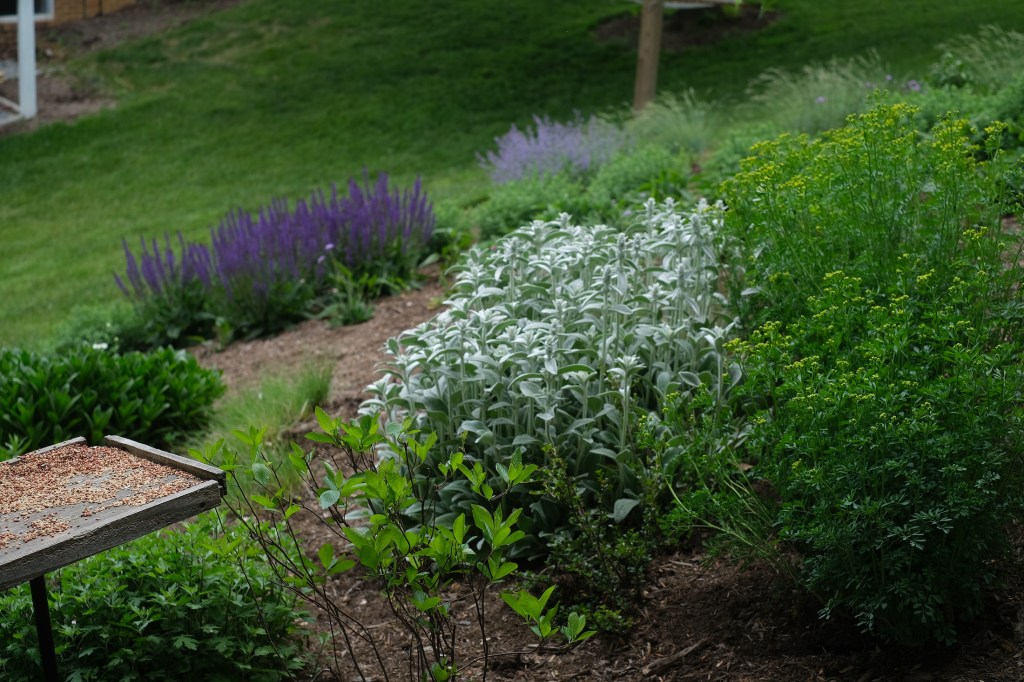
Back bed from the foot of the hill: marjoram and purple salvia in foreground, lambs ears and rue in front of the chair, shasta daisies to the right
The sugar snap peas are flowering
View from the top of the hill
My new passionflower ♥️
Lambs ears, penstemon, Walker’s Low nepeta
Yarrow
Penstemon
I planted the new bed (background) last weekend. The zinnia seeds have started to emerge, and the milkweed seedlings have survived so far. I put in some red salvia annuals so there’d be at least something there while everything fills in.
The Mexican feather grass isn’t coming in very thick this year 😦
We threw our windows open three days ago. At long last.
Sun pours into the kitchen window and spreads yellow rectangles of light on the shiny oak floor under the dining table. A crow’s caw tears the empty morning. The whine of a prop plane’s propeller builds and then fades overhead. Chirrups of songbirds trill in the silence after it passes.
The trees are still. There is no wind. The air is heavy with humidity, but cool on my arms as it drifts inside.
A robin bobs on the driveway, then on the grass. It pulls worms from the earth. A bunny eats dandelions in the the neighbor’s yard.
The dogwoods next door are green now — the white flowers have all fallen — and the slant of light from the newly risen sun sends their shadows across the full width of our yard. Dew sparkles on the grass, and the yellow morning light makes the lemony yarrow and the blazing orange blanket flowers look like summer. Indigo salvia and Walker’s Low catmint send up spikes of purple flowers that are freshest this time of year; the leaves on the plants are unmarred, and none of the blossoms have browned or faded. The lilac finally flowered as well; its blossoms have just begun to open.
The air is fragrant with honeysuckle and an almond scent from a tree that blooms in white frilly fingers. I don’t know the tree’s name, only its scent. I see buds on the butterfly bush, and the ornamental onion has fat tips as well. Brown-eyed Susans, the grasses, and the trees have all leafed out now. The world is a bright fresh green.
Last week I wore sweaters, long pants, and socks. The past three days I wore short sleeves, skirts, and bare feet. The foreseeable forecast is highs in the 80s and lows in the 50s and 60s. We can keep our windows open night and day to let the fresh spring air and birdsong in.
April was a good month for me for reading. I devoured two publications that experiment with form and structure: the novel Ducks, Newburyport and the online magazine Pipewrench. As I mentioned in a previous blog post, Ducks, Newburyport is a 1,000-page sentence. Pipewrench magazine is structured like a dinner party: the main essay is the guest of honor, and the companion pieces, named for the guests at the dinner party who wrote them (the Musician, the Poet, the Educator) are like conversations at the table that explore the main essay’s themes from different perspectives.
Both publications are unlike anything I’ve ever read. They take risks that in the wrong hands could crash and burn. Their creators jumped off the cliff and soared.
I recently learned that appreciation of beauty and excellence is a strength (YES! I wish I’d known 30 years ago), and when I took the VIA strengths test yesterday, I found it is my top strength. This makes me feel better about not being able to create such writerly wonders myself but instead sit back and enjoy when others do.
I also recently learned that awe and wonder boost happiness. I can confirm that this is true because after I experience the excellence of literary risk-takers like these, I am filled with joy and appreciation. I am delighted by their perfect execution even now, a month after reading them.
The reverberations I still feel after reading Ducks, Newburyport and Pipewrench make me think a lot about what makes a work, or even a simple conversation, rich and deep and fulfilling. Some writing is enjoyable and fun and makes me turn pages quickly, but I don’t feel fulfilled afterwards. The story does not stick. Some paintings are pretty to look at, but they don’t inspire me to engage with them, to think, to feel, while others captivate me and inspire me to come back to them again and again.
We use the word “deep” a lot — a deep conversation, a piece of writing that goes deep. I think a common element of things that resonate and stick are that they go deep. But what does that mean? What distinguishes shallow from deep? The answer to this question is elusive to me.
I think one way an author creates depth is by layering. You hear about cooking, “You must season at every step!”, and this is something I think exists in art as well. A piece of writing that resonates goes deeper than just the surface layer of the story itself, and every layer is thoughtful and well-executed: characters, subject matter, word choice, themes, exploration of humanity, leaving enough out so that the reader engages to fill in the blanks. In works that reverberate, all of these layers are perfectly executed and interact with each other to provide richness and complexity. In the examples of Ducks, Newburyport and Pipewrench magazine, I mentioned structure. Until I read these I would have never said I cared about how a piece of writing is structure. And then these both did something with structure that surprised me, that I wasn’t sure how they would work, and as I read, I realized their structure played as essential a role as the plot, word choice, and characters to pull off what the creators were hoping to achieve. I’m still delighted by this.
For me, perspective also contributes to depth. Art that resonates often gives me a new perspective, a deeper look into how someone else sees and and experiences the world. Getting at the motivators of human behavior is endlessly fascinating to me, and different perspectives, when done well, show us those drivers. Seeing those drivers for behavior help us expand beyond the story and the specific characters on the page to broader humanity, giving us empathy not just for the characters on the page, but for our fellow humans.
I think a contributor to my experience of works that reverberate is that they challenge me. I don’t want to read or look at a piece of art so difficult that it blocks me from consuming it, but I do like to be challenged. With Ducks, Newburyport, the lack of terminal punctuation challenged me as a person who likes tidiness and order and a clear stopping point. With Pipewrench, reading the experiences of the grief of being Black in America challenged me as a white woman who contributes to the systems that cause that grief. Challenge breaks down barriers. It makes me see things in new ways. One of my favorite things about abstract art is that it challenges us as the viewers to interpret it our own way, to see what we will see in it. I find this exciting. It’s a way to fire new synapses, to think in new ways. Challenge allows us to constantly recreate our world-view.
I guess that’s another contributor to depth: universality. This feels cliché to even bring up because it’s in every writing book ever. But it’s true, writing that reverberates can be expanded beyond the story or the characters on the page. Well-crafted works of art make us think big thoughts about humanity and the world and the universe, about forces bigger than ourselves, about Nature, about cruelty and hope and what we can do to be better in the world.
Ducks, Newburyport is a masterpiece. I finished it three days ago and I can’t stop thinking about it. I don’t even know how to describe it. It is the running monologue inside the head of an unnamed Ohio mother of four (transplanted from New England), and it is a single sentence that goes on for 1000 pages. It is punctuated with commas; there is no terminal punctuation until the final page. The only breaks in the monologue are sporadic, brief sections that give us a peek into a mountain lioness’s interior thoughts which, compared to the woman’s stream of consciousness, are clear, direct, structured, and punctuated. With paragraphs! And periods!
The contrast between the thought patterns of the human mother and the mother wildcat are stark: the thoughts of the mother of four in America are memory, big thoughts, the mundane, deep thoughts, brand names in the kitchen, recollections of dreams, and incessant brain chatter about nothing and everything. The wildcat mother of a litter of cubs, on the other hand, is precise in her thoughts. There is no mental noise. She senses the external world — the scent of rain, the tremble of flowers that helps her distinguish between prey and not prey, predator and not predator.
What sort of creature cannot sleep contentedly on a warm rock, or drape itself across a few high branches and be still?
– Lucy Ellmann, Ducks, Newburyport
The lioness’s thoughts connect directly to surroundings and survival. And her story parallels the Ohio housewife’s. The woman and the lioness are both mothers caring for their young. They both protect them from the dangers of man, which include violence, pollution — water, air, noise, you name it — climate change, predation, violence, mindless destruction for selfish means, and of course, violence.
the fact that in domestic violence cases, women are five times more likely to be killed if there’s a gun on the premises,
– Lucy Ellmann, Ducks, Newburyport
I am in awe of how Lucy Ellmann wove this story, and wrote it in a way that I was willing to, and wanted to keep reading a 1000. Page. Sentence. I am amazed by how perfectly she wrote the mental chatter so that I was like, I’ve thought that exact thought, that exact way, get out of my head. She was able to make a 1000 page single sentence readable, relatable, and funny. And among the ordinary, the worry, the intuition, and the baking tips, she includes moments of transcendent beauty.
the fact that you know the leaves are enjoying this warm sun going right through them, the fact that the leaves seem to be sunbathing, letting the sun lick them, the fact that there are times, maybe the most unlikely times, that you realize you’re simply thrilled to be alive, and what a great piece of luck it is just to be a part of things, to have a body, so you can feel and see and walk the earth, for just a little while,
– Lucy Ellmann, Ducks, Newburyport
The thing that leaves me gobsmacked, though, is that Ellmann is able to weave tension, foreshadowing, and a story that goes somewhere, into this stream of consciousness. Among all the chatter, a lot of which is noise, she drops in signal. She builds to a climax. This is the genius in this book. Through this unstoppable monologue of the daily toil of raising four kids in Ohio, running a pie-making business, being a cancer survivor, grieving over the death of parents, and dealing with unwanted drop-in visitors — a monologue which paints a vivid, familiar picture of everyday life for a white middle-class mother in America, with the grocery lists and political news and errands and emotional baggage and child-rearing — the author weaves in the woman’s incredulity at how violent, and how carelessly destructive we as humans are, and how selfish and entitled, and that these attitudes and behaviors have an impact.
Every person shot and killed in the United States is a mother’s child. Every being we destroy would like to carry on its life without us screwing it over. Our prioritization to protect guns and big corporations over life is astounding, and the author conveys this coherently and compellingly in a 1000 page sentence. I can’t get over it. Huge thanks to my friends Elizabeth and Daryl who both told me, “I think you might like this book.”




 Butterfly Mind