Another Saturday, another winter storm. “Storm” is a bit of an overstatement, really. Especially compared to the snow others are getting right now. We’ve just got freezing rain, sleet, and ice. No wind, no snow. Definitely no thunder snow.
It’s super gross outside. But at least the ice is pretty. I took my 15 year old digital camera out to take pictures of the ice, then spent the rest of the day agonizing over whether to push the button to Buy Now on a camera.
I looked at the photos from my old camera and then Bought Now. I should have the new-to-me camera next week. Then I just need to save another six months for the lens I want. I’m hopeful I’ll be able to find one used by the time the caterpillars and butterflies start showing up.
I built a fire last night, like I did last Saturday night, in anticipation of an overnight winter storm. Two weekends in a row, we’ve woken on Sunday morning to a white world. This weekend is even thicker snow than last. It is fluffy and sticks to everything, and as I photographed this morning, it fell in great clumps from the trees. Rain will come later and wash most of it away, so I tried to catch it before that happened.
View from front doorLooking down the street from front landing
At the end of every summer, I think, cool, the garden is good. It looks great. I will leave it as it is; I won’t obsess during winter or move a bunch of stuff around in the spring.
Then January comes. I order seed catalogs. I pace. I look out the windows. This year, I started a journal — with drawings! — to help me see the garden’s beauty even when the colors are just a dozen shades of brown.
Jan 23 garden journal
Jan 24 garden journal
Jan 31 garden journal
As I looked at seed catalogs and paced and looked out the windows, I thought, you know, I really want a big swath of Mexican sunflowers. And a giant patch of zinnias for the butterflies. And I really want more milkweed, too, and dill.
But all the beds are already full.
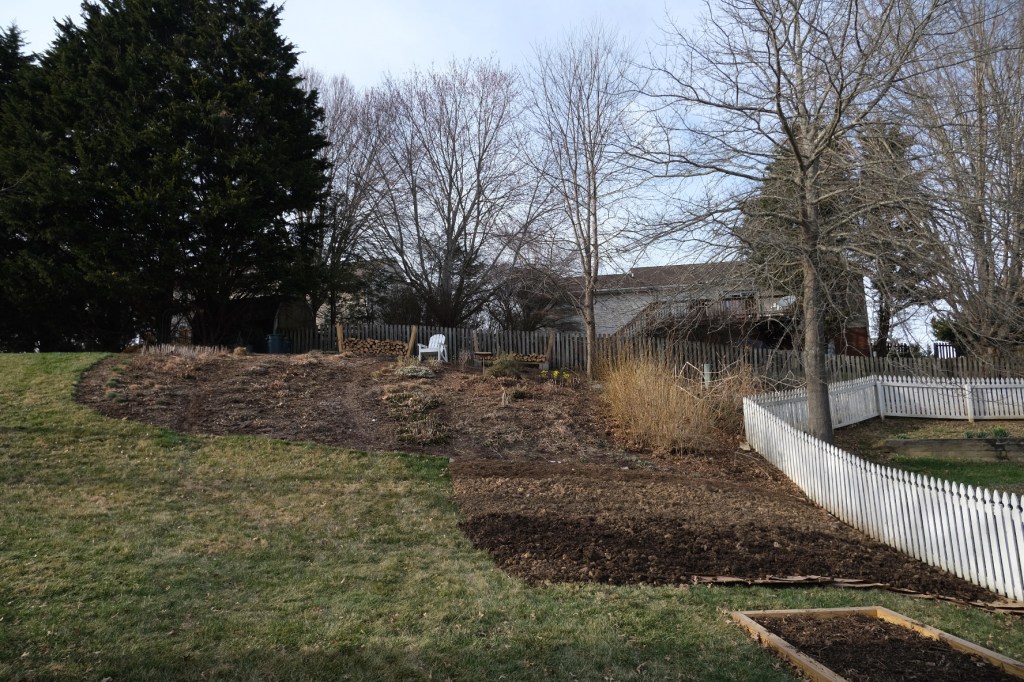
So I paced and looked out the windows more. I looked for a place a bed could go. A place with sun and that I could reach with the hose and that was somewhat level so the tall Mexican sunflowers wouldn’t flop down the hill when they could no longer bear up under their own weight.
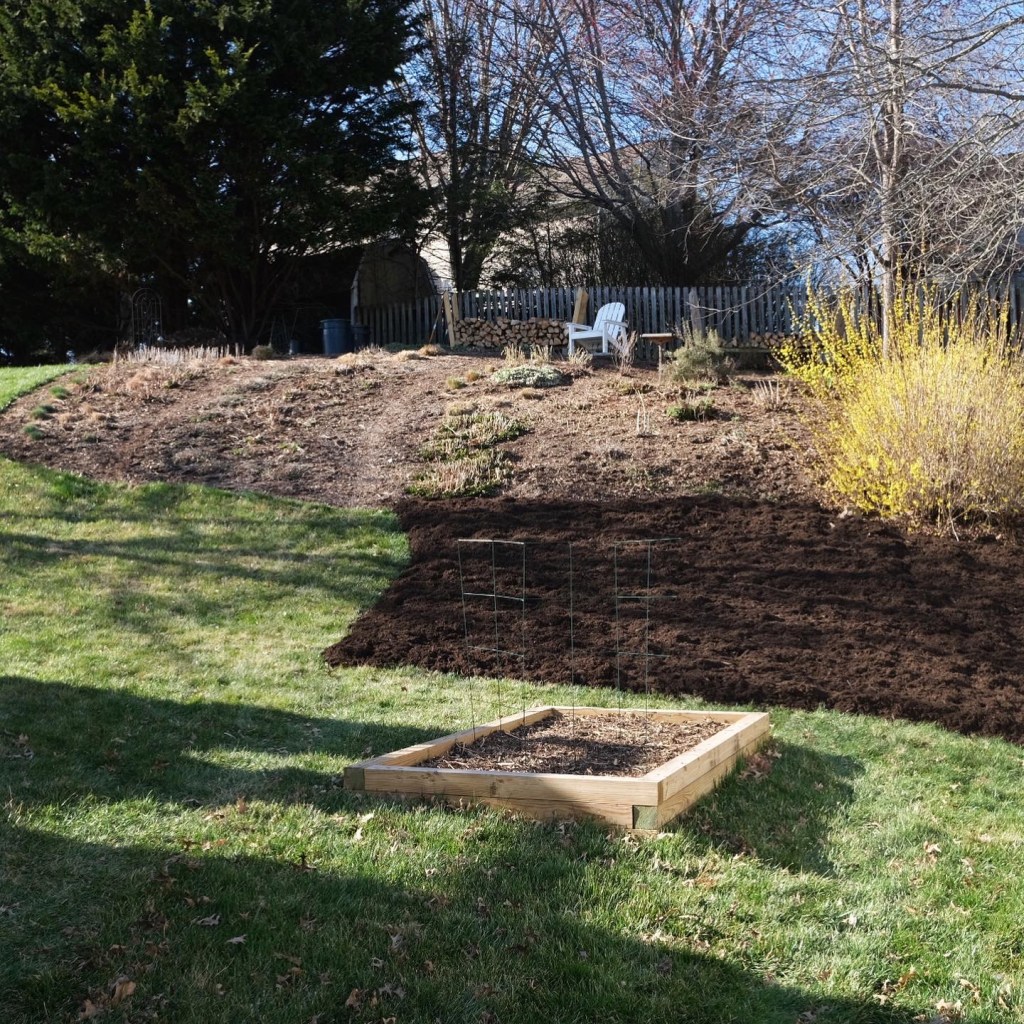
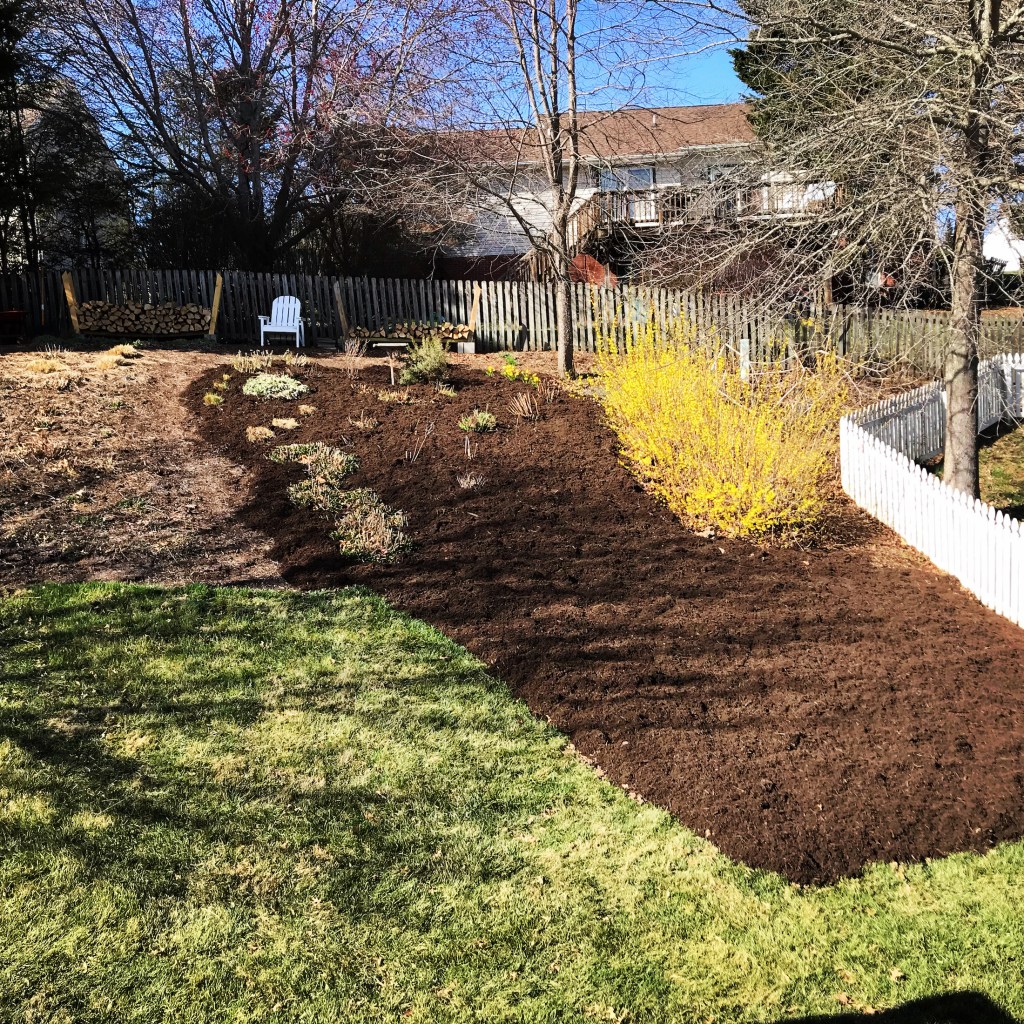
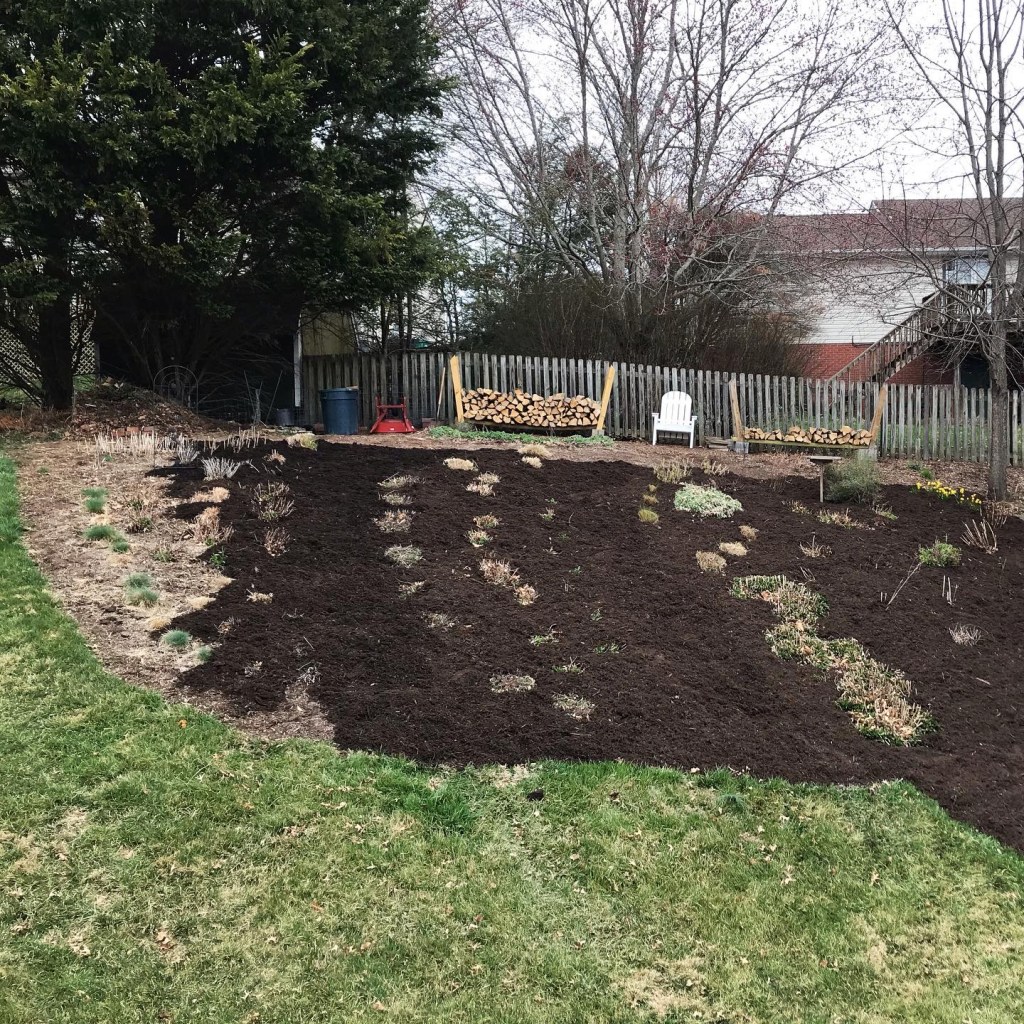
There’s a big section of one flower bed that gets too much shade in summer for me to grow the things I want in it, but I realized if I pull it down a bit, I can create some space that gets more sun, is less steep, and would be a perfect place for a big flower patch.
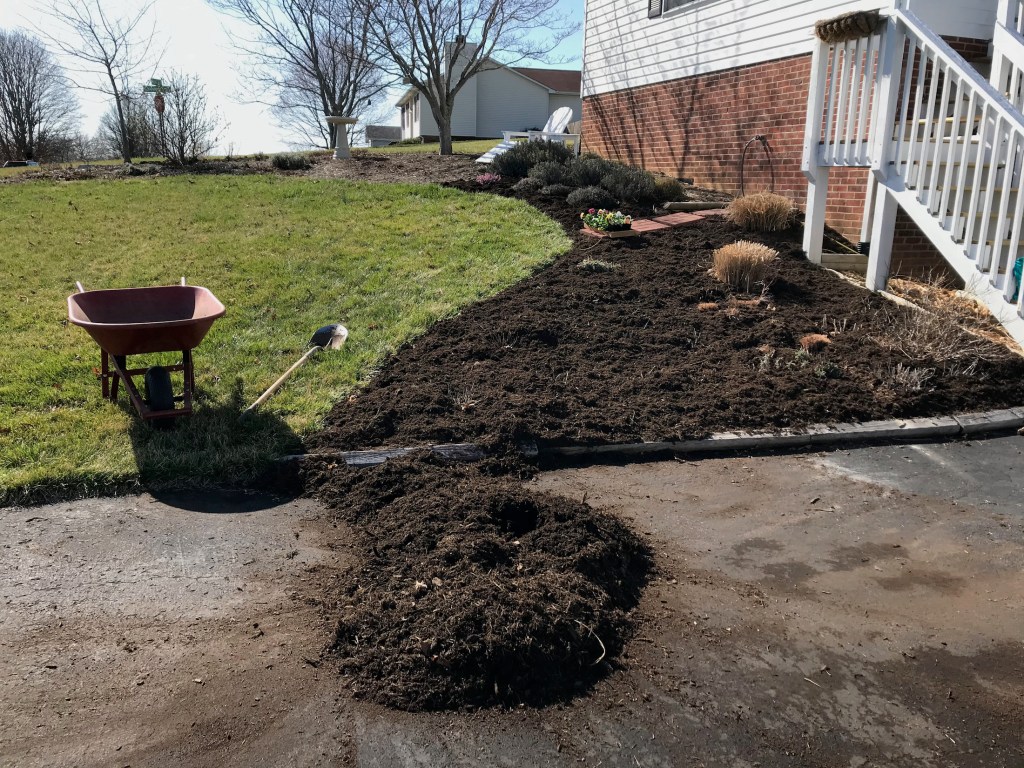
We still had a bunch of cardboard boxes left over from Christmas, so on a warmish day (for January — it was maybe 45 ℉), I set the lawn mower on its lowest setting to shear the grass close to the ground in the area I want to transform into a bed. I broke down the cardboard boxes, spread them out, and weighed them down with bags of topsoil.
Topsoil
Super sheared grass to kill – Jan 23
Cardboard layer – Jan 23
My idea is that if I start now, I can create a physical barrier between the grass and the sun to kill it. Meanwhile, I’ll cover the cardboard with topsoil to weigh it down. The topsoil will also provide dirt to scatter seeds directly into come May when it’s time to sow zinnia seeds. I’m hopeful the next three months of snow and rain will soften the cardboard enough that by the time June gets here and the zinnias are sending down roots, they won’t hit an impenetrable barrier.
First row of cardboard and dirt – Jan 24
This is all very much a fly by the seat of my pants idea, by the way. I’m pretty sure it will work.
However, I fear it will only work if I get started, like, now. As soon I exhausted our cardboard supply, I plotted when I could put more down. I had time off scheduled today, and I thought, awesome, I’ll do it then!
And then this happened.
Hello snow. Jan 31.
Which means the area I wanted to work in today looks like this.
Guess I won’t be working in the garden.
Now, instead of laying more cardboard down, I’ve decided I should extend the bed even further, all the way around the raised bed, because why not? I can put in some sugar snap peas.
I couldn’t work out there today, but after a coworker inspired me with his compost delivery, I did put in an order with my mulch supplier for dirt to be delivered next week or the week after, depending on the weather. That gives me two weeks to scrounge up more cardboard, and hopefully not come up with more ideas of where to kill lawn. I don’t know how my back will handle shoveling this much more mulch in spring.
After the holidays, when the fun part of winter has ended but there are still at least three months of bare trees, no flowers, and cold that keeps us indoors, I start getting antsy about the garden. I stand at the windows and stare out, plotting, planning, making mental lists of seeds and plants to buy, wondering, “should I kill more grass for another flower bed?”
Usually I make lots of notes in pencil in a composition book, in words, never easy to find again when it’s time to actually do something in the garden. Those notes are always planning for a future rather than enjoying the present moment, which, like it or not, I must live through to get to the spring and summer where green will sprout from the ground, flowers will bloom, butterflies will flit and flutter, and I can sit on the back deck in short sleeves and bare feet to soak it all in.
This year I wanted to try something different. Every January, I have to consult old calendars to see when I did what for the garden: when did I start seeds indoors? When did I order mulch? When did the forsythia bloom? This year, I want to create a visual journal of these winter months. I want to be able to flip through it and see what was going on and when. I also want to acknowledge the beauty of winter so that I can better bear these dormant, cold months.
And, let’s be honest, I wanted another excuse to use my fountain pens. I’ve filled multiple lined journals with inked words. What if I use all these colors to make pictures, too?
When I organized my ink samples on Friday, I changed the inks in almost all of my fountain pens. I loaded pens with the colors I see outside in January — Honey Bee (golden), Walnut (brown), Moon Dust (gray), Cardinal Kestrel (red), and Coral (ok, I don’t see this one as much, except at sunrise). I switched out the turquoise blue in one pen for more of a sky blue.
Then, I took inspiration from my friends who draw, and I drew little pictures. I drew birds at the feeder, a bloodtwig dogwood I saw on a walk, the dry golden grasses that are still beautiful, even in winter.
The very first picture I drew, of the salmon sky at sunrise on Friday, is pretty terrible. Drawing is hard! You really have to look (and translate what you see through your body and into a correctly-proportioned rendering on the page). As I attempt to draw, I realize that when writing, it’s easy to leave gaps. I can write “cardinal” and that will conjure a mental image of a red bird, with a few distinguishing characteristics filled in, depending on how familiar the reader (or writer) is with cardinals. But when I’m trying to draw a cardinal — what color is its beak? And what shape? And how long? What’s the shape of its head? Its body? What color are its legs? You can’t really continue with your drawing without knowing those things. You can’t leave an empty space where a beak would be.
Those details force me to pay attention in a way I haven’t in the past. Drawing demands me to see more fully. I like that. Plus, paying attention really does make me appreciate the beauty of winter, even if I’d much rather the world outside to be green and warm.
I joked with friends the other day that after transcribing several years worth of hand-written journals from my younger years, I now recognize it would be no great loss if they were all destroyed in a fire. There’s little of interest in them. They’re not deep, they’re not filled with big ideas or beautiful writing. They’re just me writing about whatever was on my mind that day.
I also realized that at the rate I’m transcribing, I will never digitize all of my hand-written journals. I still write longhand every day, and the amount I write each day outpaces the amount I transcribe. This doesn’t make me want to write any less, and it does not detract me from writing longhand. Especially now that I look for excuses to write just because my fountain pens are fun to write with.
And it hit me: I care less about what I produce, about the end product, than I do about the act of writing. I just like to write. It feels good. It’s satisfying. It helps me clarify thoughts, yes, and I’m sure that’s part of it. But there’s something tactile about it, too, the transformation of ephemeral thought into physical matter. That’s kind of miraculous, right?
Writing solidifies something that’s not even as material as air. Thought isn’t made of molecules. Not until you write it, or make music of it, or paint or draw or otherwise express it as something that can be seen or heard or tasted or felt. I guess writing is like any other form of creation in that way, and the creation of something from nothing is wondrous to me.
But clarifying thoughts and creating a thing of substance from insubstantial thought, those are bonus outcomes. They are not why I write. I write because it’s fun to write. Whatever else happens as a result of writing is sprinkles on top.
It feels nice to realize this, that it is the process that brings me pleasure, not the outcome. I always thought if I like to write I should have life goals like “write a book” or some other product-oriented aspiration. But then what? I’d still want to write. I’m starting to understand that my life goals are less about stuff and destinations and are more about feeling content and fulfilled and happy, and having love and purpose and meaning in my life. I don’t need to produce anything for those. I can just write, and enjoy the process, and that is enough.
As I may have mentioned before, I’m a little enamored with fountain pens right now. Some time in 2020, I realized I could purchase ink samples instead of full bottles. I’ve… accumulated a few vials of ink.
As the collection of vials grew, they tumbled all over each other in the little wooden box I stored them in. They wouldn’t stand up or stay organized. This was super annoying. Also, I couldn’t tell what the ink would look like on paper just by holding the vial up to the light; the color of ink in liquid form does not translate to the color of ink on paper.
I researched options for storing these ink vials, and I saw several tutorials for making racks. I knew I would not do this. I’m not going to measure and drill and be precise. I want to write with ink, not learn how to woodwork. The place I buy my inks from recommends test tube racks. These would work, but I wasn’t thrilled about the way they looked. Nor did I want to order and wait for them.
Last week, I explored to see what kind of storage doo-dads might be available. Surely there was something out there. And there was! There is! I found the perfect solution: cosmetic organizers. Specifically, lipstick racks.
Ink samples in lipstick racks
I also bought white circle stickers for the cap of each vial and a box of cotton swabs. Today, on this rain-sleet-snow-y day that I took off from work, I organized my inks. Using the Q-tips, I swabbed each vial’s ink on an adhesive white dot for the cap. I also swabbed each ink in a pocket sized Leuchtturm1917 notebook, since that is my new favorite paper.
Ink swab once it’s loaded in a pen
Ink swab not loaded into a pen yet
Now I know exactly what each ink will look like when I load a pen to write in any one of my many journals — book log, garden log, well-being log, regular old daily life log. I guess I have a lot of journals.
Once I organized the inks and cleaned out my pens, I reloaded them to match the colors I see outside this time of year, including the brilliant coral of clouds at sunrise, which I saw this morning.