I always think of spring as being the beautiful season, with its bright pink flowers, its new green leaves, and the reawakening to life after the cold hardness of winter. But the deep tones of fall – the mustards, the rubies – remind me that there is as exquisite a beauty in going to sleep as there is in waking up.
This photograph was taken on a rainy October day in our townhouse parking lot. The mundane scene was beautiful to me, and this photo is my entry to the Daily Post’s Dreamy photo challenge.
I first published this two years ago today. As I plan to head back to John’s camera shop to finally buy the 50mm lens I’ve been wanting for five years, I thought I’d post it again. Enjoy.
It was a damp, drizzly day here in Blacksburg. There was no direct light, just a gray, overcast sky – a perfect backdrop for the saturated colors of slick, wet leaves, dripping and mostly green, but with October pops of yellow, orange, and red.
And a perfect diffused-light day for photography.
It’s been a while since I’ve paid much attention to my photography. Mostly I snap quick shots to make sure we have mementos of our kids’ childhood – their cute chubby faces, their missing teeth, the glee in their eyes at Disney World. But lately, especially after hiking in the mountains here, I’m feeling an itch to photograph more – the dozens of varieties of mushrooms we saw on the War Spur Overlook, the white blazes of the Appalachian Trail on our first return to it since my husband’s 500 mile hike in 1996. But more importantly, I want to take more care in the photographs I take.
So I took my fancy digital camera over to John’s Camera Corner, a little downtown shop tucked in next to the hookah lounge and across the street from The Rivermill (the bar that inspired my Life in a college town. With kids. post), to get the lens cleaned up and get a filter to protect it from grubby little fingers.
I walked in and it was like walking back in time. The walls were lined with old cameras – film cameras. Brownie, Pentax, Minolta, Canon. A darkroom condenser reminiscent of the ones I used during a workshop at SCAD was propped in the corner. Old camera bags, lenses, and filters littered the floor and shelves, and by the glass display case at the cash register, there was a postcard spinner with antique photos of Blacksburg. I wandered around with my mouth open, touching cameras, recognizing equipment, until John asked if he could help me. While he searched for his lens cleaning kit, patting his pockets like the grandpa in The Princess Bride, feeling absently for lens tissue, lens cleaner, lens caps, or whatever else he might have misplaced, I told him, “Wow, this is awesome. I used to be into photography in high school. Look! Photographic paper!” On a rack in front of me were the distinctive white boxes of Ilford black & white paper. “Makes me miss my old camera, and film…”
“The smell of fixer,” he said.
And I could smell the ammonia again. “Yeah,” I smiled, “And the smell of fixer.”
John found an old Nikon UV filter for me ($10 vs. the $40 a new one would have cost), and while he cleaned up my lens, I wandered over to the Minolta wall of camera bodies. I wondered, could it be here? And there it was – my very first camera. The Minolta SRT 101. My grandfather’s old camera. The camera he used to photograph his family and the world on his tours of duty in the Air Force. The camera that captured my adolescence.
I picked up the Minolta in John’s shop, and as soon as I held it in my hand, I was 16 again, photographing my best friend on black and white film. The camera went straight to its natural place in my palm, the heft of it supremely satisfying, my right thumb on the film advance lever. I pushed the lever and savored the phantom feel of film advancing. Pushed the shutter release and felt the solid, gratifying shudder of the shutter mechanism. All of my senses were engaged when I photographed with that camera. It was completely manual, so I was present in the taking of each photograph, adjusting for light, framing each shot, taking care because unlike digital photography, film was not only finite – 24 or 36 frames – but there was also a tremendous time lag between when you shot the film and when you could actually see what you shot. It was important to be precise and get it right with each release of the shutter, and that need for precision made me very mindful when I photographed.
These days, I set my camera on automatic and carelessly press an insubstantial button, thinking “eh, I’ll just take a bunch and then edit with GIMP when I get home.” And then take weeks to even put the images on the computer. And then never make a print of a single one. The images are just pixels of light that disappear with the click of a mouse button, and the whole experience is like eating refined flour. It leaves me hungry.
But as I stood there in John’s camera shop, not even forty years old and already reminiscing about the good old days, I recognized that as much as I loved that old Minolta, and as much as I loved shooting and processing and printing film, it is outdated and has gone the way of the typewriter (RIP). My manual Minolta forced me to be present, and I’m thankful for that because it taught me the principles of photography. It made me work for every image, and because of that work, the images are imprinted in my brain as much as they are printed on that Ilford black and white paper.
I also recognized, feeling the sturdy weight of the camera, that we no longer live in that time. And I’m okay with that. Holding that old Minolta in my hand reminded me of my old love for photography, and of the good old days, but as I placed it back on the shelf, I remembered the limitations of film that led me to a digital camera – a young family, precious little leisure time, a budget that does not allow for endless film and processing. A digital culture that is phasing out film and the processing of it.
I loved my Minolta. It is as much a part of my shaping as the clink of my dad’s ring on the stainless steel wheel of our boat. Now that we have kids, I hope my digital Nikon will find a similar place in my heart.
Thanks to John, that Nikon is all cleaned up and ready to go shooting. And thanks to this drizzly gray day, and the heft of that Minolta, I’m ready to take the time to work for a shot, and bring home a pretty picture.
I just realized I posted my first Butterfly Mind entry two years ago today. We lived in Minnesota at the time and I was supposed to be packing up the house to prepare for our cross-country move. Instead I started a blog. Since then I’ve published more than 250 posts and am still loving every minute of it. Thank you, readers, for making it so much fun to be here. Here’s that debut entry.
Posting a photograph last Friday of where I walk when I listen to my podcasts reminded me of a piece I wrote soon after our family moved to Blacksburg, Virginia. Nearly two years later, we still love it here; I think that means we have a chance at durable happiness. Please enjoy this post from the very early days of Butterfly Mind (October 18, 2012).
“RESEARCH OFFERS HOPE FOR THOSE SEEKING DURABLE BOOST IN HAPPINESS.” That’s the title of an article I clipped from the paper this summer. I don’t think I’ve ever clipped a newspaper article, but I saved this one. Because in this piece, I learned the secret of people who are able to sustain happiness after an exciting life change (being newly married, or, say, taking the perfect job): that, even beyond the initial excitement of their good news, rather than letting the novelty wear off and searching for something newer and better, these happy folks continue, on a daily basis, to appreciate the positive differences the change has made in their lives.
Kind of like how every time I drive out of our neighborhood and see Appalachians in front of me, I think, “Wow! I can’t believe we live here!”
I’ve been thinking a lot about this article since we made our move to Blacksburg because it tells our story – “When Jim Gubbins finally got the job he’d been working toward for 12 years, he was a very happy man.” Every day, my husband and I marvel at our good fortune, that all of our work actually paid off in they way we were hoping it would, and in a place so spectacular. But what really caught my attention, especially since, like my husband, this Gubbins character is a professor, is that after three years in his tenure-track position, Gubbins is even happier than when he first landed his dream job. All because he is satisfied with what he has, because he is not looking for something better. Because he marvels at his good fortune. After three years, he still savors the changes his job has offered him in all aspects of his life – the friendships he’s cultivated in his workplace, the perks of being at a smaller university, the opportunity to share knowledge. The amazing place he lives.
That last part – the amazing place he lives – resonates deeply with me, and makes me think we might have a shot at this durable happiness thing. My husband and I moved around a lot before settling in Blacksburg, no place ever feeling like quite the right fit, no place feeling like home. A friend likened us to Goldilocks, as we started in Florida (too hot), then moved to Minnesota (too cold), and are finally settling down in Virginia (just right). But it’s not just the climate that fits. Every time I see hemlocks and white pines, or we hike with our kids on the Appalachian Trail, or I smell the scent of mountains – a crisp mix of dry leaves, warm granite, damp earth, and high, clean air – every time I hear a Southern drawl, or my manager at work says “cotton-pickin’,” I delight in our good luck. I can’t believe we live here.
Sometimes I hesitate to get too attached, or I try to rein in my happiness, because I’m so used to having to uproot, to not get too close. Or I think the novelty will wear off at some point. The mountains will surely become so everyday, such a normal part of the landscape, that I won’t even notice them anymore.
This article, though, it’s urging me to risk it – to get attached, to get real close, to notice the mountains (like broccolli forests in summer, glittering gemstones in fall), to breathe the Appalachian air. It reminds me to savor these gifts. Having already hiked six different trails in six weeks – with waterfalls and babbling brooks, views of Allegheny ridges and the New River Valley, with boulders, hemlocks and white pines, deciduous trees ablaze in citrine, garnet, and yellow sapphire – and countless choices for new hikes, all within 30 minutes of home, the outlook is good that even in a few years we will still be in awe that we get to live here. Because we haven’t even unpacked our camping gear yet.
But the most exciting bit of encouragement that our happiness will endure comes from folks who have lived here a while. On a late-summer day in the courtyard at our kids’ school, when the sky was a crystalline blue, and the sun was warm, but not too warm, on my face, and another time, on a damp autumn morning, when fog rolled over the gentle green domes of the Appalachian mountains, I said to my companion of the day, “Every day, I look around me, or I smell the air, and I think, I can’t believe we live here.”
And my friends – two separate women, unknown to each other and on separate occasions – said quietly to me, both smiling in the same conspiratorial way, “You know, I’ve lived here for 14 years, and I still feel that same way.”
Appalachian Trail sign at McAfee Knob parking lot, Blacksburg, VA
Portraiture is possibly my favorite form of photography. Faces show character in every laugh line, every weathered wrinkle, in tan lines left by always-worn sunglasses, in the trickle of sweat through trail dust. In the scraggly beards of men who have walked the woods for weeks.
On our drive through Catawba valley, my husband said, “It’s getting close to peak thru-hiker season.” We were headed to Sawtooth Ridge, a portion of the Appalachian Trail between McAfee Knob and Dragon’s Tooth, near our home in Blacksburg, Virginia.
“It is?” I asked, my wheels turning. I had just checked my email and seen a photography challenge regarding culture, and I thought, oooh, maybe I can cover AT culture. Shoot portraits of rugged hikers.
“Yeah, if they left Springer Mountain [Georgia] on March 1, they’d start getting here near the end of April and in May.”
A local friend of ours said she gives away her chocolate snacks when she encounters thru-hikers on the trail. I thought of when my husband was thru-hiking, back when we were boyfriend and girlfriend, and how he would put an entire stick of butter in his ramen noodles at night. “I wish I would have brought more food,” I said.
In the McAfee Knob parking lot, I fingered my camera as large groups of day-hikers clustered around car trunks and tailgates, stuffing water bottles in daypacks, eating pre-hike sandwiches from Subway, mixing formula in bottles for the baby a dad would carry on his back. I wasn’t brave enough to ask to take their pictures. On the trail, I told myself. I’ll ask hikers on the trail.
We headed south while the crowds headed north towards McAfee Knob. For twenty minutes, we saw no-one. No day hikers. No thru-hikers. The only evidence of humans we found, besides the trail, was a “Home Sweet Home” sign nailed above a squirrel hole. “Kids! Look at this!” I crouched down and snapped shots.
Squirrel hole on Appalachian Trail
“Do you think a squirrel made that?” Our son asked.
“Or maybe fairies?” said our daughter.
I wondered about whoever had made this miniature sign, who had brought a screwdriver onto the trail to attach it to this little spot. A local day hiker? A Virginia Tech student? Whoever it was, they made me smile with this little surprise in the woods.
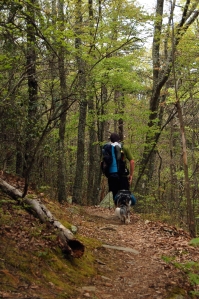
We rounded a bend and met a young man and his dog headed north on the trail. The man carried a full pack, with a pair of dusty gray Crocs tied on the side. His hands were red and raw as he gave his dog a treat for sitting obediently as our kids approached.
“Hey, how’s it going?” we said.
Hiker and his dog on the Appalachian Trail
“Good, good. I just picked this guy up in Pearisburg,” and he pointed at his dog. “I’m trying to train him.” The black and white mottled dog carried his own saddlebag pack and was calm and sweet as he sniffed my hand. His nose was speckled pink and black. The man gave him another treat.
“Well, y’all have a good day!” And he continued north as we continued south. I’m not sure if he was hiking from Georgia to Maine, or if he was just out for a weekend backpacking trip. I did not ask his story, and I did not take his picture, except from the back.
The next hikers we encountered were obviously thru-hikers. My husband and kids and I sat on fallen trees in a clearing, munching trail mix and baby carrots, when two women powered through the glade. They carried full packs, wore quick-dry nylon hiking pants in olive green and pewter grey, and their strides were long and purposeful. I wondered where they were from, when they had started, how many miles they were doing that day. Had they mailed boxes to themselves, filled with fresh food supplies, and cash, and lightweight spring clothing? Were they in a hurry to get to a post office and bury their faces in fresh tee-shirts? Clean socks? They said a quick “Hello,” which we returned, and then they were gone. I did not photograph them, or ask them their story. “The next one,” I told myself. “I’ll talk to the next one.”
On our way back to the car, we passed a scruffy young man smoking a cigarette on a slab of rock by the side of the trail. He sat atop a bulging backpack, stuffed full like a giant army-green sausage. He was backpacking, not day hiking. Carrying cigarettes and wearing New Balance sneakers, he didn’t fit the profile for a thru-hiker, but he could have been. I’m sure he had a story. He was lounging, I could have easily asked for his portrait. But he wore headphones, and I didn’t want to intrude, so I hiked by with a nod and a smile.
By the time we arrived at our car, where five dusty, bearded, twenty-something men lay draped over their backpacks, or sat on them as chairs, or propped their backs against them in the white gravel parking lot, I knew that I would not talk to these hikers either, nor photograph their faces. I am fascinated by journalists – by their grit, by their ability to shove in and get the story, by their speed in turning stories out – but I realized on the trail that that is not the stuff I’m made of.
Instead of shooting photographs of “the next one,” or of those prone hikers reclining not 20 yards from our car, I knew I’d bring their images home in my mind, and l’d write their portraits with words. I’d hole up at home, in retreat like many hikers seek, contemplating solitude, and the Appalachian Trail, and a culture that includes power-hikers, dog-rescuers, smokers, families of four, and those who would nail a tiny sign over a tiny hole, in the wilderness, for smiles they’ll never see, but that they’ll know, quietly.
White daisy-like wildflowers on the Appalachian Trail, VA
Appalachian trail, Sawtooth Ridge near Blacksburg, VA
Pink mountain azaleas in bloom on Appalachian Trail in April, Sawtooth Ridge, VA
Tiny green succlents on Appalachian Trail in spring, Sawtooth Ridge, VA near Blacksburg
View from rock outcrop on Sawtooth Ridge hike near McAfee knob, VA on Appalachian Trail in April
Pink mountain azalea buds on Sawtooth Ridge on Appalachian Trail, VA
Tiny blue feather on Appalachian Trail in April, Sawtooth Ridge, VA
Fern unfurling in spring on Appalachian Trail, Sawtooth Ridge, VA
Lichen covered log and white wildflowers on Appalachian Trail in April, Sawtooth Ridge, VA
(R) Repost – I am away, chaperoning the fourth grade trip to Jamestown, VA. I’ll be on a bus with, corralling, and sleeping in cabins with 60 ten-year olds for 48 straight hours, and am prohibited from drinking alcohol during that time. I know you’re jealous. Anyway, I was rummaging through my archives and saw this post from a year ago today and I thought I’d repost it to herald thru-hiking season in Virginia.
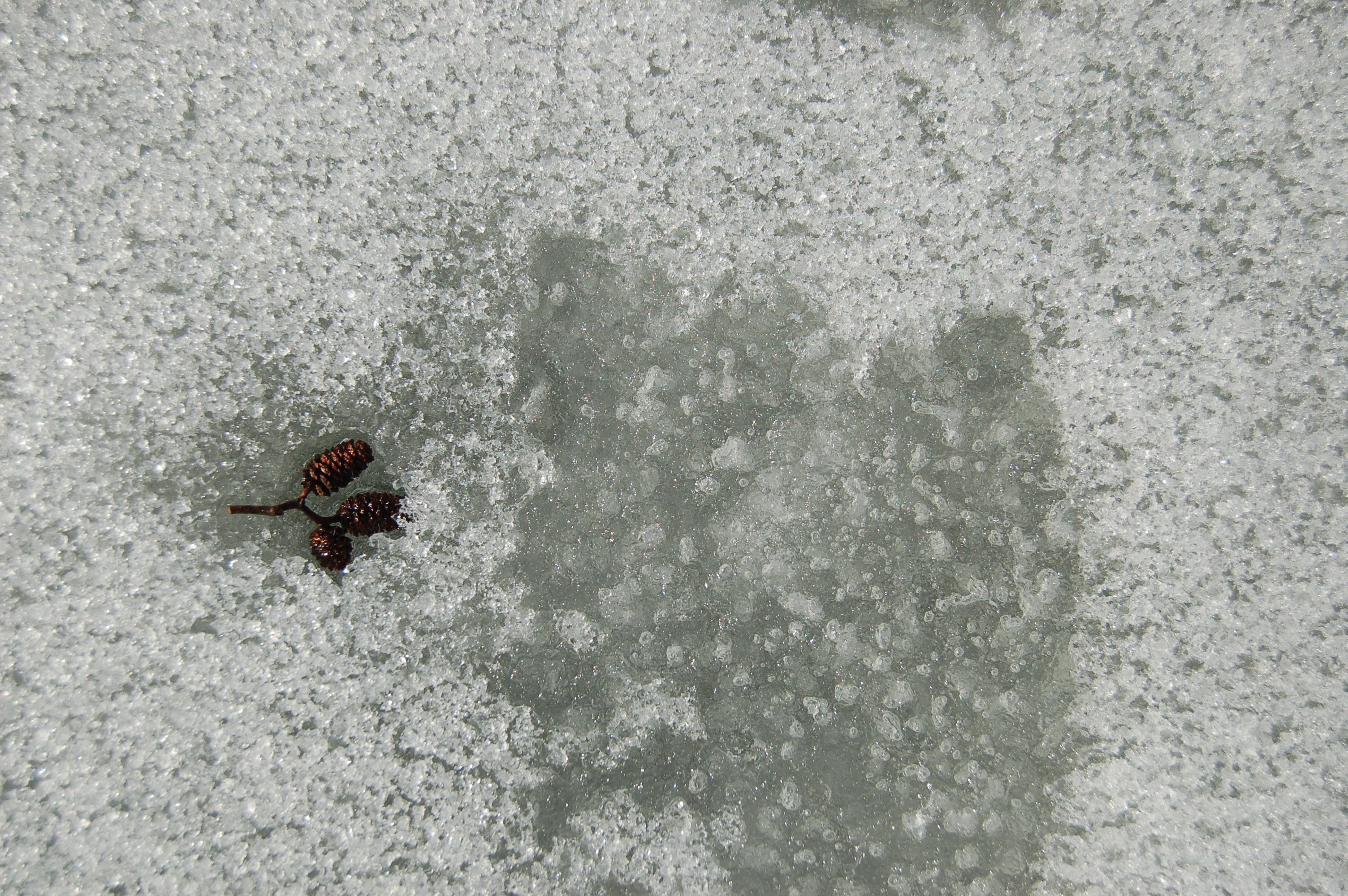
On February 1, 2014, my husband had an itch to hike the woods around Pandapas Pond. It was a sunny, 50 degree Saturday after two weeks of sub-freezing temperatures, and we had seen pictures in the paper of folks skating and ice fishing on the pond. I asked if the kids and I could ride along. When we arrived, he waved and disappeared into the forest, and our children and I wound our way down to the iced over water. College students walked across the pond’s hard shell – all the way across – and threw snowballs through sunlight. Our kids begged to go out on the ice, and all I could see was them crashing through. I was terrified. I told them to stay near the edges – the surface looked wide and treacherous, more of a lake than a pond, really, with all that shockingly cold, surely fathoms-deep water beneath a thinning sheet of cracking, melting ice. I white-knuckled my camera; I told myself, unclench your jaw. I reminded myself, Breathe, as they ran reckless, full speed, heads-back, mouths-open-in-laughter races on the sun-warmed ice; as I stepped onto pond’s slushy skin. I probably lost five years of my life that day, but our kids remember it as one of the best days of theirs.
Unknown plant, Pandapas Pond, Blacksburg, VA February 2014
Cracking? ice on Pandapas Pond, Blacksburg, VA February 2014
Walking on ice, Pandapas Pond, Blacksburg, VA February 2014
This is my entry for the weekly photo challenge: Threes






 Butterfly Mind