More time means more books. Over the past three months, I’ve maintained my early to bed, early to rise schedule even though I didn’t need to get up for work. The cats wake me at 5am, and most days, I just stay up after I feed them.
When I’m working, I eat breakfast, exercise, shower, and write before logging on at 8am. I work all day, relax with my husband, eat dinner, and then crawl in bed around 9pm and indulge in a few pages of a novel before my eyes close. Sometimes I might read a little on my lunch break.
On sabbatical, I read in the morning. I read during the day. Fiction! During the day! I read at night. I spent the entire afternoon yesterday on the couch devouring Loving Frank, a novel about the love affair between feminist Mamah Borthwick and architect Frank Lloyd Wright. I read for a couple of hours, cat-napped for an hour, then reached over to the table from the couch and picked it right back up without getting up. It was an intense and brutal novel, and I feel melancholy after reading it (and after lying on the couch all day). But now it’s done, and I can move on to the next on my long list of other books I want to read.
I know I won’t be able to read this much when I go back to work, and that’s okay. I need to create and not just consume. But I will certainly miss taking in all the stories, the beautiful writing, the characters, the settings. I’ll keep my wake-up and go-to-bed hours when I go back to work next week, but I might shift my working hours. Maybe I’ll start and end later to accommodate a slightly longer swim workout, and to give myself time to read while I’m awake rather than as my eyes are closing for the day.
Books I read (so far) on sabbatical:
Paris Letters: A Travel Memoir about Art, Writing, and Finding Love in Paris, Janice McLeod ♥️
The DaVinci Code, Dan Brown
The Inferno, Dante Alighieri
A Gentleman in Moscow, Amor Towles ♥️
The Iliad, Homer (translated by Emily Wilson)
The Paris Wife, Paula McLain ♥️
James, Percival Everett ♥️
Beloved, Toni Morrison ♥️
Slaughterhouse Five, Kurt Vonnegut, Jr.
The Paris Novel, Ruth Reichl ♥️
1000 Words: A Writer’s Guide to Staying Creative, Focused, and Productive All Year Round, Jami Attenberg
Less, Andrew Sean Greer
The Road, Cormac McCarthy ♥️
Night Watch, Jayne Anne Phillips
Now Is Not the Time to Panic, Kevin Wilson ♥️
In Our Time, Ernest Hemingway
The Turn of the Screw, Henry James
The Lost Queen, Signe Pike ♥️
The Things They Carried, Tim O’Brien ♥️
The Godmother, Hannelore Cayre
Die with Zero: Getting All You Can from Your Money and Your Life, Bill Perkins
I’m upstairs in the reading room at Shakespeare and Company while Owen shops downstairs. It’s quiet up here. The walls are lined with wooden bookshelves filled with English language hardbound books that aren’t for sale. Next to me is a reading nook, like a window seat in the corner, with a red velour cushion on it. I could sit there with my back against the honey wood wall and read if I were reading instead of writing. At the end of the hall in the room across from me, facing the window that looks out over the Seine and Notre Dame Cathedral, is a wooden table with an ancient typewriter with circle keys.
The floor is old cracked hexagonal tiles, brick red and faded terra cotta, wonderfully worn.The ceiling is wood beams, old old with gaps in the grain from swelling and shrinking. The ceiling is low. On the wall in the stairwell are black and white photos of authors: Virginia Woolf, Daphne du Maurier, Sylvia Plath. Maurice Sendak. James Baldwin. Other authors, like Hemingway and F. Scott Fitzgerald, are painted in line illustrations in the stairwell beneath the photos. A piano sits in the corner. Photos of more authors adorn the walls around it. Walt Whitman. Toni Morrison.
Painted over the door is “Be not inhospitable to strangers lest they be angels in disguise.”
Painted on the stairs, “I wish I could show you when you are lonely or in darkness the astonishing light of your own being.”
–May 31, 2025, 3:20pm
On our first full day in the city, I got to spend time alone with each person in my family doing something cool in Paris.
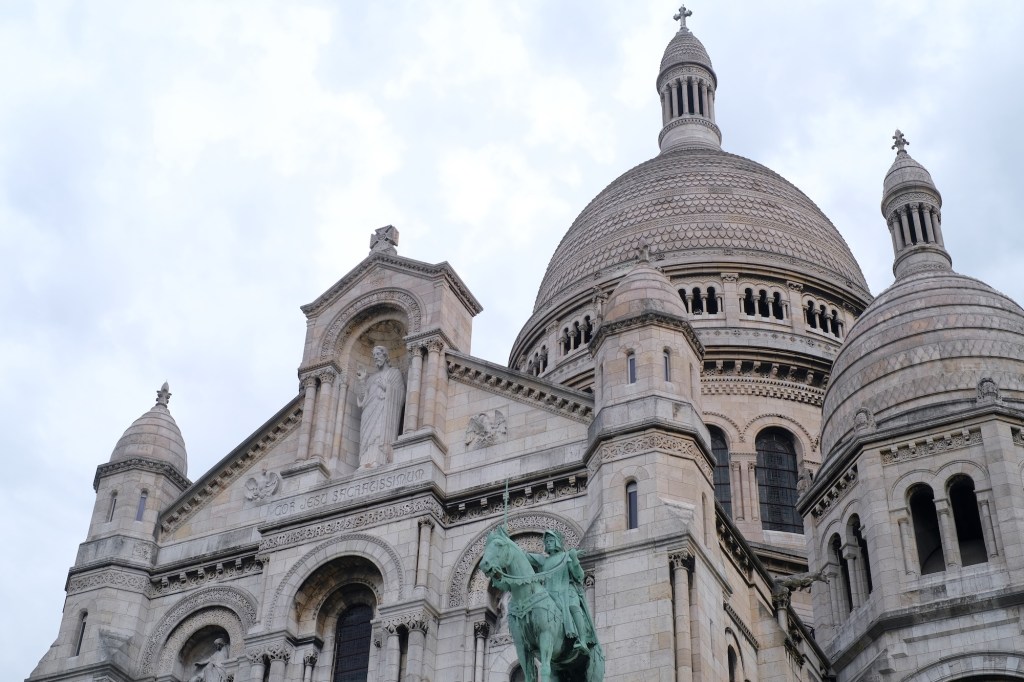
My husband and I were up before the kids, as we always are. We walked the Montmartre neighborhood again, this time in the cool of morning before the streets were clogged with tourists. We climbed the more than 200 steps to Basilique du Sacré-Cœur while runners with hydration vests ran down the steep cobbles beside the stone stairs. From the basilica, which sits at the top of Montmartre hill, you can see the whole of Paris.
After our walk, he and I had pastries and coffee at a little boulangerie around the corner, Chez Carla, where as I stood in line, I watched as they slid batches of fresh croissants off a pan into the display case. The croissants made a sound like stuffed dry leaves as they tumbled, flaky light and substantial at the same time.
Once the kids were awake, the four of us tried to figure out how to manage all of our desires. We each had a different One Thing we wanted to do in Paris. My husband wanted to head towards the river, maybe see Notre Dame. Our son’s one thing was the Shakespeare and Company book store. Our daughter wanted to shop, but her real one thing was to see the Eiffel Tower at night. I wanted to do it all. Plus Luxembourg Gardens.
We committed to shopping since our daughter’s time with us was limited.
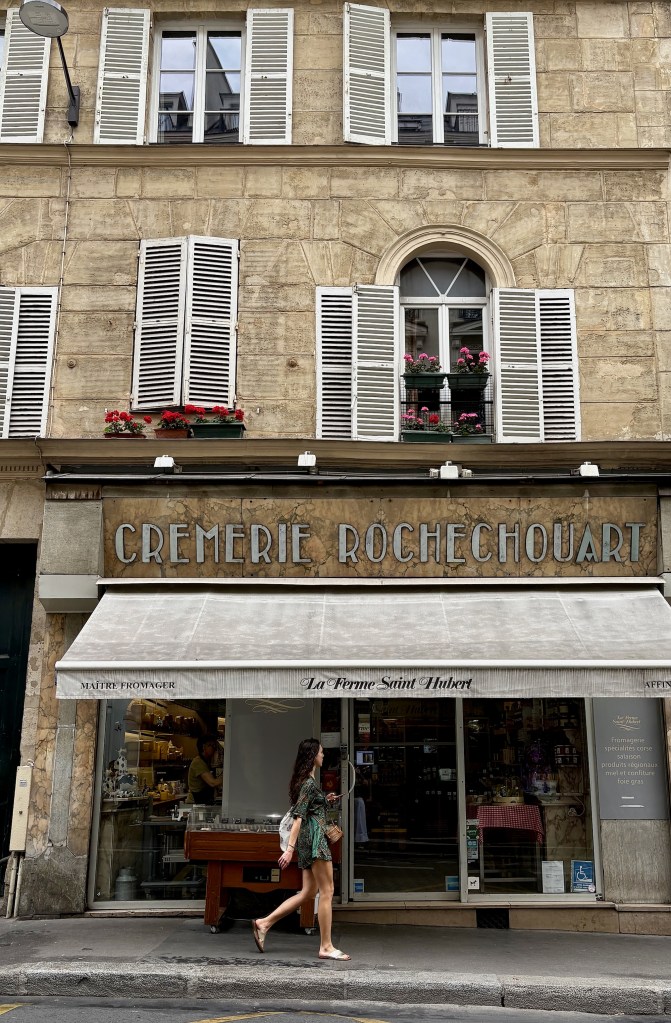
We ventured out of our neighborhood, down Rue Marguerite de Rochechouart towards the Seine. We weren’t 5 minutes from our apartment when I grabbed a photo of what delighted me as a quintessential Parisian scene: flower boxes and window shutters above a fromagerie (cheese shop), with a chic woman walking through the frame just as I snapped the shot.
On our meanderings, our daughter and I stopped into a multi-level Zara next door to the Palais Garnier Opera House. The time we spent waiting in a sweltering line for sweltering fitting rooms ultimately paid off — she found a dress she loved. While we were in Zara, my husband and son sat on the palace stairs and listened to a street musician. Our son said later that that was one of his favorite moments from the trip, just sitting there taking in the guitar player, the busy streets, the palaces.
We walked by ritzy shops and through Jardin des Tuileries before standing on one of the more than a dozen bridges that crosses the Seine. At this point, the Left Bank, where Shakespeare and Company is, was right there, just a few steps further. I knew our son really wanted to go to the book store. I asked, do you want to go now? I do. We can split up.
So we split up. He and I walked the mile or more along the Seine, past the book vendors that I’ve read about so many times in so many books, including Hemingway’s A Movable Feast from his time in Paris more than100 years ago.
When we arrived, there was a line to get into the shop. There were lines for everything that day. The sidewalks were packed. The restaurants and cafés and museums and shops were packed.
Once inside, Shakespeare and Company was not packed; the purpose of the line was to control how many people are in the store at any given time. Once you’re in, you can breathe and feel the coziness of being in a really special book store, where beloved English language authors have found kindred spirits in their time in Paris, borrowed literature when they couldn’t afford to buy it, leaned on the shop owner to find rare books; they’ve read, written, thought, and found shelter.
I loved being with our son there. I loved that I got to go with him and experience it together. He picked up several books, put some back, picked up more, put more back. He’d brought his backpack so he could carry any books he bought. Ultimately, he took home The Brothers Karamazov by Fyodor Dostoevsky and Norwegian Wood by Haruki Murakami. I bought Devotionals by Mary Oliver. We said yes when asked if we wanted our books stamped with the Shakespeare and Company stamp.
After the book store, we waited in the leafy cover of the Marché aux Fleurs (flower market) for my husband and daughter. Our son wanted to go back to the apartment. Our daughter wanted to shop more.
I went with our daughter, even though I was hot and hungry.
As soon as we started walking in the sun, she wilted, too. I saw a brasserie with tables in the shade, Le Sarah Bernhardt, and when I asked about a seat, the waiter took us around to a much better set of tables — we’d gone to the quiet side, and he took us around front where the people-watching was spectacular. We got seats at a little round table outside, facing the bustling Place du Châtelet, and sighed with pleasure to get off our feet.
I convinced our daughter that what she wanted was an Aperol Spritz. “They’re so refreshing on a hot day.” I got one, too. Our waiter was fun and friendly, full of smiles in in his tanned and wrinkled face. He brought us olives, and ice for our water (we were hot and I misunderstood him when he asked “still?” for our water, and I said, “Yes, chilled please.”)
Annabelle and I refreshed ourselves in the shade. We sipped our Aperol Spritzes and iced water, shared a caprese salad, and watched the fantastic style on display on the cobbled sidewalks in front of us. We commented on all the fashion we saw, what we liked, “Ooh, I love those pants,” “Look at those shoes!” , “That bag is spectacular,” “I like whatever this trouser thing is some of the guys are doing,” “I love how everyone uses color,” “Look how she pulls that off.” She talked about how refreshing it is that all the college girls where she’s studying abroad don’t wear the same things as each other like they do at home — women have their own style and wear what they wear because they like it, because they put it together, because it’s them. They don’t just wear whatever they’re supposed to wear so that they fit in. She admires the confidence and is inspired by it. And she loves that people actually care about style.
My edges were relaxed and fuzzy after the Aperol Spritz, and I felt wonderfully happy. We were fortified for another round of shopping after our rest and refreshment, and so we were off to Bershka, a store we don’t have at home, and where she found success and bought dresses and tops.
I was so happy to have that time alone with our daughter, and before that, with our son, and before that, with my husband, in this beautiful city. Our first morning at a café with coffee and croissants with my husband, appreciating Shakespeare and Company with our son, and Aperol Spritzes and people watching with our daughter were three of my favorite moments in our time in Paris.
Life of Pi is always the book that jumps to the front of the line when I think about books that had an impact on me or changed my life. My experience with it was deeply personal and I don’t expect that others will undergo something similar, but Life of Pi gave me permission to believe in whatever brings the most joy, meaning, and sense to my life. For this I will always be grateful. For as long as I can remember, I’ve been drawn to the unknown and unknowable, to the transcendent, to the depths inside of us, to universal connection, to the divine force. To all of the things that would be encapsulated by the word “God” except that the first association of that word conjures an image of the Judeo-Christian god, which does not match at all what I want to think about when I think about the divine. Until Life of Pi, I felt torn about this mismatch, and about what I can or can’t believe about God. Now I believe exactly what I want to believe, and I have fun with it, and it feels real and right to me.
Roots
Though it’s been many years, Roots by Alex Haley also had a deep impact on me. I was maybe in my twenties when I read it, and it was the first piece of art I’d experienced that showed slavery in an unabstracted, un-whitewashed way. It was the most brutal book I’d ever read at that point in my life. It humbled me.
Roots opened my eyes in a way that no public or private schooling in Georgia did. Last year I read How to Say Babylon by a Jamaican author who escaped her patriarchal Rasta home and landed at UVA in Charlottesville, Virginia. She was shocked there to be confronted constantly on campus by statues and monuments to Confederate “heroes.” In Jamaica, the statues and monuments were to those who overthrew slavery, not to the ones who perpetuated it. In the South when I grew up, we didn’t go deep on the realities of slavery for the enslaved nor how it continues to reverberate in the Black American experience now. My guess is that Southern schools don’t go there now either.
I remember I kept thinking, in and around the heartbreak and shock of reading Roots, This wasn’t that long ago. I know now that Roots is problematic for plagiarism and because Haley didn’t outright represent it as fiction, but I read it as a novel, and I stand by its impact. Literary fiction helps us understand one another. Understanding helps us love one another. We could use a lot more love among one another right now. Roots showed the realities and ramifications of slavery in a way I never had been exposed to before. It made me want to understand deeper, to bear witness, and to not forget. In doing so, it paved the way for some of the richest reading of my life, like The Color Purple, Their Eyes Were Watching God, The Trees, James, and most recently, Beloved.
Ducks, Newburyport
Other than the two people I know who already read this — both of whom recommended it to me — Ducks, Newburyport is not a book I expect anyone in my life to read or ever have any desire to read. It is a single sentence that goes on for 1000 pages, which I know sounds awful and terrible and the worst thing ever, who would want to read that? Where do you stop when you need a break? I totally get that, which is why I don’t expect anyone to read it, and is also why I love it so much and why it goes on a list of three books that had an impact on me. The audacity! Who would do this? What writer would have the guts to say, you know what, I’m going to write an entire novel in one sentence, and not only that, but it’s going to be a good novel, with characters and plot and a phenomenal central conflict that is going to come out of nowhere at the end (or maybe the reader got a tiny hint, because I did throw in some foreshadowing) and it is going to BLOW the reader away?
A true artist, that’s what writer would do it.
I wrote about this book right after I read it (see Gobsmacked), so I won’t repeat all that again. If you do think you might want to read the book, maybe don’t read the blog post, it might have spoilers.
Daily writing prompt
List three books that have had an impact on you. Why?
I, of course, immediately took a field trip to Blacksburg Books and ordered Attenberg’s book. And subscribed to her Craft Talk newsletter.
After hearing the episode last month, I toyed with the idea of joining the community to write 1000 words a day for two weeks on something besides my rambly what’s-in-my-head journaling. In morning writes, I’ve listed topics to explore. While I wondered when this year’s #1000wordsofsummer event might start, I considered what project I might work on for a two week, 14,000 word commitment.
I learned a lot about my writing self in the process, namely that I recoil from planned writing work. That’s what it feels like when it’s planned: work. Right now, what attracts me to writing is spontaneity, and being in the moment. As soon as a topic becomes planned, I lose interest. Right now, I want to play. I don’t want to work.
One of my favorite writing prompts is the Here and Now* exercise. I frequently do this exercise when I want to write but don’t have anything in mind to write about. I love it because it makes me pay attention, right here, right now. It engages my senses and makes me realize how much I don’t know, like what kind of trees those are across the street, the ones I see every dang day of my life, or the name of the little hat a pendulum (pendant) light wears (it’s a shade, just like a lamp), or whether those metal ceilings with stamped patterns in them have a name (pressed tin ceiling).
I’d considered focusing on a particular topic for 1000wordsofsummer — I found one I thought I was excited about — but as it became more clear that it would feel like work instead of fun, Jami announced the dates of this year’s event: May 31 – June 13. The entire time I’ll be on vacation in Europe.
There’s no way I’m doing a project that feels like work while I’m there. But can I sit in a café, on a train, in a garden, on a museum bench, and write 1000 words on the here and now? Hell yeah I can. And I can’t wait to do it.
*There are many variations on this prompt. Here and Now is what Priscilla Long calls it in The Writer’s Portable Mentor. In Old Friend from Far Away, Natalie Goldberg uses “I’m looking at,” which can be expanded to “I’m listening to, I feel, I smell…”
There’s a certain thrill in recognition. When I read Moby Dick and encountered famous passages, especially later in the book after I’d really put in the work, I thought, “I know that line! And here I am! Reading the book!” After my mom and I went to New York and had tea at The Plaza, and unrelatedly, I re-read The Great Gatsby, and realized Daisy, Tom, Nick, and Gatsby drank their drinks during the boiling hot New York City day at the Plaza, I thought, “I was there! At the Plaza! I know that place!”
I don’t know what makes recognition exciting. Maybe it’s the connection to humanity. Lines from literature become famous because they resonate with so many people. This hotel is so decadent and desirable, artists create stories within it. Maybe the recognition reinforces connection among us all and creates a sense of belonging. “Ah yes, me too! I see now.”
I don’t have regrets. Every choice I’ve made has led me to where I am, which is a place of deep love and satisfaction. I sometimes daydream, though. If I could maintain the most important pieces of my life — my husband, kids, and friends — boy it would have been fun to have studied literature. There are so many great works I haven’t read. And so many I struggle to understand on my own. Our son went to college to study Computer Science. He took English classes for fun, and he fell in love with them, and now he is double-majoring in CS and English. He tells me about his lit classes, and what he’s reading, and makes recommendations to me, and loves being in classes where someone else knows what they’re talking about and can help the students understand the genius that lies in a piece of writing.
It’s not the same as having an instructor and a classroom full of people to discuss something with, but I am making an effort to read classics I probably otherwise wouldn’t pick up on my own. The book podcast I listen to (Book Riot) recently put out an episode on which classics to read to be well-read. I paid for a Patreon membership just to get access to this episode.
I read The Odyssey, which was first on their chronological list. I’d read it in college, but my only memory of it was that it bored me to distraction. I struggle when the language is stodgy or impenetrable and doesn’t flow naturally to my sensibility. I can’t get past the stilted wording to get to the underlying story, and I therefore find the whole thing dull. I almost ran into the same problem this time, when I downloaded the free version from Project Gutenberg. My eyes glazed over and I knew I wasn’t going to get anything out of this exercise. I asked my friend Gracie, who loves The Iliad and fulfilled her life purpose by visiting the Trojan ruins on our team meetup to Istanbul, if she had a favorite of The Odyssey. She shared the translation by Emily Wilson. I checked it out from the library, and I was completely absorbed. Translation makes huge difference!
That said, I didn’t have any moments of deep recognition with The Odyssey, other than when Odysseus is tied to the mast to listen to the siren song without dashing his ship to pieces on the rocks. My main thought about the scene was, “That was so short!” It was only a couple of lines. Maybe the recognition will come later when something references The Odyssey and I will get it.
Yesterday, after titling a blog post “Waiting for mulch,” it occurred to me that I’ve seen Waiting for Godot referenced maybe a million times throughout my life. I’d never read it or watched it and had no idea what it was about, so I loaded an audio version on my phone and listened while I shoveled mulch. I tell you what, nothing clicked for me on that one either. I had to research it after I listened to understand why it’s a big deal and why it’s so important.
It would seem that this ambition to read classics is not really working out for me. I am not dissuaded. I want to read Emily Wilson’s translation of The Iliad to decide for myself which is better — The Iliad or The Odyssey — since there is not agreement among my friends and family. I’ll keep trying with other classics as well. One that gets referenced almost as much as Moby Dick is Don Quixote. Don Quixote is so influential, it spawned a new word in the English language: quixotic. Someone used that word at work the other day, and though I had to look up its meaning, I knew its origins were Don Quixote, which made me want to read this absolute doorstop of a book, just because a word was created from it, and someone used that word in every day conversation. I just don’t know if I can do Don Quixote. I’ve tried once before and kept putting it down to do literally anything else. I guess it took two tries and 10 years for me to read Moby Dick, so there may yet be hope for Don Quixote. I’m also considering Dante’s Inferno. I read that one in high school but don’t remember it.
I don’t know why I want to read this stuff. It’s not guaranteed that I’ll have exciting moments of recognition when I read them. I guess I just want to be a part of the connective tissue that literature creates.
Somewhere, someone — an author, or maybe a songwriter — challenged his readers or his students (or maybe himself?) to write a 6-line rhyming poem every day. I liked the sound of this challenge. This is very different from the kind of writing I normally do. Mostly I brain dump the thoughts in my head into notebooks, I type all day at work, I message friends and coworkers, I blog. I do not rhyme, I do not (knowingly) pay attention to rhythm, I do not write verse.
Recently, our son has gotten me interested in poetry. He’s double majoring in Computer Science and English in college. Whenever I talk to him, I want to know how his English classes are going, who he’s reading, what he likes, who I should read, too. He loves T.S. Eliot, especially “The Waste Land,” so I bought a small volume of Eliot poems that I pick up every few days to read and re-read, to try to understand what’s happening. I usually do not understand.
I do understand Mary Oliver’s poetry. It is simple. It is beautiful. It blows my mind. When I read it, I shake my head in wonder. How does she do this? How does she distill the essence of life into these elegant, uncomplicated verses? Into this one line? If you have not read Mary Oliver, and you like beauty and have an interest in the evocative power of words, I recommend her. “The Summer Day” ends with a line you might recognize. “Invitation” is one of my favorites. As a morning-lover, I love her Thousand Mornings collection.
At our local bookstore, when I asked the shopkeeper if they had a writing section, and she smiled apologetically and said, “Well, yes, but there’s not usually much there,” I may have gasped and made a small clap with my hands when I saw Mary Oliver’s name on the shelf. There sat a used copy of The Poetry Handbook. I did not know this book, but I did not need to. The combination of “Mary Oliver” and “writing section” was enough for me. I bought it and stuck my nose in it even as I pushed the door open with my shoulder (because my hands held the book) and walked down the sidewalk.
From this book I’ve learned about sound, meter, rhyming patterns, and diction (word choice). Each morning for a week, I read from this book, read the example poems, then picked up Eliot again. I couldn’t get his rhythm, so I looked on Spotify if I could find anyone reading his poems. And what do you know – I found Eliot himself reading his poems. I listened to him read “The Love Song of J. Alfred Prufrock” and “Portrait of a Lady,” and now when I read the poems, I hear his lovely voice, and the soothing rhythm.
At the end of the week, after I’d finished The Poetry Handbook, my husband and I went to see the saxophonist Sarah Hanahan, and as we listened, I thought, Music and poetry are the same! They are math and they are language — they are sound, meter, pattern, and diction — and my god humans are creative and amazing and beautiful!
To add some novelty to my own writing practice, and to break me out of creative ruts, I’ve been writing 6-line rhyming poems every day for the past week or so. They’re terrible, truly. But I do have a couple of fun ones that make me laugh.
Fuck it
At some point I’ll smoke a joint And quit worrying about creating.
Soon There will come a date I’ll say fuck it, and I’ll create.
Kitty
Rattly purr Shedding fur You look up to my face.
Rest on my belly You’re kind of smelly Yet you wriggle into my heart space.