Life is a mystery: how we got here, who we are to each other. Why we exist. What it all means. It can be a lot to go through every day and do the work of living. We have to feed ourselves and maintain our lives. Ideally, we stay hopeful in the face of humanity’s long history of greed and violence.
Artists get us through. They draw from something ineffable, some unseen and unknowable source, to bring beauty and meaning into our lives. They help us tap into the gorgeousness all around us. They challenge us to think about things from someone else’s point of view.
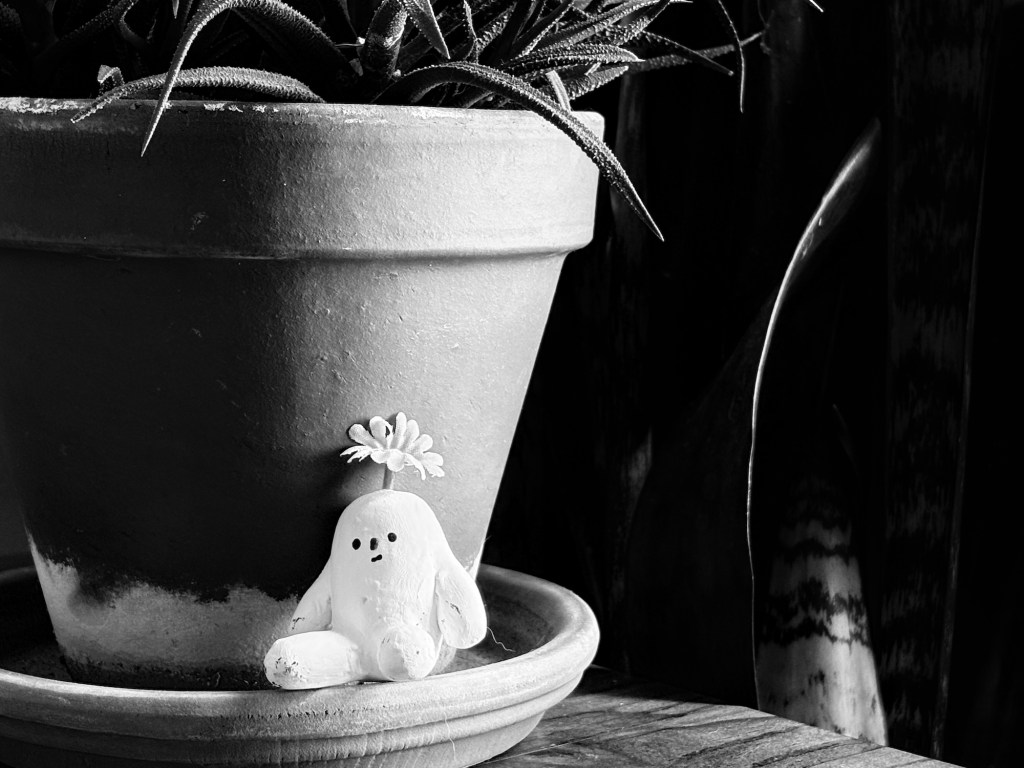
And sometimes they bring small delight, a little giggle when we come across their creations. Like this little guy our daughter made, who makes me smile every time I see him. He’s so innocent and nonthreatening. He looks squishy and sweet and huggable, like a marshmallow, and the little flower sprouting out of his head tells me he goes through the world spreading joy and hope. I love him so much.
Just after lockdown began, I went for a run. I burst into tears as I ran by tulips that had just opened, and cherry trees in bloom. Their beauty was more than I could bear as I wondered, “Are we going to run out of food? We don’t have a survival plan. Are we all going to die? What does this mean for humanity?” Pink blossoms quivered in sunlight, and I wept.
That was almost a year ago. Flowers and sky, sunshine and water got me through a lot of the pandemic in 2020. When fall arrived, and flowers dropped, and leaves dropped, and temperatures dropped, we moved indoors. I watched the world turn brown. We got snow, which is pretty, and ice, which is pretty, but the winter world is cold and desolate, and after nearly a year of no socializing, no meals in restaurants, no coffee dates with my husband, after nearly a year of all four of us being in the house together, after a year of watching terrible things happen to Black men and women and immigrants and their children, and people dying by the tens of thousands, and ugliness and lies and meanness and vitriol coming from our president, I felt cold and desolate too. And in winter, there are not flowers and sky, sunshine and water to get me through.
Until yesterday. After four weeks of snow storms and ice storms and temperatures consistently below freezing, the sun came out and shone warm. It melted the snow and ice. It warmed the ground. I put on short sleeves to run, and I felt sun on my skin. I smelled the scent of thawing dirt as I ran. I felt heat radiate from the asphalt. I ran under blue sky.
When I returned home, I walked across our lawn, still panting from my run, to check on the bulbs our mail carrier gave us from her garden. Last year they bloomed February 13. I’ve checked them every week in February, through snow and ice, and finally, yesterday, they bloomed.
First flowers of the year ♥️
With these little flowers, I feel a release. I feel like I can make it now. The world around me is thawing. We have a kind and compassionate leader who acknowledges the hurt of the world and wants to help heal it. In a few weeks I will have my annual gardening vacation, where I spend an entire week outdoors, cutting, pruning, shoveling mulch. Soon I will be able to sit on the back deck in the sunlight and watch the world come back to life.
I’ve been busy at work these past weeks and have worked beyond my self-imposed boundaries. Now that Christmas is here, I feel light, and this weekend, I feel a sense of, ahhhh for the first time in a while. I’m leading a book club next week, which I’m excited about, and also, everything slows down for the holidays, thankfully. Plus, I remembered I have to pace myself — if I push too hard, I’ll hit a wall, just like I used to do in cycling or triathlon until I learned my lesson. For endurance events, you have to nourish yourself, get good rest, and push at a pace you can sustain for a long time or else you’ll be miserable and suffer. At least that’s true for me.
Christmas is this week and I am excited to slow down and enjoy it. We cut a bigger than ever Christmas tree this year to help make up for 2020 and the fact that we won’t be able to go to Florida to see family we haven’t seen now in two years. Every year at the Christmas tree farm, our son pushes for a taller tree. Two years ago it was seven feet. Last year it was eight. This year we got a nine-footer.
The tree is beautiful with its white lights and glittery silver and rose gold ornaments. It draws all of us into the living room to sit quietly and do our various solitary things. Last night I built a fire, and our teenage kids and I all sat in the room with the fire and the tree, them with their earbuds in playing on their phones, me listening to Christmas jazz through the big speakers, also playing on my phone. A friend told me about the Pangram game, which I currently pop onto whenever I’m waiting for a pan to heat up to fry something, or when I’m waiting for water to boil for coffee, or when I’m sitting by the fire in the living room drinking wine, with my kids nearby and cats snuggled up with them.
We weren’t able to get tart cherries to make a cherry pie for Thanksgiving, so I’ve kept cherries on my grocery list these past three weeks to make one at Christmas. But nobody has cherries. None of the Krogers or Food Lions in our town or the next town over, not Aldi, not Target, not even Wal-mart. Not the health food store, not the world market. 😭. I checked online, and unless I want to pay $40 for four cans of sour cherries, it looks like we won’t have a cherry pie at Christmas either. Our mouths are watering for cherry pie — so red and Christmassy and sweet and tart and delicious — I am at a loss for what to make instead. I mean, I’ll certainly make pecan pie, but I’m the only one in our household who cares about that. I guess it’ll be another apple pie, like Thanksgiving.
We’ve made several rounds of cookies, and we’ve already eaten them all. We made snowballs, then peanut butter blossoms, then our daughter made gingerbread cutouts and iced them. All were gone within two days of making them. My mom sent more snowball cookies, and we ate those within a day too. So here we are five days out from Christmas and we have no cookies. I should fix that today. I want something different, so I’m not sure yet what to make. Shortbread? Snickerdoodles? Something almondy? I kind of want something almondy.
It’s overcast out, and there were snowflakes on the back deck this morning when I looked out. Just a few. They’re gone now, but it reminded me to check the weather. Every year we hope for a white Christmas, and every year we are foiled. This year we might actually have a chance. A winter storm is forecast to enter our area on Christmas Eve. Two days ago, there was a 30% chance of snow showers on Christmas, then yesterday it was up to 40%, and today it’s up to 50%. Of course, last week when we were expecting 3-5 inches, we got a sheet of sleety ice instead. I know better than to get my hopes up, but my hopes are up.
Anyhoo, I just wanted to say hi since I haven’t blogged in a few weeks. I hope you are all well and can take a moment to slow down. Tomorrow is the shortest day, and then there is hope again as every day after brings more light.
“Alright, kiddos, we’re changing the structure of your allowances.” I leaned forward on the couch with my elbows on my knees. My hands were clasped, and I opened them to say, “You get a raise with the new year” – our children bounced and clapped their hands – “BUT with the condition that you put a portion away for long term savings, and you put a portion aside for charity.”
—-
My husband and I discussed the kid’s allowance for weeks as we worked on our own budget. After ten years of supporting a family of four on one income (an income which consisted of student loans, part time graduate teaching assistantships, and when we hit the big time, a post-doctoral stipend), we are behind on savings: retirement savings, college savings, orthodontic savings. Emergency savings for car repairs and those surprise bills that always seem to arrive when you finally think you’ve got your finances under control.
Over the past year and a half we have worked to catch up on paying off debts, and now its time to start carving money out of my husband’s checks to build up a savings buffer. And though every cent of our income was already accounted for – groceries, gas, clothing, sports – we wanted to build charitable giving in as well. Using our new budgeting software*, You Need a Budget (YNAB), we cut a little here, arranged a little there, reduced our family entertainment budget, and created a little pile for charities we feel strongly about supporting.
“Most of the financial stuff I read recommends setting aside 10% of your income for long term savings,” my husband told me. He dunked his tea bag as he ran numbers in his head. “We’re doing well with that through the University’s retirement plan.”
“Okay,” I said, “we can set that same goal for the kids: 10% of their allowance towards long term savings – savings they can’t touch til they are 16 or something.” I remembered my savings account, the one my Grandmother encouraged by matching contributions to it. I adored getting my statement in the mail and seeing tens of dollars turn to hundreds. I don’t remember what I ultimately used the money for, but I loved the safe feeling that savings account gave me.
“That’s going to suck for them to watch their allowance go down,” my husband said. His eyebrows worked together, wrinkling his forehead as he worried for the kids. “It’s already hard enough for them to save up for something they want.”
“Well, that’s pretty much how it works for us too,” I said. “We think we have all this money, then we budget it out and there’s barely enough to go to a movie.”
“But they get so little.” Our son saved allowance for ten months to buy a Wii U. His resolve to save was inspiring; he opted every allowance cycle to put money in his bank account instead of getting paid in cash. For almost an entire year. It seemed wrong to shrink his income when it already took so long to save for short term purchases.
“What about charity?” I asked. “What are the recommendations for that?”
“It’s kind of all over the place,” my husband said. Suggestions range anywhere from 2.5% of income to 10% of income or 1% of net worth, whichever is greater.
“How about we suggest 5% to the kids?” I ran calculations in my head and realized even at that rate their total annual contribution would be less than $10. I sighed. “Anything less and it will barely be pennies,” I said.
“I don’t know. This could be a hard sell.”
Our previous allowance model gave them the option of $5 in cash or $6 in their bank account to encourage saving. “Well, I’ve budgeted their allowance at $6 apiece,” I said. “We could up their allowance to $6 so it won’t be such a hard transition for them. Their pocket money would end up being the same.”
“That works for softening the blow to their wallets, but it doesn’t leave much for their savings accounts or donations,” my husband said. We both worked numbers in our head and realized that at this savings rate, by the time our son turns 16, he will have only saved about $200. That won’t do much for buying a car. My husband sighed. “I guess the point is to get them in the habit.”
“Maybe we can offer matching like my Grandma did for me. If someone gifts them money, we could match whatever portion they choose to put into savings.” Now my forehead was the wrinkled one as I tried to figure out where that money would come from.
“Well, it’s when you donate some of your money to someone in need, or to a place that isn’t in the business of making money, but is in the business of providing a service that isn’t focused on profiting but on spreading awareness, or culture, or sharing art.” Our ten-year-old son cocked his head at me. He didn’t know what I meant.
“You know that radio station Daddy and I always listen to? The one with the funny Car Talk guys?” They both nodded. “That’s called public radio; they don’t sell advertising, and the only way they can provide their service is if people donate money to them.”
“Oooooh,” our son said.
“So that’s one of the places Daddy and I donate money.” I stood up and told them to hang on a second. I trotted downstairs to the storage shelves in the basement and pulled two Ball jars off the wooden slat. I cut a rectangle of paper to a length and width that would wrap around the jar and carried the three components upstairs.
I set the jars on the coffee table and asked the kids, “Is there anything you feel really strongly about donating money to? There are a million causes you could support: libraries, the arts, giving books to people who don’t have access to them, animals -”
“OOOHH! Animals!” Our daughter jumped up and down. I gave her the rectangle of paper as a template to cut a label for her charity jar.
“You can decorate it however you want, and when you get your allowance, you will put your 5% for charity in the jar,” I said. I turned to our son. “What about you, buddy?” He didn’t seem moved by additional suggestions I gave. “Do you have anything you feel strongly about supporting?” He looked at the floor and didn’t answer.
“Oh, I have an idea,” I said. “Daddy is giving some of his personal allowance money to help keep the Appalachian Trail maintained and protected. Do you think you’d like to support that too?” Besides soccer, our son’s favorite activity is hiking. He loves nature and waxes philosophical when we are out on the trail.
His eyes got big and he shook his head up and down and smiled. He grabbed his jar and ran upstairs. “Wait! Your change!” I counted out quarters and nickels from the rolls my husband picked up at the bank and jogged them up to our kids’ rooms.
A few minutes later both kids trampled down the stairs to show me their jars.
“But these have dollar bills in them,” I said. “I only gave you change.”
“I know,” our son said. “I wanted to give some more.”
From the podium, I looked out into an audience of about 60 people. Their eyes focused on me, and from their facial expressions – a smile in the second row, fascination in the fourth – I saw that they were absorbed. Nobody sipped coffee, or coughed. Nobody shifted position. I continued reading.
“The air was heavy, thick with heat and mud. We skirted exposed oyster beds in the shallow water, moving slowly enough that we could hear the oysters snap and pop.”
My mouth was dry, but I was reading better than all of my practice sessions, and I didn’t want to throw my momentum by taking a sip of water. All weekend I tried to suppress my nerves as we cheered our son’s team at a soccer tournament in Charlotte. I did not succeed in hiding my stress from my husband, though, and he asked what was wrong.
“I’m just nervous about my reading on Sunday.” I attempted a smile.
“I wondered,” he said. “You seemed really nonchalant about the whole thing.”
And I was nonchalant. At first. Talking in front of a crowd doesn’t bother me. I used to give informational meetings several times a week in front of total strangers when I worked for The Leukemia & Lymphoma Society. But as the Valley Voices reading approached, and I practiced my piece over and over and over again, finding another fault with each and every read-through, I realized that reading your own work, for which you’ve mined every word, for which you’ve excavated your soul, is a very different thing than giving a sales pitch for your employer. Sharing your own work on a blog already makes you feel vulnerable, even though you get to be secreted away in the privacy of your home when others read it. So to stand in front of a crowd and expose your creation out loud? It makes you feel squishy and naked, with every flabby flaw exposed.
My husband asked, “Why are you so nervous now, when you weren’t before?”
“Because I heard the other writers read at rehearsal, and they were really good.” I studied the cobalt blues in the hotel hallway carpet. “I don’t have any confidence in mine.” I didn’t say it, but I thought, maybe mine was was the only nonfiction submission they received. Maybe that’s how it slipped in.
“You’re just sick of looking at it, and you’re nervous about reading. Don’t beat yourself up.” He hugged me. “It was selected, Andrea. The judges liked it. That’s why you’re there.”
My mouth was parched. Only two pages to go. I felt a little faint. I looked up again and saw the same rapt attention. I had passed the place where I thought the piece sagged, and the audience was still with me. Their silence was electric. I could feel that I was reading well. Thank God. It didn’t suck.
When I finished, I croaked out a small “Thank you,” then sat in my chair, quaking, relieved that I was done. I was able to enjoy the other writers’ work, and was grateful for the beauty in their poetry, and the laughter they surprised out of me with their humor.
After the reading, I was speaking with one of the judges, thanking her for reading all of our work, when a woman tapped my shoulder and told me, “I loved your piece. I was right there with you. I could smell those marshes, and I’ve never been there.”
“Thank you. Thank you so much for telling me that.” I beamed at her.
Later, one of the organizers of the event gave me a big smile and told me I had read well.
“Thank you, Jane! My God, I was so nervous. I couldn’t believe it even made it in.”
“Why not?”
“Because it doesn’t have a point! It’s just pretty. No tension, no drama, no climax.” None of the elements of a successful story.
She looked surprised. “It doesn’t have to have all of that. I was with you on that boat, I was engaged the entire time. I could hear the motor, I could smell the marsh. I experienced that boat ride with you. We all did.”
On the way home, I mulled the problems I had seen in my piece. I painted a picture, yes, but is setting enough without a story? Is “pretty” enough without a punch at the end? I chewed on Jane’s words, “It doesn’t have to have all that.”
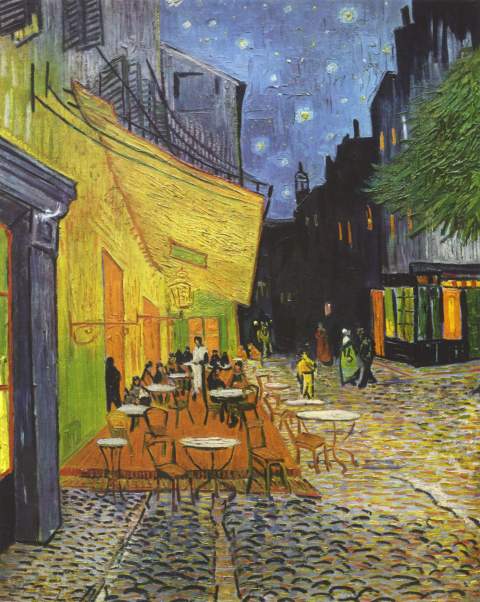
And then, I thought about visual art. I pictured nudes reclining, and a still life of golden pears, and how the beauty in well-rendered scenes moves me. I thought about Van Gogh’s oil painting of a café terrace at night. Its rich blues and vibrant yellows, the halos of the stars, the luminescence of light from the cafe spilling onto the dark cobbled street. There is an inherent tension between the welcoming café glow and the inky darkness of night, a drama in the contrasts, if you really want to analyze it. But mostly, I just find the painting pretty. There is a beauty in it that doesn’t need a story. A beauty in it – the contrasts of light and dark, of blue and yellow, a couple walking toward the cafe, a triangle of green fir on the edge of the painting – that is a story.
It occurred to me then that with all the ugliness in the world around us, sometimes, pretty is enough.
The Café Terrace on the Place du Forum, Arles, at Night, c.1888 by Vincent van Gogh


 Butterfly Mind
