When I sit at my tan desk, in our beige room, with dull buff carpet beneath my chair, I often have a hard time coming up with color words. I google “synonyms for green,” rifle through crayon boxes, and scroll through images of paint chips and artists’ color names, but I am not usually inspired by what I find.
Then today, in an effort to wring the last few drops of fun out of summer before the kids go back to school, we rode our bikes over to the Virginia Tech horticulture garden, where they love to play in the sprinklers and find flowers in the colors of the rainbow (“Here’s a red one!”, “I found orange berries!”). I had folded up a blog post draft and stuck it, along with a pen, in my back pocket so that I could work on it in the quiet of the gardens while the kids played, and as I scribbled and edited, walking the mulched paths, filling the page with ink, I saw a pale green hydrangea.
“Hey guys, here’s green,” I said.
“Oh, flowers!” our daughter said when she saw them. “We don’t usually find green flowers, we just use leaves for green.”
I studied the hydrangea petals, trying to determine their color, and thought, celadon. Is that what color celadon is?
Yes.
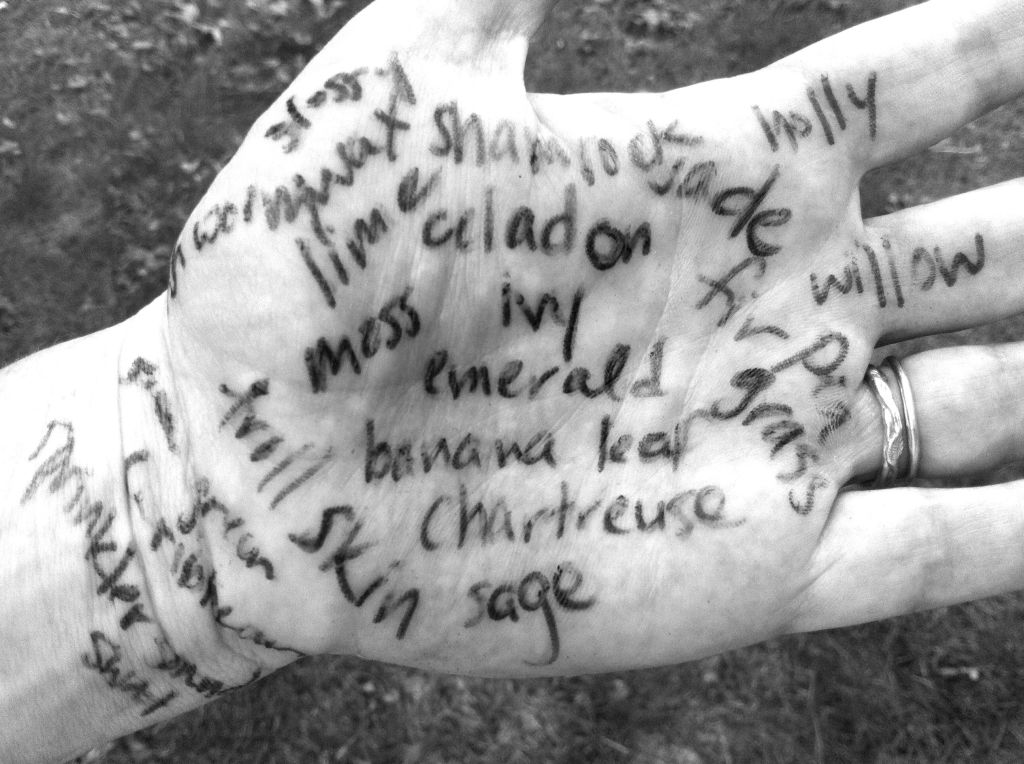
I looked around and saw banana leaves, fir trees, weeping willows, and thought, these are each a different green – dark and glossy for banana leaves, shadowy blue-green for firs, a soft yellow-green for willow. Each plant species is its own hue. And so I started writing. I’m not usually a write-on-my-hand type of person, but my paper was full, and I needed these words.
“Mom, what are you doing?”
“I’m writing down all the greens I see,” and wrote sage. “What greens do y’all see?”
They shrugged, as if that were a dumb question, and then our daughter said, “Shamrock.” Yeah, she’s good.
“Inch worm,” said our son.
They ran off to play in the sprinkler, and I sat and filled my hand. A few minutes later they came back dripping, and our daughter said, “We saw some algae in the pond that looked like troll skin.”
“Troll skin! That’s perfect,” I said, and wrote it down.
“Troll skin isn’t a color,” said our son.
“Sure it is – it’s silvery blue-green and warty.”
“Yeah,” said our daughter, “that’s what color the algae was – it was even bubbly like warts.”
On the bike ride home, the kids shouted out more words – “pea,” “yellow-green,” and “olive” – and when I saw my friend Dee, she asked, “Did you get peridot?” Now, thanks to their assistance, and to inspiration from the gardens, when I am sitting in our neutral living room, trying to conjure color words, I have an entire page in my lexicon dedicated to the color green:
It is summer, and that means it’s time for sipping iced drinks out on the porch while… wait, is it a porch? Maybe it’s a deck. A lanai? Maybe a veranda.
When I wrote my second vignette from a white sand beach, the one about the woman sweeping her walk, I originally wrote, “I sip coffee on the porch while my family sleeps in.” After a few reads, I realized that wasn’t quite accurate. I witnessed the scene from above, from the second floor, but the word “porch” suggested that I was on ground level. After a few rounds of adding descriptive sentences to give the reader the impression of height, to indicate a bird’s eye view, I sighed in frustration that I was gunking up the piece with too many extra words. Then I looked at “porch” and realized I only needed to make one change. I swapped “porch” with “balcony” and was finally able to move on.
That small change reminded me that though I grew up in a world in which outdoor seating areas are as important as living rooms, I never know the right word to use for each one. Did we rock on Grandaddy and Nannie’s front porch, or was that a veranda? When we sat in cushioned wicker furniture and ate peanuts from a crystal bowl on a glass-topped coffee table at Grandma and Grandpa’s, was that a screened porch or something else? Why was my parents’ screened area in Georgia called a screened-in porch, but when we moved to Florida everyone’s screened porch was called a lanai? Is a deck the same as a patio? Is “porch” an umbrella word that covers veranda, lanai, patio, and deck? Or does a porch have certain specifications – a railing, perhaps, or a cover?
Well, folks, I decided to find out. Here’s a primer* on balconies, porches, and patios.
balcony – 1. A platform that projects from the wall of a building and is surrounded by a railing, balustrade, or parapet. [from Old Italian balcone meaning scaffold]
courtyard – An open space surrounded by walls or buildings and adjoining or within a building.
deck – 2. a. A platform or surface likened to a ship’s deck. 2. b. A roofless floored area that adjoins a house.
lanai – 1. A Hawaiian word for veranda. 2. A veranda or roofed patio, especially a fully furnished one used as a living room. (so it doesn’t have to have a screen!)
patio – 1. An outdoor space for dining or recreation that adjoins a residence and is often paved. 2. A roofless inner courtyard, typically found in Spanish and Spanish-style dwellings. [from Old Provençal patu, pati meaning pasture or Latin patere, to lie open]
porch – 1. A covered platform, usu. having a separate roof, at an entrance to a building. (a porch does have a cover!) 2. An open or enclosed gallery or room attached to the outside of a building; a veranda. [from Latin porticus ‘entrance hall,’ and before that porta meaning ‘gate’]
portico – A porch or walkway with a roof supported by columns, often leading to the entrance of a building [from Latin porta meaning ‘gate’]
veranda – A porch or balcony, usu. roofed and often partly enclosed, extending along the outside of a building. Also called regionally gallery. [Hindi varanda, and before that Persian bar amadah, meaning coming out]
So it turns out that “porch” is not an umbrella word that covers all of these. Based on the etymology of the word, a porch is necessarily attached to an entrance, and its origins lie in the fact that a porch provides shelter at a doorway. Similarly, the etymology of veranda suggests that a veranda is also attached to an entrance. It seems that veranda and porch can be used interchangeably, though veranda seems to suggest extension along the side of a building while a porch can either extend or occur solely at the doorway. Verandas and porches do not require railings, but balconies do.
As for where we rocked at Nannie and Grandaddy’s and watched fireflies, the red planked area was roofed, attached to an entrance, had a railing, wrapped around the house, and was raised off the ground, so it would be accurate to call it a porch, a veranda, or a balcony. At Grandma and Grandpa’s, where we admired coastal Georgia sand dunes from the comfort of a fully furnished screened porch, if we wanted to get exotic (they did live on an island, after all), we could say we sat and ate peanuts on their lanai. Although, in my research, I found that lanais are generally floored like a patio, in the sense that they are tiled or paved, and Grandma and Grandpa’s porch floor was planked. Also, lanai tends to be used in more tropical climates, which explains its popularity in Florida, so maybe Grandma and Grandpa’s was more accurately a screened-in porch or veranda.
And finally, patios. Though patios are related to courtyards, the difference is that a patio does not have to be surrounded by walls or buildings, whereas a courtyard does. The difference between a deck and a patio is that a deck is floored, usually with wooden planks, like a ship’s deck, while a patio is paved with cement, brick, or stone pavers, like a courtyard. Additionally, a patio will be laid directly on the ground, while a deck will be slightly raised as it requires some sort of support. Neither is covered, which differentiates them from porches and verandas, and a patio can be either connected to the house or separate from it while a deck is generally attached.
So there you go. Now I’m going to go out back to sweep our brick patio and dream about the adirondack chairs my husband is going to build for our wooden deck.
*Definitions from 1993 The American Heritage College Dictionary, Third Edition
I made a hat. Kindergarten-inspired 100 posts, 100 words hat
This is my 100th blog entry since my first, One last move, in June of 2012. Woohoo! To mark the occasion, I read my previous 99 posts and plucked a favorite word from each. I was fascinated by trends in word choices. For example, I discovered an apparent affinity for gerunds (words ending in -ing) and that I gravitate towards adjectives and adverbs rather than selecting “concretes” – strong nouns and verbs that require no further descriptors. I had to search hard to find nouns and verbs for this list. I aim to improve on that in my next 100 posts.
When our kids were in kindergarten, they made hats like this one on their 100th day of school (only they didn’t write favorite words in the dots.) I always thought they were funny. Also, for my friend who challenged me to write a post of 100 words, check out the word count on that first paragraph.
Driving our daughter to her swim meet yesterday, I faded the speakers to the front and cranked up the volume while the kids sang spring break songs in the back seat. Nina Totenburg, NPR’s legal affairs correspondent, was covering the Supreme Court arguments on the Defense of Marriage Act (DOMA).
As I listened to her expert and always gripping coverage of the back and forth between Justices, I heard a word that had me scrambling for my phone at a stoplight to register a voice memo. I pressed the red record button with my thumb, put the microphone graphic to my lips, and said, “new Lexicon word: animus.”
This morning, I ate a boiled egg while I read The Roanoke Times piece by Michael Doyle, “Justices may be ready to scrap marriage act,” and there was the quote again.
Associate Justice Kagan asked of the 1996 law, which denies federal marriage benefits to same-sex married couples, “Do we really think that Congress was doing this for uniformity reasons, or do we think that Congress’s judgment was infected by dislike, by fear, by animus?”
When I heard Nina Totenburg speak it, and when I read it again in the paper, that word had a powerful impact on me. Animus. Though I didn’t know the definition, it felt like animosity – like spitting, like scowling, like hatred and hostility – but somehow more potent. Deeper. More elemental. A conviction rather than a behavior.
When I looked it up, so similar in sound and scope to animosity, I found that animus is both “an attitude that informs one’s actions” and “a feeling of ill-will.” A conviction that drives a behavior. In this case, convictions of moral judgement that drive behaviors of discrimination. An attitude of animosity that governed our leaders’ actions.
Is that what we want? Discriminatory legislation founded on impulses of ill will? Laws that are driven not by the Constitutional commitment to ”promote the general Welfare” but by an attitude of hostility towards our own citizens? As Justice Kagan quoted from the 1996 House Report, “Congress decided to… express moral disapproval of homosexuality” in passing the Defense of Marriage Act.
Well, I’ll tell you where the 1996 Congress can put their moral disapproval. They can stick it in the bosoms of their mistresses. In their illegal prescription pill bottles. They can file it with their affair-driven divorce papers or their fraudulent income tax reports.
Meanwhile, I’m going to stand by my married and hope-to-be-married gay friends. The ones whose values I share and trust. The ones who love their partners as much as I love mine, who struggle with the same issues all married couples struggle with, and then some. The ones who, even though they have more justification for attitudes of ill will than the 1996 Congress, they rise above it, love their partners, and are not infected by dislike, by fear. By animus.
I’ve been cranking along with my New Year’s Resolution to read five memoirs or biographies this year. I started with Swimming To Antarctica: Tales of a Long-Distance Swimmer by Lynne Cox, then listened to Enchantment: The Life of Audrey Hepburn by Donald Spoto. Both were more informative than entertaining, and both felt quietly deceptive, like the authors were holding back the full truth of the subjects’ personalities. The women seemed too perfect. Too nice.
And then I picked up Wild: From Lost to Found on the Pacific Crest Trail, Cheryl Strayed’s memoir of her 1100 mile solo-hike, at age 26, after she had destroyed her marriage with infidelities, dabbled in heroin, and most critically, because her mother had died four years previous and Strayed’s life had been spiraling downward ever since (see: infidelities and heroin).
Unlike the two tame memoirs I read before it, Wild is raw. It is brutally honest. Strayed lays everything on the pages for all the world to read. She doesn’t candy coat herself or present herself as anything other than who she is.
I admit that with a title like Wild, I expected more raving, more lunacy, more squatting and grunting, eating raw meat with a dirt-smeared face and nits in her matted hair. But Strayed’s genius in this book is that she writes wildness in a much more stealthy way, solitary and quiet, like the animals whose eyes glow at her in the darkness before their silent retreat. She gets at the heart of what it meant for her to be wild, not by snarling and howling, but reflectively, by using incisive language that had me scrambling for my Lexicon every few chapters.
And that’s the real reason I loved this book. Strayed uses kickass words – vivid words with spunk, that cut to the quick, that make her experience real and honest. So rather than write a huge long review, I want to share four words I gathered from Cheryl Strayed’s Wild. I collected these words from her pages, and to me they are the distillate of what what Wild is all about:
mox·ie – n. Slang. 1. The ability to face difficulty with spirit and courage. 2. Aggressive energy; initiative. 3. Skill; know-how.
cru·ci·ble – n. 1. A vessel made of a refractory substance such as graphite or porcelain, used for melting and calcining materials at high temperatures. 2. A severe test, as of belief.
grit – n. 4. Informal. Indomitable spirit. Pluck.
pri·mal –adj. 1. Being first in time; original; primeval. 2. Of first importance; primary.
And though I’m not sure if pluck was on her pages, it went into my Lexicon, too, with an asterisked *Cheryl Strayed next to it.
“So, have you noticed that irony is super trendy now?” I dealt Phase 10 cards to Amy and my two kids. “‘The Ironic Generation.’ I keep hearing that. What does that even mean? That people want to live off the grid, yet they can’t survive without Facebook and Twitter?”
Amy fanned and arranged the cards in her hand. “It’s a hipster thing.”
“What’s a hipster?” Our son’s big eyes looked up at me.
“Well,” I said, “Every generation – do you know what a generation is?”
“Yeah, it’s like a thousand years or something.”
“Not quite,” Amy and I laughed. “It’s a group of people of a certain age. Like, you and all your friends, and all the kids in elementary school right now are your generation. Daddy and me and Amy and all of our friends are our generation.”
He discarded. “Okaaay.”
“Each generation has a group of, I don’t know,” Rebels? Outsiders? “A subculture that kind of defines the generation. In the 20’s it was flappers.” I played a card and looked across the table at Amy. “When were beatniks?”
“Beatniks were in the 60’s,” she said. “And hippies were the 60’s and 70’s.”
“Punk was the 80’s. And now,” I said, “it’s hipsters.” I peered over my cards at our son to see if he understood. He did not.
“There were tons of hipsters in the Twin Cities,” I told him. “They think they’re really cool. Like, they were cool before cool was cool.” He had no idea what I was talking about. He’s nine.
I played a card and asked my friend, “Do you know how the hipster burned his tongue?”
She raised an eyebrow, waiting for my answer.
“He ate pizza before it was cool.” I giggled hysterically. Our son rolled his eyes.
Amy was more useful to him, describing the hipster look – the skinny jeans, the PBR tee shirts. “And then there are the older hipsters, like Ira Glass and my husband, with the glasses, and the beard, like my husband has.” She moved some cards around in her hand. “Although he had the glasses and the beard before they were a thing.”*
I giggled again, thinking she was making fun of herself, saying that her husband had adopted the hipster look before it was cool. I looked up from my cards to acknowledge her cleverness, but she wasn’t smiling about it. She was laying down her sets, getting ready to go out.
“So, back to irony,” I said. “I’ve always loved irony, but I never know how to explain it. If somebody asked me to define irony, I could give an example, but I couldn’t define it.” I laid down my sets of four and discarded. Amy looked thoughtful, turning her eyes up as if she could look into her brain, rifle through files, and find a definition for ironic.
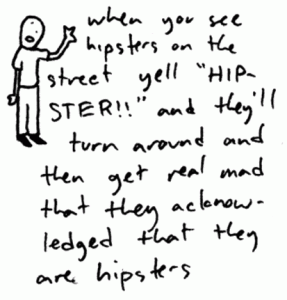
“Only Hipsters Know Irony,” writing and “art” by J. David Ramsey
“But the irony I know is not anything like that Alanis Morissette song,” I said. “ ‘It’s like 10,000 spoons when all you need is a knife.’ What the hell is that? That’s not ironic. That’s just annoying. Ironic has some sort of, I don’t know,” I gestured toward my heart. “Mystical quality.”
Amy’s eyebrows shot up and she grinned. “Let’s look it up!”
I gave her the dictionary, and she riffled pages while I shuffled cards. Her face turned scowly.
“What the hell?” She said. “Listen to this:
“Ironic. 1. Characterized by or constituting irony. 2. Given to the use of irony.
“That doesn’t tell you anything,” she fumed. “It uses irony in the definition!”
My son arranged his new cards. “It’s your turn Amy.”
“Oh, sorry,” she said, then smiled and stroked the book. “I have this dictionary now, you see,” and she played a card.
“Well, look up irony then,” I said.
She followed the words with her long finger.
“Irony. 1.a. The use of words to express something different from and often opposite to their literal meaning.”
I had had a couple of whiskey sours at this point. “What? That confuses me,” I said, and took another sip. “This is an example of irony to me. I have this friend whose mom was a super fructavore – she loved fruits and veggies and ate them all the time. They were her snacks, her desserts, always a component in her meals. Tons of fiber, you know? Well, she died from colon cancer.” I laid down a card. “That’s ironic.”
“Okay, listen, though. Here’s the third definition of ironic:
“3. Poignantly contrary to what was expected or intended.”
“Poignant! That’s going in my Lexicon.” I jumped up to get my Moleskine. “Poignant is one of my favorite words. It’s like irony – it has this mystical quality,” and I gestured toward my innards again. “It makes me feel.”
“Mom! It’s your turn!”
“Sorry babe.” I played a card and thought of the example of irony I had just told. “My friend’s mom contracting colon cancer after a lifetime of fruit eating is, well, poignantly contrary to what was expected. That’s a perfect definition! That’s the irony I’m talking about. It’s all about the poignancy.”
“You really need to read the usage examples here,” Amy said, pointing at the entry in the dictionary.
I thought about all the young hipsters in the Twin Cities as play went round the the table. I thought about the sad irony that they try desperately to avoid anything mainstream, yet they have become so mainstream they even have a look. Glasses, skinny jeans, fixed gear bicycles. iProducts.
When it was my turn again, I fingered my cards, then hitched up my skinny jeans so I could start the music back up on my iMac. I smirked, “Well, I’ve loved irony for, like, 20 years. Irony spoke to me before it became a ‘thing’.”
And then I laid down my cards and laughed.
Usage Note: The words ironic, irony, and ironically are sometimes used of events and circumstances that might better be described as simply “coincidental” or “improbable,” in that they suggest no particular lessons about human vanity or folly. Thus 78 percent of the Usage Panel rejects the use of ironically in the sentence In 1969 Susie moved from Ithaca to California where she met her husband-to-be, who, ironically, also came from upstate New York. By contrast, 73 percent accepted the sentence Ironically, even as the government was fulminating against American policy, American jeans and videocassettes were the hottest items in the stalls of the market, where the incongruity can be seen as an example of human inconsistency. (The American Heritage College Dictionary)
When I was researching this post, I came across some pretty hilarious stuff. Like the wikiHow article 9 Ways to Be a Hipster. I also found a fascinating opinion piece in the NY Times: How to Live Without Irony by Christy Wampole. Both great reads if you are curious about hipster counterculture.
 Yes.
Yes.






 Butterfly Mind