Our son takes a coding class on Tuesday nights, and to entertain myself while I lingered last night in a squeaky bean bag on the floor of Techpad, I dug out my dive logs from my SCUBA years.
I became certified to dive at age 12. My dive master was a giant ex-Navy-seal named André. He was big and loud and uncouth, and he made me feel safe, and I loved him. Through my high school years my family dove with André and the Savannah dive club, driving to Crystal River or West Palm Beach on long weekends, and we took diving vacations each summer. We spent all of our spare time underwater.
Sadly, I didn’t journal about our dive trips or write about my love for being underwater. In those days I only wrote about things I didn’t understand: boyfriends, atoms, the universe. (But mostly boyfriends). I didn’t write about being underwater because I didn’t feel the need to analyze or dissect it; I only cared about getting underwater and staying there. I wasn’t at a point yet to appreciate that I would one day thirst for those descriptions.
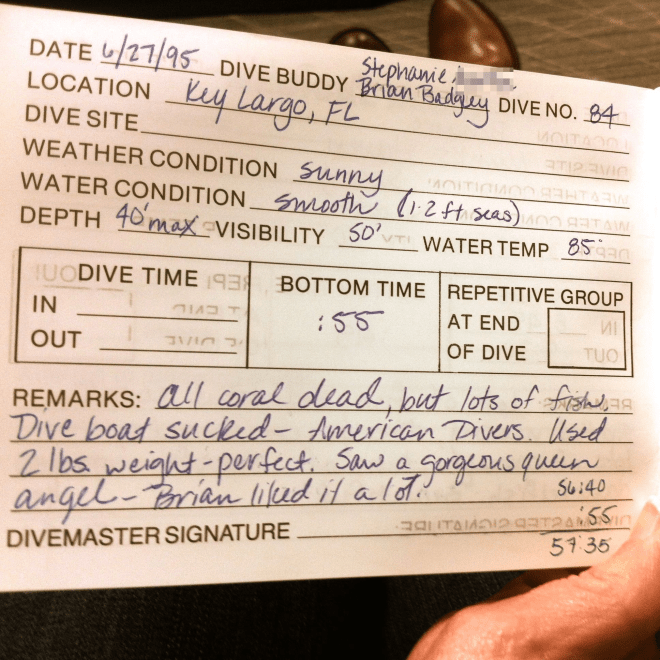
But I did keep dive logs, with depths, temperatures, notes on what we saw and where, how many hours I’d logged underwater, and who was with me on the dives. These are some of my favorites.
From 1988, when I was 13. We were maybe 20 or 30 miles offshore, and the seas were big. I’m shocked I wasn’t seasick. What I love about this one is that we could feel the surge of 8 foot seas when we were 50 feet underwater. I remember that feeling, of moving with invisible waves, being lifted and dropped at the bottom of the ocean. 8 ft seas. Felt a surge 50 feet underwater.
From 1989, when I was 14. I don’t remember being underwater during a storm, but I love the thought of sitting on the bottom and looking up, watching lightning flash and rain patter the surface: Underwater during a storm
From 1990, when I was 15. “Mom had a cow.” That makes me laugh every time I see it. Also, I love that I used a semicolon in this one: Journey to my 15 yo self
Also from 1990, age 15. I love this one for my dad’s handwriting. I have letters from my grandmother in her handwriting, and something about seeing her handwriting makes me feel close to her even though she’s gone. My dad is still alive, thankfully, but when I came across my dad’s writing in this one, it made me feel close to him like my grandmother’s handwriting makes me feel close to her: Dad’s handwriting
From 1995, age 20. On the field course when I met the man who is now my husband. I didn’t know at the time of this entry that I was in love with him, though it seems obvious to me now: Five days before I realized I was in love
Grandma loved to go to Sunday brunch, and when I was a kid, her favorite brunch spot was Shoney’s. We’d drive over the drawbridge from St. Simons Island to Brunswick, Georgia, and once we had waited in line for a large enough table, all the grown ups would order coffee and tea. My older brother would order the buffet, as would I, though all I ate off it were the French toast or the pancakes.
Grandma, after studying the menu as if she might get something new, would eventually order liver and onions. Every time.
My dad, her son, must have made involuntary gagging faces after a lifetime of hiding liver in napkins, out the window, under the rug, on liver Wednesdays at home, because I finally asked Grandma one time at Shoney’s, “Grandma, do you like liver and onions?”
She flicked her hair, “Of course I do!”
Then she thought a little bit and said, “Well no, not really.”
I knew this. “Then why do you order it every time?”
She looked at me as if even she knew her answer was ridiculous and said, “Because it’s good for you.”
I looked at the congealed brown mass on her plate, smothered in soggy onions, and thought, I doubt that.
Given her utter disregard for her taste buds in honor of her “health,” her reasoning for drinking gin and milk should have come as no surprise to me. But one evening, when she settled into her chartreuse chair, she sat a rocks glass filled with a thin, milky cocktail down on a cork coaster. I had seen her with this strange drink before, and it unsettled me. Milk diluted in any way is offensive, especially to an eight year old, and yet she drank this every night.
Finally, I asked, “Grandma, what is that you’re drinking?”
“Gin and milk,” she said.
Even at my young age, I knew that combination was just wrong. “Why?” I asked.
She looked at her dewy tumbler, the milky liquid even thinner around the ice cubes, and rolled her eyes at the things she did for her health. “Well, I’m on Weight Watchers now.”
I waited for more.
“And on Weight Watchers you have to have a certain amount of milk every day.”
She looked at her sad drink on the end table, polluted with skim milk. She lifted it off the coaster, which had the words “Bottoms Up” printed in thick black ink on it, flicked her bangs out of her eyes, and said, “And I have to have a certain amount of gin every day.” And she tipped the glass into her mouth.
I first published this two years ago today. As I plan to head back to John’s camera shop to finally buy the 50mm lens I’ve been wanting for five years, I thought I’d post it again. Enjoy.
It was a damp, drizzly day here in Blacksburg. There was no direct light, just a gray, overcast sky – a perfect backdrop for the saturated colors of slick, wet leaves, dripping and mostly green, but with October pops of yellow, orange, and red.
And a perfect diffused-light day for photography.
It’s been a while since I’ve paid much attention to my photography. Mostly I snap quick shots to make sure we have mementos of our kids’ childhood – their cute chubby faces, their missing teeth, the glee in their eyes at Disney World. But lately, especially after hiking in the mountains here, I’m feeling an itch to photograph more – the dozens of varieties of mushrooms we saw on the War Spur Overlook, the white blazes of the Appalachian Trail on our first return to it since my husband’s 500 mile hike in 1996. But more importantly, I want to take more care in the photographs I take.
So I took my fancy digital camera over to John’s Camera Corner, a little downtown shop tucked in next to the hookah lounge and across the street from The Rivermill (the bar that inspired my Life in a college town. With kids. post), to get the lens cleaned up and get a filter to protect it from grubby little fingers.
I walked in and it was like walking back in time. The walls were lined with old cameras – film cameras. Brownie, Pentax, Minolta, Canon. A darkroom condenser reminiscent of the ones I used during a workshop at SCAD was propped in the corner. Old camera bags, lenses, and filters littered the floor and shelves, and by the glass display case at the cash register, there was a postcard spinner with antique photos of Blacksburg. I wandered around with my mouth open, touching cameras, recognizing equipment, until John asked if he could help me. While he searched for his lens cleaning kit, patting his pockets like the grandpa in The Princess Bride, feeling absently for lens tissue, lens cleaner, lens caps, or whatever else he might have misplaced, I told him, “Wow, this is awesome. I used to be into photography in high school. Look! Photographic paper!” On a rack in front of me were the distinctive white boxes of Ilford black & white paper. “Makes me miss my old camera, and film…”
“The smell of fixer,” he said.
And I could smell the ammonia again. “Yeah,” I smiled, “And the smell of fixer.”
John found an old Nikon UV filter for me ($10 vs. the $40 a new one would have cost), and while he cleaned up my lens, I wandered over to the Minolta wall of camera bodies. I wondered, could it be here? And there it was – my very first camera. The Minolta SRT 101. My grandfather’s old camera. The camera he used to photograph his family and the world on his tours of duty in the Air Force. The camera that captured my adolescence.
I picked up the Minolta in John’s shop, and as soon as I held it in my hand, I was 16 again, photographing my best friend on black and white film. The camera went straight to its natural place in my palm, the heft of it supremely satisfying, my right thumb on the film advance lever. I pushed the lever and savored the phantom feel of film advancing. Pushed the shutter release and felt the solid, gratifying shudder of the shutter mechanism. All of my senses were engaged when I photographed with that camera. It was completely manual, so I was present in the taking of each photograph, adjusting for light, framing each shot, taking care because unlike digital photography, film was not only finite – 24 or 36 frames – but there was also a tremendous time lag between when you shot the film and when you could actually see what you shot. It was important to be precise and get it right with each release of the shutter, and that need for precision made me very mindful when I photographed.
These days, I set my camera on automatic and carelessly press an insubstantial button, thinking “eh, I’ll just take a bunch and then edit with GIMP when I get home.” And then take weeks to even put the images on the computer. And then never make a print of a single one. The images are just pixels of light that disappear with the click of a mouse button, and the whole experience is like eating refined flour. It leaves me hungry.
But as I stood there in John’s camera shop, not even forty years old and already reminiscing about the good old days, I recognized that as much as I loved that old Minolta, and as much as I loved shooting and processing and printing film, it is outdated and has gone the way of the typewriter (RIP). My manual Minolta forced me to be present, and I’m thankful for that because it taught me the principles of photography. It made me work for every image, and because of that work, the images are imprinted in my brain as much as they are printed on that Ilford black and white paper.
I also recognized, feeling the sturdy weight of the camera, that we no longer live in that time. And I’m okay with that. Holding that old Minolta in my hand reminded me of my old love for photography, and of the good old days, but as I placed it back on the shelf, I remembered the limitations of film that led me to a digital camera – a young family, precious little leisure time, a budget that does not allow for endless film and processing. A digital culture that is phasing out film and the processing of it.
I loved my Minolta. It is as much a part of my shaping as the clink of my dad’s ring on the stainless steel wheel of our boat. Now that we have kids, I hope my digital Nikon will find a similar place in my heart.
Thanks to John, that Nikon is all cleaned up and ready to go shooting. And thanks to this drizzly gray day, and the heft of that Minolta, I’m ready to take the time to work for a shot, and bring home a pretty picture.
I was unloading the dishwasher the other day, and my wedding ring clinked against a glass bowl, making a sound so similar to a sound from childhood that I was transported instantly to a motorboat, zipping through briney rivers, the sun on my face and the wind in my hair. I even caught a whiff of salt air.
I grew up on a tidal creek off the coast of Georgia (on a small “hammock” island just before you get to Tybee Island), and we spent every weekend during the summers out on the boat. My mom was in charge of the beach bag, chairs, towels, snack foods, lunches, and packing the cooler, and my dad was in charge of everything relating to the boat and the dock – fuel, mechanicals, boat and dock maintenance, crab traps, lines, first aid/life jackets, and driving the boat. My brother and I would cast us off, then I’d take my seat in the bow, my head hanging over the side like a dog, and Adam (my brother) would hang out by the steering wheel with my dad. And as we pulled away from the dock, when my dad first put his hand to the stainless steel wheel, his wedding band would clink against it.
Throughout our hundreds of hours on the rivers, the clank of my dad’s ring on that steering wheel was as much a part of the weekend soundscape as the buzz of the motor, and it always, always made me feel safe, and secure, and loved. The sound, because it was made by his wedding band, was an audible reminder of my dad’s love for my mom, and for us, his family. And because it was tied up with my favorite thing on earth (riding around in the boat with my family) the clang of of his ring against the stainless steel wheel captured every good memory, every happy feeling of those childhood summers – the salt smell of the air, the warmth of the sun, the fun of the four of us being together, the freedom of the wind and the water, the thin crust of salt on our skin at the end of the day. Cold Cokes and salty snacks.
So when my wedding band clinked against a glass bowl the other day, that little sound filled me up. I could feel the warmth swelling in my heart til it overflowed. I was there again, as a kid in the boat, with my dad at the wheel. I was safe, and free, with salt air in my nose and the wind in my hair. It made me wonder what small thing, whether a sound, or a scent, will send my kids back to childhood when they’re grown, standing in their kitchen, remembering.
I wrote this in July, 2011 and published it here on June 17, 2012. I wanted to republish it today for Father’s Day. Happy Father’s Day, Dad!
“November was here, and it frightened her because she knew what it brought – cold upon the valley like a coming death, glacial wind through the cracks between the cabin logs.” – Eowyn Ivey, The Snow Child
When we left Florida on November 1, 2009 to make the drive north to Minnesota, our station wagon packed so full of belongings that we couldn’t see out the back windows, the grass was lush and green, butterflies flitted at the mouths of hibiscus blooms, and the air conditioner was running in my in-laws’ Sarasota home. When we arrived in St. Paul four days later, the world was brown and grey, and bony branches rattled in the cold breath that chilled the city. We wore hats, coats, and gloves when we stepped out of the car onto our new driveway.
Once we unpacked our moving Pods and got our home in order, I remember lying in bed one night next to my husband, listening to a wintry wind whistle through naked tree limbs and catch in corners under the eaves. I felt a panic come on, and I turned to my husband.
“I’m scared,” I told him.
“Of what?” he asked.
“Of winter.”
Having grown up in the mild state of Georgia, I did not know true winter. I did not know frozen earth and scoured limbs, months of barrenness, and shivering as soon as I turned the shower off day after day after day. I knew live oaks dripping with Spanish moss – oaks that kept their leaves year round – and Christmases that sometimes allowed for a crackling fire, and sometimes required short sleeves and shorts. I knew azaleas that bloomed in early March, not snow that lasted into June.
I was afraid of how I would handle the blanket of snow that would shroud the earth from November to May. I felt suffocated by its eternal coverage. I was afraid of the bleakness, the lack of color. I was afraid of cabin fever, and the madness that the endless repetition of dressing and undressing might bring: 20 minutes of layering and wrapping and covering and zipping and mittening and booting to leave the house, and 20 minutes of shaking off snow and stomping out boots and unwrapping and uncovering and unzipping and unmittening when we came back in. Life was so much easier where it was warm. So quick to skip out the door, hop in the car, and go.
One morning, my husband crawled out of bed in the dark, dressed in his winter running clothes, and stepped out into the silent -10° blackness. I lay in bed under the down comforter, cozy and warm, until I started thinking about all the things that could happen to him out there. The rest of the city still slept – he often did not see another soul on his pre-dawn runs – and I thought about the ice out there in the darkness, and the fact that if he slipped and fell and broke his leg, nobody would find him before the cold got him. And this is what gave me shivers despite our down comforter.
We lived in a place that could kill us.
Over time, I was surprised repeatedly by how Minnesotans embraced this deadly cold. Winter didn’t drive Minnesotans in, it drove them out. Our first winter we bought sleds, I bought snow shoes, my husband bought skis, all four of us bought ice skates, and no matter which equipment we chose each weekend, we’d see dozens of flushed cheeks, glittering eyes, and North Face logos on the backs of shoulders as other folks sledded, or snowshoed, skied, or ice skated too. Golf courses switched to cross country ski routes in winter, and local parks flooded plank-walled ovals for outdoor skating rinks. Some of them even had hockey goals.
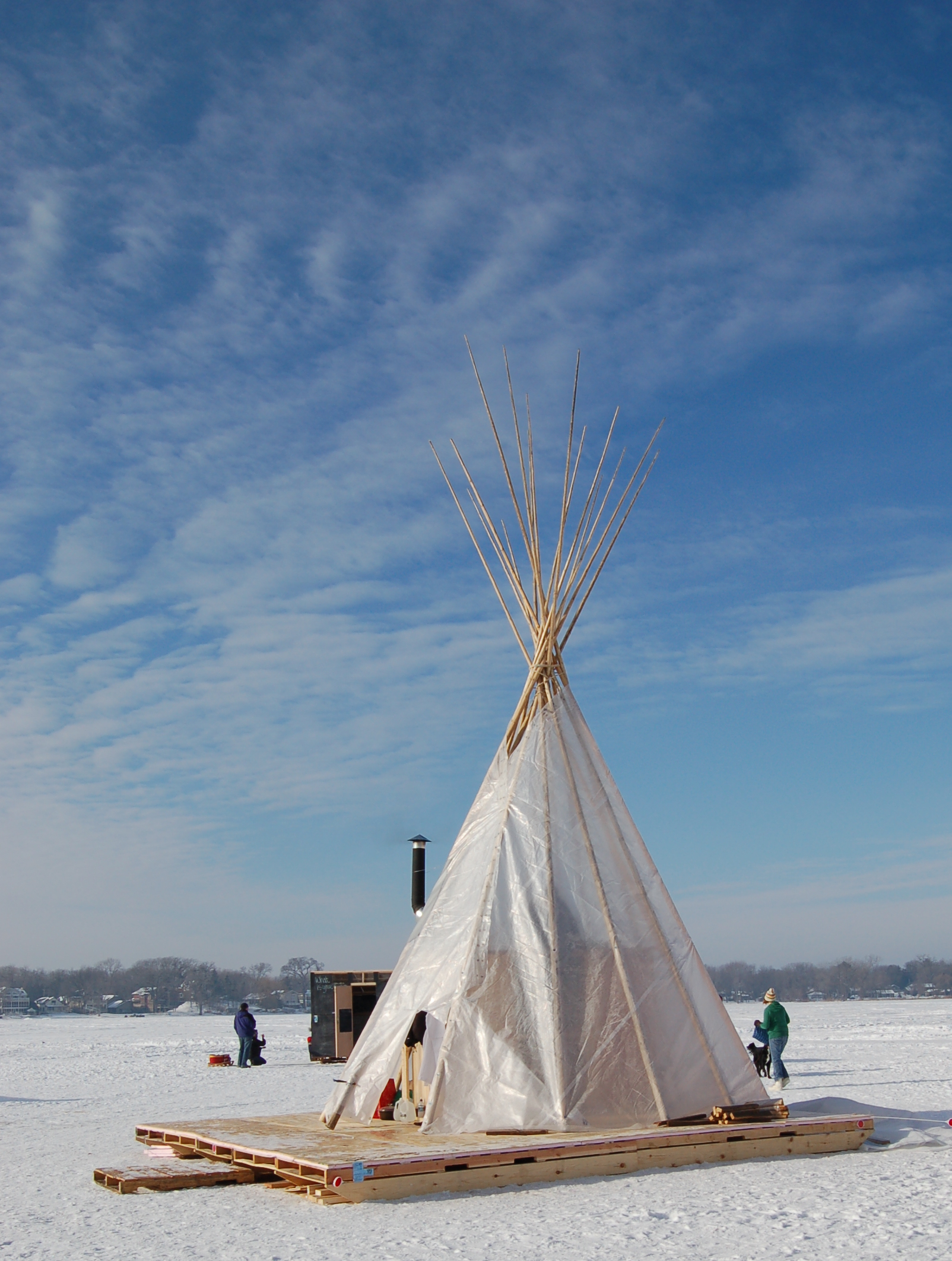
On a brilliant sunny Saturday under a thin azure sky, we walked out onto a frozen lake to visit an art installation: Art Shanties. Local artists erected and decorated ice fishing shacks, from a traditional fishing shelter complete with a hole cut in the ice to show its thickness to a Nordic Immersion shanty where we made lanterns out of snowballs. The activities included a bicycle race on the lake, and as we walked among the bundled entrants, a Ford F-150 drove by us on the ice. The thick, crystal skin popped and cracked under the weight of the truck, and fear took my breath away. But in Minnesota they know how thick the ice has to be for the weight of their vehicles – this is the type of knowledge that is useful in a place like Minnesota – and so we did not fall through to the icy blue depths below.
Art swap shanty, Minnesota, 2010
Ice fishing hole, Art Shanty, Minnesota, 2010
Swedish lanterns, Nordic Immersion Art Shanty, Minnesota, 2010
Walking on a frozen lake, Art Shanty exhibit, Minnesota, 2010
Another weekend we explored snow sculptures at the state fairgrounds, sculptures that included towering vikings, Tom Sawyer whitewashing the fence, and a maze we entered at one opening and navigated through to the end. Another weekend we drove downtown at night to see ice sculptures of crystal dragons and diamond palaces glittering in the white lights strung through giant spruces in the park. We even witnessed lawn mower ice racing. And I can tell you, you haven’t lived until you’ve watched the Minnesota Lawn Mower Race Association skid around tight turns on a frozen lake on lawn mowers.
After that first year, I didn’t fear winter anymore. We all survived it, and I grew to love the crystalline beauty of ice, the soft silence of snow. But being among people, and neighborhoods, and buildings, and festivals is a different thing altogether than being alone with your spouse in a handbuilt cabin on a homestead in Alaska where, “Whenever the work stopped, the wilderness was there, older, fiercer, stronger than any man could ever hope to be.”
I am both inspired and envious of Jack and Mabel’s story, and how over time, they too overcame their fears. Only they did it alone. Without neighborhoods and buildings and winter festivals. I was surprised that I grew to love the piercing beauty of winter in Minnesota, and reading The Snow Child makes me ache for the wilderness Eowyn Ivey writes. But if I’m to be honest, I am not made of as tough of stuff as Minnesotans or Alaska homesteaders. As much as I think I would love to brave an Alaska winter, to live in the wild beauty Ivey brings to life on her pages, I’m pretty sure I’m more content cuddling in our Appalachian home, blowing steam from my hot cocoa, safe on our snug sofa instead of scorching my eyes and lungs, isolated and alone in a landscape that could kill me.
I am reading America: 3 books from each state in the US with the following authorships represented – women, men, and non-Caucasian writers. To follow along, please visit me at andreareadsamerica.com.
The Snow Child by Eowyn Ivey. “Alaska, 1920: a brutal place to homestead, and especially tough for recent arrivals Jack and Mabel. Childless, they are drifting apart–he breaking under the weight of the work of the farm; she crumbling from loneliness and despair. In a moment of levity during the season’s first snowfall, they build a child out of snow. The next morning the snow child is gone–but they glimpse a young, blonde-haired girl running through the trees…”(Goodreads blurb)
Today is the anniversary of my first post, One Last Move, on June 7, 2012 on Butterfly Mind. In that first post, and in many subsequent ones, I wrote about trying to find my way as an at-home mom when our children both went off to elementary school, leaving me alone in quiet, not for minutes but for hours, for the first time in 9 years. I didn’t know if I should pursue a new career, and if so, what would I do? Who would I be? A young friend in Blacksburg commented on one such searching post:
“For your main line of work, I would follow whatever you naturally gravitate toward when you feel the need to be productive.”
How very wise he was. Thank you Phil. You were right. I gravitate towards words when I want to be productive, and I did not see that at the time. When I thumb through old diaries, I realize I’ve gravitated towards writing all along. Every couple of years I express in those private pages my desire to be a writer. A desire that seemed so impractical and unattainable, I never gave it credence. Until this blog. Now, I’m building a writing practice, laying a foundation so that when the kids grow up and move away, I can move forward into a writing career. If that’s still what I want to do ten years from now.
To celebrate my first anniversary, I thought I’d serve up the year’s most popular posts. For those of you who have been around since the beginning, thank you. I am grateful for your support. For those of you who are new here, welcome. Perhaps this run-down will give you an idea of where to start and what to expect on Butterfly Mind. Thanks to all of you for your readership, and enjoy.





 Butterfly Mind