There was a bakery in St. Paul, or actually Minneapolis, across the street from Lake Calhoun, and the bakery was called Rustica. The bakery portion, where the actual baking took place, abutted the sidewalk and had huge plate glass windows so you could stand outside and watch the breads being moved on wooden paddles, the baguettes proofing in their cloth canoes, the buns and torpedos and rolls and loaves being pulled by floured forearms. I remember the bakery being white and stainless steel.
The next set of windows, and the door, led into a warm wooden room that smelled of freshly baked bread, golden crusts, and coffee. Croissants flaked in baskets on the the display case. Elephant ears sparkled with crystals of sugar, cinnamon rolls glistened sweet with brown spice, and olive loaves sat dusty and dark: caramelized crusts covered in flour with slices of black olives poking through. I could never decide what to get. I usually got a savory and a sweet — a dessert pastry for after my bread.
But, as if the bread weren’t enough, this bakery had the best coffee I’ve ever tasted. And I swear it had something to do with their grinder. It was an intense thing, the coffee grinder — a BIG DEAL — behind the counter, up against the wall, on it’s own sturdy table. It was rectangular, heavy, solid, stainless steel. It probably weight 100 pounds.
The grinder whirred and whined and ground the coffee almost to a powder. And when they brewed the coffee, it came out rich and strong, subtle and smooth, with no outlier burnt flavors or unpleasant bitterness. I did not know coffee could be so good.
I visited there several times when we lived in Minnesota. On winter days I’d whoosh in the door with the frozen lake behind me. I’d find a small table since I was alone, and I’d claim it with my notebook. I’d take off my wool hat and puffy down coat, unwind my scarf and pull off my gloves, and then I’d stand at the case forever before finally ordering a piece of olive bread, an almond croissant, and a coffee. And then, I’d nibble, and I’d sip, and I’d look out the window, and I’d write.
For the month of April, I will be publishing a 10-minute free write each day, initiated by a prompt from my prompt box. Minimal editing. No story. Just thoughts spilling onto the page. Thank you to cindyloucamp for the prompt, “coffee grinders.”
I am 23, newly married, and my husband is on a research trip in Bermuda for the next six months. I am a young woman alone in our new home in Takoma Park, Maryland, but I feel safe up here in the upstairs apartment of a cute cottage house with a steep, angled roof. The landlady, a hip, smiling woman with centimeter-long bleached curly hair and velvety chocolate skin, painted our walls a gleaming white – not an ecru or an eggshell, but a white white that shines clean and bright when the sun pours in all of our windows. She lives downstairs with her two handsome sons, and she welcomed us by tossing pennies under the throw rugs when we moved in. To bring us prosperity, she said. She’s studying feng shui.
Maria is over today. She works with me in the lab and her Os are round when she speaks them. She’s from Minnesohta. She keeps me company while my husband is away, and we carpool together to work. The first time we parked in the UMD garage she got out and walked to the front of the car, put her hands on her knees and crouched down to inspect the cement wall in front of us. “Where do you plug your car in in winter?” she asked. Being from Georgia I had no idea what she was talking about. Now, she fans her armpits a lot and says, “My Gahd it’s hot.” Being from Georgia, I am tickled by how much the heat of a Maryland summer distresses her. Maryland summer is nothing compared to the oppressive, heavy heat of coastal Georgia.
Being from Minnesota, she was probably tickled in winter when I white-knuckled the steering wheel when it snowed, or in spring when the trees were in bloom and I couldn’t stop gasping. On the coast of Georgia spring is subtle. Most of the trees have leaves year-round, and they do not burst forth into flower before leafing into green. When we drove to work, I’d exclaim over every cherry blossom, every Bradford pear, every redbud. “Look at that one, Maria! Those pinks!” I’d turn my head and see another, “And that one is just covered, I mean COVERED with white flowers!” She’d smile quietly and think of her Minnesota home.
Now, we are in the spare room with newspapers spread on the round wooden table. Maria is teaching me how to make patterns for sewing. Calico cloth that reminds me of Ma Ingalls is draped over the back of a wooden chair. My bike leans against one white wall, and Maria and I bump against the others. It being an upstairs apartment with slanted ceilings, the room is small and cramped, but it is happy with bright light pouring in the windows and reflecting off those crisp white walls. Maria tells me about paddling the boundary waters while she positions spaghetti straps on newspaper, straps that remind me of summer and freckles and Georgia beaches. I tell her about jellyfish and seashells and palm trees while I finger the Little House calico.
The sun glints off of scissors as Maria cuts through print along the pencil mark she traced from the tank top she brought. We are copying the pattern, two women alone, crafting summer garments from what we have, from what we know, cutting cloth and making something new.
The submissions for my Andrea Reads America American Vignette series are rolling in, and they are a pleasure to read. This is my entry for the second prompt, American Vignette: Summer Garments. If you have a story to tell about summer clothes in your state , I hope you will submit!
The grown-ups stood at the front window sipping spiked coffee and doctored hot cocoa. Our entertainment that day was watching Ed, the mail man, bend into the blizzard as he trudged through thigh deep snow to get to our across-the-street neighbor’s wall-mounted mailbox. All the kids entertained themselves by – well, I don’t remember how they occupied themselves. All that mattered was that they were entertained.
That was three years ago. Today, as the sky spits wet ice that coats cars and roads in slick sheets of slippery sleet, our son plays his Wii U instead of kicking the soccer ball with boys he invited over for his birthday. Once again, winter weather has thwarted his birthday plans.
Three years ago, when we lived in Minnesota, when our kids were still young enough to combine their birthday parties (their birthdays are two weeks apart in the middle of holiday season. Fun.), we planned a Saturday party at the bowling alley. It was December 11, 2010, a celebration of our son’s seventh birthday and our daughter’s fifth. In Minnesota, things don’t get cancelled for snow. In three winters, our children did not get a single snow day from school, despite several blizzards and a foot-thick perma-layer of white.
That Saturday, as we watched the inches pile up, as we watched the ground disappear beneath a thickening blanket of white, we bit our cuticles and wondered, do we cancel? We kept checking the bowling alley website, checking the forecast, checking the depth of snow in the street. Four inches. Six inches. Eight inches. A foot.
Finally, with only two hours til the party’s start time, when our street wasn’t plowed and we knew our soon-to-be salt-crusted Passat wagon wouldn’t be able to push through the accumulation, I looked at the cookie cake I had already baked, the snacks I had already packed in totes, and I picked up the phone.
“Hey Stace. I don’t think we can get to the bowling alley. We’re going to have to cancel the party.”
“Oh no! The kids will be so disappointed.” She had three of her own, all with Swiss and Germanic names peppered with Ks and Vs and Zs, who had been excited about the party all week. Now they would be cooped up in her house, full of pre-party excitement that would not get bowled out.
“Well, I was thinking, if you and Ben want to still get out of the house, we do have this cookie cake.” Her family lived around the corner, a block or two away. “Y’all want to come over here?”
We extended the same invitation to other guests, most of whom also lived nearby. Two hours later, at the bowling party’s start time, my husband and I looked out our front window into the blowing snow and saw two parka-clad grown-ups bent into the gale, each pulling a sled laden with brightly colored puff-balls of children. The snow was deep – almost to Ben and Stacy’s knees – and they pushed through it like my brother and I pushed through marsh mud as children. The sleds sank under the weight of a seven-year old, a five-year old, and a toddler, and Ben and Stacy made their way towards our house lumbering step after lumbering step.
The storm picked up as they brushed off snow and stomped their boots in the mudroom. We could no longer see the street corner they had rounded. Our friends’ noses and eyes burned red. Snowflakes melted in their eyelashes, and I immediately offered them coffee and hot cocoa.
The kids disappeared into the living room, and the grown-ups stood at the back window. We blew steam from mugs and watched snow squall. A figure materialized from the whiteout – our neighbor, Matthew, with his four-year old daughter on his shoulders. A wake of snow pushed in front of his knees like water before a ship’s bow.
“Matthew, come in! Come in! We need to run a rope between our houses like Pa Ingalls ran between the cabin and the barn.”
I put a cup of coffee in his hands and offered a shot of whiskey in it. His blonde eyebrows shot up and he smiled a Nordic smile.
Once the third family emerged from the other blowing corner of the back yard and made it safely to our door – our Lutheran neighbor who sang in a gospel choir – the children disappeared into kid rooms. The adults moved to the living room. Some of us stood at the front window and watched snow pile.
“I bet it’s up to 16 inches now.”
“Hard to tell with the drifts”
We warmed our hands on earthenware mugs. Blew steam. Sipped coffee.
“Oh my God, is that Ed?” Our friends who had been lounging on the sofa jumped up and padded over to the window. We all shared Ed, the neighborhood mail carrier. We stared openmouthed as he bent into the blizzard. The flaps of his fur-lined USPS-issued hat were pulled over his ears and tied under his chin, and his blue postal parka with the reflective stripe was flecked with white. He trudged through thigh deep snow to get to the wall-mounted mailbox on our neighbor’s front stoop.
We watched, entranced, as if we were watching a movie. “I better put another pot of coffee on.” I took my time – Ed wasn’t getting anywhere fast in that blowing mess, and he still had to tramp to two more houses before he’d get to ours.
When he slogged his way onto our stoop, I opened the door and told him, “Come inside Ed! This is crazy that you’re out delivering mail.” Even the Minnesotans thought it wild. He pulled his snow mittens off and stuffed them into the mail bag slung over his shoulder. I put a cup of black coffee in his hands. Threads of blood vessels reddened his nose and cheeks, and his eyes watered.
“I had to leave my truck over on Roselawn,” he said. “Couldn’t get it down the street.” He wrapped his chapped hands around the mug and gulped large sips while the coffee was hot.
“It’s really blowing,” he said, and finished off the cup before it had a chance to cool. He handed the mug to me and smiled, “Thank you very much for the coffee.” He pulled his mittens back on, and we all patted him on the back before sending him back out into the storm.
“Thanks Ed, be safe out there.” He bent his head and plowed through the knee high drifts in our front yard. When we dug out the next day, after the storm had blown through and the sky was a crystalline blue, we made sure to dig out the postman’s path.
“We need to give him a nice tip this Christmas,” my husband said.
I don’t think the kids cared that year that their bowling party was cancelled. I certainly didn’t. We ate cake and fed Ed and drank whiskied coffee in the early afternoon, and the kids played warm inside together while the world outside blew white and cold. We were all happy.
View of house from plowed street
Snow piled up to windows
Compost bin peaking out from snow
Digging the postman’s path
This year, our daughter was able to have her party (Saturday), but our son’s was supposed to be today. I don’t have a cake or snacks because he wanted it to be low-key. He doesn’t like to be the center of attention. He didn’t even want his friends to know it was a birthday celebration. He just wanted to play soccer, 3 on 3 with his five friends. Without cake, or parents carrying children through blowing snow, or drinking hot spiked drinks before five o’clock, or children tinkering in kid rooms, what will our memories of this cancelled party be?
I guess they will be whatever I make them here: my husband and son wrapping black railings in white lights while icy rain sleets down; our son exclaiming, “My snow globe!” and beaming as if he’d rediscovered a lost friend when I unwrapped the Christmas decorations; me lighting holiday candles in the middle of the day. Today’s memory will not be of Ed trudging through a blizzard to deliver our mail, but of our son, who cracks windows to listen to rain, who loves the delicacy of snow, who delights in bad weather because he likes to be cozy inside.
The memories of this thwarted soccer day will be of our son who is happy as a clam, snuggled in the poofy chair next to the Christmas tree, reading a Hardy Boys book and smiling in contentment for his favorite kind of day: the lazy ones.
“November was here, and it frightened her because she knew what it brought – cold upon the valley like a coming death, glacial wind through the cracks between the cabin logs.” – Eowyn Ivey, The Snow Child
When we left Florida on November 1, 2009 to make the drive north to Minnesota, our station wagon packed so full of belongings that we couldn’t see out the back windows, the grass was lush and green, butterflies flitted at the mouths of hibiscus blooms, and the air conditioner was running in my in-laws’ Sarasota home. When we arrived in St. Paul four days later, the world was brown and grey, and bony branches rattled in the cold breath that chilled the city. We wore hats, coats, and gloves when we stepped out of the car onto our new driveway.
Once we unpacked our moving Pods and got our home in order, I remember lying in bed one night next to my husband, listening to a wintry wind whistle through naked tree limbs and catch in corners under the eaves. I felt a panic come on, and I turned to my husband.
“I’m scared,” I told him.
“Of what?” he asked.
“Of winter.”
Having grown up in the mild state of Georgia, I did not know true winter. I did not know frozen earth and scoured limbs, months of barrenness, and shivering as soon as I turned the shower off day after day after day. I knew live oaks dripping with Spanish moss – oaks that kept their leaves year round – and Christmases that sometimes allowed for a crackling fire, and sometimes required short sleeves and shorts. I knew azaleas that bloomed in early March, not snow that lasted into June.
I was afraid of how I would handle the blanket of snow that would shroud the earth from November to May. I felt suffocated by its eternal coverage. I was afraid of the bleakness, the lack of color. I was afraid of cabin fever, and the madness that the endless repetition of dressing and undressing might bring: 20 minutes of layering and wrapping and covering and zipping and mittening and booting to leave the house, and 20 minutes of shaking off snow and stomping out boots and unwrapping and uncovering and unzipping and unmittening when we came back in. Life was so much easier where it was warm. So quick to skip out the door, hop in the car, and go.
One morning, my husband crawled out of bed in the dark, dressed in his winter running clothes, and stepped out into the silent -10° blackness. I lay in bed under the down comforter, cozy and warm, until I started thinking about all the things that could happen to him out there. The rest of the city still slept – he often did not see another soul on his pre-dawn runs – and I thought about the ice out there in the darkness, and the fact that if he slipped and fell and broke his leg, nobody would find him before the cold got him. And this is what gave me shivers despite our down comforter.
We lived in a place that could kill us.
Over time, I was surprised repeatedly by how Minnesotans embraced this deadly cold. Winter didn’t drive Minnesotans in, it drove them out. Our first winter we bought sleds, I bought snow shoes, my husband bought skis, all four of us bought ice skates, and no matter which equipment we chose each weekend, we’d see dozens of flushed cheeks, glittering eyes, and North Face logos on the backs of shoulders as other folks sledded, or snowshoed, skied, or ice skated too. Golf courses switched to cross country ski routes in winter, and local parks flooded plank-walled ovals for outdoor skating rinks. Some of them even had hockey goals.
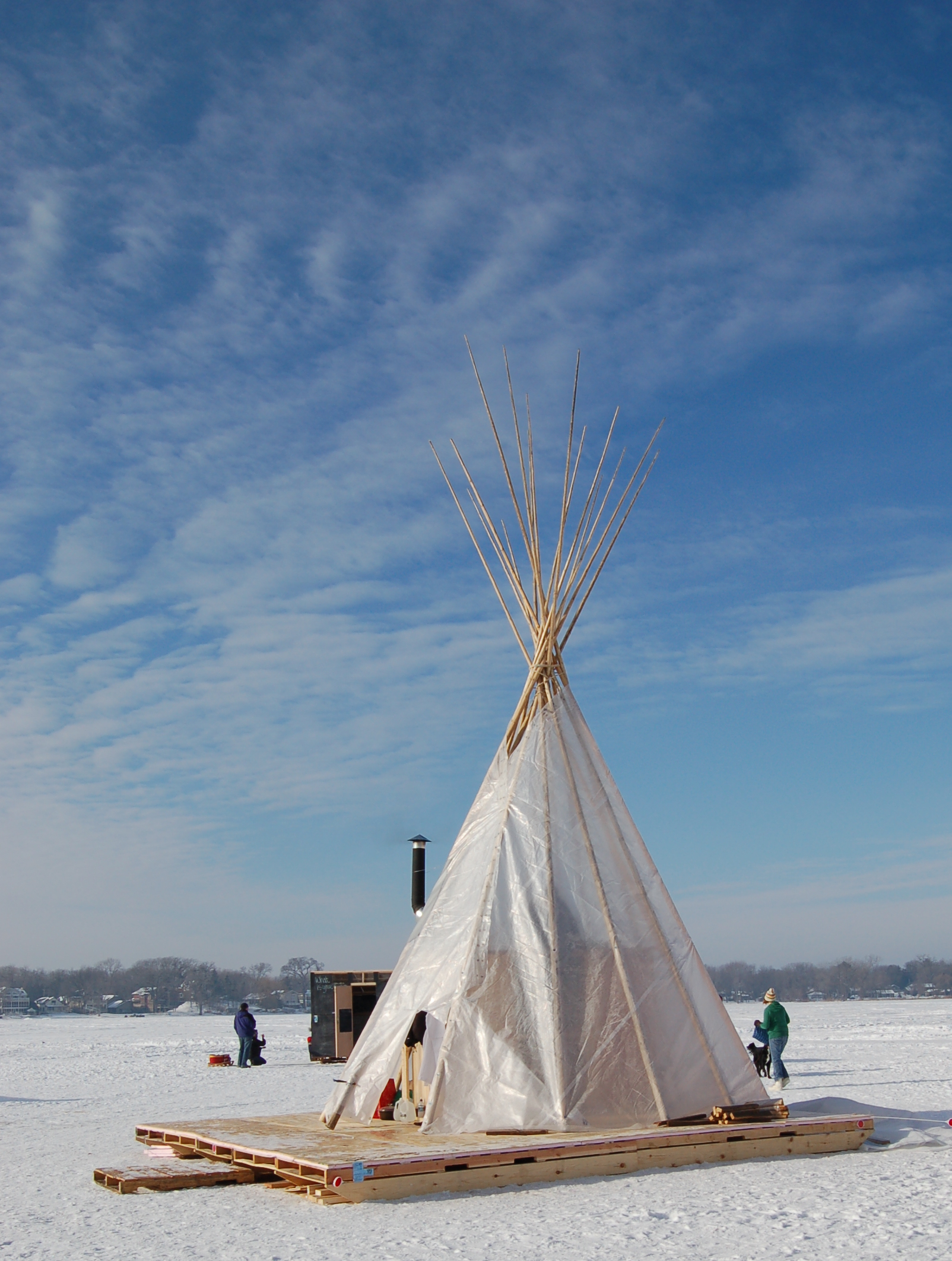
On a brilliant sunny Saturday under a thin azure sky, we walked out onto a frozen lake to visit an art installation: Art Shanties. Local artists erected and decorated ice fishing shacks, from a traditional fishing shelter complete with a hole cut in the ice to show its thickness to a Nordic Immersion shanty where we made lanterns out of snowballs. The activities included a bicycle race on the lake, and as we walked among the bundled entrants, a Ford F-150 drove by us on the ice. The thick, crystal skin popped and cracked under the weight of the truck, and fear took my breath away. But in Minnesota they know how thick the ice has to be for the weight of their vehicles – this is the type of knowledge that is useful in a place like Minnesota – and so we did not fall through to the icy blue depths below.
Art swap shanty, Minnesota, 2010
Ice fishing hole, Art Shanty, Minnesota, 2010
Swedish lanterns, Nordic Immersion Art Shanty, Minnesota, 2010
Walking on a frozen lake, Art Shanty exhibit, Minnesota, 2010
Another weekend we explored snow sculptures at the state fairgrounds, sculptures that included towering vikings, Tom Sawyer whitewashing the fence, and a maze we entered at one opening and navigated through to the end. Another weekend we drove downtown at night to see ice sculptures of crystal dragons and diamond palaces glittering in the white lights strung through giant spruces in the park. We even witnessed lawn mower ice racing. And I can tell you, you haven’t lived until you’ve watched the Minnesota Lawn Mower Race Association skid around tight turns on a frozen lake on lawn mowers.
After that first year, I didn’t fear winter anymore. We all survived it, and I grew to love the crystalline beauty of ice, the soft silence of snow. But being among people, and neighborhoods, and buildings, and festivals is a different thing altogether than being alone with your spouse in a handbuilt cabin on a homestead in Alaska where, “Whenever the work stopped, the wilderness was there, older, fiercer, stronger than any man could ever hope to be.”
I am both inspired and envious of Jack and Mabel’s story, and how over time, they too overcame their fears. Only they did it alone. Without neighborhoods and buildings and winter festivals. I was surprised that I grew to love the piercing beauty of winter in Minnesota, and reading The Snow Child makes me ache for the wilderness Eowyn Ivey writes. But if I’m to be honest, I am not made of as tough of stuff as Minnesotans or Alaska homesteaders. As much as I think I would love to brave an Alaska winter, to live in the wild beauty Ivey brings to life on her pages, I’m pretty sure I’m more content cuddling in our Appalachian home, blowing steam from my hot cocoa, safe on our snug sofa instead of scorching my eyes and lungs, isolated and alone in a landscape that could kill me.
I am reading America: 3 books from each state in the US with the following authorships represented – women, men, and non-Caucasian writers. To follow along, please visit me at andreareadsamerica.com.
The Snow Child by Eowyn Ivey. “Alaska, 1920: a brutal place to homestead, and especially tough for recent arrivals Jack and Mabel. Childless, they are drifting apart–he breaking under the weight of the work of the farm; she crumbling from loneliness and despair. In a moment of levity during the season’s first snowfall, they build a child out of snow. The next morning the snow child is gone–but they glimpse a young, blonde-haired girl running through the trees…”(Goodreads blurb)
I’m reading Forrest Gump. I haven’t seen the movie since it came out in 1994, and I’ve never read the book, and I haven’t gotten anywhere near the part where Bubba tells Forrest about shrimp:
“Shrimp is the fruit of the sea. You can barbecue it, boil it, broil it, bake it, saute it. Dey’s uh, shrimp-kabobs, shrimp creole, shrimp gumbo. Pan fried, deep fried, stir-fried. There’s pineapple shrimp, lemon shrimp, coconut shrimp, pepper shrimp, shrimp soup, shrimp stew, shrimp salad, shrimp and potatoes, shrimp burger, shrimp sandwich. That- that’s about it.” – Bubba in Forrest Gump
In fact, I have no idea if that scene even happens in the book, but just being on the page with Forrest, and hearing his voice, and seeing the name Bubba in chapter 3, I remember the movie. And now I’m thinking about seafood. I’m thinking about the shrimp boats of my Georgia childhood, and the crab traps baited with raw chicken, and the fishing poles sticking up from our boat’s white rod holders, and the cast nets that you held the weighted skirt of in your teeth while you got your hands in the right position to spin the white web out over the water. I’m thinking about seagulls squawking and dolphins chittering behind shrimpers, waiting for them to pull their nets in, about the sound of blue crab legs scuttling in the bottom of a white plastic compound bucket, about that dock under a bridge on Wilmington Island where Mom would buy shrimp fresh off the boat.
But mostly I’m thinking about oyster roasts and crab boils and red hot skillets for blackening Dad’s caught-today grouper, and fresh fish on the menu at riverside restaurants, and watching Mom drop blue crabs into a huge pot of boiling water, and then pulling them out as hot and red as a bad sunburn.
My husband and I have moved around a lot, sometimes near the ocean, and sometimes not. We wintered in Maine one year and took full advantage of the lobster fishery there. I remember lobster rolls from a roadside stand on our way to somewhere; I don’t remember where. I only remember seeing the stand under a bridge. The light was beautiful that day – slanted and yellow warm against a crisp blue sky. And I remember lobster chowder at a shack on a rocky jetty that jutted into a wild winter sea. Angry icy waves crashed against jagged stone, and we sipped steaming hot chocolate and slurped thick lobster stew as wind and water raged outside.
We weren’t so lucky in Minnesota, though. Minnesota is the farthest from ocean I have ever lived, and it wasn’t until we planted ourselves there that I fully appreciated what in meant to be landlocked. We wanted oysters one night, and I drove to every grocery store in a five mile radius hunting for them. I ended up at the fancy market, the expensive one – Byerly’s – because that was the only place they carried them. When I finally spied oysters on ice at the seafood counter, I wanted to buy – how many? I only knew them by the bucketful – and the oysters were a dollar apiece. I stood there a full minute in sticker shock before I finally bought the six individuals they had. My husband and I got three oysters each. Growing up we had cooked piles of them, mountains of them, filled five gallon buckets with hot oysters and tossed them in a steaming ridge along 6-foot newspaper-covered tables, over and over again. Neighbors stood around those tables with their oyster knives, shucking and slurping and dashing with tabasco, tossing oyster carapaces like peanut shells. Piles of them. And in my little bag in Minnesota, I had six.
But there, in the middle of the country, in the cold heart of winter, more than 1000 miles from the nearest brackish water, eating those oysters was like eating slippery morsels of ocean: saline, lusty, and warm.
They weren’t the best oysters on earth, nor is any of the seafood we can get where we live, so we don’t eat it often. By the time marine fare makes it through the hills, it is no longer vibrant. It has lost its vitality. We have no idea where it came from, who caught it, how many times it has been frozen. And the only fish we can afford are sad and soulless. They taste like silt from the farms they were raised in, or are dyed to look more vital, more alive.
I’m pretty sure I’ve eaten shrimp every way that Bubba describes it, and shrimp isn’t even my favorite seafood. In fact, it’s probably the seafood I care least about. I’d rather have blackened grouper that my dad caught offshore, salty and sunburned for his efforts, standing over hot coals at the end of the day, waiting for the cast iron to glow before he throws in those succulent filets coated in butter and cajun spice to sizzle and sear. Or I’d love some crab-stuffed flounder, or crab au gratin made from blue crabs my brother and I caught in our creek. Or, Mahi-Mahi Dad caught on vacation in the Florida Keys, or spiny lobsters we tickled out of crevices during lobster season down there.
But now that we live in the mountains in Virginia, even though they’re not my favorite, even though they aren’t grouper, or Mahi, or lobster, or blue crab, I’d take a pile of shrimp. Or even just three apiece, if they’re fresh.
I am reading America: 3 books from each state in the US with the following authorships represented – women, men, and non-Caucasian writers. To follow along, please visit me at andreareadsamerica.com.
Forrest Gump: A novel by Winston Groom. Six foot six, 242 pounds, and possessed of a scant IQ of 70, Forrest Gump is the lovable, surprisingly savvy hero of this classic comic tale. His early life may seem inauspicious, but when the University of Alabama’s football team drafts Forrest and makes him a star, it sets him on an unbelievable path that will transform him from Vietnam hero to world-class Ping-Pong player, from wrestler to entrepreneur. With a voice all his own, Forrest is telling all in a madcap romp through three decades of American history. – from the paperback blurb
I stood behind my husband in Minnesota, rubbing his shoulders while he sat at our desk, focused on the screen in front of him. He was transferring all my files from our desktop to the laptop I was to take with me to Virginia.
I watched branches sway in the breeze, laden with the heavy weight of broad sumac lives, fingers of blue spruce needles, or delicate walnut leaflets. Our kids and their neighbor friends, the ones they spent eight hours a day with outside, popping in for a popsicle or an apple snack before dashing out again, tromped through the yards, all in a line, singing and pumping their arms like they were in a parade. They reminded me of the lost boys in Peter Pan.
I rubbed my husband’s neck and began, quietly, to cry.
The keyboard clickety-clacked while he loaded programs onto the dinosaur laptop, then stopped when he heard me sniff.
“Are you crying?” he asked.
“Yes.”
He reached up behind him and held my hands on his shoulders. “Because of the kids?” He watched them laugh and parade with the friends they would soon leave.
“Yes,” I said. “And because of the trees.” And the move. And the unknown.
“Why the trees?”
I pointed to the tallest tree on our lot – the one all the neighbors hated because it was tall and gangly and had been carved out in the middle of its crown to accommodate power lines.
“That’s a black walnut,” I said. “It is a host plant for the luna moth.” I wiped my eyes, thinking about yet another move. “I always wanted to have a walnut tree.”
The first time I saw a luna moth was nearly 20 years ago, before I married, before I had kids, when I was an ecology student in Athens, Georgia. It was night, and I had pulled into an empty bank parking lot to hit the ATM before going out for beers. I stepped out of my car, and as I slammed the door, something in the parking space next to me caught my eye. I looked down and there on the ground, two feet from my front driver’s side wheel, motionless with its wings spread flat, was a the largest moth I had ever seen. Luminescent green, it was more beautiful than butterflies. Had it crawled on my palm, its wings would have eclipsed my hand.
I forgot about the bank, forgot about the bar. I cared for nothing but this otherworldly creature on the pebbly black asphalt. The saucer-sized moth was the color of absinthe, and even with me standing over it, even after my feet crunched, and my ton of rubber and steel gravelled over pavement just inches from its body, it did not move. It lay there, basking in the light of a street lamp, as if in a trance. I had never seen anything like it. I stood there in that dingy parking lot, under the street light, in front of a brick bank, the most ordinary, paved over, non-natural setting, and experienced a sacred moment as I witnessed this gorgeous creature who had stopped time and space for me with its luminous glow.
Since that night, almost 20 years ago, I have hoped for the gift to see another. The only time I’ve seen one, besides in photographs on the internet or pinned in glass cases at a science museum, has been in a commercial for a sleep aid. Lunesta. I remember the first time I saw that ad, how offended I was that it had exploited such a special creature for the pedestrian purpose of peddling pills. It was like using God to sell toothpaste.
Ten years after that moth, when we bought a home in Florida, I wanted to cultivate a butterfly garden. I learned that you could attract local species by planting host plants for caterpillars (milkweed for monarchs, parsley for swallowtails, passionflower for frittilaries) and nectar flowers for butterflies (lantana, echinacea, goldenrod, plumbago). After successfully inviting multiple generations of monarchs and swallowtails, Gulf Frittilaries and zebra longwings, after watching the adults drink nectar, and their caterpillars munch leaves, and their chrysalises transform squishy larvae into winged butterflies between the slats of our wooden fence, I one day saw a tremendous, absinthe green caterpillar crawl across the our garden path. Its colossal size (larger than the largest swallowtail caterpillar I’d seen) and its luminous color (it seemed to glow even in daylight) immediately put me in mind of my magical moth, and I thrilled that it could possibly be a luna larva. I rushed in to fetch my camera and field guide, but when I reemerged and got down on my hands and knees in the mulch, trying to follow its trail, I could not find the caterpillar again.
Luna moth caterpillar: photo credit Dave Wagner, 2002
Having seen my only luna moth in the foothills of the Appalachians, it never occurred to me that I might find one in Florida. I researched Actias luna to find the luna’s host plants: persimmon, sweetgum, hickory, walnut. All large specimens. None in our postage stamp yard in Tampa. I searched the neighborhood for these trees but never found them, nor did I find another luna larva.
When my husband accepted a three year postdoctoral position in Minnesota, and it was time to move away from Florida, I made a wish board of what I wanted in our new northern home: 3 bedrooms, a big kitchen, good schools, a yard for the kids, and a host plant for the luna moth. I forgot the board during our rushed two-day house-hunting trip. All we were looking for was a place we could afford in the school district that offered half-day kindergarten. A place we could spend three years and be comfortable. We moved in November, and one month later had our first snow. We didn’t see leaves or earth until the following May.
In September, after ten months in Minnesota, our kids clomped through the mud room one Saturday with their fingers stained black. “What on earth?” I asked.
“There are these things all over the yard – I think they’re coconuts!” our son said.
I walked outside with our daughter and him to find a pile of lime-sized green globes they had collected. Some had tiny fingernail gouges in them, some were chewed by squirrel teeth until a black pulp showed, some were inexpertly shredded by child fingers, and some were broken open like to show fibrous husks like… coconuts.
“Huh,” I said. “I don’t know what those are.”
A few days later I was kneading dough in the kitchen and I heard a THUNK. I looked up at the ceiling where it sounded like something had landed on the roof. I kneaded the bread some more. THUNK. I wiped my hands, THUNK, and walked to the big plate glass window that looked out on the yard. I saw one of the heavy green globes plummet to the ground, THUD, and my eyes traced its path up to a branch in a tree. There, a squirrel nibbled the thick husk of another one and sprayed flakes of the olive green skin from its mouth as it chewed.
I walked over to a neighbor’s house and asked, “What are these things?” I showed her an intact nut. It was heavy in my hand, like a stone.
“That’s a black walnut,” she said. “The kids love to try to tear them open. Be careful, though – the black stain is really hard to get out.”
I remembered the wish board I had forgotten and thought, holy shit, my magical thinking worked: we have a walnut tree.
After I realized we had a host plant on our property, after I realized my wishful intent had come to pass, I thought, “It’s meant to be! I will find another luna moth!” In spring and summer, I searched for luna caterpillars, but the crown of the tree was too high, and there were no climbing branches. I couldn’t see the leaves way up there in the sky. I could not see if luminous larvae ate them. I checked by the porch light at night for adults and walked outside in moonlight through the neighborhood.
Season after season went by, and in the three years that we lived in that house, I never saw a luna moth.
When we left Minnesota and I stood by the window with my husband, I was sad to leave the tree so soon. Sad that I never got a chance to see my moth. Sad to leave what was known. Again.
We moved into our Virginia townhouse in December. The trees were bare when we dragged furniture up stairs and decided which cupboard would hold the plates, which drawer would hold the silverware. After settling in, we sledded in the neighborhood in January, bicycled past pastures in July, gathered words in the horticulture gardens in August. I forgot about the luna moth. Had given up on it. Did not wish for a host plant when we relocated, not (consciously) out of disappointment, but because I had moved on. Because my mind was on practical things: transitioning our children, affordable housing, school districts. Soccer. Swim team. The daily grind.
Summer turned to fall in our new home, and with September came the first day of school. As we did last winter and last spring, the kids and I walked through the park in our neighborhood to wait at the bus stop. We shuffled our feet in the few golden oak crisps that had already fallen, and when the bus arrived, our children looked to the windows and saw friends they hadn’t seen in three months. Little hands stuck through open rectangles, waving. A face popped up with bright eyes and a mouthful of teeth and beckoned them onto the bus. Our kids grinned and said hi to their driver and climbed on the bus with more excitement than they were willing to admit on the first day of school.
I was relieved to see them happy, thrilled to know they had already made fast friends, proud that they had not only survived the transition, but were now thriving in their new, not-Florida, not-Minnesota home. I walked through the park that morning with my hands in my pockets, kicking crunchy leaves, at peace. I was grateful for where we landed. Thankful that our family could finally settle down in a town we loved, in a town we wouldn’t have to leave.
I watched leaves fly fluttering from the toe of my shoe, and then I stopped. There on the ground, next to the curving brick path, among the brown leaves, was a husk. A husk like the ones the squirrels threw from tree tops in Minnesota. The ones that thunked on our roof and littered our yard in September. A husk the size of a lime, but woody like a coconut. I scanned a wider area and spread among the crisp oak leaves, like peanut shells at a picnic, were hundreds of these husks. The earth was littered with black walnut hulls. The park was full of walnut trees. I walked deeper into the neighborhood and saw hickories and sweetgum. Looked out over the Appalachians and realized in our forever home, in the town we wouldn’t have to leave, we didn’t just have one tree, we had a whole forest. Ridges and valleys lush with host plants. An entire mountain range of habitat.
My heart jumped, and I smiled at the trees, and I thought, “It is meant to be.”






 Butterfly Mind