I remember games of Monopoly that lasted for days in the hot summers of childhood. When my brother and I exhausted all of our other ideas and were bored, we’d pull out the good old Parker Brothers Monopoly board. Now, my son and daughter do the same.
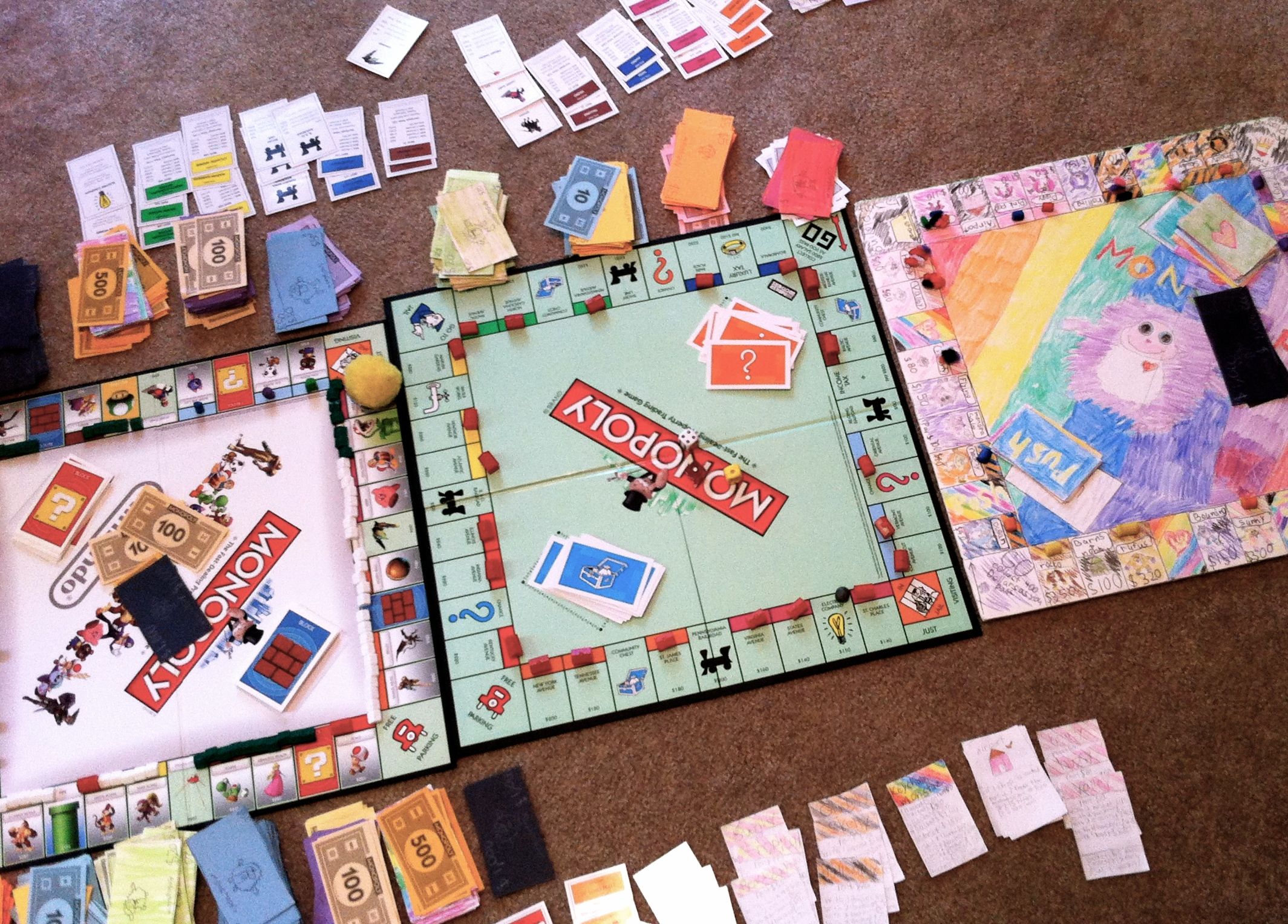
I came down to the basement last week to check on the kids and found all three of our Monopoly boards – the original Parker Brothers, a Nintendo version, and the kids’ homemade Monstopoly version from last summer – lined up side by side for an epic summer game of Triple Monopoly.
I asked our kids how it worked and they explained that they threw all the money and properties up in the air, grabbed wildly, and started the game with everything they secured in the chaos. To move around the the boards they travel all the way around one, then move to the next one and travel all the way round it, and so on.
They bored quickly of the lack of challenge – unlimited money, unlimited properties – and they abandoned their game after a couple of hours. Fortunately for me as I worked upstairs, sorting the monies and deeds and game pieces for cleanup kept the kids occupied for almost as long as the game did.
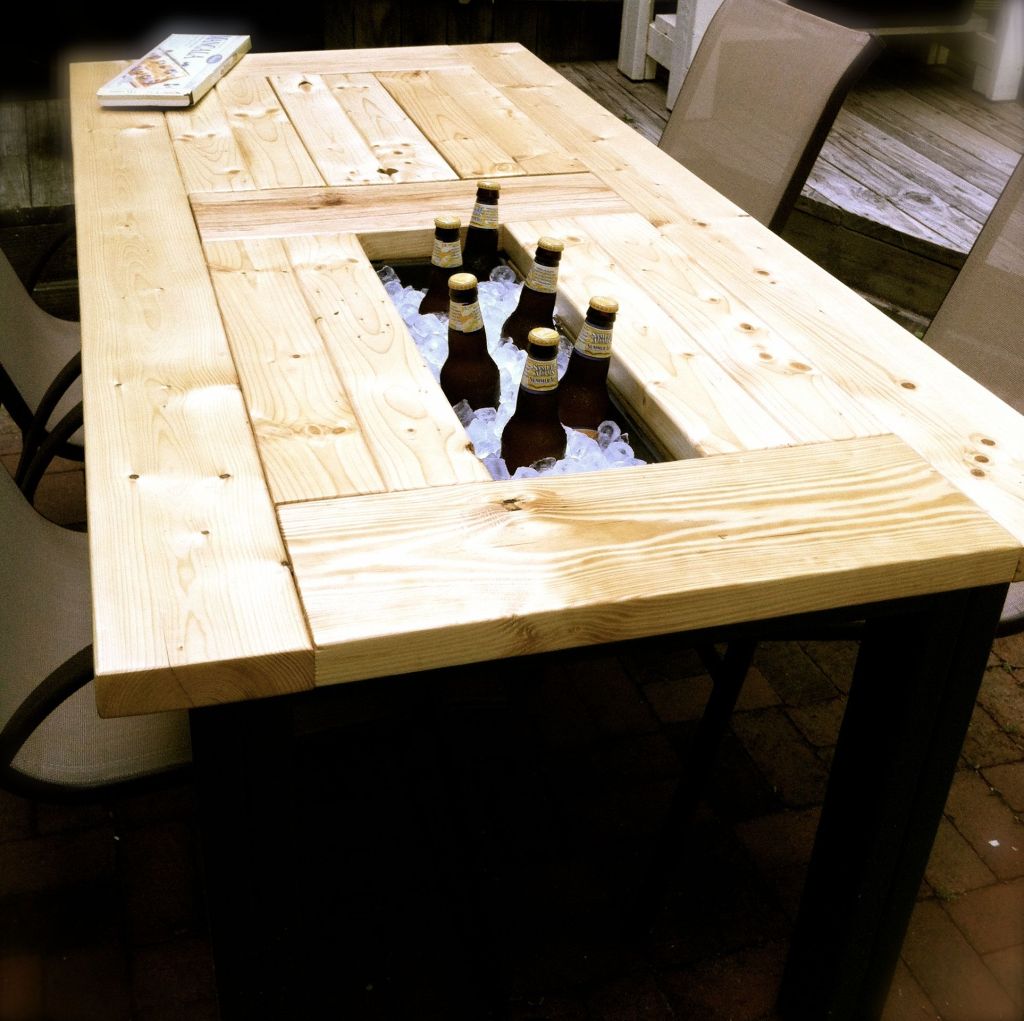
What better container is there than a table that ices your beer? None, that’s what. My husband found plans for this awesomeness over on Ana White’s site and he put it together in a couple of weekends. It makes me happy.
Art Credit: KendyllHillegas on Etsy, Key Lime Pie original illustration
Tart. Tangy. Zesty. Zany. Key Lime Pie: it’s yellow, not green.
You might think if I was going to write about pie in Georgia I’d write about pecan, all sugary and whiskey brown, the pecans a toasty crunch then a succulent give between the teeth, or maybe peach with its sensual slippery melon-colored sweetness. But I’m not. I’m writing about Key Lime because it’s hot and humid outside, and when its hot and humid out and I think of dessert, I think of my Dad fishing in the Gulf Stream and the sunburn and the grill and the chilled pie that followed.
Summer dinners of my coastal Georgia childhood – or at least the summer dinners my mouth still waters for – often consisted of blue crabs we caught in the creek, or fresh shrimp my mom bought from the marina under the bridge. We’d follow those warm seafood meals with ice cream or Pudding in a Cloud (chocolate pudding in a “crust” of Cool Whip), but the best days were when Dad ran the boat 4 hours offshore Savannah to where the water changed from coastal brown to deep ocean blue, dropped a line, and brought home fresh fish. He came home salty in the late afternoon, with a raccoon burn on his face from his sunglasses, and before changing clothes or rinsing the boat he cleaned the fish, scraping scales with a flashing silver knife till they popped off and glistened in the sun.
Dad brought the fish up to Mom in the kitchen where she rubbed the fillets with butter and Paul Prudhomme’s Cajun seasoning while he lit the coals in a kettle grill. He sipped beer while he watched the coals, waiting for them to glow. When they burned till each one formed an even crust of ash he nestled a cast iron skillet into them. An onshore evening breeze rustled the palm fronds and cooled his burned skin, and after a while, the cast iron skillet would begin to glow. Dad tossed the seasoned fillets into the red hot pan and they hissed, blackening within seconds. He pulled them off – moist, succulent fillets encrusted with paprika and cayenne, garlic and thyme.
The fish flaked on our tongues, soft and buttery, crisp and spicy, and on lucky nights, the dinner was followed by Key Lime Pie. There was not better accompaniment for blackened fish than that cold yellow silk pie that zinged your tongue with citrus summer and crunched sugary buttered graham between your teeth. Mom made the pie while Dad bobbed in the ocean, and it chilled while he burned.
I don’t remember now if Dad cleaned up by the time we ate dinner or if he dined with the ocean still encrusted on his skin. I do remember the clean feeling after eating Key Lime Pie, though – that crisp, cool, fresh finish to a hot, salty summer day.
This is my entry for the American Vignette: Pie challenge on Andrea Reads America. I hope you’ll consider submitting. Key Lime Pie recipe follows.
~
Thankfully, Key Lime Pie had a moment in the 80s or 90s and now you can buy Nellie & Joe’s Key Lime Juice nearly anywhere in the US. Or at least on the eastern seaboard. I bought mine at our local Kroger in the mountains in Blacksburg, Virginia. Key Lime Pie is one of the easiest of all pies to make ever. You don’t even have to cook it if you don’t want to – the key lime juice denatures the egg yolks, “cooking” the pie like ceviche. Make it with whipped cream or without, with merengue or without, it’s up to you. I prefer mine neat. Follow the recipe right on the bottle of Nellie & Joes or follow this adaptation from Maida Heatter’s Pies and Tarts:
4 egg yolks
1 14 oz can sweetened condensed milk
1/2 cup Key lime juice
1 9-inch graham cracker crust
You can use an electric mixer, an egg beater, or a wire whisk. Beat the yolks lightly to mix. Add the condensed milk and mix. Gradually add the lime juice, beating or whisking only until mixed.
Pour into the crumb crust. It will make a thin layer; the color will be pale lemon, not green. It will be fluid now, but as it stands a chemical reaction takes place and the filling will become about as firm as a baked custard. Refrigerate overnight.
Or, if you wish [Andrea’s note: this is how I prepare it], bake the filled pie for 10 minutes in a 350 degree oven, then cool and chill.
Whipped cream is optional on this, natives do not use it – restaurants do.
I am 23, newly married, and my husband is on a research trip in Bermuda for the next six months. I am a young woman alone in our new home in Takoma Park, Maryland, but I feel safe up here in the upstairs apartment of a cute cottage house with a steep, angled roof. The landlady, a hip, smiling woman with centimeter-long bleached curly hair and velvety chocolate skin, painted our walls a gleaming white – not an ecru or an eggshell, but a white white that shines clean and bright when the sun pours in all of our windows. She lives downstairs with her two handsome sons, and she welcomed us by tossing pennies under the throw rugs when we moved in. To bring us prosperity, she said. She’s studying feng shui.
Maria is over today. She works with me in the lab and her Os are round when she speaks them. She’s from Minnesohta. She keeps me company while my husband is away, and we carpool together to work. The first time we parked in the UMD garage she got out and walked to the front of the car, put her hands on her knees and crouched down to inspect the cement wall in front of us. “Where do you plug your car in in winter?” she asked. Being from Georgia I had no idea what she was talking about. Now, she fans her armpits a lot and says, “My Gahd it’s hot.” Being from Georgia, I am tickled by how much the heat of a Maryland summer distresses her. Maryland summer is nothing compared to the oppressive, heavy heat of coastal Georgia.
Being from Minnesota, she was probably tickled in winter when I white-knuckled the steering wheel when it snowed, or in spring when the trees were in bloom and I couldn’t stop gasping. On the coast of Georgia spring is subtle. Most of the trees have leaves year-round, and they do not burst forth into flower before leafing into green. When we drove to work, I’d exclaim over every cherry blossom, every Bradford pear, every redbud. “Look at that one, Maria! Those pinks!” I’d turn my head and see another, “And that one is just covered, I mean COVERED with white flowers!” She’d smile quietly and think of her Minnesota home.
Now, we are in the spare room with newspapers spread on the round wooden table. Maria is teaching me how to make patterns for sewing. Calico cloth that reminds me of Ma Ingalls is draped over the back of a wooden chair. My bike leans against one white wall, and Maria and I bump against the others. It being an upstairs apartment with slanted ceilings, the room is small and cramped, but it is happy with bright light pouring in the windows and reflecting off those crisp white walls. Maria tells me about paddling the boundary waters while she positions spaghetti straps on newspaper, straps that remind me of summer and freckles and Georgia beaches. I tell her about jellyfish and seashells and palm trees while I finger the Little House calico.
The sun glints off of scissors as Maria cuts through print along the pencil mark she traced from the tank top she brought. We are copying the pattern, two women alone, crafting summer garments from what we have, from what we know, cutting cloth and making something new.
The submissions for my Andrea Reads America American Vignette series are rolling in, and they are a pleasure to read. This is my entry for the second prompt, American Vignette: Summer Garments. If you have a story to tell about summer clothes in your state , I hope you will submit!
When I sit at my tan desk, in our beige room, with dull buff carpet beneath my chair, I often have a hard time coming up with color words. I google “synonyms for green,” rifle through crayon boxes, and scroll through images of paint chips and artists’ color names, but I am not usually inspired by what I find.
Then today, in an effort to wring the last few drops of fun out of summer before the kids go back to school, we rode our bikes over to the Virginia Tech horticulture garden, where they love to play in the sprinklers and find flowers in the colors of the rainbow (“Here’s a red one!”, “I found orange berries!”). I had folded up a blog post draft and stuck it, along with a pen, in my back pocket so that I could work on it in the quiet of the gardens while the kids played, and as I scribbled and edited, walking the mulched paths, filling the page with ink, I saw a pale green hydrangea.
“Hey guys, here’s green,” I said.
“Oh, flowers!” our daughter said when she saw them. “We don’t usually find green flowers, we just use leaves for green.”
I studied the hydrangea petals, trying to determine their color, and thought, celadon. Is that what color celadon is?
Yes.
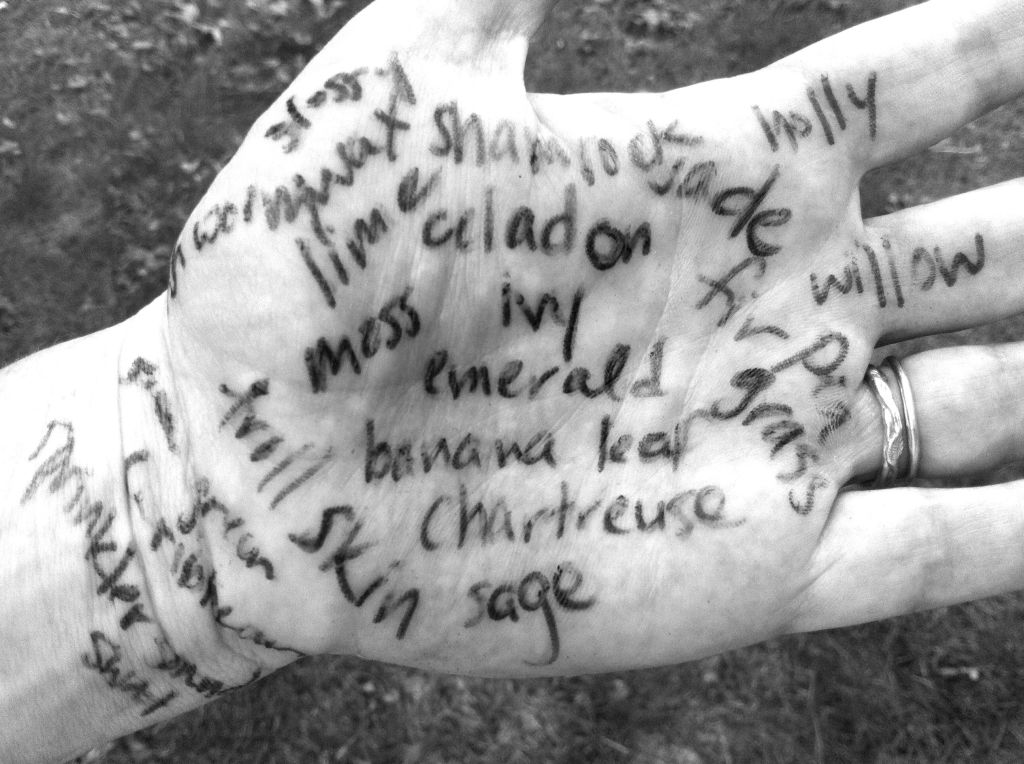
I looked around and saw banana leaves, fir trees, weeping willows, and thought, these are each a different green – dark and glossy for banana leaves, shadowy blue-green for firs, a soft yellow-green for willow. Each plant species is its own hue. And so I started writing. I’m not usually a write-on-my-hand type of person, but my paper was full, and I needed these words.
“Mom, what are you doing?”
“I’m writing down all the greens I see,” and wrote sage. “What greens do y’all see?”
They shrugged, as if that were a dumb question, and then our daughter said, “Shamrock.” Yeah, she’s good.
“Inch worm,” said our son.
They ran off to play in the sprinkler, and I sat and filled my hand. A few minutes later they came back dripping, and our daughter said, “We saw some algae in the pond that looked like troll skin.”
“Troll skin! That’s perfect,” I said, and wrote it down.
“Troll skin isn’t a color,” said our son.
“Sure it is – it’s silvery blue-green and warty.”
“Yeah,” said our daughter, “that’s what color the algae was – it was even bubbly like warts.”
On the bike ride home, the kids shouted out more words – “pea,” “yellow-green,” and “olive” – and when I saw my friend Dee, she asked, “Did you get peridot?” Now, thanks to their assistance, and to inspiration from the gardens, when I am sitting in our neutral living room, trying to conjure color words, I have an entire page in my lexicon dedicated to the color green:
“I’m drinking coffee in bed.” That was going to be the first line of my blog post today, a line that I landed on at 3 o’clock AM and then continued with for hours as I lay awake, composing. And the line was going to be true. I was going to drink coffee in bed, which I have never done before, because my husband was going to work out in my writing space (the living room) this morning, because his mom and our nephew are in his workout space, sleeping.
So I lay awake, thinking about what I’d write, propped up in bed with my composition book in my lap, pillows behind my back and smooth sheets over my legs, and my white porcelain cup sitting on a makeshift nightstand of a large stack of books. I imagined the inspiration I’d draw from my new writing position, not just because it would be a novel space, but because it would be private. With a door.
As I wrote, in my head in the dark, without keyboard or pen or paper, I thought of a million other things as well, as people will do when they lay awake at 3AM. I thought of the beans I need to cook today, and wondered if I make a pot of coffee at 6, will it still be fresh when my mother-in-law wakes up? I remembered all the things I need to squeeze in, and attempted to manage everyone’s wishes for the day – the boys want to go to the turtle pond by themselves, our daughter wants to go bowling, I need to cut tags off and launder some back to school clothes, Grandma would like to return and exchange others. The kids want to go to the toy store. Interspersed with those exciting thoughts were regrets about my writing practice, and how far it has fallen these past few weeks. Words crawled through my head like spiders as I lay there, trapping me in their webs, keeping me awake. I haven’t been sweeping them out, and I felt like I was going a little mad, like an injured athlete who cannot train at the level she wants, who paces, restless, waiting for the time when she can get back to it already.
And then I’d come back to “I’m drinking coffee in bed,” and long for the privacy, and think how I’m looking forward to the first day of school like a kid looks forward to Christmas. I counted the days (23) and told myself I can make it.
I didn’t drink my first cup in the sheets this morning, propped against pillows and lifting my cup from a stack of books next to the bed. I’m on the couch instead, composition book in my lap, my legs tucked underneath me and my coffee cup on its regular perch on a small wooden stool. I’m in the living room because my insomnia kept my husband up, too, and now he is catching up on sleep instead of working out. Of the six people in our home, I am the only one awake, so though I am in an open space, without a door, I am still able to sneak a few minutes of privacy.
Soon, life will get back to normal. Soon the kids will be back in school and I will have quiet, and routine, and freedom to listen to my podcasts without worry of listening ears, or constantly drying my hands to hit pause for endless interruptions – “Mommy, can I have a snack? Will you play a game with me? Where are my shorts? Will you cut me a peach?”
Soon I’ll have privacy and the solitude my sanity depends on, without having to hide in my room, drinking coffee in bed. Soon I will be writing again. I’ll get back into my practice and sweep out the words. Soon. 23 days.


 Butterfly Mind