If you are a parent, or have ever been around the parent of a new baby, you may be familiar with the term “growth spurt.” It is usually paired with the words, “I don’t know what’s wrong with Little Johnnie – he must be going through a ____” (growth spurt).
Babies get fussy during growth spurts. None of a parents old tricks work – change the diaper, add a blanket, remove the socks, coo, bounce, rock, swing. Things are changing inside Little Johnnie, things we can’t see, and let’s face it: it’s uncomfortable. Scary. Whatever is going on, it’s unfamiliar, maybe even painful, and Johnnie doesn’t like it one bit.
I think that’s what’s happening to me right now. Through kismet or coincidence (or perhaps because it is a basic, necessary skill), both my writing group and the craft book I’m reading are intensely focused on structure. As in, structure your writing instead of pantsing it, build it a skeleton before dressing it with skin, and your work will stand erect. Structure is the foundation and the frame; without it, building a piece is a tenuous process, like trying to build a house out of shingles, but with nothing to nail them to. You must contort yourself to hold the shingles up while you frantically staple them together.
I have never structured my work before. Ever.
At first, I was ravenous for information and experience, like Little Johnnie at the breast, gorging in preparation to grow. I told my group, I get it now! I get why revision evades me – because I’m moving shingles around without knowing what I’m nailing them to. I told them, I can’t wait to tackle this homework, 9 paragraphs on a concrete, a noun, something you can touch and taste and see:
1. Facts
2. Origins
3. Ancient perceptions
4. Facts
5. Anectdotes
6. Personal story
7. Metafacts
8. Historical story
9. Personal return to subject
Writing into a structure. I thought, look, it’s all laid out! I thought, this will be fun! This will be easy! I will write about turquoise. Turquoise is simple, it’s not fraught with personal drama that I’m afraid to get close to on this first attempt at a new way of writing. Look how great this will work! I will have paragraphs. I can move them around to observe the flow of information. I can experiment. I can play.
Three weeks and ten hours of active writing later, I’ve got not nine paragraphs but four. Four paragraphs and they are B-O-R-I-N-G.
Meanwhile, my Andrea Reads America project confronts me with a problem I’ve never had before: because I am reading deliberately, writing my reactions, and comparing works, and because I am simultaneously studying the craft of writing, I have become a critical reader.
I don’t want to be a critical reader!
I don’t want to be that peppery old snoot who doesn’t like anything except the finest, the top shelf, the Hendrick’s gin only, please. I liked it better when I liked everything. There are so many more opportunities for pleasure that way. Sure my appreciation of a finely-crafted novel is more profound now, transcendent almost, as when we ate at a five star restaurant and the food was so good we didn’t want to profane the experience by talking. Diners around us chattered while they absently forked steak that melted like butter, or sipped tomato soup that wrapped around your tongue like having God in your mouth, and my husband and I thought, they are not giving this food the reverence it deserves. They’re not even paying attention.
But not every meal can be a five star fine dining experience, and not every novelist can achieve sublimity. I used to be able to accept that, but now my tolerance for fiction that doesn’t work for me has plummeted. It’s not fair for me to expect perfection, especially because I appreciate how difficult it is to achieve, and because I fail so miserably at achieving it myself, yet I can’t help now but notice flaws and see where things don’t work in my reading life.
So I’m fussy. I’m uncomfortable. My reading and writing worlds are changing, and it’s painful, and I don’t like it one bit. Can’t I just go back to when it was easy? When I pantsed my writing and I liked everything I read? Can’t someone coo at me and make it all better?
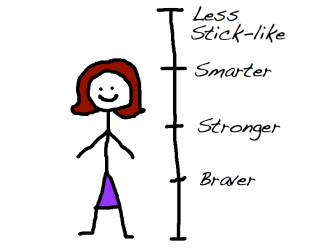
I take comfort from our children, our Little Johnnies who fussed and flailed and suffered and screamed their way through too many growth spurts to count. And on the other side of every one of them, after they suffered their torment, our babies smiled, they laughed, they radiated serenity. They came back to their happy selves again. Only they were bigger. Deeper. Less like babies, more like people. They had grown.
The nine paragraph structure my writing group is working with is from Priscilla Long’s The Writer’s Portable Mentor; the craft book is Jon Franklin’s Writing for Story: Craft Secrets of Dramatic Nonfiction by a Two-Time Pulitzer Prize Winner.




 Butterfly Mind