I always think of spring as being the beautiful season, with its bright pink flowers, its new green leaves, and the reawakening to life after the cold hardness of winter. But the deep tones of fall – the mustards, the rubies – remind me that there is as exquisite a beauty in going to sleep as there is in waking up.
This photograph was taken on a rainy October day in our townhouse parking lot. The mundane scene was beautiful to me, and this photo is my entry to the Daily Post’s Dreamy photo challenge.
The word fray no longer makes me think of threadbare jeans or ratty-edged towels. It makes me think of the swim start in a triathlon, when your heart has hummingbird wings that beat inside your throat. When, after waiting for hours for your heat to begin, you finally line up shoulder to shoulder with your comptetitors, and you finally run into the water, and when it’s knee deep, you finally dive in and and you slither over another swimmer and you get kicked in the face and elbowed in the ribs, and you suddenly feel a knee in your back as a swimmer slithers over you and you go under and swallow lake water, and then you pop up again and get elbowed in the ear and you try to cough out the water and hope your goggles don’t get kicked off. That’s what fray is to me. Being in the fray at the start of an open water swim.
*Photo from the TriAmerica triathlon in 2002, in our pre-children life. I’m not sure whether my husband or my mom took the picture, or even if I’m in it. This is my entry for The Daily Post Photo Challenge: Fray.
I just realized I posted my first Butterfly Mind entry two years ago today. We lived in Minnesota at the time and I was supposed to be packing up the house to prepare for our cross-country move. Instead I started a blog. Since then I’ve published more than 250 posts and am still loving every minute of it. Thank you, readers, for making it so much fun to be here. Here’s that debut entry.
“November was here, and it frightened her because she knew what it brought – cold upon the valley like a coming death, glacial wind through the cracks between the cabin logs.” – Eowyn Ivey, The Snow Child
When we left Florida on November 1, 2009 to make the drive north to Minnesota, our station wagon packed so full of belongings that we couldn’t see out the back windows, the grass was lush and green, butterflies flitted at the mouths of hibiscus blooms, and the air conditioner was running in my in-laws’ Sarasota home. When we arrived in St. Paul four days later, the world was brown and grey, and bony branches rattled in the cold breath that chilled the city. We wore hats, coats, and gloves when we stepped out of the car onto our new driveway.
Once we unpacked our moving Pods and got our home in order, I remember lying in bed one night next to my husband, listening to a wintry wind whistle through naked tree limbs and catch in corners under the eaves. I felt a panic come on, and I turned to my husband.
“I’m scared,” I told him.
“Of what?” he asked.
“Of winter.”
Having grown up in the mild state of Georgia, I did not know true winter. I did not know frozen earth and scoured limbs, months of barrenness, and shivering as soon as I turned the shower off day after day after day. I knew live oaks dripping with Spanish moss – oaks that kept their leaves year round – and Christmases that sometimes allowed for a crackling fire, and sometimes required short sleeves and shorts. I knew azaleas that bloomed in early March, not snow that lasted into June.
I was afraid of how I would handle the blanket of snow that would shroud the earth from November to May. I felt suffocated by its eternal coverage. I was afraid of the bleakness, the lack of color. I was afraid of cabin fever, and the madness that the endless repetition of dressing and undressing might bring: 20 minutes of layering and wrapping and covering and zipping and mittening and booting to leave the house, and 20 minutes of shaking off snow and stomping out boots and unwrapping and uncovering and unzipping and unmittening when we came back in. Life was so much easier where it was warm. So quick to skip out the door, hop in the car, and go.
One morning, my husband crawled out of bed in the dark, dressed in his winter running clothes, and stepped out into the silent -10° blackness. I lay in bed under the down comforter, cozy and warm, until I started thinking about all the things that could happen to him out there. The rest of the city still slept – he often did not see another soul on his pre-dawn runs – and I thought about the ice out there in the darkness, and the fact that if he slipped and fell and broke his leg, nobody would find him before the cold got him. And this is what gave me shivers despite our down comforter.
We lived in a place that could kill us.
Over time, I was surprised repeatedly by how Minnesotans embraced this deadly cold. Winter didn’t drive Minnesotans in, it drove them out. Our first winter we bought sleds, I bought snow shoes, my husband bought skis, all four of us bought ice skates, and no matter which equipment we chose each weekend, we’d see dozens of flushed cheeks, glittering eyes, and North Face logos on the backs of shoulders as other folks sledded, or snowshoed, skied, or ice skated too. Golf courses switched to cross country ski routes in winter, and local parks flooded plank-walled ovals for outdoor skating rinks. Some of them even had hockey goals.
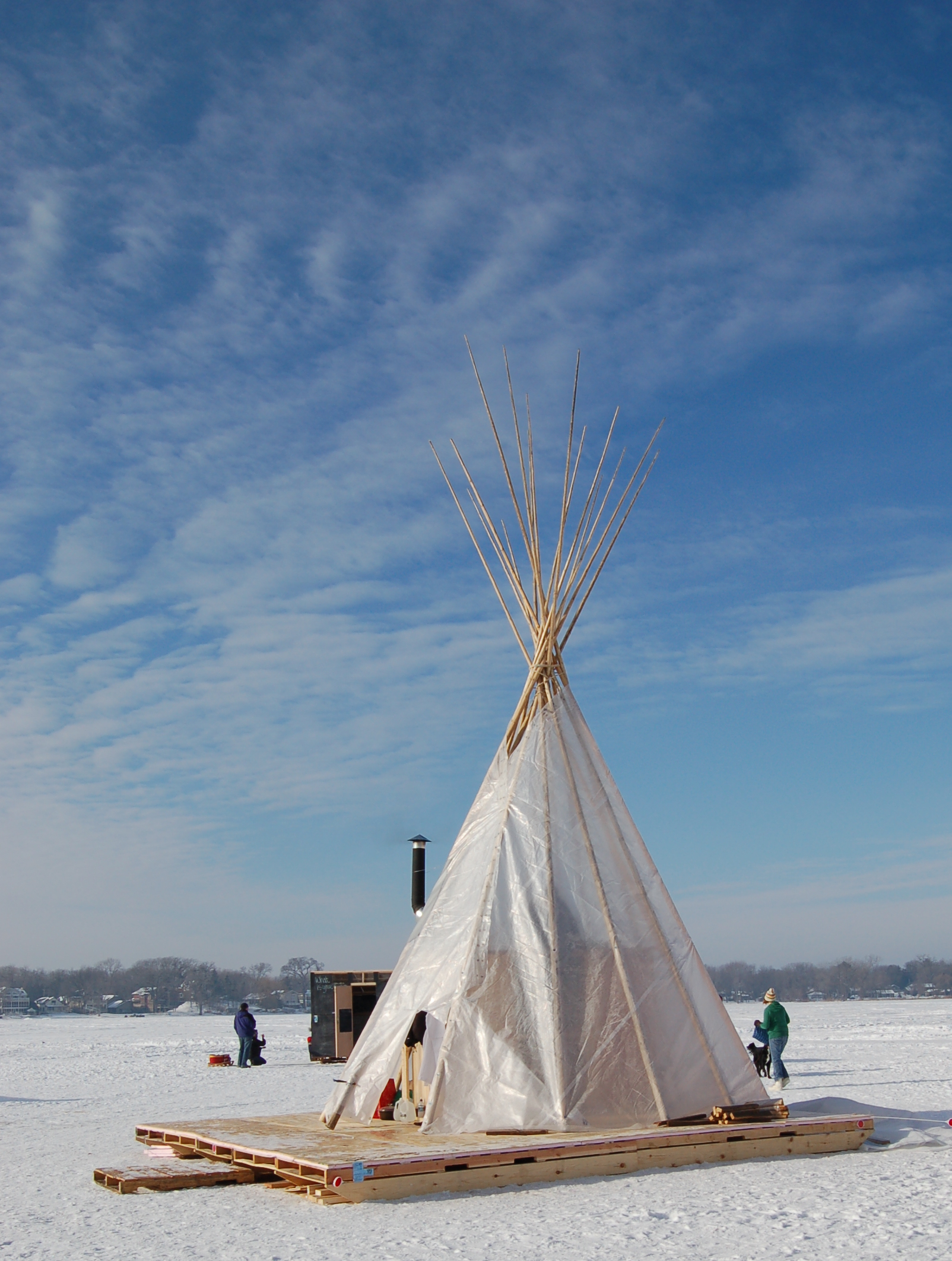
On a brilliant sunny Saturday under a thin azure sky, we walked out onto a frozen lake to visit an art installation: Art Shanties. Local artists erected and decorated ice fishing shacks, from a traditional fishing shelter complete with a hole cut in the ice to show its thickness to a Nordic Immersion shanty where we made lanterns out of snowballs. The activities included a bicycle race on the lake, and as we walked among the bundled entrants, a Ford F-150 drove by us on the ice. The thick, crystal skin popped and cracked under the weight of the truck, and fear took my breath away. But in Minnesota they know how thick the ice has to be for the weight of their vehicles – this is the type of knowledge that is useful in a place like Minnesota – and so we did not fall through to the icy blue depths below.
Art swap shanty, Minnesota, 2010
Ice fishing hole, Art Shanty, Minnesota, 2010
Swedish lanterns, Nordic Immersion Art Shanty, Minnesota, 2010
Walking on a frozen lake, Art Shanty exhibit, Minnesota, 2010
Another weekend we explored snow sculptures at the state fairgrounds, sculptures that included towering vikings, Tom Sawyer whitewashing the fence, and a maze we entered at one opening and navigated through to the end. Another weekend we drove downtown at night to see ice sculptures of crystal dragons and diamond palaces glittering in the white lights strung through giant spruces in the park. We even witnessed lawn mower ice racing. And I can tell you, you haven’t lived until you’ve watched the Minnesota Lawn Mower Race Association skid around tight turns on a frozen lake on lawn mowers.
After that first year, I didn’t fear winter anymore. We all survived it, and I grew to love the crystalline beauty of ice, the soft silence of snow. But being among people, and neighborhoods, and buildings, and festivals is a different thing altogether than being alone with your spouse in a handbuilt cabin on a homestead in Alaska where, “Whenever the work stopped, the wilderness was there, older, fiercer, stronger than any man could ever hope to be.”
I am both inspired and envious of Jack and Mabel’s story, and how over time, they too overcame their fears. Only they did it alone. Without neighborhoods and buildings and winter festivals. I was surprised that I grew to love the piercing beauty of winter in Minnesota, and reading The Snow Child makes me ache for the wilderness Eowyn Ivey writes. But if I’m to be honest, I am not made of as tough of stuff as Minnesotans or Alaska homesteaders. As much as I think I would love to brave an Alaska winter, to live in the wild beauty Ivey brings to life on her pages, I’m pretty sure I’m more content cuddling in our Appalachian home, blowing steam from my hot cocoa, safe on our snug sofa instead of scorching my eyes and lungs, isolated and alone in a landscape that could kill me.
I am reading America: 3 books from each state in the US with the following authorships represented – women, men, and non-Caucasian writers. To follow along, please visit me at andreareadsamerica.com.
The Snow Child by Eowyn Ivey. “Alaska, 1920: a brutal place to homestead, and especially tough for recent arrivals Jack and Mabel. Childless, they are drifting apart–he breaking under the weight of the work of the farm; she crumbling from loneliness and despair. In a moment of levity during the season’s first snowfall, they build a child out of snow. The next morning the snow child is gone–but they glimpse a young, blonde-haired girl running through the trees…”(Goodreads blurb)
I was planning to run my first bike/run combo today, which is called a “brick” in triathlon lingo, because your legs feel like bricks when you try to run after riding a bike. But when I checked the forecast yesterday, it called for thunderstorms all day today, with an extra special treat of severe weather this afternoon, which here in Minnesota usually means tornadoes.
In the middle of the night, I woke to crashing thunder several times, with lightning flashing through the openings in the curtains, and every time I thought, “Go on weather. Get it out of your system now so I can wake up to clear skies.” I really didn’t want to ride and run in a lightning storm.
And when I woke this morning at 7 AM, this is what I saw through the slats in the blinds:
Blue Sky
You’d better believe I jumped out of bed to take advantage of it. Because what I couldn’t see from my bed was the ring of black sky all around the small patch of blue.
My bike ride was awesome, as bike rides always are, and I was tempted to take it even longer than my training schedule suggested (only 30 minutes – what’s the point in that?). But the sky was darkening back up, and I figured I should get back home and run before my luck ran out.
I dropped my bike off, changed shoes, grabbed my headphones, and took off running. At first I thought, “Bricks? What bricks? My legs feel totally normal. Like I didn’t even ride my bike!” By the end of the block it felt like someone had opened me up and poured lead into my waist. The heaviness seeped down my hamstrings, into my calves, all the way down to my heels and toes. Picking up my feet was like uprooting trees. And I thought, “This sucks.”
I looked at my watch and 4 minutes had gone by. Only 4 minutes? I’ve got to do this for 26 more minutes? What the hell was I thinking of signing up for a triathlon?!
The sky was grey and gloomy. No more blue skies and happy clouds. All I could think of was my friend Liv’s blog post, Three Ways to Make Blogging Suck Less, and how I wanted someone to inform me of three ways to make running suck less. Besides doing more running.
The clouds parted (for real!), I found my stride, and the Runner’s High commenced. My right foot fell on every down beat, in perfect rhythm with the music. I was swift, I was light, I was running, and it didn’t suck! I ran like a track star, like I’d been running all my life, like my legs were feathers. My stride lengthened. My shoulders loosened. My lungs opened. I grinned a stupid grin while I ran.
In short, I kicked ass.
I have no idea what the song is about, because my Spanish is no good, but I do know that that song lifted my feet and lightened my load, and it put me on cruise control for the remaining 20 minutes. The next thing I knew, the run was almost over, and James Brown’s Make it Funky came through to take me home. I feasted on homemade crepes and a perfect cup of coffee with my family as the sky opened up and poured its deluge onto the roads I had just ridden and run.
Originally written May 22, 2011 in Minnesota, when I was training for my first (and only) post-children triathlon, I thought this would be a good fit for this week’s Daily Post photo challenge: Good Morning! Also, Calle 13’s “Pa’l Norte” has this effect on me every time it comes on my iPod when I run. I’m kind of sick of my other workout music though. Do you have any favorite running tunes?
The town was “between mountains so steep and irrational, they must have blocked most of the sun most of the day.” – Dennis Covington, Salvation on Sand Mountain
I know exactly the types of places Covington means. In our explorations of the Appalachians, my husband and I have been in those steep mountains that obliterate the horizon. You’re stuck down low, in a narrow crack between peaks, where you can’t see over, you can’s see around, and you feel penned in and claustrophobic. The sun seems to set at 2 in the afternoon because the horizon is so high.
The place we hiked this weekend was decidedly not like that.
Stand of firs from Wilburn Ridge on Appalachian Trail, hike to Mt. Rogers from Massie Gap, VA
View from Appalachian Trail along Wilburn Ridge, hike to Mt. Rogers from Massie Gap, VA
Kids on rock outcrop on Wilburn Ridge, Appalachian Trail, hike to Mt. Rogers from Massie Gap, VA
Wild ponies, colt, and view of Appalachians from Wilburn Ridge on AT, hike to Mt. Rogers from Massie Gap, VA
The views we saw on our hike to Mt. Rogers were not from the top of the mountain, they were from all but the top of the mountain. About 7 miles of the 9 mile round trip hike, from the trailhead at Massie Gap to the summit of Mt. Rogers, the trail climbs gently through wide, open meadows, offering spectacular vistas of mountaintop grasslands, marshmallow cloudscapes, stark rock outcrops, and panoramic views of the Appalachians. I felt like we were on the western frontier, that life was full of possibility.
Wild highland ponies along Appalachian trail on hike from Massie Gap to summit of Mt. Rogers, VA
Pink mountain laurel flowers in Massie Gap, along Rhododendron trail to Mt. Rogers, VA
View from Appalachian Trail, from Massie Gap to Mt. Rogers trail, VA
Wild Pony in sunlight along Appalachian Trail on Wilburn Ridge, hike to Mt. Rogers, VA
We originally thought the hike was going to be 11 miles round trip. Though our kids (7 and 9) had hiked Old Rag, a 9 mile hike with lots of technical bouldering, we thought 11 miles might be a little much. We bought them real hiking shoes, just in case, but I was prepared to turn back early with either or both of them so that their Dad could climb to the top of Mt. Rogers. At 5729 feet, it is the highest natural point in the state of Virginia, and I knew he wanted to see it.
When we realized the hike was only 9 miles, I got excited that maybe I’d be able to see it, too. “Hey guys, it’s actually only 9 miles, not 11,” my husband told the kids. “Do you think you’ll want to go to the top, to climb the highest mountain in Virginia?”
“I do!” our son said. Our daughter was less enthusiastic.
“There are ponies along the way…” my husband told her. “And the top is in a forest. A forest filled with Christmas trees…”
That got her. Within ten minutes, his first promise paid off. And continued to pay off. For nearly three miles, we shared the trail and the mountainsides with wild highland ponies.
Wild ponies under trees, Appalachian Trail to Mt. Rogers, VA
Wild ponies from Wilburn Ridge on Appalachian Trail, hike to Mt. Rogers, VA
Wild ponies from Wilburn Ridge on Appalachian Trail, hike to Mt. Rogers, VA
Wild pony from Wilburn Ridge on Appalachian Trail, hike to Mt. Rogers, VA
We stopped so much along the way to take in the views from rocky tops, and to hang out with the ponies, that we made slow progress. The day was perfect – partly cloudy and only 73 degrees – but the sun was hot on our necks, and our son wanted forest. We were surprised when we got to a mile marker and saw we had only hiked 2 miles, so we picked up the pace to get to the top. We passed through Rhododendron gap, a tunnel of rhododendrons that had just bloomed and dropped their petals, and that provided brief shelter in cool, damp shade. Then we were out in the meadows again before turning off onto the Mt. Rogers spur trail to finish the final half mile of climbing.
We ascended in dense forest as we neared the summit, where it was dark and wet and felt like rain forest. The air chilled our skin, and every rotting log, every mound of earth, every tree trunk was covered in emerald moss and peridot ferns. Our arms brushed red spruces and Fraser firs and released the scent of Christmas trees. Our daughter sang Jingle Bells.
New growth – ferns and evergreens along trail on hike to Mt. Rogers, VA
New foxtail growth on evergreen in forest at summit of Mt. Rogers, VA
Fraser firs along trail in forest at summit of Mt. Rogers, VA
Pink rhododendron flowers and fern, Rhododendron Gap, Appalachian Trail, hike to Mt. Rogers from Massie Gap, VA
Green forest at summit of Mt. Rogers, VA
Mushroom, moss, and fir at summit of Mt. Rogers, VA
Nobody turned back, and before we knew it, we were at the top of Virginia. We had hiked a trail unlike any we had ever traveled – wide open to the sky, above the world, sharing the trail with wild ponies – and we all made it. All four of us, hiking companions til the end.







 Butterfly Mind