One of my favorite things about winter in the Appalachians is the juxtaposition of green against white.
Fern and snow on winter Cascades hike near Blacksburg, Virginia. andreabadgley.com
Rhododendron and snow on winter hike to Cascades near Blacksburg, VA. January 2014 on andreabadgley.com
Whether moss, lichen, rhododendron, or fern, there is something hopeful about green vegetation pushed up against a fresh white snow. It reminds me of the persistence of life, despite harsh conditions.
Icicles on winter hike to Cascades near Blacksburg, Virginia. January 2014 on andreabadgley.com
Moss, lichen, stone, snow on hike to Cascades near Blacksburg, VA. January 2014 on andreabadgley.com
Cascades trail sign in snow. January 2014
Ice sculpure in stream on Cascades hike near Blacksburg, VA January 2014
Icicles on winter hike to Cascades near Blacksburg, Virginia. January 2014 on andreabadgley.com
Icicles, snow, and stream on Cascades hike near Blacksburg, VA January 2014
I also love winter in Appalachia for the ice. The fluidity of water is frozen in still form, in crystal sculptures that capture movement, that suspend the liquid nature of water in a solid form that we can walk around and marvel over and contemplate for hours without it moving.
Icicles and snowy stream on hike to Cascades near Blacksburg, VA January 2014
Ice formation on hike to Cascades near Blacksburg, VA January 2014
Frozen Waterfall: The Cascades, January 26, 2014 near Blacksburg, Virginia
Finally, I love winter in the Appalachians for the steaming shower after a January hike. The steaming shower that turns your skin pink, and the fuzzy sweatpants you put on afterwards, and the hot dinner you sit down to, famished after hiking, with your family and friends.
Sunday was a beautiful day for a hike at the Cascades in Blacksburg, Virginia: high in the upper 30s after a fresh snow the night before. The kids packed snow balls along the way, threw them into the creek, and watched the slush drift downstream, taking it’s time to melt in the frigid water. We try to hike the Cascades during every season to witness its changes. For other photo essays from the Cascades waterfall, please see Waiting for Winter and Cascades of Green in Winter.
Zippers and buttons clank against the metal drum of the dryer: snowpants tumbling after a morning romp in fresh snow. Our eight year old daughter, her hair a stringy mess of snow-wet tangles, blows on a pot of boiling water, trying to make the starchy foam go down after adding a cup of dry elbow noodles. Our ten year old son forks the scrambled egg she made him. “Since eggs are better when they’re hot, will you watch the noodles while I eat this?” he asked her.
It is Tuesday. A school day. I look out the window and watch snow fall.
Now they both peer into the boiling pot. They wear pajamas at lunch time. He is teaching her how to cook pasta. After – after I empty the dishwasher then reload it – I will make hot cocoa while I grind nuts for almond butter, then scrape the food processor and grind nuts for nutella; I’ll only have to wash the bowl and blades once if make the butters back to back.
I sit at the table eating a lettuce wrap with my left hand and writing with my right. A tomato slips out the end of my wrap and splats onto my plate. Our daughter groans when I ask if they’ve grated Parmesan for their noodles. “Well, you don’t have to have Parmesan,” I say. She slumps her shoulders and stomps to the cabinet where we keep the box graters. She sticks her lip out. “I want Parmesan,” she says as she jangles metals together in the cabinet, “I just don’t want to grate it.”
Welcome to the world, kid.
Our son stands on a stool and stirs the pot with a wooden spoon. Steam rises in front of his red, snow-play cheeks. The window next to him fogs up in the corners; beyond the glass panes are white-covered cars, a line of white along the top rail of the park’s split rail fence, sticky clumps of white on twiggy tree limbs.
Our son lifts a noodle from the steaming pot with his wooden spoon, steps down from the stool, and walks to the kitchen sink where he runs cold water over the macaroni spiral. He tastes it and says, “Mom, the noodles are ready. Will you come pour them out for us?” That’s the one step I’m still uneasy about: our eight- or ten-year old carrying a pot of boiling water across the kitchen and pouring its heavy, hot load into a colander. I set down my pen and my lettuce wrap, remove the napkin from my lap, and drain the pasta for them.
He takes over then, spooning noodles into bowls, drizzling olive oil, bringing his sister’s portion to her at the table. The kitchen counter is strewn with Parmesan cheese shreds, measuring cups, pots, pans, the tub of spreadable butter, a macaroni box. A dry elbow crunches under my slipper, then another. Parmesan curls litter the floor.
One thing at a time. I’ll teach them how to cook, then I’ll teach them how to clean.
Our children have finished their plates and await their hot cocoa. Soon, after the floor is swept, and the counters wiped, and the dishwasher is running (again), we will pull downy pants on, hot from the dryer, and we will traipse out the door to go sledding.
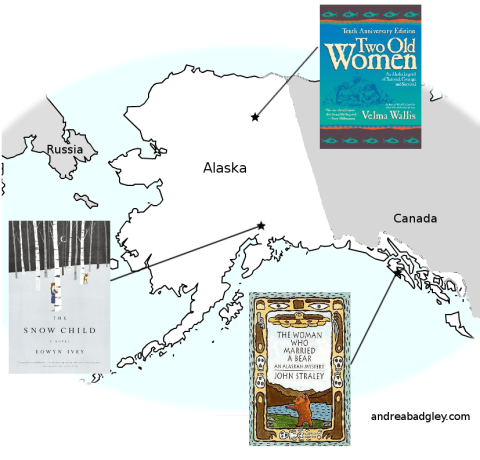
I have to tell you, I was really excited when I realized my Andrea Reads America tour would have me reading Alaska in winter. I love cozying up with icy books when it is cold outside – I reread The Shipping News nearly every winter – and Alaska literature has not disappointed. I’ve gone back and forth between shivering, swearing “I’m reading a warm book after this!” and succumbing to the wild brutality of Alaskan winter, my thirst for its realness and its close-to-the-earthness unquenchable. Reading books populated with marten and wolverine, bear and fox, glaciers and tundra, I’m learning a new vocabulary: breakup (aka Spring, when the ice breaks up and avalanches downstream), ptarmigan (grouse), and babiche (rawhide strips used for cording, as in making snowshoes). I am scribbling descriptions of ice and snow and the piercing cold because the frosty words paint pictures of a place that is exotic, full of a wonder and wildness I will never experience here in Virginia.
While my Alabama reads dealt with social themes – racism, community, and doing the right thing – my Alaska reads contend with themes of wilderness, survival, legend, and the strong pull of the natural world. The landscape is as much a character in each book as the humans are, and I was pleased to find books set not only in isolation in the far north of Alaska and inland on a homestead, but also one set in more populated areas, on the raw coast. I’m a sucker for coasts.
Novel: The Snow Child
Author: Eowyn Ivey, raised in Alaska
Setting: 1920s Alaska homestead
Categories: Literary fiction, Pulitzer Prize finalist
I didn’t think I liked magical realism, but it turns out I just hadn’t found the right book to pull me in, ground me in a reality, then sprinkle magic in a way that is wondrous and enchanting, and leaves you puzzling throughout – is it magic or is it real? The Snow Child was this book for me.
Set in the wilderness of 1920s interior Alaska on the Wolverine River, The Snow Child is the story of a aging couple who have moved west from Pennsylvania to homestead in Alaska in an effort to escape the emptiness left by their stillborn child. A two hour horse ride to the nearest “town” and then a train ride away from Anchorage, Mabel and Jack become isolated even from each other, grieving while they labor separately to make workable land from wilderness. One night, they succumb to the magic of a snowfall, and in laughter and joy, they build a child from snow. The next morning, the snow figure is gone, and a wildling girl appears in the forest.
The Snow Child chronicles the growing affection between Faina (the wildling) and the elderly couple, who over the years grow to think of her as their own, though she comes and goes without notice, and though they live with opposing stories of her flesh-and-blood father who Jack buried and the idea that Faina is a snow maiden of their creation, as Mabel read about in a Russian Fairy Tale. A tale that never ends well.
The magic in this book isn’t just the obvious fairy tale quality of it. The magic is in the crystalline descriptions of Alaska in winter. Author Eowyn Ivey may not be Eskimo, but I would argue she has a thousand words for snow. Her descriptions are like snowflakes on the tongue – delicate, feathery crystals that sting in their loveliness:
“The December days had a certain luminosity and sparkle, like frost on bare branches, alight in the morning just before it melts.”
“Dawn broke silver over the snowdrifts and spruce trees.”
“The child was dusted in crystals of ice, as if she had just walked through a snowstorm or spent a brilliantly cold night outdoors.”
“The cranberries were tiny red rubies against the white snow.”
“Around the curve the valley opened up, and in the distance spires of blue ice glowed.”
This is a biting and beautiful book of love: love for neighbors, of husband and wife, for children, and love for the wild pull of the land, the forest, the snow, and the wilderness. It is one I will come back to when I want the magic of winter.
Two Old Women, a tale of Athabascan Indians written by Velma Wallis, a native Athabascan author, takes place north of the Arctic Circle in the interior of Alaska. It tells a tribal legend passed orally to Wallis by her mother, of two elders who were abandoned one lean and brutal winter by their tribe.
“That day the women went back in time to recall the skills and knowledge they had been taught from early childhood. They began by making snowshoes.”
At the time they were abandoned, the old women depended on the youth of the tribe to care for them. Because of this dependence, with The People on the brink of starvation, the Chief determined the women were holding the tribe back, threatening the survival of the many for the demands of the few, and he left them to die, old, crippled, and alone on the open tundra. The two women could barely walk, even with canes, when they were left behind, but the taste for survival was sharp in their mouths, and they gathered their strength and elder-wisdom to stay alive. They made snowshoes from babiche a grandson had left them, and used the shoes to trek to a safe winter-over spot; they caught rabbits in snares; they slept in snow pits they dug with gnarled hands and lined with spruce boughs for bedding.
What I love about this story, aside from a portrayal of the very real struggle for survival for indiginous people living without permanant shelter – nomads north of the Arctic Circle – was the focus it places on elders. The elders in our communities have seen much more than the youth have. They know more, they have lived more, they are wiser. It is easy for young ones, in their arrogance and vigor, to toss the old aside, thinking they are outdated, their knowledge obsolete, their presence a hindrance holding the young ones back rather than a source of wisdom that could propel them forward. Wisdom that could nourish and equip them for the unknown that lies ahead.
I imagine this story would be powerful as an audiobook, told with native Athabaskan inflection and in its traditional, oral story form.
My head is a cup left out on a stormy autumn night; half full of water, and a spider.
The fact is, I can’t. Especially when the novel is a murder mystery set in October in the port town of Sitka, off the raw southeastern coast of Alaska. Unlike the previous Alaska books I read, which were set in isolation in the interior of the state, Staley’s novel portrays peopled coastal regions in Alaska: cities with pubs and coffee shops, police departments and wharfs. Eskimos and other natives populate scenes in diners, bars, and airplanes, always reminding the reader you’re in Alaska.
Since it’s a mystery novel, I won’t go too much into the plot, except that it involves a murder (duh), Tinglit Indian legend, and Cecil Young, an alcoholic private investigator with a penchant for poetic thought
“Her skin was as white as a sea anemone, and as soft as the pool of warm air you pass through while rowing across the bay.”
and a knack for nailing scenes
“As the bottle got lighter our gestures became wilder, our eyes widened and we imagined were were expanding into our own stories.”
“The landscape seemed to press in and make Juneau seem like a smaller, less sophisticated town than it really was.”
“The water boiled with little silvery fish dense on the surface like a trillion dollars in quarters spilling onto a sidewalk… There was a massive exploding breath and the damp smell of fish and tideflat… Whale. Humpback whale, feeding on herring.”
I read this as winter descended on Blacksburg, Virginia, and it was a perfect curl-up-on-the-couch cozy mystery read. The language in this book is beautiful, enough so that I was intrigued by a mystery writer who wrote so poetically, and I discovered that Straley has studied poetry and was the Alaska State Writer Laureate from 2006 to 2008.
The Woman Who Married a Bear is the first in a series of Cecil Young mysteries.
For further reading in Alaska
Books I’ve read and recommend: Ordinary Wolves by Seth Kantner Into the Wild by Jon Krakauer (nonfiction)
Books that have been recommended to me but I have not yet read: The Raven’s Gift by Don Reardon Two in the Far North by Margaret E. and Olaus Johan Murie (nonfiction) Drop City by T.C. Boyle The Only Kayak by Kim Heacox (nonfiction) Journey to a Dream by Mary Lovel (nonfiction) My Name is Not Easy by Debbie Dahl Edwardson Don’t Use a Chainsaw in the Kitchen by Rosalyn Stowell
I am reading America: 3 books from each state in the US with the following authorships represented – women, men, and non-Caucasian writers. To follow along, please visit me at andreareadsamerica.com.
In the summer of 2013, my parents packed up their RV and took the adventure of their lifetime: the two of them and their yellow lab, Blondie, drove from Georgia to Alaska and back again. Mom wrote and photographed their journey on her blog, Wandering Dawgs.
The grown-ups stood at the front window sipping spiked coffee and doctored hot cocoa. Our entertainment that day was watching Ed, the mail man, bend into the blizzard as he trudged through thigh deep snow to get to our across-the-street neighbor’s wall-mounted mailbox. All the kids entertained themselves by – well, I don’t remember how they occupied themselves. All that mattered was that they were entertained.
That was three years ago. Today, as the sky spits wet ice that coats cars and roads in slick sheets of slippery sleet, our son plays his Wii U instead of kicking the soccer ball with boys he invited over for his birthday. Once again, winter weather has thwarted his birthday plans.
Three years ago, when we lived in Minnesota, when our kids were still young enough to combine their birthday parties (their birthdays are two weeks apart in the middle of holiday season. Fun.), we planned a Saturday party at the bowling alley. It was December 11, 2010, a celebration of our son’s seventh birthday and our daughter’s fifth. In Minnesota, things don’t get cancelled for snow. In three winters, our children did not get a single snow day from school, despite several blizzards and a foot-thick perma-layer of white.
That Saturday, as we watched the inches pile up, as we watched the ground disappear beneath a thickening blanket of white, we bit our cuticles and wondered, do we cancel? We kept checking the bowling alley website, checking the forecast, checking the depth of snow in the street. Four inches. Six inches. Eight inches. A foot.
Finally, with only two hours til the party’s start time, when our street wasn’t plowed and we knew our soon-to-be salt-crusted Passat wagon wouldn’t be able to push through the accumulation, I looked at the cookie cake I had already baked, the snacks I had already packed in totes, and I picked up the phone.
“Hey Stace. I don’t think we can get to the bowling alley. We’re going to have to cancel the party.”
“Oh no! The kids will be so disappointed.” She had three of her own, all with Swiss and Germanic names peppered with Ks and Vs and Zs, who had been excited about the party all week. Now they would be cooped up in her house, full of pre-party excitement that would not get bowled out.
“Well, I was thinking, if you and Ben want to still get out of the house, we do have this cookie cake.” Her family lived around the corner, a block or two away. “Y’all want to come over here?”
We extended the same invitation to other guests, most of whom also lived nearby. Two hours later, at the bowling party’s start time, my husband and I looked out our front window into the blowing snow and saw two parka-clad grown-ups bent into the gale, each pulling a sled laden with brightly colored puff-balls of children. The snow was deep – almost to Ben and Stacy’s knees – and they pushed through it like my brother and I pushed through marsh mud as children. The sleds sank under the weight of a seven-year old, a five-year old, and a toddler, and Ben and Stacy made their way towards our house lumbering step after lumbering step.
The storm picked up as they brushed off snow and stomped their boots in the mudroom. We could no longer see the street corner they had rounded. Our friends’ noses and eyes burned red. Snowflakes melted in their eyelashes, and I immediately offered them coffee and hot cocoa.
The kids disappeared into the living room, and the grown-ups stood at the back window. We blew steam from mugs and watched snow squall. A figure materialized from the whiteout – our neighbor, Matthew, with his four-year old daughter on his shoulders. A wake of snow pushed in front of his knees like water before a ship’s bow.
“Matthew, come in! Come in! We need to run a rope between our houses like Pa Ingalls ran between the cabin and the barn.”
I put a cup of coffee in his hands and offered a shot of whiskey in it. His blonde eyebrows shot up and he smiled a Nordic smile.
Once the third family emerged from the other blowing corner of the back yard and made it safely to our door – our Lutheran neighbor who sang in a gospel choir – the children disappeared into kid rooms. The adults moved to the living room. Some of us stood at the front window and watched snow pile.
“I bet it’s up to 16 inches now.”
“Hard to tell with the drifts”
We warmed our hands on earthenware mugs. Blew steam. Sipped coffee.
“Oh my God, is that Ed?” Our friends who had been lounging on the sofa jumped up and padded over to the window. We all shared Ed, the neighborhood mail carrier. We stared openmouthed as he bent into the blizzard. The flaps of his fur-lined USPS-issued hat were pulled over his ears and tied under his chin, and his blue postal parka with the reflective stripe was flecked with white. He trudged through thigh deep snow to get to the wall-mounted mailbox on our neighbor’s front stoop.
We watched, entranced, as if we were watching a movie. “I better put another pot of coffee on.” I took my time – Ed wasn’t getting anywhere fast in that blowing mess, and he still had to tramp to two more houses before he’d get to ours.
When he slogged his way onto our stoop, I opened the door and told him, “Come inside Ed! This is crazy that you’re out delivering mail.” Even the Minnesotans thought it wild. He pulled his snow mittens off and stuffed them into the mail bag slung over his shoulder. I put a cup of black coffee in his hands. Threads of blood vessels reddened his nose and cheeks, and his eyes watered.
“I had to leave my truck over on Roselawn,” he said. “Couldn’t get it down the street.” He wrapped his chapped hands around the mug and gulped large sips while the coffee was hot.
“It’s really blowing,” he said, and finished off the cup before it had a chance to cool. He handed the mug to me and smiled, “Thank you very much for the coffee.” He pulled his mittens back on, and we all patted him on the back before sending him back out into the storm.
“Thanks Ed, be safe out there.” He bent his head and plowed through the knee high drifts in our front yard. When we dug out the next day, after the storm had blown through and the sky was a crystalline blue, we made sure to dig out the postman’s path.
“We need to give him a nice tip this Christmas,” my husband said.
I don’t think the kids cared that year that their bowling party was cancelled. I certainly didn’t. We ate cake and fed Ed and drank whiskied coffee in the early afternoon, and the kids played warm inside together while the world outside blew white and cold. We were all happy.
View of house from plowed street
Snow piled up to windows
Compost bin peaking out from snow
Digging the postman’s path
This year, our daughter was able to have her party (Saturday), but our son’s was supposed to be today. I don’t have a cake or snacks because he wanted it to be low-key. He doesn’t like to be the center of attention. He didn’t even want his friends to know it was a birthday celebration. He just wanted to play soccer, 3 on 3 with his five friends. Without cake, or parents carrying children through blowing snow, or drinking hot spiked drinks before five o’clock, or children tinkering in kid rooms, what will our memories of this cancelled party be?
I guess they will be whatever I make them here: my husband and son wrapping black railings in white lights while icy rain sleets down; our son exclaiming, “My snow globe!” and beaming as if he’d rediscovered a lost friend when I unwrapped the Christmas decorations; me lighting holiday candles in the middle of the day. Today’s memory will not be of Ed trudging through a blizzard to deliver our mail, but of our son, who cracks windows to listen to rain, who loves the delicacy of snow, who delights in bad weather because he likes to be cozy inside.
The memories of this thwarted soccer day will be of our son who is happy as a clam, snuggled in the poofy chair next to the Christmas tree, reading a Hardy Boys book and smiling in contentment for his favorite kind of day: the lazy ones.
“November was here, and it frightened her because she knew what it brought – cold upon the valley like a coming death, glacial wind through the cracks between the cabin logs.” – Eowyn Ivey, The Snow Child
When we left Florida on November 1, 2009 to make the drive north to Minnesota, our station wagon packed so full of belongings that we couldn’t see out the back windows, the grass was lush and green, butterflies flitted at the mouths of hibiscus blooms, and the air conditioner was running in my in-laws’ Sarasota home. When we arrived in St. Paul four days later, the world was brown and grey, and bony branches rattled in the cold breath that chilled the city. We wore hats, coats, and gloves when we stepped out of the car onto our new driveway.
Once we unpacked our moving Pods and got our home in order, I remember lying in bed one night next to my husband, listening to a wintry wind whistle through naked tree limbs and catch in corners under the eaves. I felt a panic come on, and I turned to my husband.
“I’m scared,” I told him.
“Of what?” he asked.
“Of winter.”
Having grown up in the mild state of Georgia, I did not know true winter. I did not know frozen earth and scoured limbs, months of barrenness, and shivering as soon as I turned the shower off day after day after day. I knew live oaks dripping with Spanish moss – oaks that kept their leaves year round – and Christmases that sometimes allowed for a crackling fire, and sometimes required short sleeves and shorts. I knew azaleas that bloomed in early March, not snow that lasted into June.
I was afraid of how I would handle the blanket of snow that would shroud the earth from November to May. I felt suffocated by its eternal coverage. I was afraid of the bleakness, the lack of color. I was afraid of cabin fever, and the madness that the endless repetition of dressing and undressing might bring: 20 minutes of layering and wrapping and covering and zipping and mittening and booting to leave the house, and 20 minutes of shaking off snow and stomping out boots and unwrapping and uncovering and unzipping and unmittening when we came back in. Life was so much easier where it was warm. So quick to skip out the door, hop in the car, and go.
One morning, my husband crawled out of bed in the dark, dressed in his winter running clothes, and stepped out into the silent -10° blackness. I lay in bed under the down comforter, cozy and warm, until I started thinking about all the things that could happen to him out there. The rest of the city still slept – he often did not see another soul on his pre-dawn runs – and I thought about the ice out there in the darkness, and the fact that if he slipped and fell and broke his leg, nobody would find him before the cold got him. And this is what gave me shivers despite our down comforter.
We lived in a place that could kill us.
Over time, I was surprised repeatedly by how Minnesotans embraced this deadly cold. Winter didn’t drive Minnesotans in, it drove them out. Our first winter we bought sleds, I bought snow shoes, my husband bought skis, all four of us bought ice skates, and no matter which equipment we chose each weekend, we’d see dozens of flushed cheeks, glittering eyes, and North Face logos on the backs of shoulders as other folks sledded, or snowshoed, skied, or ice skated too. Golf courses switched to cross country ski routes in winter, and local parks flooded plank-walled ovals for outdoor skating rinks. Some of them even had hockey goals.
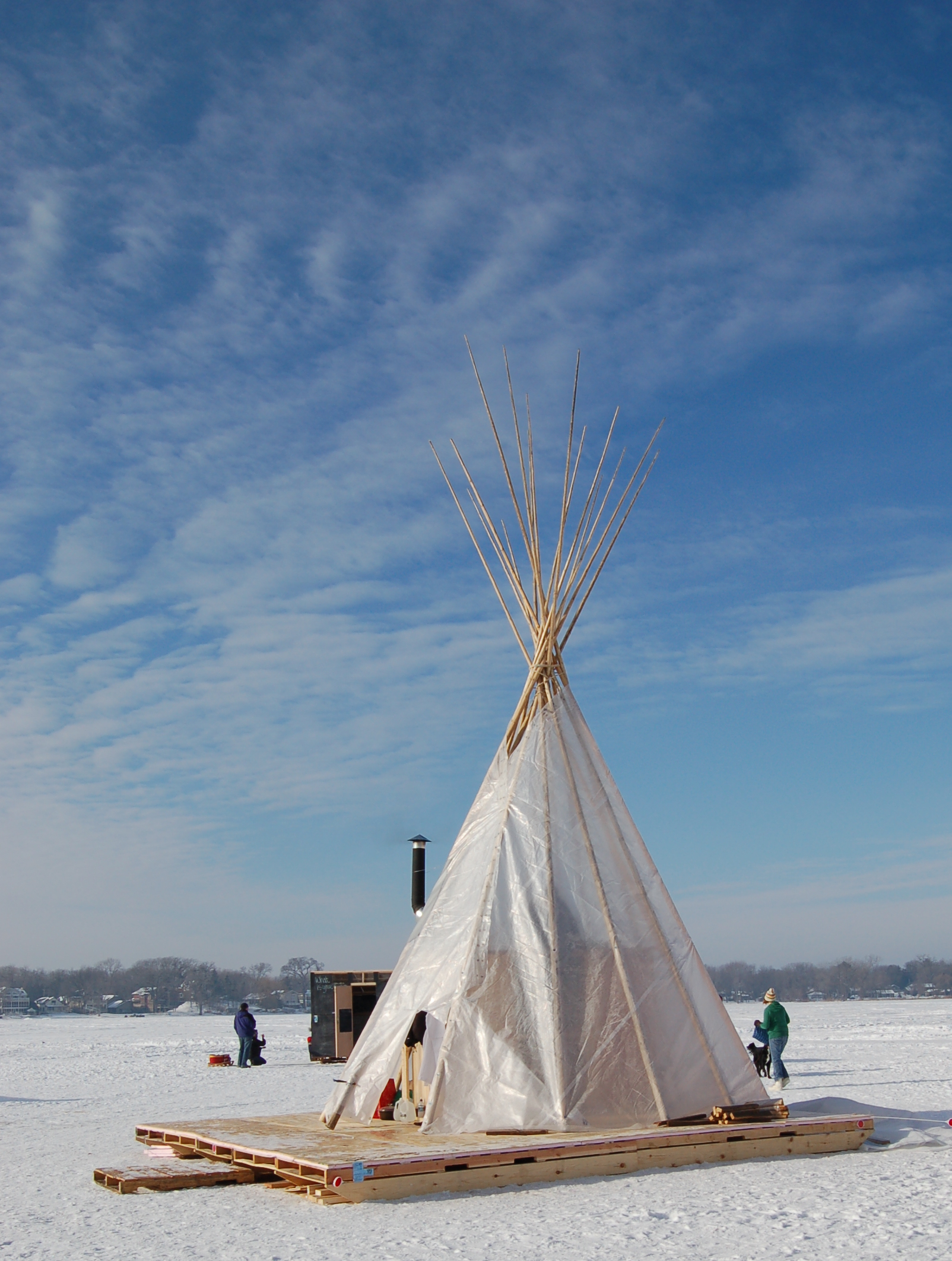
On a brilliant sunny Saturday under a thin azure sky, we walked out onto a frozen lake to visit an art installation: Art Shanties. Local artists erected and decorated ice fishing shacks, from a traditional fishing shelter complete with a hole cut in the ice to show its thickness to a Nordic Immersion shanty where we made lanterns out of snowballs. The activities included a bicycle race on the lake, and as we walked among the bundled entrants, a Ford F-150 drove by us on the ice. The thick, crystal skin popped and cracked under the weight of the truck, and fear took my breath away. But in Minnesota they know how thick the ice has to be for the weight of their vehicles – this is the type of knowledge that is useful in a place like Minnesota – and so we did not fall through to the icy blue depths below.
Art swap shanty, Minnesota, 2010
Ice fishing hole, Art Shanty, Minnesota, 2010
Swedish lanterns, Nordic Immersion Art Shanty, Minnesota, 2010
Walking on a frozen lake, Art Shanty exhibit, Minnesota, 2010
Another weekend we explored snow sculptures at the state fairgrounds, sculptures that included towering vikings, Tom Sawyer whitewashing the fence, and a maze we entered at one opening and navigated through to the end. Another weekend we drove downtown at night to see ice sculptures of crystal dragons and diamond palaces glittering in the white lights strung through giant spruces in the park. We even witnessed lawn mower ice racing. And I can tell you, you haven’t lived until you’ve watched the Minnesota Lawn Mower Race Association skid around tight turns on a frozen lake on lawn mowers.
After that first year, I didn’t fear winter anymore. We all survived it, and I grew to love the crystalline beauty of ice, the soft silence of snow. But being among people, and neighborhoods, and buildings, and festivals is a different thing altogether than being alone with your spouse in a handbuilt cabin on a homestead in Alaska where, “Whenever the work stopped, the wilderness was there, older, fiercer, stronger than any man could ever hope to be.”
I am both inspired and envious of Jack and Mabel’s story, and how over time, they too overcame their fears. Only they did it alone. Without neighborhoods and buildings and winter festivals. I was surprised that I grew to love the piercing beauty of winter in Minnesota, and reading The Snow Child makes me ache for the wilderness Eowyn Ivey writes. But if I’m to be honest, I am not made of as tough of stuff as Minnesotans or Alaska homesteaders. As much as I think I would love to brave an Alaska winter, to live in the wild beauty Ivey brings to life on her pages, I’m pretty sure I’m more content cuddling in our Appalachian home, blowing steam from my hot cocoa, safe on our snug sofa instead of scorching my eyes and lungs, isolated and alone in a landscape that could kill me.
I am reading America: 3 books from each state in the US with the following authorships represented – women, men, and non-Caucasian writers. To follow along, please visit me at andreareadsamerica.com.
The Snow Child by Eowyn Ivey. “Alaska, 1920: a brutal place to homestead, and especially tough for recent arrivals Jack and Mabel. Childless, they are drifting apart–he breaking under the weight of the work of the farm; she crumbling from loneliness and despair. In a moment of levity during the season’s first snowfall, they build a child out of snow. The next morning the snow child is gone–but they glimpse a young, blonde-haired girl running through the trees…”(Goodreads blurb)






 Butterfly Mind