When we opened the curtains yesterday morning, the sky was grey and the world felt dark, even though the sun had risen. Rain pattered on the roof. My friend turned on the fireplace with the flick of a switch. My slippers felt warm on my feet, and we were cozy in the pine-paneled room with our steaming coffee.
We lounged in pajamas in the living room yesterday morning (and afternoon), feet tucked underneath us on the couch or legs stretched out before us on the coffee table. From the moment we woke and poured coffee in our mugs, my girlfriends and I talked.
We talked and laughed for hours. For the two of us who woke early, we were involved in conversations for 16 hours straight. We talked so much I have no brain for writing. As I sit here at my keyboard, I can’t think of a single thing we talked about. There are too many. Maybe when I get home to the stillness of my own house, when it’s silent with nobody around, and I’ve got my fountain pen and my notebook and a flat surface to write on, I will want to dive in and write. But for now I’m going to pour a cup of coffee and go talk to my friends.
The self-doubt is creeping in. I’ve published 12 blog posts in a row, all written on the fly with minimal editing, and with rare exception, minimal planning. I get up, I write, I publish.
I needed to break out of a rut. I was writing privately, a lot of nothing, and frankly, I was trying too hard. I was putting pressure on myself to write a cerain way, to write a certain type, to write meaningfully, to write big ideas, to provoke thought, to write something different, to go beyond myself. I felt like I was pressing against an elastic wall, and private writing wasn’t helping me break through.
Then I said the hell with it. This isn’t working for me. I’ve got to get out of my notebooks. I’ll just write. I’ll write on my blog, and maybe sometimes something good will come out.
And for the first few days that was good. And I was good. I started getting streak notices: You’re on a 3-day streak on Butterfly Mind! Then 6-day, 10-day, 12-day. Today will be 13.
Then I made the mistake of reading my posts and I’m like, who cares? Why would I publish this instead of just hiding it safely in my journal?
I mean, I know why I did it. I know why I do it even though it’s lot safer inside my elastic-walled bubble. I am more disciplined, and I examine my work more closely when what I write might actually be read. Sometimes I even choose better words for the published post than the ones I used in the first draft. Sometimes I like what I wrote enough to give it that much care. When I publish, I’m working on the craft of writing in a way I don’t when I just dump my brain in a journal.
Still, I second guess. I see all the flaws, the mediocrity, the lack of action, or tension, or point. I try to remember that perfection is not the goal, but improvement is. If I keep writing, sometimes something special will happen.
I’ve been transcribing my childhood diaries off and on for the past year, and while it’s not as horrifying as I thought it might be to revisit teenage me, I am let down. Not by what’s in there, but by what is not.
I have memories of specific scenes from my life — Grandma showing me how to brush my teeth with my finger when we spent the night with her and forgot toothbrushes, riding out a thrashing thunderstorm in an open boat with my dad, needing Outback Red shirts and Sebago shoes in 8th grade — but none of those things are in my diaries. In fact, there are no descriptions of anything real or physical. There are only my feelings and what’s going on in my head.
I’ve been thinking a lot about this, and why it might be. The most obvious reason is that the primary purpose of journaling was never to record scenes or paint pictures for future me; the purpose was always to process my thoughts and feelings. Writing in a diary was my outlet.
Also, we have no idea in the moment what is going to be most important and memorable to us later. What I’m most worried about in my life right now, today, is not going to be something I even remember 20 years from now. Likewise, the priorities I felt compelled to write about in my diaries as a teenager are not the same priorities I have as a 45 year old woman transcribing those diaries so I can throw them away. We don’t know what will be memorable or important to us later. It will likely be something very different from what’s important to us right now.
If I’m honest, I am sure I left things out because they were too scary to admit. I certainly do that now, and I’m trying to correct it because that’s where the really good stuff is.
But the most interesting reason I see for not recording scenes in a journal, for not writing down the details of a person’s face, or what the air smelled like, or the sounds in the background, is that they feel unremarkable when you’re living them. Mundane. So why would you write them?
Looking back, I wish I had written them because they are the physical details that anchor the moment. It’s hard to remember what a feeling feels like, but boy do I remember the earthy damp concrete scent of my grandparent’s garage when I’d go out through the kitchen door with Grandaddy on dewy mornings, knock spider webs out of Nannie’s boots, and clomp with him through the wet grass up to the barn to dump the cantelope rinds from breakfast. I was probably too young to know I felt safe and content in those moments with Grandaddy, so I would never have written about walking to the compost pile as an 8 year old. When I write about it now, I realize that’s exactly what those quiet morning walks with Grandaddy made me feel: safe and content.
Since my old journals don’t include scenes I remember and I so wanted to read about, I’m making more of an effort now to include physical details when I journal. It’s not easy. I often feel like it’s either / or — either I’m writing about what I’m thinking and feeling, or I’m recording a physical scene with no action or thoughts included. Joining them seamlessly is a challenge, but I guess that’s why we keep trying.
I’ve never had a fountain pen. Prior to this Christmas, I used the Signo Uniball 207. You can buy the Uniball at the grocery store or Target or the drug store, and they are fast-writing, smooth, inky pens. They’re great, accessible pens for when you need an instrument that can write (almost) as quickly as you think. I used to buy Uniball ink refills from a local art supply store until the owners retired and closed up shop; I didn’t like throwing away perfectly good pens, but grocery stores and Target and drug stores don’t carry the ink, only the bodies.
Though the Uniballs are fast, they’re far from perfect. They’re not a pretty tool, for one thing. They look like you bought them from the school supplies section of Kroger or CVS, and that you had to rip them out of the same kind of packaging as a toothbrush. And because the tip is a perfect ball, which is part of what makes them so fast, they lack control. They don’t provide any aim, which makes it too easy for your handwriting to run off course.
Of all the pens from the school and office aisle, the Uniball was the best I’d tried. After several years of using it, I was pretty bored with the pen, though. The most exciting thing I did with the Uniball is switch between blue and black ink.
In early December as I was shopping for other people, I had a fleeting thought that I might want to buy someone a pen, and then I realized really, I wanted a pen. I didn’t feel justified in buying myself anything beyond the drugstore Uniball variety, though, seeing as how I’m just a hobby writer. I did have a secret wish, just for a moment, where I thought how special it would make me feel if someone gave me a pen. I daydreamed about nice pens, and how they might feel, before snapping out of it to get on with my shopping.
On Christmas morning, there was a gift for me under the tree the size and shape of a mascara box from a cosmetics counter. I thought, huh, that’s weird, Brian has never bought me cosmetics before. When I tore the paper off, it still looked like a fancy mascara box.
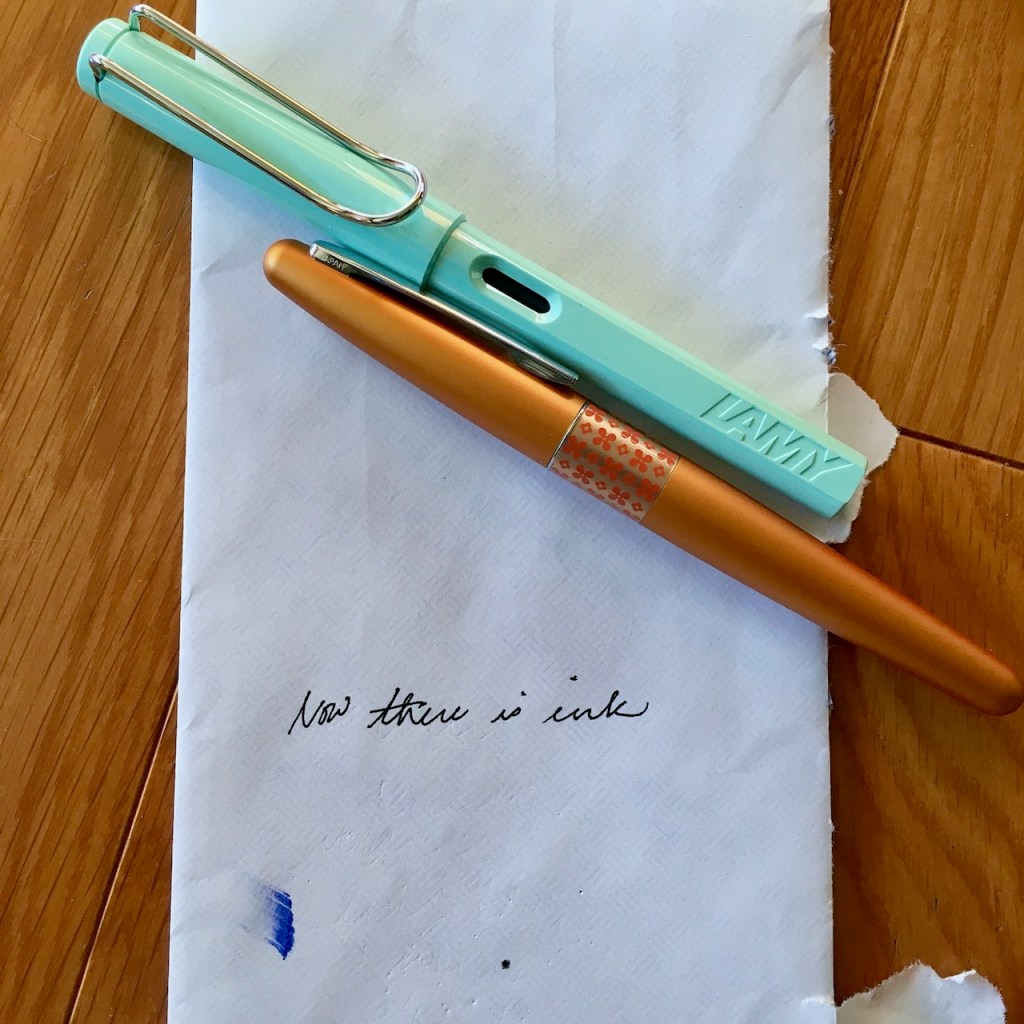
Then I opened up the box. Inside, there was a turquoise Lamy Safari fountain pen. I was floored. Did he read my mind that day when I was shopping, alone, and had my secret wish that I never expressed aloud? When it was my turn to open a gift again, I opened a larger box that contained a tangerine Pilot Metropolitan with tiny retro daisies on it.
My heart melted. I felt seen, and known, and loved.
Getting the ink flowing in my new fountain pens
I spent the morning getting the cartridges loaded properly. Then, when everyone else was occupied with their Christmas loot and I felt okay disappearing into my own little world, I sat down with my notebooks to feel the ink flowing through metal nibs onto paper. I wrote to feel the weight of the pens, to feel how their barrels dance in the webbed crook of my hand, to feel how the section nestles on the calloused pad of my ring finger where pens and pencils rest.
I had thought the Uniball wrote fast. It drags a brick compared to these fountain pens. They feel like liquid silk on paper. The nibs provide direction, helping me keep my words and my slant even, and helping me underline in straight lines instead of wobbles.
With these pens, I want to write and write and write, even though I have nothing to say. They draw me in simply because I want to feel the ball of their metal nib, wet with ink, flow across paper. They inspire me to think big. To live up to the pleasure they bring me when I write with them.
What I want to do with my life is be happy and be satisfied and appreciate the wonder of the world around me and help others be happy and be satisfied and appreciate the wonder of the world around them because life is awe-inspiring and miraculous and we waste so much of it not-living and worrying and hurting ourselves and each other or focusing on all the things that are wrong which is sometimes ok because sometimes things can be improved and that’s a great thing but for the most part what I want to do with my life is say and write and do things that inspire others and help them which is why I get a thrill from writing especially when I publish something that resonates with others like even something simple like publishing a 10 minute free write on coquinas sparkling and then Zandy telling me she walked on the beach the other day and heard the clicking of shells as a wave receded and she might not have noticed it had she not read what I’d written about the coquinas and I thrilled when she told me that or when I posted a note internally at Automattic about an error message I’d come across in a live chat and I wanted to post it so it’d be searchable in case any other customers had that same issue and then Happiness Engineers thanked me when they found my note in their searches because they did have other customers with that same issue and my note saved them some time or on my blog when I publish something and a reader comments and says it resonated or they can relate or what I wrote has made them see something differently or think of it in a different way and I love that so much and it is one of the happiest most satisfying things in my life when it happens becuase I feel useful and like I’m helping but the weird thing is I don’t feel like I’m useful and helpful in the same capacity at home and it’s so strange because I feel like I’m failing or letting people down by not doing things for them which now that I’ve written that is ridiculous because you don’t help people by doing things for them you help by empowering them unless they really can’t do something for themselves and then you can do it for them and I realize this is vague for what I want to do with my life but it’s the deep meaningful thing I want to do and in terms of more superficial stuff I want to do I want to travel and I want to live on or by the ocean again because traveling and the salt water inspire me and show me the wonder and beauty of the world and the ocean especially humbles me before its power and greatness because it is vast and is both water and mineral earth and it is beautiful and blue and never the same but always the same and calm and wild and shallow and deep and provides us with the water we need to survive and tempers our climate and is the beginning of life on earth.
This was a writing exercise from Priscilla Long’s The Writer’s Portable mentor: “write for fifteen minutes a single unpunctuated sentence that begins, ‘What I want to do with my life is…’” I expected the exercise to be daunting but it ended up being really fun.
More than 20 years ago, when I was in college, an acquaintance left a note and a gift on the coffee table in my apartment. I guess I had baked cookies and they ate a few. A single word from their note is still branded on my brain: “I give you this [gift I don’t remember] in recompense for the delicious cookies.” Recompense! I was so delighted by the word that I kept the note in a memory box for probably ten years. I still remember the person’s name who wrote it, and if ever I hear the word recompense, I think of them.
I also remember where I first came across the word jangle used to describe a person rather than a sound. It was in Paula McClain’s The Paris Wife:
Steffens took me to dinner and tried to calm my nerves, but even with several whiskeys in me, I jangled.
– Paula McClain, The Paris Wife
The word jangled puts me in the character’s body. I feel tightness in my neck and a metallic discordance in my head and chest when I read it. One word. All that sound and feeling.
A handful of words trigger associations with specific individuals for me. Now whenever I am exposed to what I think of as “their” word again, I think of them. I associate obfuscate with my friend Daryl. Abattoir with my friend Elizabeth. Matt Mullenweg used ossify in a company town hall to describe doing something the same way so many times that it becomes rigid like bone. My friend Josh often describes himself as salty.
The beauty of these words is that they are singular words that paint pictures. They contain color and sound, sometimes touch and taste, and they create images in my mind. These words surprised me when I heard (or read) them, and I have happy associations with the people who used them.
I’m a fan of plain language. As Strunk & White advise, “Do not overwrite.” There’s no need to write utilize when use works just fine. Does anyone say the word utilize out loud except on career-related podcasts?
You might say that words like obfuscate or abattoir don’t sound like plain language. You wouldn’t be wrong. That’s what is so beautiful about them: they’re unexpected. When they turned my head, they came up in regular conversation. I don’t know that any of the words highlighted in this post would have stood out if they were surrounded by overly-ornate language. These words just happened to be the exact right word for the situation they were describing. Their precision made a lasting impression.
 Butterfly Mind