I considered trying to see the Mona Lisa, but I got panicky in the crowds. I was in a great hall, a huge red room with paintings bigger than our living room walls, one row at eye-level part of the wall where one might hang a painting, and then another row stacked above so that you had to crane your neck to see them. I hardly looked. I felt suffocated by the swarming mass of people.
I escaped to a part of the Louvre in the Denon wing that preserved the ceiling to show off what the palace had looked like when it was a palace, and that was spectacular, and there was nobody in there, which was nice, but the clock was ticking and I felt pressure to move on and understand the building so I could see more, hopefully with fewer crowds, in the 1 hour and 40 minutes I had left.
-Monday June 2, 2025
Before we left for Paris, friends who’d been told me, “If you go to the Louvre, be sure you go with a plan! Otherwise you will be overwhelmed. Do not expect to see all of it.”
By the time we’d sorted out amongst our family when we were going to do what in Paris, and we’d agreed to go to the Louvre on Sunday while our daughter was with us, there were no tickets left on Saturday or Sunday. The only reservations available were on our last day, Monday, after our daughter had left, at 4pm. Two hours before the museum closed for the day at 6pm. I grabbed three tickets before we lost that option as well. Our daughter could come back to Paris from Lille, but this was our only chance.
I studied the maps of the Louvre before we went and decided I’d focus on sculptures. Typically in the US I visit paintings when we go to art museums. This would be my opportunity to see art I can’t see at home. The Louvre contained names that seemed magical and unreachable and so far away when I learned them in childhood, when I heard them in every art class I’ve ever taken: Michelangelo, Venus de Milo.


Despite looking at maps of galleries ahead of time and trying to plan my strategy, I was totally overwhelmed once I was in the lobby under the glass pyramid of the museum. My husband, son, and I had decided to split up since we had so little time. Even with a map, I could never tell what level I was on or where I was going. With all the people and half stairwells, it was nearly impossible to get my bearings.
And then I would stumble into a hall of magnificent art.
I saw Michelangelo’s Rebellious Slave and Dying Slave, the Venus de Milo, The Three Graces, Flying Mercury by Giambologna. I saw lovers loving. I saw heroes conquering. I saw ancient goddesses radiate feminine strength and glory. I saw Greek marble carved 1800 to 2100 years ago.


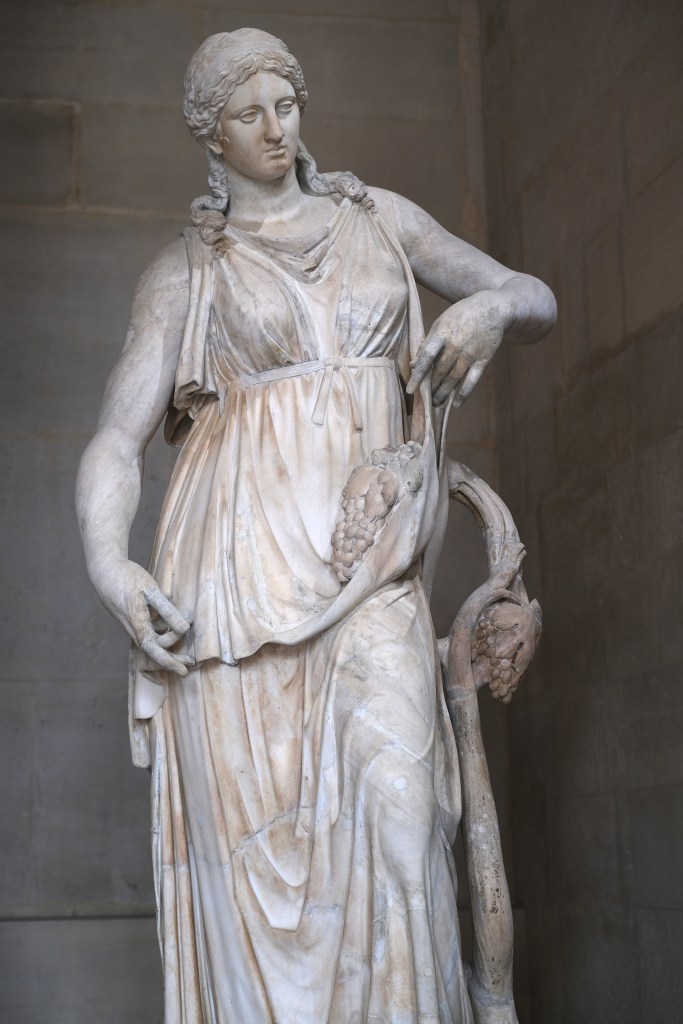
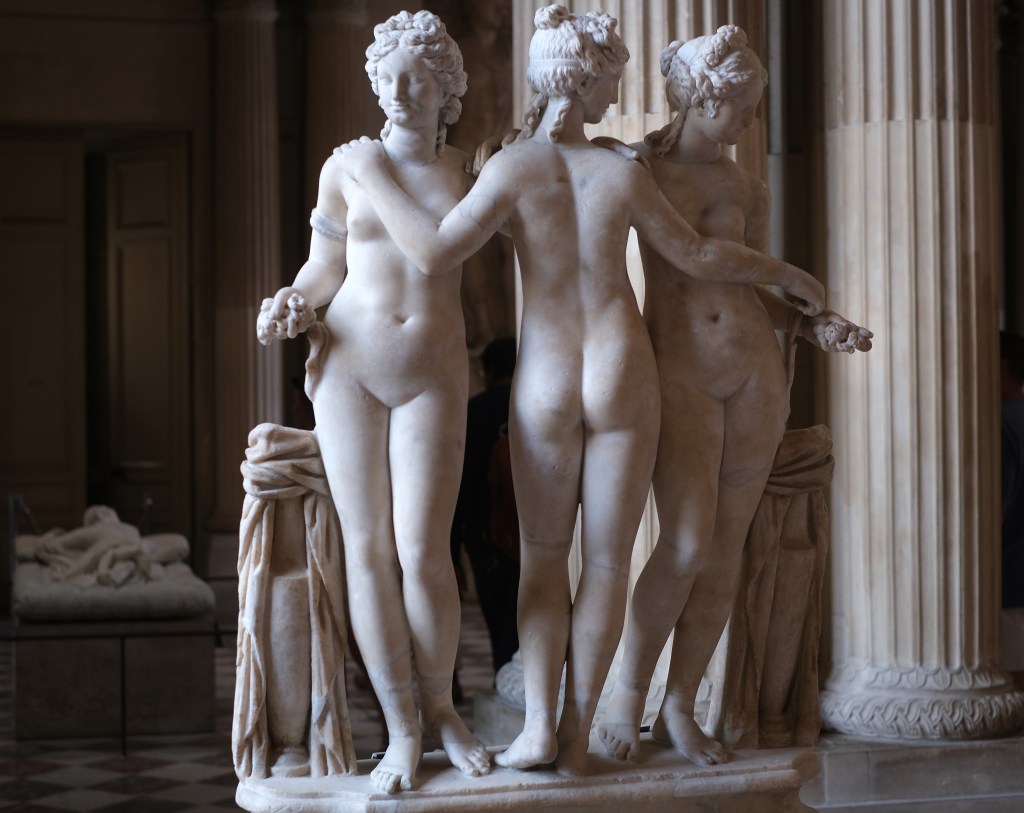
I loved being able walk a complete circle around the sculptures to see them from every angle. I loved the way they were placed in the galleries such that natural light from the palace’s windows shone on them. Light is everything. It makes the stone glow. It highlights lines and curves, creates shadows and depth. With a painting, the light and colors and textures are mostly complete and laid on a flat surface by the artist; with a camera in hand, the best you can hope for is to capture the artwork accurately. With a sculpture, you can photograph it from different angles to change the composition of your photograph, and with different light to change the mood. You can extend the art and make additional art of it (not me, but great photographers could!).


I saw Aphrodites and Venuses, Athena, and the incredible detail of the Caryatid columns from a Renaissance French palace. I saw the beauty of the human body glorified in marble and bronze, the ideal image of the human for these artists and their times, every woman’s and goddess’s breasts the exact same size and shape, every man’s and god’s chest, abs, and biceps muscular and hard and strong. The supermodel has been around for much longer than I realized.
In the sculptures that most captivated me, the marble was so smooth, it looked supple like skin. I snapped a photograph that I intended to capture the exterior of the building from inside the Louvre. When I looked at it after the trip, I thought, “Why is there a naked person in my photograph?” It is not a naked person. It’s a sculpture. That’s how fine the artistry is.

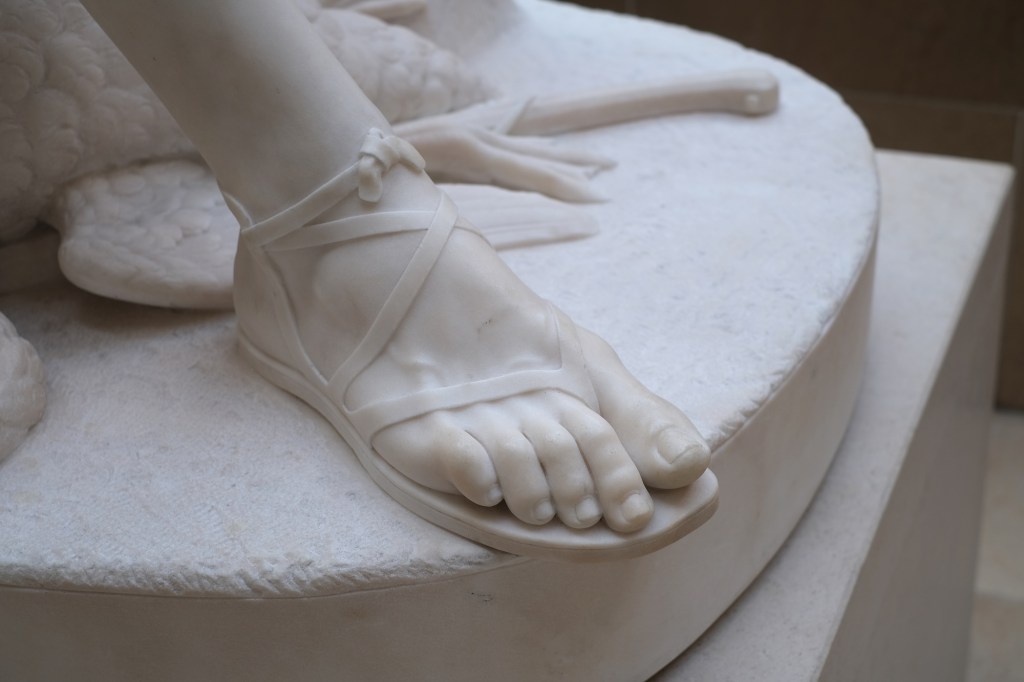
I was stunned by how perfect these sculptures were, in their shapes and proportions, their grace and details, their smoothness. I could not stop thinking about how mind-numbingly tedious it must have been to work so closely, so precisely, to chip away at the hard stone and make these human forms and ornate textures come out of it. The artists’ patience to suffer that tedium, and their persistence to push through it, resulted in something real, something permanent, something that lasts for all of humanity to experience. This is true of all artists — musicians, writers, painters, sculptors. I am grateful for their patience. I am grateful for their drive and tenacity and madness to make the millions of tiny choices, the millions of tiny marks, that create such wonder that we can still appreciate and enjoy 1 year or 2100 years later.
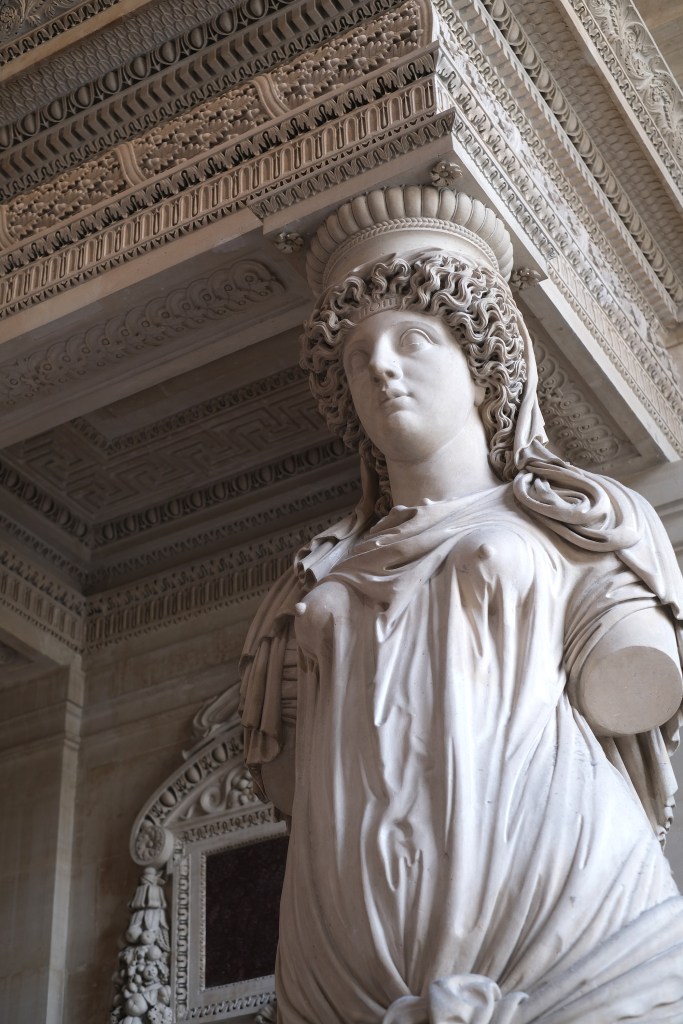
The craftsmanship was impeccable. Other sculptures look rough and crude now after seeing these perfect specimens.
After spending time with these masterpieces, I still had about an hour left. Looking at a map afterward, I now see that I was on the level underneath the great galleries of paintings, including the Mona Lisa gallery, which was why each time I tried to climb the stairs to explore other areas, I met huge crowds. I could not figure out how to get out of the wing I was in to get away from the masses. I stumbled on an underground passage where you could walk through the Medieval foundations of the Louvre. It was refreshingly cool and empty down there, underground, with those ancient stone walls all around.
I finally found my way out of the Denon wing, which is where the Da Vinci paintings are — one name whose work I did not see — and where the largest crowds were. I exited and went to the Richelieu wing where I had originally intended to go, and where I rescanned my ticket for entrance.
I entered and wandered into the passage on the right. I emerged in a beautiful atrium filled with natural light from a high glass ceiling.
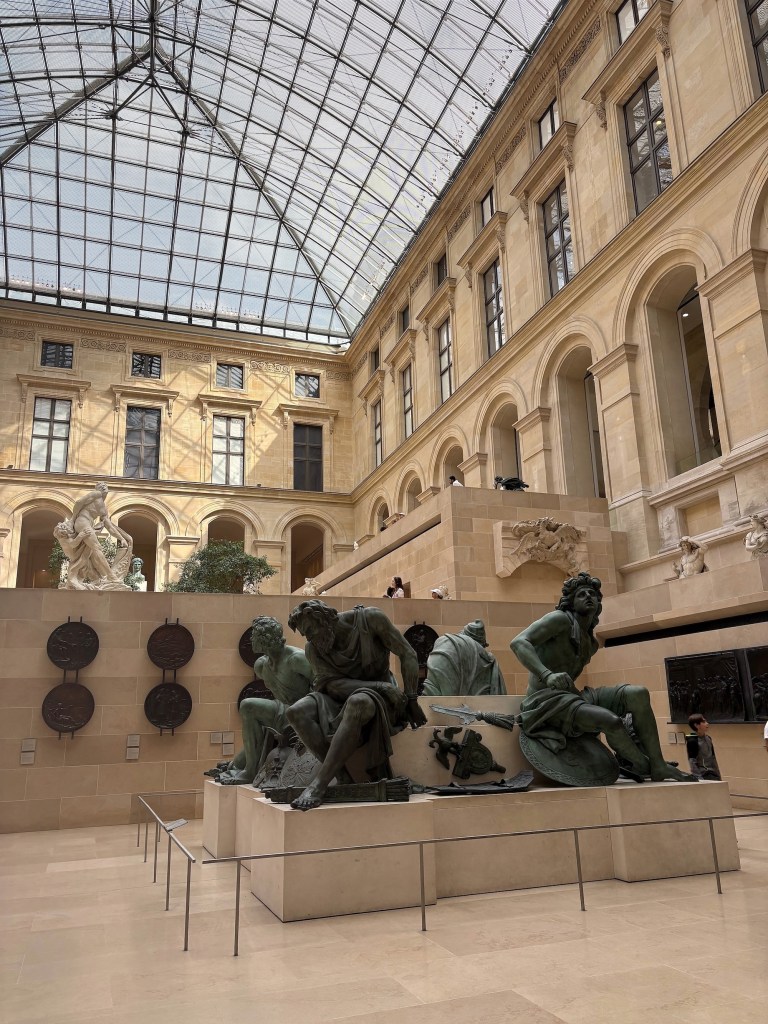

I was surrounded by huge marble sculptures of gods and myths, and there were trees and light, and there were people but not crowds, and there was sunlight and lots of air, and it was glorious. I stood in the entry and felt the sunlight and the clean, open space recharge me. When I climbed the stairs, I was confronted with a spectacular sculpture catching sunbeams.
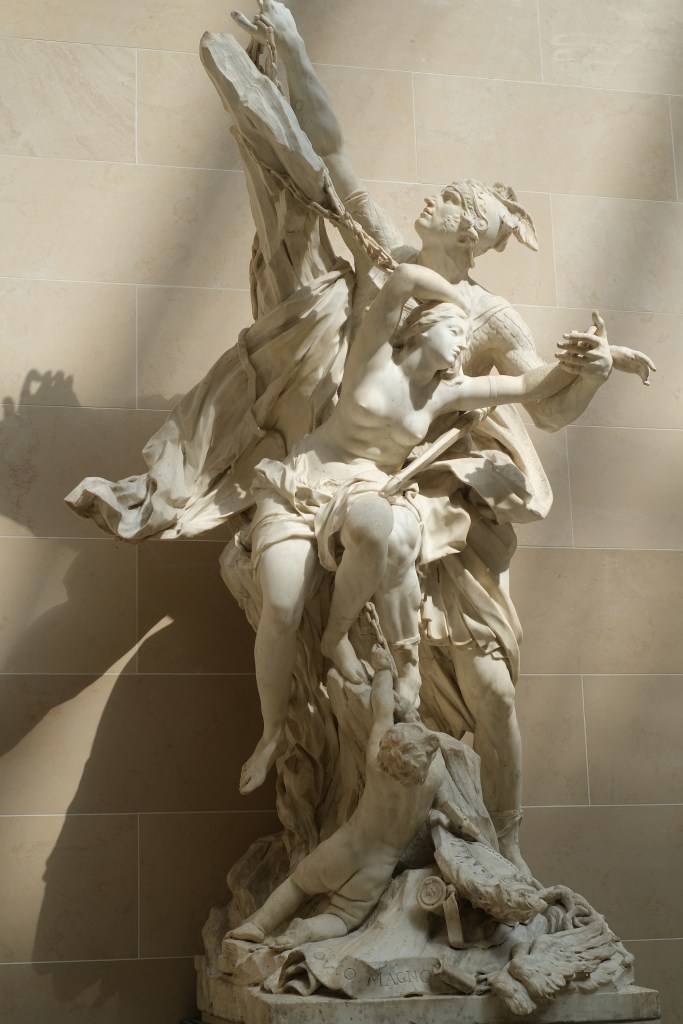
The top of the stairs opened into a gallery streaming with light and that overlooked a serene indoor courtyard. The green of the trees was lovely against the white and cream stone, and it picked up the green of the bronze sculptures, creating a sense of harmony between these natural living beings and the human-made creations around them.


I stood and watched people interact with the sculptures, looking up at them, photographing or having their photograph taken with them, like the goofy grinning man who had his picture made with the bronze Hercules conquering a serpent, as if he, too, could conquer such a beast.
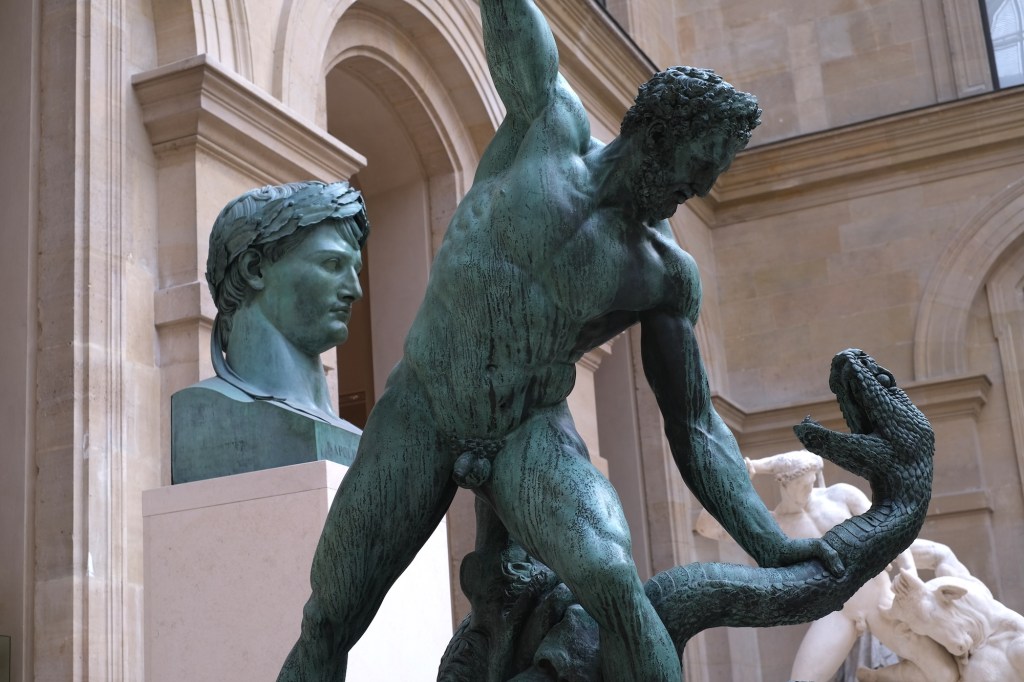
Hercules Fighting Achelous Transformed into a Snake

I spent the rest of my time at the Louvre in this hall. I can’t get enough of this place. Of Paris, of the art, of France. I want to come back.
 Butterfly Mind
3 responses to “Panic and peace at the Louvre”
What a lovely post, Andrea. Thank you sharing and letting me escape to the Louvre for a little bit on this Tuesday morning.
I’m not a sculptor, but from what I’ve read, I don’t think it IS tedious to be meticulous, honestly. Now, some of these old masters who had enormous studios (read: many many apprentices, artisans, and artists) maybe didn’t bother to engage in some of the fine detail work any longer, but that was probably as much a matter of time as anything.
I will say that nothing makes me happier than making a part of a drawing work, even if it takes hours and is a tiny detail.
Also, I fully agree about the skin texture of some of these pieces, and I support your rave of the sunlight on the marble. Exquisite. I am always blown away by fabric details on marble, and the columns you shared detail that gorgeously.
I wondered about the apprentices and also I guess you’re right that it’s not tedium to folks who are super into it and derive great satisfaction from doing something so well and getting it exactly the way they want. That makes a lot of sense.