It just wouldn’t be April without a photo essay of the status of the garden. Here’s where everything stands right now, after last week’s drenching rains: herb blossoms, shrubs in bloom, and perennials building up their flowers.

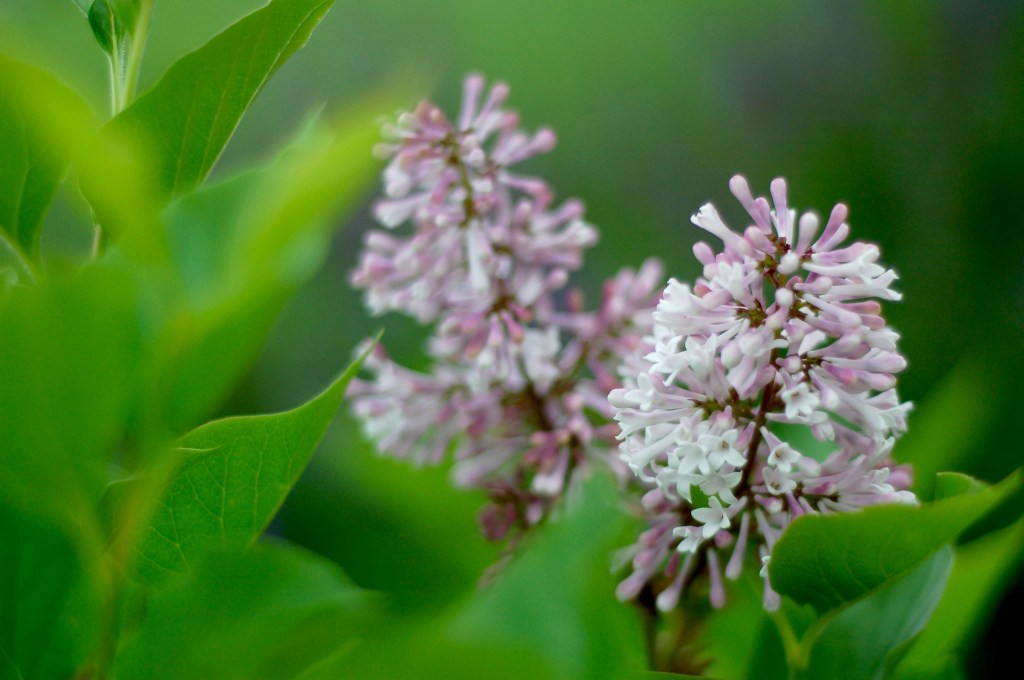
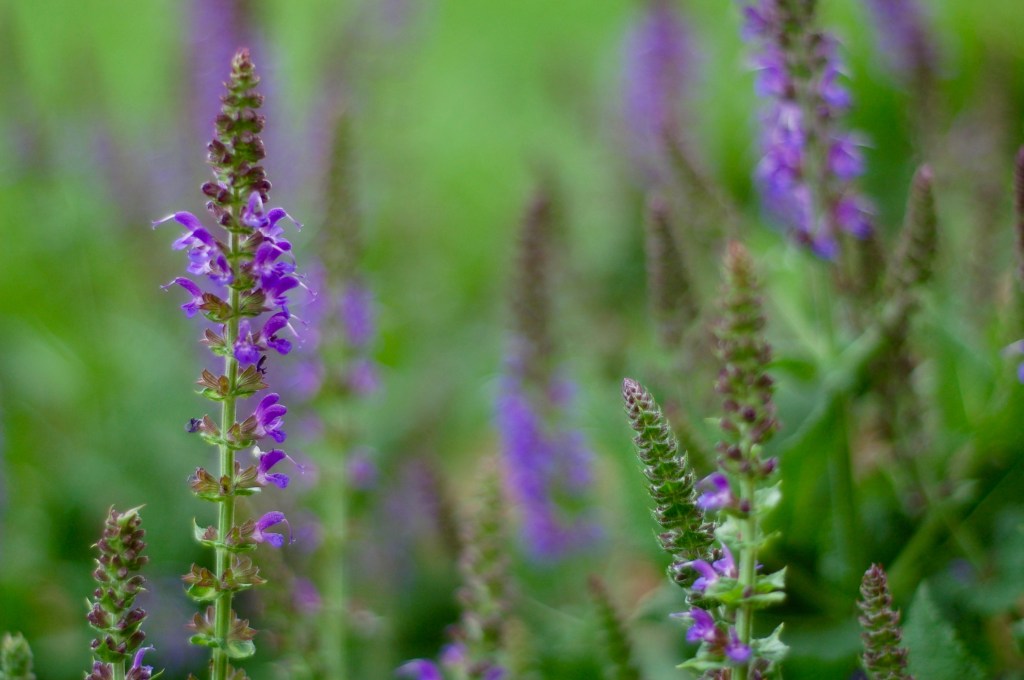


It just wouldn’t be April without a photo essay of the status of the garden. Here’s where everything stands right now, after last week’s drenching rains: herb blossoms, shrubs in bloom, and perennials building up their flowers.
I did it. I set out to fill a 100 sheet/200 page composition book in April, and today, three days before the month’s end I filled the final page.
A friend asked me recently if I’d ever considered writing a book. “I have not,” I told him. “What would I write about?!”
“That is the worst excuse,” he said.
I think not having a topic is the best excuse for not writing a book. When I told another friend I filled 80 pages of my notebook on vacation, he asked what I wrote about. “Whatever was in my brain,” I told him. In other words, random thoughts. I’m not writing a novel, I’m not working on a project.
I daydream about writing a book, but I know I couldn’t make a living from it, especially if I don’t even have a topic. Maybe in retirement, when my husband and I are living on a sailboat. I can write about what we eat when we live aboard. I’m sure there’s a huge market for that.
I’m reading Thinking Like Your Editor: How to Write Great Serious Nonfiction — and Get It Published by Susan Rabiner and Alfred Fortunato, and as I progress through their advice, I stand by my conviction that not having a topic is an excellent excuse for not writing a book. As they explain in their chapter on proposals, and what an editor is looking for in a book proposal, there are five critical questions an editor wants the answers to:
- What is the book about?
- What is the book’s thesis (many in publishing refer to it as the book’s argument), and what’s new about it?
- Why are you the person to write this book?
- Why is now the time to publish the book?
- Who makes up the core audience for the proposed book, and why will they find it appealing?
If my blog is any indication of the answers to these questions:
As you can see, I do not have a book here. These questions are compelling, though, especially the thesis question. What would the argument of a book I wrote be? What is the argument of my blog? Surely there is a mindset that ties everything together.
Natalie Goldberg, poet and author of Writing Down the Bones, suggests that writers have obsessions — “things they can’t forget; stories they carry in their bodies waiting to be released” — that they return to again and again. I recently published a post called I remember St. Simons, and what didn’t make it into the post, the words that are in my notebook but not on my blog are:
I remember writing all this before, or is it just that I’ve turned these memories over so many times in my life and my mind that it seems like I’ve written them before?
After I published the post, I searched my blog. I was certain I had written something similar, it couldn’t just be memories in my mind. And then I found it: a piece called Writer’s Block, which was published in the online journal Southern Women’s Review. In I Remember St. Simons I used some of the exact same phrasings I wrote more than four years ago in a piece I haven’t looked at in years.
So there are obsessions running throughout my blog, but as Rabiner and Fortunato clarify in Thinking Like Your Editor, an obsession or a topic is not a thesis. What is the thesis of my blog? What is the thesis of my life? That’s the more important question, but not one I have an answer to.
I still don’t have plans to write a book. I have no topic, no thesis, no audience in mind. But these questions have invoked a curiosity about what — if I had to sum my argument about life and living in one sentence – would my life’s thesis be?
The time of year has finally come: time to change the blankets. We replaced our thick down comforter this weekend with a lighter weight one. It is spring.
Already the days lengthen. A week ago, when I sat by the window at 6:20AM writing, the world outside glowed moon blue. This morning at that same time, the world shone peach: orange sherbet clouds, pink dogwood blossoms, apricot sunlight warming the white siding of houses.
We can grill as late as 7:30 pm and still have daylight. My husband sat on the white-railed porch in the evening sun last night, relaxing in a cobalt canvas chair, sipping a gin sling. Goldfinches and woodpeckers flitted at the bird feeder hanging from the oak out back, and smoke from the charcoal grill filled the air with the scent of campfire.
When we lived in Florida, I hated summer. It blazed eternal, an inferno. The searing rays of the sun and the scorching heat were relentless. My skin burned. My eyes burned. I’d start sweating the moment I stepped out of the shower.
Here in the Appalachians, where we have all four seasons, I love summer. Summer is the season of butterflies and gardens in bloom. It is the season of family vacations — a trip to New York City with my mom, a trip to Goergia with the kids, and a beach vacation for all four of us on the Gulf of Mexico. It is the season without school during the week, without soccer tournaments or swim meets on the weekends, the season when we can finally take our canoe on a camping trip, and sail on the lake on the weekends.
Yes, I like this time of year, when winter changes to spring, when summer is on the horizon. A time of warmth and sunlight. I like this time of year, when we change our blankets.
This is my entry for The Daily Post blanket prompt.
The drenching has finally subsided. For three days it rained. Maybe four. The kids’ school was cancelled Monday due to flooding. Yesterday our grass was shin high and thick. It looked too dense to push a mower through.
During the rains, I watched the garden from the window. So much green against the darkness! The knee-high yarrow is a silver mound that looks like it could pick up its skirt and walk away. The catnip domes to mid-thigh. The Echinacea is lush and dense with long, dark, blue-green leaves that don’t yet have age spots or brown edges from the blazing summer sun.
One evening I couldn’t stand it anymore. I yanked my raincoat off its hanger in the hall closet, pulled on my green rubber boots, opened my polka-dotted umbrella, and I walked the garden in the rain. Drops pattered on the taut nylon of my umbrella, and my boots squished in soft, wet earth.
It had been 10 days since we sowed our wildflower seeds, and I wanted to find sprouts. And boy did I ever find sprouts. In the area we scattered zinnia seeds, several pairs of cotyledons had emerged. In the wildflower bed, dozens of tiny stems pushed up through the mulch. Beneath the ground their seeds have split open, sending a shoot towards the light and roots into the earth. Germination. “The process of something coming into existence.” What a beautiful word.
The seedlings are fragile at this stage, as they anchor themselves, brand new and vulnerable in the big, new world. They will need to grow leaves to gather sunshine and make food; they will need to spread roots to gather water and make a foundation. And they will need space for both: above ground to collect light, and below ground to absorb their drink.
This means I need to weed.
I’ve not yet figured out how to do that, especially since I’m not sure which of the seedlings are the weeds and which ones are the wanted. I can dig out the established weeds, though: the grass that’s creeping into the flower beds, the dandelions and spiny thistles that will never die. Up on the hill there are other weeds I’ve not dealt with before, broad-leaved and fast-growing: wild rhubarb and others I haven’t identified. Like the dandelions, these hillside weeds will be my nemesis throughout the growing season. I will have to be relentless with the spade, digging them out at their roots, refusing to let them take hold and dominate the hill and its new inhabitants.
The fog was thick this morning, and the grass and garden shone neon green as the sun rose and finally cast light on the quenched earth. On Friday I have a flex day. It will be warm and sunny, and I can’t wait to get out there and make space for our seedlings. To give them the chance to put down some roots.
This is my response to The Daily Post’s one-word prompt, roots.
The hamza and the ‛ayn were driven to a meeting hall for an appointment of some kind.
“You two twins?” the cabbie asked. His right wrist rested on the top of the steering wheel.
“No,” said the hamza, with a roll of its eye.
The ‛ayn showed more compassion. “That’s a common question, sir, and I don’t blame you for thinking so. We look very much alike!”
The cabbie looked at them again in the rearview mirror. They hung like commas in the air above the back seat, black silouhettes against the bright rear window.
“Here we are.”
The hamza grunted.
“Thank you sir!” said the ‛ayn.
They jumped out of the taxi. The hamza bounced once. The ‛ayn, never able to supress the glee of using its foot like a pogo stick, bounced three times. They glided towards the hall for their appointment.
This was a silly writing exercise where I took a snippet from The Chicago Manual of Style about hamzas (’) and ‛ayns (‛) — “The hamza (’) and the ‛ayn (‛)…” — and meshed it with a snippet from The Tao of Pooh by Benjamin Hoff — “…were driven to a meeting hall for an appointment of some kind” — to create something new.
Clear, liquid gold. Scent of hot peanut oil. Spatter as beer-battered fish strips are dropped in. An eruption of oily froth with each addition, then a settling into furious bubbling around each strip, like caterpillar feet on hot sand.
We rarely fry food at home. The kids wanted fish sticks the other night. I moaned.
“They’re so messy.”
“They stink up the house.”
“And then we have to get rid of all that oil.”
We grilled the fish instead.
These days I hardly eat fried food at all, except French fries or sweet potato fries when we eat out. And occasionally potato chips. Oh, and donuts. And funnel cakes when I can get my hands on them.
I do like fried food, but I don’t go wild for it like people go wild for bacon. I never really understood the “fry everything” phenomenon, like fried Twinkies. Do people really like those? I mean, sure fried foods are okay, but there are plenty of other foods I enjoy more and that don’t make me feel like I have a brick in my stomach and want to die after eating them.
I probably used to eat a lot more fried food, just like I ate a lot more candy bars and drank a lot more Coke. As I age, my body likes to store all the goodies from those foods much more than it used to, or maybe it’s just slowing down in its processing of them.
In my 20s I started exercising so that I could eat whatever I like. I love food. It is a great pleasure I don’t like to deny myself. In those days I could eat whatever I wanted. I rode miles and miles on my bicycle, hundreds of miles each month. When I drank gin and tonics, the relaxation went straight to my legs, turning them to jelly after hard rides on hills. In my 30s, I had children to raise, so I didn’t have as much time to exercise, but I still managed without too much annoyance. My body hadn’t slowed down yet.
Now that I’m in my 40s, though, things have changed. I can walk 20 hours per week on my treadmill, watch what I eat, and still not shake the extra pounds I gained at Christmas, or on a work trip, or wherever the latest weight gain is that happens right after I get to my target weight. I have to be much more aware of what I consume and how much I exercise than I ever was before, and the changes in weight (at least the decreases), are slow.
This is annoying, of course, but is not actually the point. The slowing down of my body’s metabolism, the changes my body is going through, has bigger implications. Namely, that I’m aging. My body is beginning its journey towards shutting down. I am a physical being whose physical body is on the decline, is slowing, will one day stop. It’s only the beginning, I should have plenty of time left, but the changing of my body is a reminder of my own mortality.
So, I don’t eat much fried food anymore. Why open up more opportunities to remind myself that I will one day be gone?
This is my entry for the Daily Post one word prompt: Fry.
 Butterfly Mind