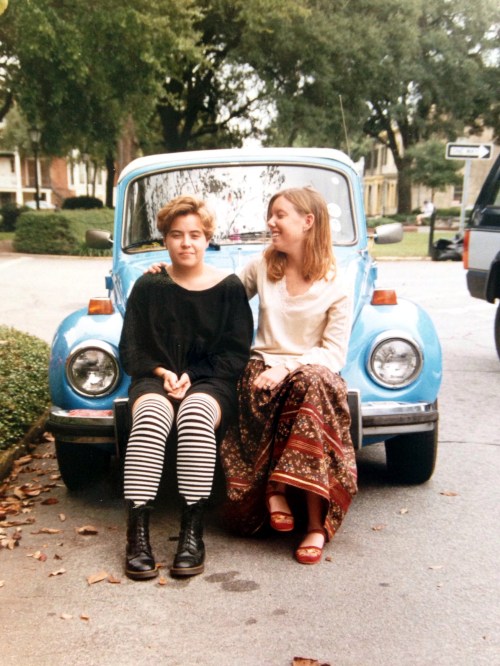
My best friend and me, 1992ish, with the Bug, parked on one of Savannah’s squares. I’m sure I just said something annoying.My first car was a convertible: a 1976 robin’s egg blue VW Super Beetle with a white top. I was the first of my friends to turn 16 and get my license, and we drove all around Savannah, Wilmington, and Tybee Island, Georgia in that car, top down, sun and sand.
Convertibles are the most fun cars, there’s no doubt about it. They are a sign of freedom and fun, they give the best experience of driving: wind and sun on a gorgeous day. They remove the barrier between you and the outside world when you’re on the road. I remember that feeling of wind on my face, of smelling the salt marsh on the causeway and the ocean at the beach.
Later, when my husband and I were courting, long after the Beetle was gone and I’d left for college and gotten a more dependable car, he drove a soft-top Jeep Wrangler, navy blue with a tan top. Taking the top down and having the doors off was even more wild and wilderness feeling than the Bug. Brian and I drove Jekyll, St. Simons, and Tybee Islands, we drove the Appalachians, we camped, we were carefree.
When we lived in Florida, convertibles weren’t as attractive as they had once been. It was very hot there. We’d see someone sitting at a traffic light with the top down in July, their bald spot burning, the heat rising from asphalt unbearable. I liked my closed up car with air conditioning in Florida.
But now we live someplace with seasons, someplace that more times than not has perfect convertible weather. I think how fun it would be to put the top down, pop in some Tom Petty, and go for a drive. Every time I see someone in a convertible on a TV show (Don Draper on Mad Men), I want one again.
For the month of April, I will publish a 10-minute free write each day. Minimal editing. No story. Just thoughts spilling onto the page. Trying to get back into the writing habit.
When we lived in the D.C. Metro area, we subscribed to The Washington Post. It landed on our stoop with a thunk before dawn. Reading the paper was part of my morning ritual: make coffee, unfold the newspaper, open it up, and read while I sipped coffee. The paper rattled as I turned pages or folded it to make it more manageable to hold. I’d touch the sharp edge of a page to turn it, or lick my thumb to unstick sheets.
My fingers turned black from the ink, and on weekends I would sharpen a pencil, fold the crossword page so only the puzzle showed, and feel the recycled texture of newspaper-grade paper under the side of my hand as I filled in boxes with my wooden pencil. The pencil smelled of wood shavings when I pulled it from the metal blade of the sharpener.
I don’t read a newspaper anymore. I get my news from the radio and from podcasts: electronically.
I was thinking about this in the shower today (my thinking place), about how we listen to music electronically, news electronically, I work electronically on a computer screen. Much of my tactile interaction with the world is via fingers on a keyboard, wrists resting on metal, fingertips tapping plastic buttons. Before our record player, much of my audio interaction with the world required pulling up music on a screen, whether a laptop, desktop, or mobile device.
A majoity of my visual interaction with the world is looking at pixels on a screen — two dimensional, the screen creating its own flat glow rather than revealing texture via reflected light.
I wonder if this sensory experience is why we crave physical objects of yesteryear — manual typewriters, vinyl records, film cameras, bound books, newspaper. These physical things have weight — the heft of a Minolta, the tension of typewriter keys; they make sound: clack and crackle, click and crinkle; they have scent — metal, oil, typewriter ink, paper pulp; and they provide a tactile experience that connects with all the other senses: the satisfying sounds they make, the textures that light reflects, the scents they emit.
Physical objects are interactive in a sense-driven world. They connect all of these sensory experiences. When we touch a newspaper, we feel its texture, we smell its pulp, we hear it rattle, we see its movement, what section we’re in. We see how many pages we’ve read and how many pages we haven’t. We create piles: finished; not interested; still to read. And when we’re done, we have compost for the garden, or fuel to start winter’s fires.
All that being said, digital life is convenient. The delete key has changed writers’ lives; records can’t be played in the car, can’t be played for 4 hours of continuous background music; digital photography is quicker and more accessible than film; I can carry a whole library with me (and enlarge the font!) with my e-reader; we don’t waste trees to carry newsprint we’ll never read.
Still, The Daily Post’s Newspaper prompt got me thinking. I miss my morning Washington Post ritual. As a digital worker, I need to be mindful of engaging all of my senses, in a three dimensional world.
For the month of April, I will publish a 10-minute free write each day. Minimal editing. No story. Just thoughts spilling onto the page. Trying to get back into the writing habit.
We ate late lunches in Baltimore — large meals at 3 o’clock in the afternoon that left us still full at dinner time. On Easter, by the time evening rolled around, we didn’t want a full meal. So instead of eating dinner, we had desserts and drinks instead.
Well, I had dessert.
We ate and drank at the B&O Brasserie, a place which delighted me because of the trains on the sign and the nostalgia of the B&O Railroad in Monopoly. For deseert, I saw things on the menu I knew my husband would like — mocha creme brulee, a chocolate torte — but what I wanted was the banana pudding. I’ve been having unusual dessert attractions lately, often wanting peanut butter or banana desserts when I’ve never cared much about those in the past.
The cocktails and the cheddar stout fondue with fresh potato chips had been amazing, so I was excited for my dessert. I anticipated a similar level of deliciousness.
When it arrived, I knew I made the right choice. Our server placed a small Ball jar filled with layers of fudge and caramel sauces, smooth pudding made from fresh bananas, glossy white marshmallow creme, and three slender wafers as long as my finger and flecked with vanilla.
The pudding was phenomenal. Even better than I imagined it would be. The marshmallow creme was pristine and perfect: gooey and soft, but breaking at the exact time you wanted it to so that you didn’t have to fight to get it onto your spoon, and you didn’t have to worry about drizzling it across the table (or your chin).
The banana pudding was at the bottom of my husband’s list of desserts he would have chosen. Banana pudding made him think of the pans on buffet or elementary school potluck tables: layers of browning banana disks, Jello pudding, and boxed ‘Nilla wafers.
When he tasted the B&O pudding, his eyebrows rose up. He took another small spoonful.
“I have to give it to you,” he said. “That’s really good.”
I nodded and “Mmmhmmm”ed, dipping in for another spoonful.
“I love the little jar,” I said. “It works for this. It reminds me of a dessert I ordered in New Orleans that was not as successful. A deconstructed pecan pie, served in a jar like this.”
My husband dipped a delicate cookie in the marshmallow creme.
“Everything else at the restaurant had been amazing,” I said. “And we were in the South, where I know they can do pecan pie.”
He spooned smooth banana and caramel into his mouth.
“But it came in a jar like this, and it just didn’t work. The pecan layer on top was like a scab. It was impossible to crack with my spoon. Once I did, pieces fell out of the jar, and the pie filling leaked over the side each time I tried to dip my spoon in. The goo was too sticky, too. It was really hard to eat.”
I sunk my spoon easily into the soft pudding.
“On top of that, there was no crust! There were these little attempts at crust pieces, tiny garnishes on the plate, but it just wasn’t right. The pie needs to bind with the crust — the crust can’t be separate.”
“You can’t have pecan pie without crust,” I continued. “WTF is up with that?”
My husband placed his spoon on the table and savored his final helping of pudding. “The thing with that is that banana pudding can be improved on,” he said. He pointed at the jar. “This is a major improvement.”
“Pecan pie, however, is already perfect,” he said. “Why mess with it? You can’t improve on perfection.”
For the month of April, I will publish a 10-minute free write each day, initiated by a prompt from my prompt box. Minimal editing. No story. Just thoughts spilling onto the page. Trying to get back into the writing habit.
My husband and I don’t get out alone much at night these days, what with children and all, but when we do, a new favorite thing to do is visit classy bars and order swanky cocktails we’d never make at home.
Actually, scratch that. Change it to we never make as well at home.
At home I like to make relatively easy cocktails that require only basic ingredients: gin martinis, rum or whiskey sours, Tom Collins in summer, Old Fashioneds in winter. If we want to get fancy in summer we’ll make basil gin smashes.
For all of those we use economical brands of liquor, and we make them in our formica-countered kitchen.
I love getting dressed up, ironing my hair, and going out for cocktails. I have fond and vivid memories of three nights out, and the associated cocktails I drank. Though two of the nights involved basic martinis, which I make all the time at home, the drinks were elevated by the quality of the gin, the elegance of the service, and the atmosphere of the establishment.
Miami, Florida: The Regent Cocktail Club
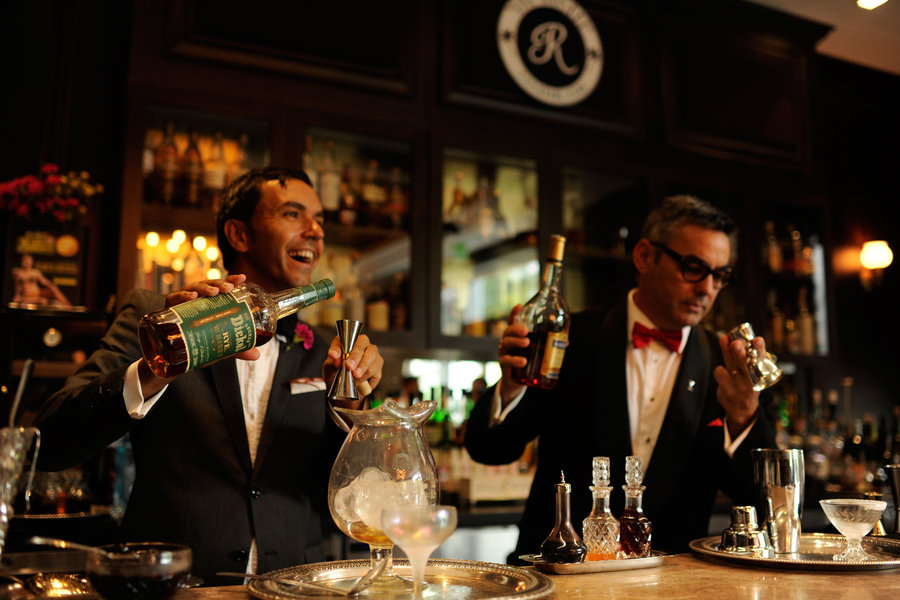
The Regent Cocktail Club, courtesy of Southern Living
Oh, The Regent, how I love thee. The picture above absolutely captures the experience of The Regent Cocktail Club: bowties and waistcoats, dark wood, fine glassware, and lots of charm from the bartenders. I ordered a martini there, and it was worth every penny of the price.
Each barkeeper had his own style of shaking cocktails, and it was like watching a dance to see the three of them behind the small bar: pulling glassware out and turning it; shaking high and low for one keep — above his head then down to his waist, above his head, down to his waist, like he was playing a musical instrument — while another keep shook outward and with a small twist from torso to chest; garnishing tumblers with fresh mint, creating lemon curls for martinis, placing ice cold crystalline glasses on silver trays for serving.
My husband and I lounged on a leather couch, watching the patrons at the bar, while we sipped our drinks. There was one man, lean and dressed in a slim, trendy suit, who was obviously a fixture at The Regent; the keeps knew him, and he made himself at home. He talked to everyone who came in and sat near him, or moved to a new stool if the ones next to him became empty.
We couldn’t hear the conversations at the bar, but we watched body language. My favorite scene was watching as a woman got bored when her date was polite to this regular, and got sucked into a conversation, ignoring her completely. The date realized his mistake and moved, incrementally, to the far side of his stool from the regular. He tried to turn his body towards the woman accompanying him. But the trendy-suited fixture leaned in, his entire body pointed toward the man, while the man, polite to a fault, would not be rude to the Regent regular. The woman poked around in her glass with a stirrer, stared at the ceiling, checked her phone.
Eventually her date turned his back to the regular to face her again, but it was too late at that point. She slipped her arms into her cardigan sleeves, and they left. The regular moved two bar stools to his left and started talking to a new patron who had just arrived.
I really loved being there, and I highly recommend it. The people-watching was brilliant. Fair warning, though: be prepared to spend some money if you ever decide to visit.
The B&O American Brasserie in Baltimore was our most recent cocktail adventure, and is the only one in this list where I ordered something other than a martini. We walked to the B&O from our hotel near the Inner Harbor, and I was delighted to see the trains on the B&O logo: the B&O Railroad! Monopoly!
Inside was warm, dark, and cozy. It was Easter evening, so it’s hard to judge what the ambiance is usually like, but it was pretty subdued when we were there. The cocktails (and the Cheddar And Milk Stout Fondue) more than made up for the sparse patronage, though. My husband declared that his Coppertop No 1 was possibly the best cocktail he’s ever had — and he’s not prone to hyperbole. Made with “Dorothy Parker” gin, Yellow Chartrreuse, ginger syrup, lemon juice, and pink & black Pepper, the Coppertop was clean and light with gin and citrus, yet warm & spicy with ginger and pepper.
His was quite good, but I’d go back for the Farmstead: Bulleit bourbon, Solera sherry, lemon juice, basil syrup, and lemon bitters. I’m a sucker for basil in a cocktail.
Anna Maria Island, Florida: The Beach Bistro.
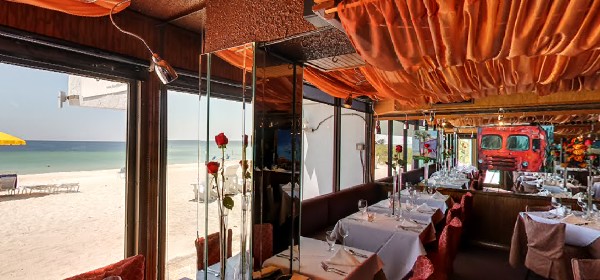
Inside the Beach Bistro, Anna Maria Island, FL
The food at The Beach Bistro is life changing. I think I’ve written about it on my blog before. But since this is a post about cocktails, I have to say that their Tony Jacklin martini is life changing too. It was so cold it felt like drinking liquid ice. And those blue cheese stuffed olives. My god. The balance of flavors was sophisticated and perfect. From the cocktail menu:
“THE TONY JACKLIN” Bombay Sapphire martini with Maytag blue cheese olives … Icy blue, like Tony’s nerves.
I remember delighting in every small sip of that martini, and of the visual of how clean and cold it was. I don’t remember much after the martini, but that’s kind of the point, right?
For the month of April, I will publish a 10-minute free write each day, initiated by a prompt from my prompt box. Minimal editing. No story. Just thoughts spilling onto the page. Trying to get back into the writing habit.
I finally did it. After 10 years with the same Yahoo! email address, I finally made the switch to a less annoying provider. For the past 2-3 years I have tolerated the ads, the bugs, the cluttered Yahoo! interface, annoyed every time I opened my mail, but too overwhelmed by what switching would entail to do anything about it.
I started seriously considering switching when my colleague, James Huff, gave a talk at our annual meeting about encrypted email. He mentioned the provider ProtonMail, and while I love that ProtonMail is Open Source and highly secure, I was mostly interested because I knew my time with Yahoo! was running out, and I needed something to switch to.
It took five months of mulling, of avoiding, of thinking, Maybe next week. Two weeks ago, I signed up, just to poke around in ProtonMail to get used to something different. After ten years with the same email interface, I’ve got a lot of habits built up, and I needed time to acquaint myself with a different look. Because it’s brand new, my email space is fresh and clean and clutter-free, and I quite like it.
I want to keep it that way.
This week, despite the overwhelming prospect of changing my email address on every account I’ve built up over the past ten years, I made the full decision to switch. And I’m doing it slowly.
I am cleaning up as I switch over: with each email that comes into my Yahoo! account, I decide whether I want that coming into my shiny new ProtonMail account. For about 70% of the emails I receive, the answer to question is No. I can’t tell you how many mailing lists I have unsubscribed from in the past two days. My goodness, I received a lot of junk.
I’m also unsubscribing from quality content that I just don’t make the time to read anymore. If I get weekly essays in my inbox, but I haven’t read a single one of them, if I’ve deleted without reading it for the past 12 months? Unsubscribe. I don’t want anything unnecessary cluttering my clean new space.
As for all those accounts and services I’ll need to change my email address on — banks, social media, shopping, medical, utilities, subscriptions, local services, schools — I’m making that transition slowly. Each day I update 5-10 sites, and I’m keeping a list of the ones I’ve finished. This could take a while.
Once I’ve changed my email address on official accounts, then I’ll work on my personal contacts. I’ve got contacts in my Yahoo! account that I do not even recognize — I have no idea who they are. I need to go through all of those and clean them out before porting them over to my pristine new account.
Ten years is a long time to accrue correspondence and contacts. I foresee this process taking me a few weeks. I’m okay with that. I have a clean slate, and am working to change my habits as I make the switch. It feels good to scrub everything out.
Brining turkey is all the rage these days. Funny I should pull this prompt right before Thanksgiving. I admit, there is a reason brined turkey is all the rage. Brined turkey is delicious. It is moist, it is perfectly seasoned.
Brine is one of my favorite words, and it’s not because of turkey. Brine is the salt water I grew up in. It is the salty rivers that seep into marshes on a rising tide, that nourishes the nurseries for marine life in those high grasses. Brine is the smell of ocean air when driving a coastal highway. It can be warm and enveloping, the scent of summer on Tybee, or cold and raw, the scent of winter in Maine, but it is always wet, and it is always salty.
Brine is a type of shrimp — a tiny shrimp. A shrimpy shrimp. When I think of brine shrimp, I think of those sea monkeys they used to sell in the back of Mad magazine or Archie comics. Were those brine shrimp? The pictures were always so enticing, with castles and underwater alien-like creatures that looked nothing like monkeys.
Salt seems to be a theme with me. I do love salt for salt’s sake, but I love brine for the word’s sake. For the vocabulary of it. Brine evokes multiple senses, and it connotes not only the scent and taste of salt, but the feel of humidity and liquid. The salty liquid of the sea, of marshes, of broth, of genesis.
For the month of November, I am participating in NaBloPoMo and plan to publish every day of the month. Usually, I will publish a 10-minute free write, initiated by a prompt from my prompt box. Minimal editing. No story. Just thoughts spilling onto the page. Follow along with the tag #NovemberDaily.
 Butterfly Mind