Mornings have been icy cold the past two days. Yesterday, I sat at our kitchen table with my notebook at 5am before my swim, and my phone rang: schools would be closed due to dangerous driving conditions. I didn’t know whether that meant the aquatic center would also be closed. I debated for ten minutes on whether to make the attempt — to go out in the cold to warm up the car and scrape the windshield in a wind that felt like ice shards — knowing the pool might be closed when I arrived.
I decided to risk it. The roads weren’t that dangerous, not in a Suburu; there was no weather happening except wind, there were just some icy patches. Nobody is on the road around here at 5:15am, and the entire 7 minute drive has a speed limit of 25mph, so I was safe.
When I arrived at the aquatic center, the lights were on inside, I saw lifeguards and our trusty early morning attendant getting the sign-in sheet ready inside, and other swimmers sat in their warm cars waiting for the doors to be unlocked.
On the pool deck, everyone chattered about going through the same wondering thought process I did — will it be open if schools are closed? — and then we all got in and swam our laps. The pool I go to is warm, thankfully, and steam rose from the lap lanes.
The locker rooms, however, are not warm. After my swim, I opened the door to the changing room, and the cold air on wet skin was a bit of a shock. The splashing of swimmers echoed on the tile floors and walls, and I stood dripping in a puddle on the cold floor. I grabbed my towel, which I’d hung next to the sauna. I eyed the sauna door and thought, hmm, it’ll be warm in there. So I stepped into the wood-planked room. The wooden floor was warm on the soles of my feet. The planks were absorbent and welcoming. No standing in puddles. I was enveloped in heat, a muted quiet, and the scent of warm cedar.
I toweled off in the sauna, and it was such a delightful experience, such an easy little treat to myself, that I will make it part of my winter swimming ritual. I’ll brave the cold mornings to drive to the pool and swim, and my reward at the end will be to dry off in the sauna, where the heat warms me to my bones.
This year, the magnetism of the tarot tugged at me more than usual. I’ve played with self-reading for a few years, but I struggled to make meaning of what I was doing.
This year, I wanted to really learn the tarot. I’d never owned or really even looked at the traditional Rider-Waite-Smith cards, which are the most well-known and referenced tarot images, so I bought myself the Radiant version of the deck. The deck came with a proper guide book I could learn from rather than the tiny paper insert that often comes with a small box of tarot cards. I also bought the book Tarot for One by Courtney Weber, and I started listening to the Tarot Heroes podcast. Those resources, along with the guidebooks from my existing decks, help me understand traditional interpretations of individual cards, deck-specific interpretations, and how to think of the tarot in general.
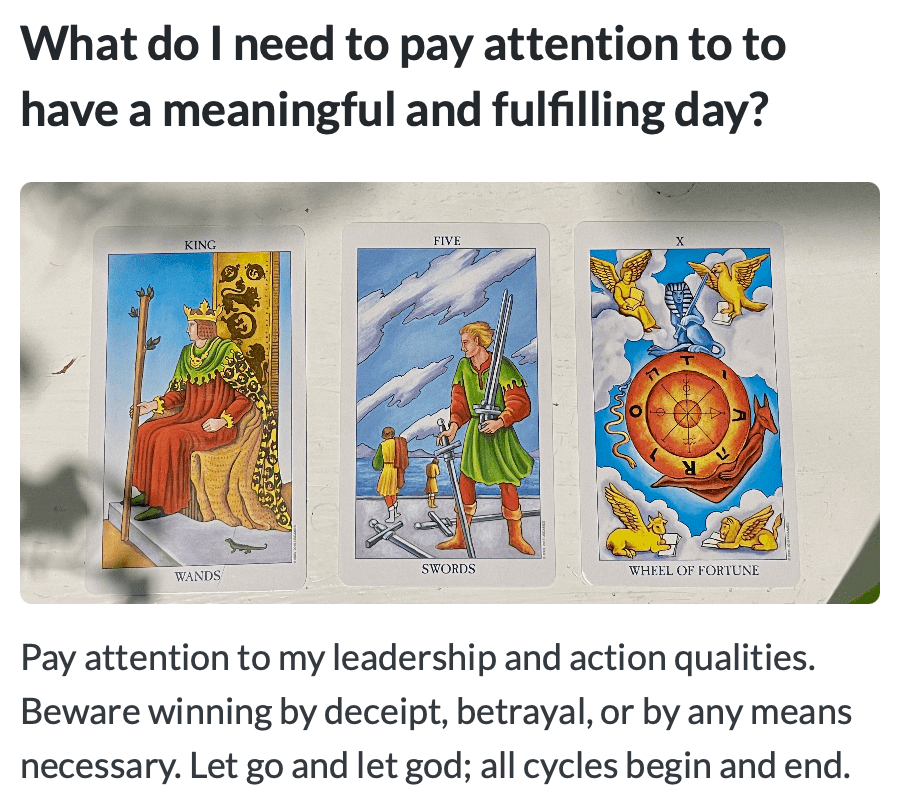
But what brought it all together, what helped me start to internalize the cards and really make meaning of them in a fun way that adds zest to my life, was to not just pull cards every day, but to journal about them. Pulling tarot cards helps me set an intention each day and focus my attention towards that intention. For example, as I shuffle I might ask, “What should I pay attention to today to have a fulfilling day at work?” Journaling about the cards helps me learn them: I pull cards, look them up, consider what I see and what guidebooks say, and write my thoughts and interpretations. At the end of the day, I look at my journal entry from the morning and reflect on the day as it relates to the cards. This last step helps me understand cards that might not have made sense at the beginning of the day (and maybe they still don’t at the end of the day! And that’s okay! This is a hobby, it’s all for fun, this is not life or death.)
I love two things about the journaling process. First, journaling reinforces the message of the cards so that throughout the day, I pay attention to events or my mindset in relation to my intention. Writing about the cards helps me remember them. For example, when I pull cards I might ask, “How can I approach today so that I have a happy day?” If one of the cards indicates “Be open to saying yes,” writing that out will help me remember that message during the day. If something comes my way that my knee-jerk reaction is to say No to, maybe I’ll pause and consider whether Yes is actually a better answer. Second, by keeping a journal, I can reference previous entries to see what happened when I pulled a certain card last time, or I can identify patterns. This helps me learn the how the cards show up in my life, what they mean for me, and what lessons keep showing up that I might need to learn.
A coworker asked for any tips on how to get started with tarot journaling, so here are some of the ways I journal.
How I journal
I started by journaling on paper, but this method missed a really important part of the tarot, which is the visual element of the cards. Tarot cards are tiny pieces of art in which every component has meaning: suit, numbers, colors, posture, sight-line, atmosphere, clothing, plants, animals, tools. In a paper journal where I just wrote words, my journal entries lacked that visual representation. So I switched to a digital journal using the Day One journaling app*. I pull cards first thing in the morning, take a photo of them, then drop the photo into a new entry in my Tarot journal on the app. I title the post with whatever intention I focused on when I pulled the card, then I write my thoughts about what the cards mean. At the end of the day, I check back in and write a summary of the day and how the cards seemed to relate.
*An added benefit of keeping a digital tarot journal is that it makes it much easier to search for specific cards from past readings.
Different kinds of entries
Daily encounter This is a three card pull: the first card represents me and how I’m showing up, the second card represents an encounter that day, and the third card represents the outcome. When I first started my tarot journey this year, I’d pull these three cards, read about them in the guide book, and write out those meanings in my journal. I pretty much copied the books verbatum, and then at the end of the day, tried to correlate the card meanings with what my experience was like that day. After a while, I realized this copy paste style was akin to memorization rather than understanding, so I switched to pulling single cards and studying the art on them to find my own meaning. Now, when I pull my daily encounter spreads, I jot down what the cards mean to me and then revisit at the end of the day.
Single card Sometimes three cards are too much to digest, or I find myself not really paying attention to what I think about them and instead just regurgitate what the guidebooks say. In those periods, I’ll pull one card for the day with the sole intent of learning that one card — I’m not even necessarily asking a question about the day. I’ll put the card next to my laptop and look at it closely while I describe it in my journal. I’ll describe the colors, the facial expressions and body language, and the overall feeling it gives me. Then I’ll write what I think it is saying as a piece of art. Throughout the day or at the end, I’ll jot down moments that felt like the energy of the card.
Bigger spreads It’s rare that I do spreads any more complex than three cards except on my birthday. On my birthday, I’ll usually do a solar year spread where I pull one card to represent the whole year, and then 12 cards: one for each month. I photograph the spread and tag it in my journal so that when the month changes over, I can easily find the spread and see what to look forward to that month.
Reference Sometimes I want to take notes that are general to the tarot, and that I use as reference entries to help in my own interpretation of cards. For example, I have an entry that describes the suits (swords, cups, pentacles, wands) and an entry for numerology. I imagine one day I might have one for colors, and I have a couple of reference entries from exercises in Tarot for One. I tag these with a Reference tag in my journal app, which makes it easy to find them when I want to jog my memory.
Have fun!
My favorite thing I learned this year about the tarot is that it originated as a card game: they were playing cards. When asked for advice he’d give beginners, Jeff Petriello, co-creator of the Pasta Tarot deck said on the Tarot Heroes podcast, “Oh my god, have fun! That is absolutely the biggest thing to remember…These cards were used as playing cards for centuries… so it’s really important to remember to play with them. They have a whole history in play so I really try to encourage beginners to have that spirit.” His advice helped me not take anything seriously, and to just play around with my cards and in my journal.
I’ve started drawing. On my recent work trip to Germany, my team lead told us she did a random thing in the airport that she would have never expected to do. She needed a new nib for one of the fountain pens she uses for drawing. When she was in the Berlin airport, one of the airport convenience stores had a whole display of LAMY fountain pens. That in itself was pretty unusual — have you ever been to an airport convenience store that sells fountain pens? She was delighted! LAMY is the pen type she needed a nib for. And at this airport convenience store in Berlin, not only did they sell the pens, they also sold nibs. So while she waited for her flight, my lead was able to complete the task of purchasing and changing her pen’s nib.
I have a LAMY fountain pen. I wanted to see a LAMY fountain pen display in an airport. But more than that, I was intrigued by the thought of using my LAMY pen for drawing. This isn’t the first time this has occurred to me (see My friends are all drawing from October 2020). Back then, though, I got discouraged pretty quickly. My focus was on a finished product: I expected a drawing that looked like the thing I was drawing. When that didn’t happen, I stopped drawing.
On our trips to Palma and Munich, my team lead would take time every day to draw or paint. She had a sketchpad that I immediately coveted. It’s small and flips open like a journalist’s notepad: you lift the cover up instead of to the left. It’s the perfect size for traveling or keeping in a purse so that you have it with you at all times. We talked a lot about her drawing and painting practice, how soothing and meditative it is for her. She continually used her phone to snap photos of things she wanted to paint or sketch: tangerines on a tree, a cocktail glass, teammates. The more we talked, and the more I saw her seeing things she wanted to draw, the more I itched to try it again. Not for the finished drawings, but for the process.
When we went to Munich, she wanted to go to an art supply store, so my teammates and I tagged along. I was toying with the idea of buying myself a pocket-sized sketchpad like hers. And maybe a couple of drawing pens.
At the shop, I found a German-made sketchbook exactly like I wanted: small and unintimidating. I also picked up three Sakura pigma micron fineliners. I wanted something different from my fountain pens. The shopkeeper bagged my tiny purchases in a plastic bag for me to protect them from the rain.
When we emerged from the shop, I was excited. On our meetup in Palma, our team lead led us in an exercise to do blind contour drawings of one another: we spent one minute looking at a teammate and drawing them without looking at the paper and without lifting our pens from the paper. The results were hilarious and fun and forced us to reject perfectionism. This exercise opened the door for me to not take drawing so seriously. I laughed and signed the portrait I made of my teammate as if it were a work of genius.
As we walked down the sidewalk away from the shop, my lead was excited for me. She talked about how how much fun it is to be fearless in drawing, to not worry about what it looks like, but to just do it for the hell of it, because the process is fun, or meditative, or whatever good feeling it gives. It got me to thinking about writing, and how much writers block ourselves by self-editing before we even write a word on the page. The joy in writing for me is not getting it perfect: the joy is in letting words spill out. Maybe I’ll fix them up, maybe I won’t, but I enjoy just letting the words flow.
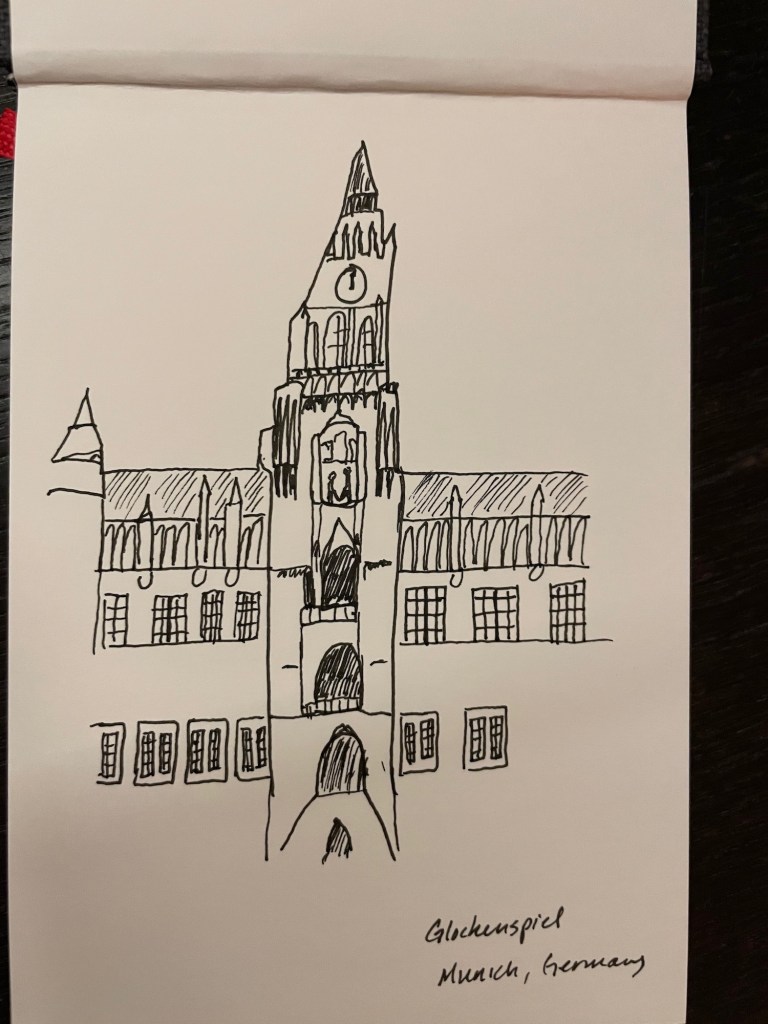
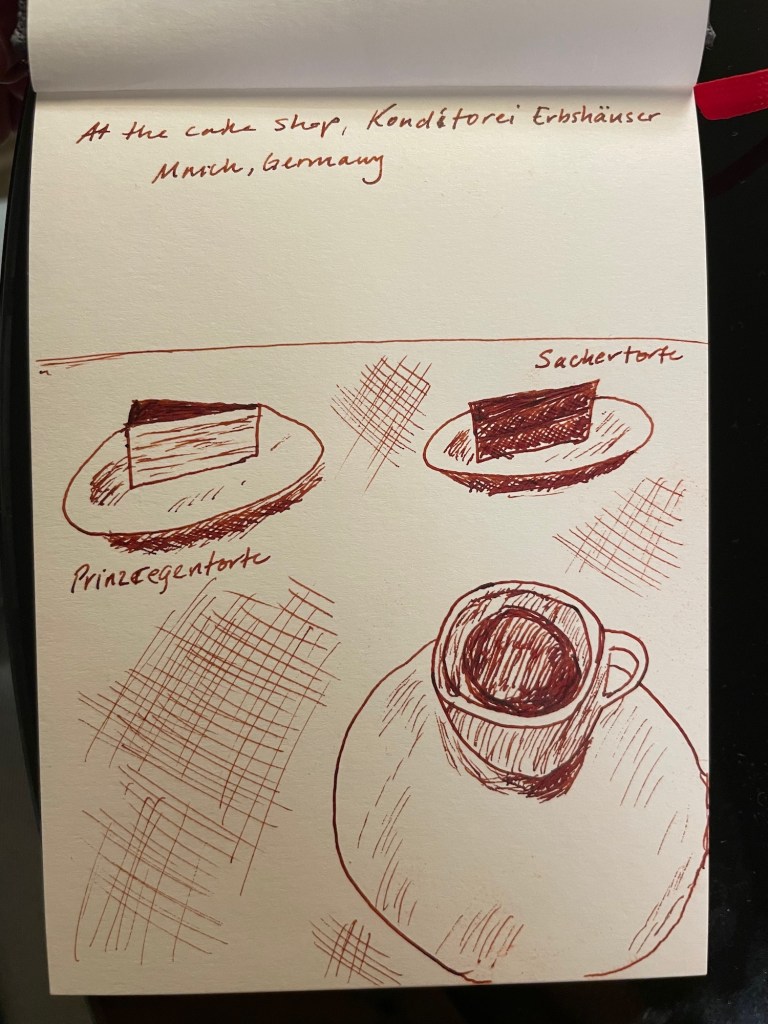
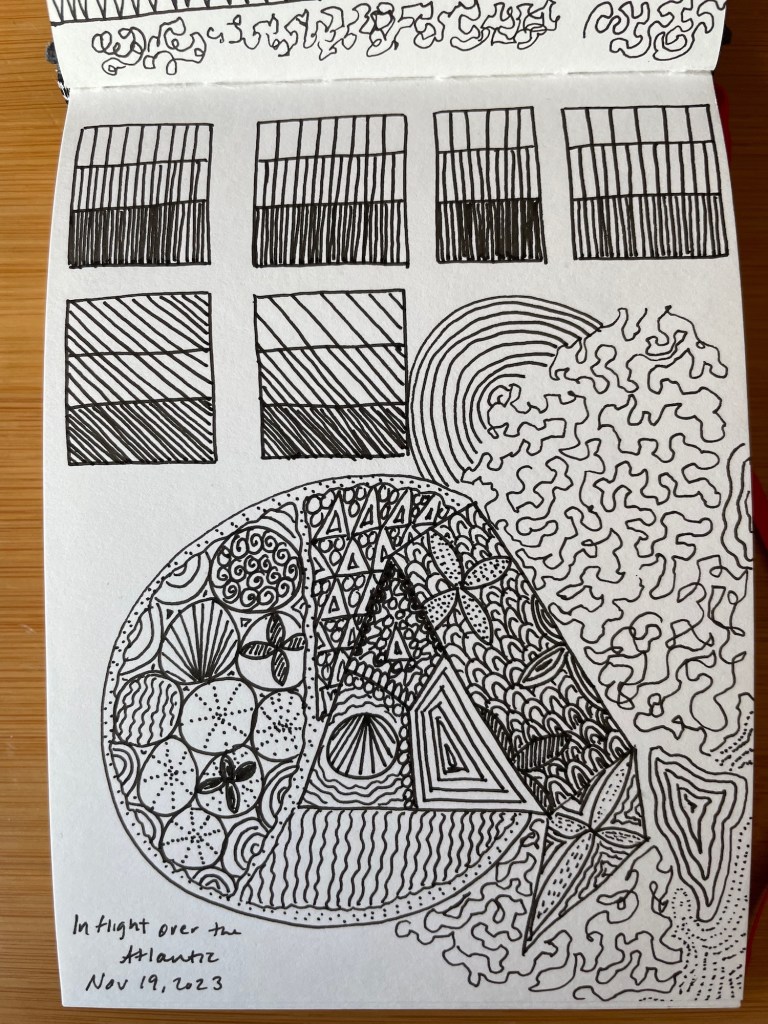
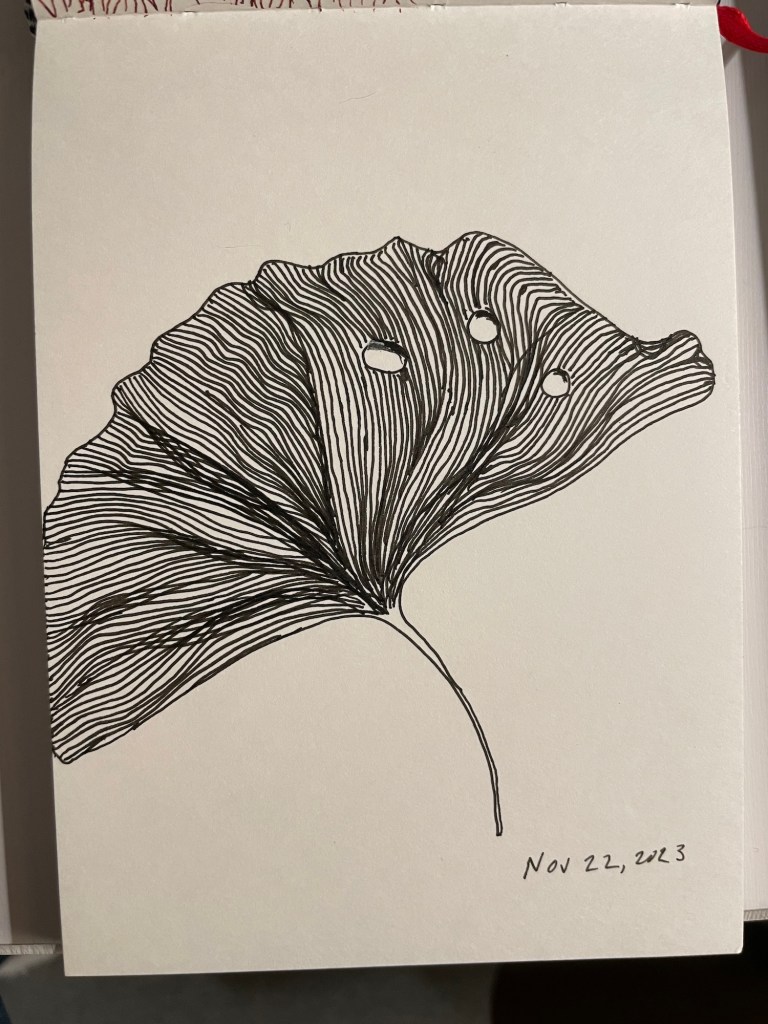
As soon as I got back to my hotel room, I sat down and drew. I drew the Glockenspiel. The next day, I drew my coffee cup and cakes from the cake shop. The third day I drew a Munich surfer, the fourth a swan on the lake I walked every morning, the fifth a leaf with raindrops on it. On the 10 hour flight home, I picked up doodling, and I spent hours just drawing lines and shapes. The plane was frigid as we flew over the Atlantic, so I plugged in the headphones and turned on the crackling fireplace relaxation video they had on the in-flight entertainment. I’d read for a little while, then pull out my sketchpad and doodle to the snap and pop of a video fire, then read some more.
Since I’ve been home, I’ve drawn every day as well: a ginkgo leaf I saw by our son’s car, the apple pie from Thanksgiving. With each drawing I do, I find a technique I want to learn. I want to learn how to do textures, I want to learn how to shade. Sometimes I find myself wishing my drawings were better, and I have to remind myself that perfection is not the point. Aiming for perfection makes it feel more like work than play, and it’s no fun anymore. But when I draw just because I like the feeling of the pen on the paper, and when I try to improve one little thing at a time — like texture, like shading — I feel invigorated, and I love it.
Some drawings. The coffee & cake drawing and the tangerine were done with my LAMY Safari fountain pen
P.S. I did see a LAMY fountain pen display in the Munich airport!Fountain pens in the airport, home of Leuchtturm paper… Germany is my kind of place.
P.P.S. I approach my blog posts these days like I approach drawing: they’re messy, and don’t necessarily make sense, and they’re far from perfect. When I aim for something clean and tidy and meaningful, something “well-written”, I end up not blogging. And I’d rather blog than not, so here we are.
Wonder is one of my favorite states of being. Or is it a feeling? Brené Brown includes wonder in her lexicon of what she calls emotions and experiences in her book Atlas of the Heart. In the section on emotions and experiences about things that are beyond us, she includes both wonder and awe. She differentiates wonder from awe — another favorite feeling of mine — by describing awe as a wish to let shine, to acknowledge, and to unite, while wonder feels similar to awe but inspires in us a wish to understand.
I’m sure I use these words interchangeably; I revere both feelings and want more of them in my life. Probably because I love thinking and feeling about things that are beyond us. Wonder and awe are not feelings that can be forced, though I guess, are there any feelings that can be forced? Sometimes awe doesn’t happen even when faced with something awe-inspiring, like seeing the Milky Way in a velvet black sky or gazing up to the top of a towering redwood tree that’s seen 800 years of change; sometimes I’m not feeling it. I’m tired or distracted or just not in the mood.
Other times, though, wonder hits in the most mundane of moments. Like when I find tiny twigs and mosses tucked into my running shoe from a bird stashing treasures to make a nest in the spring. Or like when a read a perfect sentence or see a beautiful painting or what I felt when I watched Hamilton. Or like when a cat crawls onto my arms when I’m typing, nestles up against me until comfy, looks up into my face, and starts to purr.
Tomorrow my husband and I will take a train to Washington, D.C. Train travel in the US is pretty rare, at least in the part of the country where we live, and I’m a little bit giddy about the adventure. We’ll get to watch the countryside go by while reading and doing our own thing, and without having to worry about traffic or parking when we get there.
We have tickets to see the National Symphony Orchestra perform Beethoven’s Ninth Symphony at the Kennedy Center in D.C. I was excited for this symphony in particular because it’s the one I’ve heard over and over again on the Clockwork Orange soundtrack. I have lots of fond feelings about A Clockwork Orange, which I know is weird because it’s a messed up book and movie, but my Grandma had the soundtrack in her record collection and it was her favorite. The album cover is seared into my memory, and I love that my grandmother loved it. Whenever I hear Beethoven’s “Ode to Joy” I think of both her and A Clockwork Orange.
Alas, thanks to Omicron, they switched our concert to Beethoven’s Third instead of his Ninth. The Ninth has an epic choral section that they didn’t want singers belting out in an enclosed space in the time of Covid. I’m slightly disappointed but not terribly. The Third Symphony is said by some to represent Beethoven grappling with his deafness and emerging whole on the other side, which still boggles the mind that this great composer couldn’t hear his own music. Going to the Kennedy Center and listening to the National Symphony Orchestra perform anything is a special event. We get to hear them perform Beethoven.
But that’s not all! We will have a lot of time to wander while we’re in Washington, and one of the first places we’re going to go when we get off the train is Fahrney’s Pens, a shop where US presidents and Washington Post columnists have bought their fountain pens. My husband gave me a Waterman from Fahrney’s for Christmas one year, which he ordered through the mail. In fact, I’ve done all of my pen and ink shopping by mail since I became enamored with fountain pens two years ago, and I can’t wait to go into a real shop and see real pens instead of browsing on a screen or in a paper catalog.
I’m not sure if I’ll take my laptop or if I’ll want to blog while we’re away, so whether I’ll actually blog every day in January remains to be seen. This post will mark 27 days in a row, which I’m pretty proud of regardless of what comes next.
A few years ago, I heard a new definition of strength: that a strength is an activity that strengthens you and a weakness is an activity that weakens you. I like this definition better than what I had previously thought, which is that strengths are the things you’re good at. It is entirely possible to be proficient at something, but for that thing to bring no joy, to feel like drudgery, to be painful, or to be challenging in tedious rather than interesting ways.
Marcus Buckingham, who I’m sure I heard on a podcast somewhere because that’s where I get all of my interesting non-fiction tidbits, explains strengths like this:
A strength is an activity that strengthens you. It draws you in, it makes time fly by while you’re doing it, and it makes you feel strong.
Marcus Buckingham
Under this definition, I have lots of strengths. Gardening makes me feel strong in my body and my mind and my spirit. Learning makes me feel strong. Laughing, appreciating beauty and excellence, planning my flower beds, photography, helping friends and coworkers through sticky situations, being reliable, delivering on what I say I’ll do, sharing a different perspective, communicating clearly and effectively: all of these things make me feel strong.
It’s funny. One of the things I want to develop at work this year is my ability to communicate through visuals. I think of this as being a weakness, that I don’t use visuals enough, that I’m not good at them, that creating them doesn’t come naturally to me, and that it takes a lot of effort for me to make them because basically they’re the ultimate in editing: they require that you distill into a single image what would take hundreds of words to describe.
But what were the last two things I got completely absorbed by? That drew me in, made time fly, and made me want to stop everything else so I could keep working on them? Creating visuals. I’m antsy to finish this post so I can get back to plotting my flower beds on graph paper. And last week at work, I made a flow chart that I’d been avoiding for months because it was intimidating and complex and I had charter’s block, but once I drew a shitty rough draft on paper, just to get me started, the floodgates opened and I didn’t want to stop. I’m proud of the flow chart I ultimately made, though I’m sure it still needs work. But the surprise is that this thing I consider a weakness? It didn’t make me feel weak to make it. It made me feel strong.
So I guess the moral of the story is be aware of the stories you tell yourself about your strengths and weaknesses. A thing you avoid because you think it’s a weakness may turn out to be a strength.







 Butterfly Mind