Last night at the dinner table, my husband made a comment that he apparently makes every time our son eats the round ends of the Italian sausage we serve on spaghetti night. When our son said, “That’s what you say every time,” my husband had an oh shit moment. As in, Oh shit I’m getting old. And repeating Dad jokes.
He and I talked about not knowing which is more distressing: repeating ourselves, or not even realizing we’re repeating ourselves. I’ve said things to our son and daughter that I thought were brand new thoughts to me. Our daughter is gentle when she tells me I’ve told her something before; our son is blunt. “Yeah, you said that yesterday.” When they tell me I’ve told them something before, I’m like no way, I only just now thought of it. But honestly, I trust them more than I trust myself, and maybe I’m just already losing my marbles at age 45.
I do this when I’m writing, too. I’ll do a whole 15 minute write that I’ll think is fresh and new. I’ll be pleased with a particular sequence of words and will puff myself up and pat myself on the back for my genius. Then I’ll read an old blog post with the exact same phrasing and realize, for Pete’s sake, I’ve already written this.
The main problem with repeating ourselves, aside from the losing our marbles part, is that jokes and phrases become stale when they are overused. If they somehow manage to be good the first time, the chances of them being good a second time is very low. Scarcity makes them special; the second time they come around they’re just disappointing. For example, I’m reading a book now that used the word “panache.” What a fabulous word! We all know the word, but it’s rare that I hear it or read it. When I came across it in my book the first time, I was delighted! When the author used it again 50 pages later, I was deflated. It lost its specialness in its duplication. Perhaps the author is using it intentionally for two different characters whose fates will intersect, but I’m doubtful.
My memory has always been crap, so it’s unlikely I’ll suddenly start recognizing when I’ve written something before. Without editing full time, I don’t know that there’s much I can do about the repetition thing other than apologize to you, dear reader, if I repeat myself too much about the marshes and salt water, about books and reading, about dreams and desires, so that they become stale for you. If anyone is aware of a miracle memory tonic, please let me know!
My husband and I saw Jimmy Buffett perform at the Virginia Beach amphitheater last weekend, and I wasn’t prepared for how much it would affect me. Here was the background coastal music of my whole life, from as far back as I can remember. Here was the future I want for myself and my husband, job-free and on-the-water. And most refreshing in a world of entertainment filled with betrayal, deception, explosions, fighting, power plays, ugliness, and abuse, here was playfulness and optimism. What caught me most off guard was Buffett’s joy. Every time he grinned his open boyish grin, it sent an electric current straight to my heart. His smile lit me up inside.
Like most people of my generation who grew up or vacationed on the coast, Jimmy Buffett was the soundtrack of my childhood. Like the sun and the palm trees, the waves and the sand, the boats and the beachgoers, Jimmy Buffett was always there.
About a year ago, our family was on a road trip. We had dusted off the Banana Wind CD and were listening to it in the car. I had heard the CD a hundred times, and like I usually experience music, I never paid attention to the words. My husband and daughter always listen to lyrics, I rarely do. I don’t know why. I’ll even sing words, but not think about what they’re saying or recognize that they are even language. They’re part of the music I guess, like another instrument, and I don’t process their meaning.
At any rate, I was singing along to a song, and after singing a line or two, I realized, whoa, this guy can write.
I’ve got a school boy heart
A novelist’s eye
Stout sailor’s legs
And a license to fly.
I got a bartender ear
And a beachcomber’s style
In those few words I had a full picture of the person being described. I knew he was probably barefoot, loved life and adventure, sailed, and was a pilot. But I was particularly stunned by “novelist’s eye” and “bartender ear.” In two words he tells us he’s always observing the world around him, looking for scenes and stories, carefully watching and possibly writing descriptions in his mind. In another two words he tells us that he’s always listening. He’ll listen to your story and make you feel like he’s your best friend, like you are the most interesting and important person on earth.
I started listening more closely to his lyrics after that, really paying attention. His word choices are evocative. Song after song I am blown away by how much he conveys with very few words. Like Hemingway, but fun.
And it’s not just that he can capture a scene in just a few words. He is able to transport you to where you want to be (if you want to be any of the places he sings about). His anthem Margaritaville is so overplayed I imagine he must be tired of performing it, but it’s overplayed because of how resonant it is. He creates a laid-back world his fans feel in their hearts and want to be a part of:
Blew out my flip-flop
Stepped on a pop-top
Cut my heel had to cruise on back home.
But there’s booze in the blender
And soon it will render
That frozen concoction that helps me hang on.
The lyrics that move me most nearly every time I hear them, and that made my heart swell with love for Jimmy Buffett when he sang them to a backdrop of moonlight on the ocean, the lyrics that make me feel seen, that make me feel understood, and that sing the song of my heart, are from A Pirate Looks At Forty:
Mother Mother ocean I have heard you call Wanted to sail upon your waters Since I was three feet tall. You’ve seen it all. You’ve seen it all.
I took Jimmy Buffett for granted all my life. He’s always been there. I never thought about his brilliance as a writer, even though I love words, even though I’ve listened to his music for all 44 of my years. I just knew how he made me feel: warm, relaxed, happy. His music transports me to where I want to be. He paints a beautiful world that exists right here and right now, and his smile shows me what it feels like to live in it.
Gentle reader, I try to avoid swearing in my posts, but there is swearing in this one. Just a heads up.
I was first introduced to men as the default human (and the ideal) through language: he, him, mankind. God as Father and Son.
I remember having a conversation with our son when he was maybe 8 or 10, and he used “him” as a generic term. I asked him, “Please say ‘him or her.’”
“But ‘him’ is general and includes everyone,” he said.
“‘Him’ doesn’t include me,” I said. “How about you switch to saying ‘her’ to include everyone?” He immediately understood my position. “Her” didn’t include him.
I had similar conversations with adults about God being a He. Those folks would be predictably condescending, like oh you cute thing, that’s just language, and God’s too big for language, and “Father” and “Son” and “He” really means God encompasses all.
Okay, then let Her be a She.
Male as default became apparent to me in other areas of language later in life, when I started my Andrea Reads America reading project, where I intentionally read books by women authors from each state. As I read women, I identified more with the characters, the stories, the broader inclusiveness of different types of people (ie, not just men, and not just women as sex objects). I was nearly 40 before I realized, holy shit, nearly all the books we read in school were by men and about male characters. And they didn’t include me as a woman at all. There are books that are still taught in schools today where girls and women don’t even exist: they are so inconsequential to the Very Important Ideas going on in the book that nobody thought to include them. (Which also, by the way, ingrains in us at an early age that girls and women don’t matter or have anything to contribute, if they’re not even present in the literature we select).
This teaches all of us that the male perspective is the default perspective: it’s what’s considered good and right, it explores lofty ideas, it’s the Canon. It shouldn’t come as a surprise that if man is the default in language, then man is the default in everything. Language is the foundation of how we explain and communicate our world, and it represents who we are and how we operate.
However, waking up can be a slow process. I didn’t realize what it truly meant, at a fundamental, health and safety level, for man to be the default, until yesterday, when I listened to the 99% Invisible podcast episode Invisible Women. What it means for man to be the default is that our world is designed for men: for the male body, male chemistry, male driving patterns, male priorities. As a result, because women aren’t considered at all when testing and making decisions, very few things are designed to take women’s safety into consideration, including cars and, you know, medicine.
Women are disproportionately misdiagnosed for heart attacks and are more likely to die from them because female heart attack symptoms are different from male heart attack symptoms. Male heart attack symptoms are the default we are all taught and know.
Women are more likely to die from car crashes because cars are designed for a default male body type. Cars are tested with male crash test dummies which have completely different dimensions and proportions from female body types, and car designs are based on those crash tests.
Many drugs aren’t tested on women because (women, you are going to die when you see this) periods are problematic.
Now that I’ve had kids and my periods are on a 21 day cycle, I spend a full two thirds of my life dealing with my period. One week of the cycle I’m under the influence of hormones that leave me crippled with conviction that I suck at my job and everything I touch and that I’m worthless and that my family doesn’t really love me they barely tolerate me because I’m not loveable I’m a monster. Another week I’m managing blood and underwear and tampons and diva cups, and I’m making sure I know where all the bathrooms are every time I go anywhere and God forbid if we’re on vacation somewhere that we’re going to swim and how will the sharks react in the ocean and will I have blood running down my leg when I get out of the pool. And then one week of the cycle — for one third of my life – I get to be normal and symptom free.
So, yes, periods are problematic. To 50% of the human population. Women have to deal with periods in our everyday lives, all the time and forever, and have since the beginning of time, so to anyone charged with testing medicine on women, figure it the fuck out. If periods affect test results, then they’re going to affect a medicine’s efficacy, and uh, shouldn’t someone get on that?
When the world is designed with the male as the default, then anything that doesn’t fit that default is considered problematic and therefore something to blame or fix, even if that non-default group is 50% of the population. Like with periods, or like women being “out of position” drivers in accidents and that’s why the safety mechanisms failed.
As an example of needing to fix the people who are not the default, in the workplace we talk a lot about women’s confidence, and how we need to do things to build women’s confidence because women aren’t confident enough compared to the men, and that’s why women aren’t going for promotions or sitting in the C-Suite. As Caroline Criado Perez, author of the book Invisible Women: Data Bias In A World Designed For Men, says in the podcast,
Yet study after study have shown that women are pretty good at assessing their skill, their intelligence, and actually it’s men who tend to overestimate their skill and intelligence. And so when you see that you sort of have to think well maybe it’s not the women who are rating themselves too low, it’s the men who are rating themselves too high. We just never think of it that way. Since the male is the default, we just assume that that must be the right level.
I look at the world around us and how corrupt and broken everything is, and I have to think, uh, maybe we should rethink our default?
I define a strength as an activity that strengthens you and a weakness as an activity that weakens you.
— Marcus Buckingham
I’ve stopped writing many times in the past because I psyched myself out. I rarely read creative nonfiction. What business do I have writing it?
I read fiction. When it comes time for pleasure reading, novels have my heart. So why would I produce what I do not consume? It makes no sense for me to continue if I don’t even write the type of work I choose to read.
I’m reading The Forest for the Trees: An Editor’s Advice to Writers by Betsy Lerner, and in the first chapter, she talks about finding your form as a writer. Do you write nonfiction? Poetry? Novels? Because whatever you write — whatever you gravitate to — is your form. Despite trends, despite what’s selling now, despite what you consume in your leisure time, write the form that works for you. (The fact that I am reading a nonfiction book is not lost on me. Well, it kind of was until I just re-read this. I guess I do read nonfiction, just not at night, in bed, in my leisure reading time).
And it occurred to me, a professional chef does not only eat the type of cuisine she specializes in; an Olympic swimmer does not only attend swim meets when he consumes sports in his leisure time. A pastry chef doesn’t stop baking because she loves savory soups, nor does a swimmer stop swimming because he loves to watch tennis.
As I digested this new way of thinking, that it’s okay for me to keep writing even if my preferred leisure reading is different from what I personally produce, I thought about the way writing makes me feel (productive, fulfilled), and I remembered a podcast I listened to a few months ago. It was an EntreLeadership interview with Marcus Buckingham, a former senior researcher with Gallup who has studied strengths for more than 30 years, where he surprised me with his definition of a strength as something that strengthens you, not just as something you have an innate talent for, or are good at.
Other people might say that a strength is what you’re good at and a weakness is what you’re bad at, but I don’t find that a very compelling definition because frankly there are many things that I am quite good at that bore me or drain me or for which I have zero passion, but I’m good at them.
He describes how some people build entire careers on the mistaken notion that a strength is something you’re good at, like medical professionals who became doctors because they were good at biochemistry. When they got into the job realized they don’t like sick people, but sadly, every day, there are more sick people lined up at their door.
This definition of strengths resonates with me because I find truth in it. I excelled in math and science in school. I started to build a career in science, even got my degree in a biological field, but ultimately realized the work itself did not interest me. The day-to-day activity of life in a lab did not energize me. I had no passion for it. Science was not my strength, despite an aptitude for it in school.
Yet, I continued to read and write, and gain energy from them.
Writing this blog, writing in my journal, writing for work, it all invigorates me. Communicating via words on a screen or a page is the activity I gravitate to, it is how I choose to spend my time when I manage to carve out free time, it is where I find flow, where time disappears, where I produce things I’m proud of. Writing is what I reward myself with at home — “When I get the grocery list done, I can write ten pages/brain dump my morning/edit my blog post” — and at work — “When I finish these tasks, I can write that P2 post/review that draft/revise that page.”
In other words, writing strengthens me. It sustains me despite the lack of results: I’ve not received a single paycheck for my writing, no awards, no print publications. I’ve barely submitted work anywhere, but I have more than 40 filled journals going back as far as 1982 (when I was 8), five blogs with more than 700 entries, and more than 1,200 internal blog posts at work (438,000+ words). The lack of adornments, as Buckingham calls the rewards people seek when they want the fame or the money or status of a role but don’t actually love the activity of the work, have not stopped the words from coming out.
I write because I love to write, and creative nonfiction is the form that fits me best. Reading fiction exposes me to stories, paragraphs, sentences, and words the same as any other reading would do. It exposes me to structure, to vocabulary, to themes. It makes me feel, it makes me think. It is different from what I write, so it exposes me to different points of view. Reading fiction should not stop me from writing nonfiction.
Nothing should stop me from writing, in fact, except simple desire. Our strengths — the activities we do that strengthen us — are what energize us and help us thrive. It makes no sense to stop doing them.
I was planning to run my first bike/run combo today, which is called a “brick” in triathlon lingo, because your legs feel like bricks when you try to run after riding a bike. But when I checked the forecast yesterday, it called for thunderstorms all day today, with an extra special treat of severe weather this afternoon, which here in Minnesota usually means tornadoes.
In the middle of the night, I woke to crashing thunder several times, with lightning flashing through the openings in the curtains, and every time I thought, “Go on weather. Get it out of your system now so I can wake up to clear skies.” I really didn’t want to ride and run in a lightning storm.
And when I woke this morning at 7 AM, this is what I saw through the slats in the blinds:
Blue Sky
You’d better believe I jumped out of bed to take advantage of it. Because what I couldn’t see from my bed was the ring of black sky all around the small patch of blue.
My bike ride was awesome, as bike rides always are, and I was tempted to take it even longer than my training schedule suggested (only 30 minutes – what’s the point in that?). But the sky was darkening back up, and I figured I should get back home and run before my luck ran out.
I dropped my bike off, changed shoes, grabbed my headphones, and took off running. At first I thought, “Bricks? What bricks? My legs feel totally normal. Like I didn’t even ride my bike!” By the end of the block it felt like someone had opened me up and poured lead into my waist. The heaviness seeped down my hamstrings, into my calves, all the way down to my heels and toes. Picking up my feet was like uprooting trees. And I thought, “This sucks.”
I looked at my watch and 4 minutes had gone by. Only 4 minutes? I’ve got to do this for 26 more minutes? What the hell was I thinking of signing up for a triathlon?!
The sky was grey and gloomy. No more blue skies and happy clouds. All I could think of was my friend Liv’s blog post, Three Ways to Make Blogging Suck Less, and how I wanted someone to inform me of three ways to make running suck less. Besides doing more running.
The clouds parted (for real!), I found my stride, and the Runner’s High commenced. My right foot fell on every down beat, in perfect rhythm with the music. I was swift, I was light, I was running, and it didn’t suck! I ran like a track star, like I’d been running all my life, like my legs were feathers. My stride lengthened. My shoulders loosened. My lungs opened. I grinned a stupid grin while I ran.
In short, I kicked ass.
I have no idea what the song is about, because my Spanish is no good, but I do know that that song lifted my feet and lightened my load, and it put me on cruise control for the remaining 20 minutes. The next thing I knew, the run was almost over, and James Brown’s Make it Funky came through to take me home. I feasted on homemade crepes and a perfect cup of coffee with my family as the sky opened up and poured its deluge onto the roads I had just ridden and run.
Originally written May 22, 2011 in Minnesota, when I was training for my first (and only) post-children triathlon, I thought this would be a good fit for this week’s Daily Post photo challenge: Good Morning! Also, Calle 13’s “Pa’l Norte” has this effect on me every time it comes on my iPod when I run. I’m kind of sick of my other workout music though. Do you have any favorite running tunes?
Unlike the praline catastrophe, where I was able to save the candy, my attempt at a campfire blueberry crisp was a spectacular failure from which there was no recovery. Two weeks and a dozen rounds of soaking, scraping, and scrubbing later, there is still blackened blueberry cemented to the bottom of our cast iron Dutch oven.
After years of camping together, my husband and I are sick of the same old outdoor meals we always make – mac n cheese, chili, hot dogs, s’mores – so on our most recent trip, we thought we’d branch out and try to cook a new dessert, not on a stick, over the campfire. Most of our cookware at home is cast iron, which is ideal for campfire cooking, so I went crazy online researching Dutch oven recipes, looking at pictures of coals piled on cast iron lids, and generally feeling excited and adventuresome. In my zeal, I neglected to dig deep and learn, step by step, how to cook over an open fire with a Dutch oven. It wasn’t until we started our campfire that I began to realize all of the things I didn’t know.
Mistake #1: Underprepare for firebuilding
Our trouble began at the beginning, with the campfire itself. Dutch oven cooking assumes you can build a decent campfire. We don’t generally build campfires that need time to mature, as we usually just need enough heat to toast a marshmallow or brown a hot dog on a stick, so we didn’t take the fire seriously. In other words, I forgot to pack any fat lighter. My husband spent at least an hour with his face in smoke, blowing on tiny twigs, dried leaves, and other campsite kindling trying to build a fire up.
Mistake #2: Use expensive ingredients on your first attempt
Since it was going to be our first time cooking with coals, I thought I’d be smart and minimize our variables. Rather than trying a new recipe and a new method of cooking, I went with at least one known quantity – our son’s favorite blueberry crisp. We picked fresh blueberries the week before our trip, so as soon as we got them home, I measured out five cups of fresh blueberries (5 cups!) for the crisp and poured them into a gallon freezer bag with sugar and flour so that all I’d have to do was pour them into the Dutch oven at the campsite. Our daughter and I prepared the crumble topping ahead of time as well, and at camp, I sprinkled the brown sugar and oat mixture over the blueberries.
Pre-prepped ingredients for campfire blueberry crisp
Assembled blueberry crisp in cast iron Dutch oven for campfire dessert
Mistake #3: Neglect to research how to work with coals
As my husband worked with getting the fire to catch, I fretted over the gaps in my knowledge. I had never worked with charcoal briquettes on a campfire, and my husband is the one who works the charcoal grill at home. I wondered, assuming we ever get the fire going, how long do we need to let it burn before we put briquettes on? Where in the fire do I put them to heat them? If they actually catch and burn, where do we then put the oven – in the fire, next to the fire, on the grill grate? Do we set it directly on hot coals, or prop it on rocks since it doesn’t have feet? I had no answers to these questions, and no cell service to look them up.
Mistake #4: Underestimate the strength of your fire
By the time we finally got the fire going, it was late, and we didn’t feel like waiting for it to burn forever to build embers. When we decided to start coals for the crisp, we had little faith in our fire’s heat or its staying power. We reluctantly separated the wood pieces, assumed we were killing our hard-earned heat, and threw a bunch of charcoal briquettes on the small pile of embers.
Pile of charcoal briquettes on campfire
Mistake #5: Neglect to measure your Dutch oven
Before our trip, I emailed my uncle Joe, who has been cooking over a campfire with a Dutch oven for a long time now. I asked for general advice and any recipe recommendations, and his take-to-camp advice was this:
The most important thing is to put coals on top & bottom while cooking. Not knowing the size of your oven, here’s a guide from the World Championship book:
Dutch Oven size # Coals on top # Coals on bottom
8″ 6-8 4-6
10″ 8-10 6-8
12″ 10-12 8-10
14″ 12-16 10-12
16″ 16-18 12-16
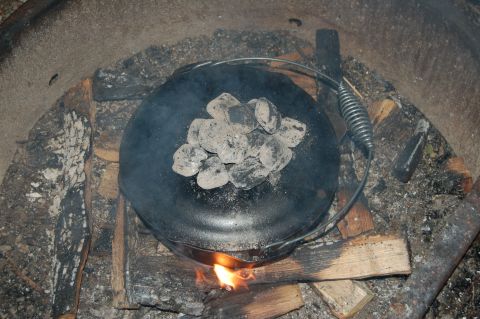
I assumed our oven was a 12″ and went with those numbers, for a total of 22 coals, plus a couple extras, just in case.
Dutch oven with campfire coals
(A week later, as I researched this post, I still am not sure what size our oven is – the base is 8″ in diameter, the top is 12″, and the lid has “10” stamped in it, which indicates a 10″ diameter. I’m thinking its a 10″ which means we used more than 5 extra briquettes. At 25 degrees per briquette, an interesting factoid which I also learned after burning the crisp, that means we added more than 125 degrees. Oops.)
Mistake #6: Disregard advice on number of coals to use
I followed Uncle Joe’s advice on placing the correct number of coals on top of the Dutch oven (for a 12″oven, which ours may or may not be), but since we did not have faith in our fire’s power, and I was not sure where exactly to put the oven, we blew off the 8-10 coals on bottom rule and just set the oven directly on the remains of the fire – charcoal briquettes (plus the extras), campfire embers, and all.
Mistake #7: Do not check progress
I am told that if you know your oven’s size and are using the correct number of coals, you can effectively create a 350 degree oven using your Dutch oven and charcoal briquettes. If you are doing it correctly, your recipe should cook for the same amount of time it would at 350 degrees at home. I know our crisp usually takes 30 – 35 minutes, so once we situated the oven and coals, I checked the time on the car clock, sat down at the picnic table, and waited. Since our fire seemed young and wimpy (see mistake #4), we feared lifting the lid and letting all the heat escape. Plus it seemed like such a pain to remove all those coals on top, especially since I had also forgotten tongs and we were using two wooden spoons to move hot coals around.
We really should have taken our chances and checked the crisp’s progress.
Because we underestimated our fire’s heat, overestimated our oven’s size (resulting in too many briquettes), and disregarded the instructions to place a certain number of coals under the oven, when we finally pulled the oven off the coals after 35 minutes and opened the lid, it looked like this:
Burned campfire blueberry crisp (note the ash on left)
I admit, I cried. Especially when I realized I hadn’t brushed off all the ash from the lid coals and I dumped a huge pile onto the crisp. Not that the crisp was edible, even before the ash, though believe me, I ate some. I downed a big smoky bowlful, even after everyone else took one bite and then asked for S’mores.
Which, thank God, I had the makings for.
Up next: Campfire pizza! Stay tuned for awesomeness…