After my recent post regarding rejection, and how my heart flutters with each new email in dread of the next “So Sorry,” I was very excited to receive two emails last week that did make my heart jump, and in a good way. The first was an acceptance note. Brevity Magazine’s Nonfiction Blog picked up one of my pieces and has republished it. Check out Why Description Matters to the Brain on Brevity’s blog, edited by Dinty W. Moore. (Interesting aside: Brevity and I share the same Oulipo blog theme. Grayscale, minimalist, word-focused. Pop of orange. In (an) other word, Awesome.) On the heels of the email from Mr. Moore, I received an email from Cheri Lucas Rowlands, an editor at WordPress.com, that she planned to include my site on the WordPress.com News blog. Sure enough, yesterday morning I saw my drunken snow day graph on A Special Sunday: A Mix of Mother’s Day Blogs. Big thanks to Mr. Moore and Ms. Rowlands for making my week. If you are a new reader and you found me through the Brevity or WordPress blogs, welcome! I’m very glad to have you here.
In other news, whether you are new here or you’ve been here a while, if you look to the left on your screen (or under “Menu” on your mobile), you’ll see some new features that I’ve added to Butterfly Mind. One is a Table of Contents (of sorts). I’ve yet to figure out a way to make my site more easily navigable, and since I’d rather write than get lost in a rabbit hole of blog design and drop-down menus, I decided to whip up this table of contents instead. It catalogs my first 100 blog posts by title and includes a favorite word from each post. The entries are in chronological order, beginning at the top with the very first post in June of 2012.
I have also added a Guestbook. Whether you’re a regular here or if you’ve just arrived, please feel free to say hi. I love to know where you’re from, what brought you here, what you like to read and write.
I have officially run out of story ideas. A friend of mine has encouraged me to submit work to the Southern Women‘s Review, and as the deadline approaches, I find myself creatively crippled.
I am a Southern woman, born in the South, raised in the South, and after a few years in the not-South, we have settled down in my motherland and will raise our children in the South. Anything I write, then, is fair game for this journal: “Submissions should be from women who were born in or grew up in the U.S. South; currently live in the U.S. South; or write about the U.S. South.”
But that’s not enough for me, to be a born and bred Southerner and to currently live in the U.S. South. I feel like I should write about the South, about how I never felt like I fit in as a Southerner growing up (I didn’t like sweet tea, for one), but when I moved away and folks sincerely thought the South was like Deliverance, that if they stopped their cars in the southeast they’d risk violent rape by toothless bumpkins, I defended my home against their ignorance and developed a fierce pride for my region. Or I could write about how I didn’t understand the South for so many years of my young life – Southern pride, the clinging to Dixie flags, the continued obsession with the “War between the states” – and how Gone with the Wind (the book, not the movie) explained my heritage and helped me understand Southern culture better than any history class ever could. Or maybe I should write about my experiences as a Southern woman who explored other regions, who has lived in other parts of the country and loved them, but how it still feels like a homecoming to move back to Virginia, even though I’ve never lived here.
Or maybe, I could write about my childhood in the South. About my Grandaddy and Nannie’s farm in Eatonton, Georgia. Where we dug worms from the wet soil of the creek bank, in the shade, by the old mill on their farm, then threaded them, still squirming, on our hooks to catch yellow-bellies in Crooked Creek. Where a trip to the hardware store with Grandaddy, in his old silver Ford pick-up truck with a shiny black steering wheel knob and the shifter on the steering column, was the highlight of our visit when we’d stay a whole week. Where we dug potatoes, and planted carrots in neat rows, and shucked corn and snapped peas under the walnut tree by the tractor shed. Where in the morning I’d say, “Wait Grandaddy! I’m coming with you,” while I hurried to put on my Nannie’s boots to walk through the dewy grass, past the scuppernong vine, and the gourd birdhouses, and the peach orchard, to the compost pile behind the barn. Where Nannie had a plaque on the wall that said “The only way to kill time is to get busy and work it to death.” Nannie, who’d grin and say “Scat!” when we’d sneeze, or “Skin the cat,” when my brother would peel off his sweaty shirt from working in the stagnant middle-Georgia heat. Nannie who worked crossword puzzles, and made cornbread stuffing, and raised three kids while Grandaddy flew bombers in the wars.
Or my mind goes back to Grandma and Grandpa’s house on 6th Street, East Beach, St. Simons Island, Georgia. Grandma with her pretty pastel pillow mints in a crystal dish on the sideboard, with the $2 she left under our pillows when we’d visit, with bottles of Rolaids on every end table, between all the couch cushions, tucked in the cushions of each chartreuse chair, where nowadays someone’s cell phone would fall, and get lost, and be found when the chair suddenly vibrates under someone’s bottom, surprising them so that their eyebrows shoot up and their mouth forms an “O.” Grandma, who introduced me to A Clockwork Orange, her favorite vinyl record, with that strange and wonderful white cover, with a man in a bowler hat and one set of false eyelashes who smiled an enigmatic smile as he emerged, dagger in hand, from a black triangle. Grandma who taught me how to brush my teeth with my finger when I forgot my toothbrush, who had a rosebush by her front door, and who’d give me scissors and a vase when I asked if I could cut pink roses for her. Grandma, who said “You all” instead of “y’all” in her sophisticated, old money, soft Southern drawl.
And Grandpa in his seersucker suit, quiet, always smiling, who’d disappear to his room upstairs, full of light and warm salty air, with a clear view of the dunes, and the wide tan beach, and the distant sound of waves swishing over sand. Grandpa who had a podium up there, with the biggest dictionary you ever saw, and an old black and white TV with a rabbit ear antenna and a knob that you turned with a satisfying click to change the channel. And Grandpa’d come back down with a handheld wooden maze where you’d have to deliver the tiny silver bead from one end to a hole in the other. Or with a wooden puzzle cube that we’d pull apart and spend hours trying to put back together. Grandpa, a career diplomat, who earned his law degree after his three sons had grown up and moved away, who was scorned as a young man by Grandma’s parents (for being poor) until he started working for the State Department, when his now proud mother-in-law began submitting his and Grandma’s travels to the Atlanta Journal’s Society pages. Grandpa, who loved Heavenly Hash ice cream, who smiled and waved at us, the grandkids coloring quietly on the green shag carpet, during the evening hours when Grandma would settle in with her gin and milk to talk politics with her sons and their wives.
But those are just descriptors, right? Childhood memories of an aging Southern woman who has returned to the South. There’s no plot. There’s no story there. So here I sit, wondering what I will write.
Work never sent out is never finished. Hidden from the world it remains safely (and sadly) on the writer’s shelf. – Priscilla Long
I wrote recently that I altered my writing practice one morning – I sat by a window and penned thoughts on paper rather than staring into a pixelated screen and clacking keys on a keyboard – and the shift electrified me. It shuffled my synapses and portended a heightened level of productivity.
Since that day, I shifted my focus to not just producing more and more new work, but to doing something with all the words I’ve already written. I bought a copy of the 2013 Writer’s Market and devoured the first 180 pages in one sitting. I learned about query and cover letters, how to format a manuscript, how to negotiate contracts, track submissions, build an author platform, use LinkedIn. Then I scanned 400 pages of submission guidelines for consumer magazines, trade journals, and writing contests, highlighted titles that my work might fit, and marked pages with paper clips.
I browsed our library’s periodicals and checked out back issues of magazines to familiarize myself with the work they print. I ordered introductory issues to The Sun and Creative Nonfiction, journals our library doesn’t carry. I studied content on online journals like Brevity, who publishes brief, concise literary nonfiction (less than 750 words) and is happy to work with budding authors.
Then? I began the work of submitting. And have reaped the heightened level of productivity my pen and ink session activated. In the past two weeks I have submitted five manuscripts to online and print magazines, two to my critique group, and one to a blog I follow. And I’ve got four more queued up.
Meanwhile, I check email obsessively, wondering about a manuscript I sent out nearly 6 weeks ago. Waiting for the note that says, “We’d like to publish your work.” To my surprise, the first email I received was not about that 6-week old submission. It was about a piece I sent barely a week ago.
And it was a rejection. I received my first rejection this morning. I felt strangely calm about it as I entered today’s date in the “date returned” column of my submission spreadsheet. Maybe because I’ve known all along that this is part of the process. Writers probably write as much about rejection as they do about writer’s block, and before I began my submission process, I read a particularly entertaining piece by Alexis Paige on The Rumpus – Rejection Sucks and Then You Die: How to Take a Dear Sad Sack Letter (and Shove it). Paige, and every writer I’ve ever read, talked to, shared a critique room with, has prepared me for this first of what will be many rejections.
So though my heart flutters with every new email I receive, now dreading the next “So sorry,” rather than anticipating the “Congratulations” I originally hoped for, I will keep submitting. Today, I will buy envelopes so that I can mail a manuscript to a publication that does not accept submissions online or by email. I will continue through my queue.
Sticks and stones may break your bones, and words may too, it turns out. At least as far as your mind is concerned. I won’t write a grisly description of a bone breaking – I did enough of that with tooth drilling yesterday – but according to cognitive research explored on NPR yesterday, if you read vivid language describing the action of say, a femur splintering, your mind doesn’t just see the words and paint a visual picture, your brain simulates the experience. If the writing is good, you might hear the femur crack, see a shard slice through skin, sense a shiver in your own femur. Feel your stomach turn.
This research has powerful implications for writers. It gives us insight into how descriptive writing works, and why it is effective.
Until the 1990s, linguists believed that language was processed by a discrete region of the brain, a language “module” that humans evolved uniquely, since no other species shows an aptitude for language like mankind does. But in the 1990s, scientists who wanted to find this module in the brain found something else entirely when they used functional MRIs to observe the brain’s response to words. They found that when a human hears language, a discrete region of the brain does not respond. The entire brain responds. As Benjamin Bergen and Jon Hamilton described in the NPR piece,
If someone read a sentence like, “the shortstop threw the ball to first base,” parts of the brain dedicated to vision and movement would light up.
“The way that you understand an action is by recreating in your vision system what it would look like… and recreating in your motor system what it would be like to be that shortstop, to have the ball in your hand and release it,” Bergen says.
Your vision system and your motor system react to language. In other words, as Bergen explains, “When you encounter words describing a particular action, your brain simulates the experience.”
This is the key element that got me excited as a writer and a reader – that language creates a virtual reality. They didn’t go into it on the show, but presumably when your mind interprets words, it doesn’t just form images and motor reactions, but good writing may also trigger physiological responses, such as the release of adrenaline or endorphins. Like when Shirley Jackson terrifies me, makes my heart race, and triggers the fight (keep reading) or flight (hide the book behind others on the shelf) response with The Haunting of Hill House. Or when Natalie Goldberg does the opposite – relaxes my muscles, lowers my blood pressure, and cloaks me in calm – with her gentle language in Long Quiet Highway.
So what does this mean for creative writers? These findings are the essence of the author’s adage, “Show don’t tell.” They explain why showing works and telling doesn’t. When we tell a story in the form of “this happened, and then this happened,” we’re not giving the reader much to work with.
Alice went to the window and got mad when she saw Tom had showed up.
What experience can the brain simulate from that? Not much. “Went” and “got mad” don’t trigger specific images that give the mind traction for launching a virtual reality. But if we use strong verbs, if we show Alice’s stride, if we describe her anger with a facial expression:
Alice strode to the window and scowled when the chauffeur opened the car door and Tom stepped out.
The reader’s brain has specific images to work with, like “strode” and “scowled,” that conjure not just visual cues, but emotional cues as well. The reader will likely experience a more vivid simulation with the second sentence. Maybe there will even be a reaction – a little fluttering in her heart as her mind braces for a confrontation.
From a big picture standpoint, these findings are thrilling to me because they show why literature moves us, why we crave it, why we are driven to create and consume it. Language is not just for communicating, as bees communicate the location of flowers through the waggle dance. Human language is also for evoking feeling, for connecting us through common crises, for teaching us how others have lived. For suggesting significance beneath the surface of it all.
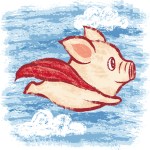
As the NPR piece explored, the brain can make sense of something that doesn’t exist – a flying pig, in their example – by extrapolating and inferring meaning through language cues. With literature, and creative writing, we are able to simulate experiences the reader has never had, or trigger ones that she has. If we write well, we are able to create a virtual reality that links a 21st century executive with the struggles of a 19th century slave, or a modern 7 year old with a pioneer prairie girl, or a gregarious extrovert with the inner workings of an introvert.
If we use language well, we make it possible to understand each other. We transmit an awareness. If the reader’s mind feels that femur splintering, she will have compassion.
If we write well, we share the human experience. If we write well, we gift the gift of empathy.
Instead of staring into a cold glow of pixelated light this morning, I kept the computer shuttered away in its desk and sat by the window, where blackness transitioned to grey, and grey blushed warm and pink as dawn approached. I turned on a lamp, pulled Natalie Goldberg’s Writing Down the Bones from the shelf, and folded my legs underneath me on the couch to write, pen in hand, ink on paper, in a marbled composition book.
I went to bed last night not knowing what I’d write about today, and I woke up in the same state of emptyheadedness. I didn’t know much, but I did know that staring at the same computer screen I stare at every morning at 6am wasn’t going to inspire me. I needed to change things up, to disrupt my routine. To jibe.
While I waited for my coffee, I flipped the pages of Goldberg’s book till I found an exercise that looked easy. Page 87. Lots of empty space with two lists of words. One list nouns. One list verbs. Sweet! I like lists.
The exercise, entitled “The Action of a Sentence,” instructs you to fold a piece of paper in half. I did this in my composition book. On the left side, write a list of ten nouns. I wrote:
On the right, write a list of ten verbs. Goldberg actually instructs you to “Think of an occupation; for example a carpenter, a doctor, a flight attendant,” and then write verbs that accompany that occupation. I missed that part though (remember, no coffee yet?) and just wrote some verbs:
jostle
drape
billow
slice
sizzle
nick
stitch
thrust
peel
jibe
Then? Put your nouns and verbs together in sentences, and voilà! You are writing.
A stiff wind peeled fresh dogwood petals from their branches.
With velvet ink, she stitched sentences onto paper.
The cold martini billowed warmth into her belly.
The candelabra draped the room in light, and in shadows.
Chartreuse shoots sliced the black earth, stretched toward the light, and unfurled triumphant cotyledons.
A butterfly jibed, frantic to find shelter as the storm gathered strength.
She thrust the Dutch oven into the coals, angry that he had swindled her. Furious that she had misjudged.
Sunlight sizzled on a sapphire sea.
Her goggles were jostled in the maelstrom of elbows and feet, already leaking two minutes into the open water swim.
Staring out the window, he nicked his knee, tap, tap, tapping it with a sharp, dried fingernail clipping.
This 72 inch geographic relocation, from sitting at the computer to sitting by the window, and the changes that resulted from it – natural light and an incandescent lamp; a paperback (not electronic) writing book, opened to page 87, tented on the couch; my hand moving across paper; lists of nouns and verbs, and the physical action of stitching them together to sew sentences – has electrified me. Has shuffled my synapses.
I feel a high level of productivity coming on.
Goldberg sees writing as a practice that helps writers comprehend the value of their lives. The advice in her book, provided in short, easy-to-read chapters with titles that reflect the author’s witty approach (“Writing Is Not a McDonald’s Hamburger,” “Man Eats Car,” “Be an Animal”), will inspire anyone who writes—or who longs to. (from Natalie Goldberg’s website)
From the podium, I looked out into an audience of about 60 people. Their eyes focused on me, and from their facial expressions – a smile in the second row, fascination in the fourth – I saw that they were absorbed. Nobody sipped coffee, or coughed. Nobody shifted position. I continued reading.
“The air was heavy, thick with heat and mud. We skirted exposed oyster beds in the shallow water, moving slowly enough that we could hear the oysters snap and pop.”
My mouth was dry, but I was reading better than all of my practice sessions, and I didn’t want to throw my momentum by taking a sip of water. All weekend I tried to suppress my nerves as we cheered our son’s team at a soccer tournament in Charlotte. I did not succeed in hiding my stress from my husband, though, and he asked what was wrong.
“I’m just nervous about my reading on Sunday.” I attempted a smile.
“I wondered,” he said. “You seemed really nonchalant about the whole thing.”
And I was nonchalant. At first. Talking in front of a crowd doesn’t bother me. I used to give informational meetings several times a week in front of total strangers when I worked for The Leukemia & Lymphoma Society. But as the Valley Voices reading approached, and I practiced my piece over and over and over again, finding another fault with each and every read-through, I realized that reading your own work, for which you’ve mined every word, for which you’ve excavated your soul, is a very different thing than giving a sales pitch for your employer. Sharing your own work on a blog already makes you feel vulnerable, even though you get to be secreted away in the privacy of your home when others read it. So to stand in front of a crowd and expose your creation out loud? It makes you feel squishy and naked, with every flabby flaw exposed.
My husband asked, “Why are you so nervous now, when you weren’t before?”
“Because I heard the other writers read at rehearsal, and they were really good.” I studied the cobalt blues in the hotel hallway carpet. “I don’t have any confidence in mine.” I didn’t say it, but I thought, maybe mine was was the only nonfiction submission they received. Maybe that’s how it slipped in.
“You’re just sick of looking at it, and you’re nervous about reading. Don’t beat yourself up.” He hugged me. “It was selected, Andrea. The judges liked it. That’s why you’re there.”
My mouth was parched. Only two pages to go. I felt a little faint. I looked up again and saw the same rapt attention. I had passed the place where I thought the piece sagged, and the audience was still with me. Their silence was electric. I could feel that I was reading well. Thank God. It didn’t suck.
When I finished, I croaked out a small “Thank you,” then sat in my chair, quaking, relieved that I was done. I was able to enjoy the other writers’ work, and was grateful for the beauty in their poetry, and the laughter they surprised out of me with their humor.
After the reading, I was speaking with one of the judges, thanking her for reading all of our work, when a woman tapped my shoulder and told me, “I loved your piece. I was right there with you. I could smell those marshes, and I’ve never been there.”
“Thank you. Thank you so much for telling me that.” I beamed at her.
Later, one of the organizers of the event gave me a big smile and told me I had read well.
“Thank you, Jane! My God, I was so nervous. I couldn’t believe it even made it in.”
“Why not?”
“Because it doesn’t have a point! It’s just pretty. No tension, no drama, no climax.” None of the elements of a successful story.
She looked surprised. “It doesn’t have to have all of that. I was with you on that boat, I was engaged the entire time. I could hear the motor, I could smell the marsh. I experienced that boat ride with you. We all did.”
On the way home, I mulled the problems I had seen in my piece. I painted a picture, yes, but is setting enough without a story? Is “pretty” enough without a punch at the end? I chewed on Jane’s words, “It doesn’t have to have all that.”
And then, I thought about visual art. I pictured nudes reclining, and a still life of golden pears, and how the beauty in well-rendered scenes moves me. I thought about Van Gogh’s oil painting of a café terrace at night. Its rich blues and vibrant yellows, the halos of the stars, the luminescence of light from the cafe spilling onto the dark cobbled street. There is an inherent tension between the welcoming café glow and the inky darkness of night, a drama in the contrasts, if you really want to analyze it. But mostly, I just find the painting pretty. There is a beauty in it that doesn’t need a story. A beauty in it – the contrasts of light and dark, of blue and yellow, a couple walking toward the cafe, a triangle of green fir on the edge of the painting – that is a story.
It occurred to me then that with all the ugliness in the world around us, sometimes, pretty is enough.
The Café Terrace on the Place du Forum, Arles, at Night, c.1888 by Vincent van Gogh
 After my recent post regarding rejection, and how my heart flutters with each new email in dread of the next “So Sorry,” I was very excited to receive two emails last week that did make my heart jump, and in a good way. The first was an acceptance note. Brevity Magazine’s Nonfiction Blog picked up one of my pieces and has republished it. Check out Why Description Matters to the Brain on Brevity’s blog, edited by Dinty W. Moore. (Interesting aside: Brevity and I share the same Oulipo blog theme. Grayscale, minimalist, word-focused. Pop of orange. In (an) other word, Awesome.) On the heels of the email from Mr. Moore, I received an email from Cheri Lucas Rowlands, an editor at WordPress.com, that she planned to include my site on the WordPress.com News blog. Sure enough, yesterday morning I saw my drunken snow day graph on A Special Sunday: A Mix of Mother’s Day Blogs. Big thanks to Mr. Moore and Ms. Rowlands for making my week. If you are a new reader and you found me through the Brevity or WordPress blogs, welcome! I’m very glad to have you here.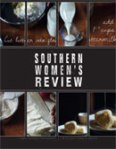



 Butterfly Mind
