Three hours in the morning is not enough time to do all the things I want to do before my workday begins. For the past 29 days, I’ve published a post on my blog every day; today will be the 30th. It’s satisfying to publish here, it makes me feel like I’ve done something.
The problem is that if I blog, I don’t journal. Three hours before work seems like a lot of time, but once I’ve fed the cats, done a short bodyweight workout, meditated, emptied the dishwasher, watered Christmas trees, made coffee, eaten breakfast, and cleaned my breakfast dishes, I’ve got about 30 minutes before it’s light enough to go for a run and get me home in time to shower and start work by 8. I can easily journal and take care of a few bibs and bobs for myself in that 30 minutes. Or I can blog. I can’t do both.
These past 30 days, I’ve opted to blog. I’m starting to miss my private journaling though. I pulled out one of my fountain pens yesterday to write a check, and I couldn’t get it flowing; the nib was clotted with dry ink. I pulled out a second, and a third. All had the same problem. This makes me sad.
I either need to restructure my days to fit in both blogging and journaling, or I have to pick between the two. I haven’t decided yet which direction to go.
I’ve blogged seven days in a row. Yesterday, I had already run out of things to say. To keep going, I pulled a prompt from a reflection deck of cards, wrote for ten minutes, and published.
Today, I was tempted to just not post. But I know what happens when I don’t post: one day turns into two, then several, and next thing I know, I haven’t written in weeks because nothing seems worthwhile to write about, and even though I want to blog, the inertia of not-blogging is hard to overcome, and then it becomes a whole thing: do I blog? What will I say?
I figured today I’ll push through and post anyway, just to keep my momentum. I’ve got the energy and drive to publish, if not a topic. I’ll just put my keys on the keyboard and let them go.
This morning as I unloaded the dishwasher, I listened to the How to build a happy life podcast’s season finale, where they talk with someone from one of the world’s longest running study on happiness, with data going back to 1938. The study has followed people through all stages of life. The researchers have found patterns of what shows up for the happiest people. They’ve asked people at the end of life about their greatest regrets. I had to stop every couple of minutes to take notes, and the five main notes I took were these:
Take care of your body like you’re gonna need it til you’re 100 (1st of 2 shared traits of happiest people).
The happiest — and healthiest — people are the ones with lots of social connections, of all types, including intimate partners, friends, and work and casual relationships (2nd of 2 shared traits of happiest people).
Maturity is marked by not pushing love away, whether through negligence or actively rejecting it. Love is most important thing, at all stages of life. Cultivate it, welcome it.
As you age: stay engaged with the world. Garden, find community. Stay physically, intellectually, and socially active.
Quote from Joseph Campbell: “If the path before you is clear, you’re probably on somebody else’s path.” Meaning, you’re likely following “shoulds” and others’ expectations, not your own. It’s okay and even good for the path ahead of you to be unclear.
I feel like there are topics here to explore more fully in future blog posts if I keep pushing through. If you’re also struggling to blog and these spark anything for you, I’d love to read what you have to say about them.
A fellow blogger, bone&silver, wondered the other day if quick, visual media like Instagram and TikTok have stolen us from WordPress and word-based-blogging. I’ve thought about her post almost every day since I read it two weeks ago. I was struck particularly by her observation not that we are all scrolling and consuming these quick reels these days — I think we can all agree we do that — but that bloggers aren’t blogging as much. I hadn’t quite put that together until she stated it so plainly.
At least three-quarters of my favourite bloggers have either stopped altogether and disappeared, or else just post once a month or so.
– bone&silver
I, too, had stopped blogging. Her post motivated me to start again. Like many bloggers, I’m on again off again with publishing. I’ll go on a several-day streak, and then I’ll dry up and stop, sometimes for weeks or months. Or I’ll publish sporadically when the mood strikes. The mood has struck since reading her post, and I’m leaning into it while it lasts.
I’m not on Facebook or TikTok, but I do scroll Instagram. What I get from it is fleeting. I see a cat or sheep video that makes me giggle, or a photo of a friend that makes me happy to see their face again, and get a snapshot of where they are in their life. And those things are good! But I don’t get a lot of insight into thoughts or feelings, and most of what I consume doesn’t stick with me or make me think. Words take more time, but I like their depth and meaning.
Two good friends of mine blogged about blogging this week, and they inspired me to get off my butt and publish again. They made me miss my blog. This space has been my companion for ten years; I published my first post in June of 2012.
I haven’t always written on a regular cadence. In 2013 I published 159 posts; in 2019 only 38. At the beginning of the year, or a month, or a particularly motivated period, I’ll tell myself, “I’m going to blog every day!” or “I’m going to publish three times a week” or whatever my goal du jour is.
I rarely meet those goals. Or I meet them and then am like, thank God that’s done, and then I abandon my blog because it had become a chore and I need a break.
It’s funny, I consider myself to be a routine-oriented person. I rely on routine to give structure to my days. When I look at my actual behavior, though, it seems I’m constantly changing things. If someone were to ask about my daily routine, I’d tell them I write in the morning. But these past few weeks, I’ve hardly written at all; I’ve used mornings to work out (because I didn’t get an A on my health assessment), edit photos (because I’ve suddenly gotten super into photography again), and meditate (because I need to chill). So though I think of mornings as my writing time, really, mornings are just my me time.
My pre-chill self might have worried about this, that I’m not writing enough, that I’m not writing like I “should” be. But when I observe reality, what has ultimately happened over the years is that I write when I want to write; I blog when I feel a wild hair to blog. I don’t need to trade in my pens because my camera suddenly has my attention; I’ll always come back to words.
I like that it gets all this mess out of my head. Without writing, I’m not sure I’d be able to maneuver in the physical space of the world. I’d be too busy following tangled mental threads, running on hamster wheels of worry, running things I need to remember over and over again in my mind until I do the thing and I don’t have to remember it anymore.
I shared once that writing for me is like Dumbledore’s Pensieve, a magical repository where he can siphon memories out of his mind for storage and later review: writing things out removes them from my head so that I can get on with my external life. Unlike the Pensieve, I don’t just write memories, and I don’t necessarily write for later review. It’s more of a mental hygiene thing, like brushing my hair or clipping my nails. Writing helps keep things from getting tangled or growing into gnarly curled claws that get in the way of everything, or that break because they weren’t cared for.
I already spend a ton of time in my head. Without writing, I’m not sure how I would get out of it to navigate life.
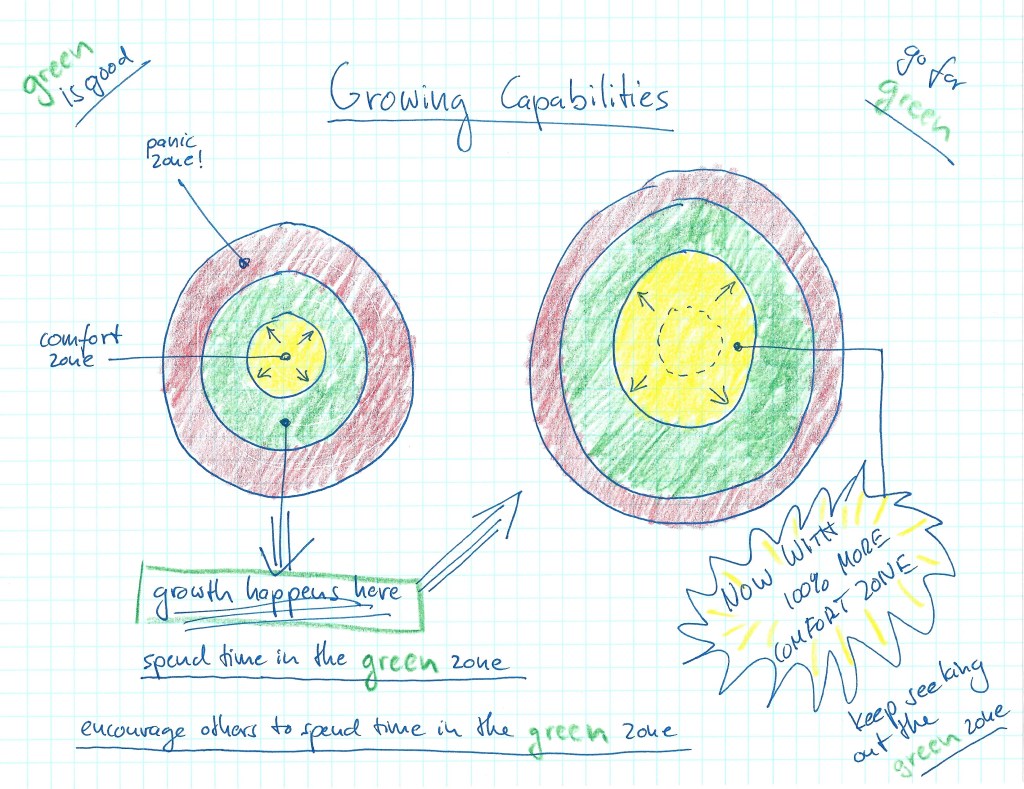
Data scientist Martin Remy once gave a talk about how we can grow our capability. He drew a picture with a small center circle, then another circle around that one, and a third, larger circle that encompassed both. The center circle he colored yellow and named it the comfort zone. The outer ring, he colored red and called it the panic zone. The middle ring, between the comfort zone and the panic zone, he colored green. He named it the growth zone.
Credit: Martin Remy (he has not published this yet but gave me permission to use it. And I quote, “Open source ftw.” Thank you Martin!)
The comfort zone is a place where we know what we’re doing and we’re comfortable doing it. It’s where we feel natural and capable. It is safe. It doesn’t require a lot of effort to occupy the comfort zone; the comfort zone is a place where you can coast. The thing with the comfort zone is that it can be a place of contentment, but it may also be a place of complacency. If you only hang out in your comfort zone, you may feel a sense of stasis. For me, staying inside my comfort zone manifests as a sense of feeling stuck in a rut.
The red panic zone, by contrast, is a place so filled with risk and unknowns that by entering it, there’s a good chance you will careen off the road, crash, and burn. In the panic zone, you are far enough outside your element that have no tools to navigate it; you have no control. You’ll make poor decisions that will be hard to recover from. We should all avoid the panic zone.
The place in between, though — the green place, the place that’s outside our comfort zone but not so far outside that we cannot handle it — is where we grow. It’s where we build on what we do know and are already skilled at, but we push ourselves a little further, into new territory. When we do that, when we push into the growth zone, we add to our knowledge, we add to our confidence, and we make our comfort zone even bigger: we are more capable at more things after we venture into the green growth zone.
In my writing life, writing in my journal is 100% inside the comfort zone. It is the center of the comfort zone: it doesn’t even come close to the edges.
Yesterday I went outside my comfort zone when I published my Writing in 2021 post. It’s one thing to confess fears and attempt to dispute them in the privacy of journal pages, and especially to write cheesy affirmations for yourself. But to publish all that? That’s uncomfortable. There’s nowhere to hide.
Because it was going to be public, though, I analyzed my negative self-talk more thoroughly than I likely would have if I’d just dashed off examples in a journal that I’d never look at again. This meant I was able to find relevant evidence to dispute those stories, and most importantly, to formulate affirmations that address the specific things I worry about. Writing for publication made me really process what I think so I could understand it myself. Only then could I express it clearly to others.
Now it’s out there for me to hold myself accountable and refer back to. If I hadn’t pushed myself to publish that post instead of secreting it away in my journal, I don’t think I’d have gotten to the point of how to move beyond the stories I tell myself, and to identify things I can do differently to change the narrative. I’m in the growth zone! And the thing is, since I’ve pushed myself into this uncomfortable place before, it’s getting easier each time. “Publish embarrassing stuff on blog” is still not in my comfort zone, but it’s now nearer the line between yellow and green, and I understand myself a little better to boot.
 Butterfly Mind