I’ve written quite a bit about how much I love my job at Automattic, but never have I written about what it takes to become a Happiness Engineer. My colleague wrote an epic post about how to prepare if you’re interested in joining the team. If you’ve ever considered applying, this is a must read!
Since joining Automattic (and to the annoyance of some people, I’m sure) I tend to go on about how much I enjoy my job and the company itself. I’ve often been asked what it takes and what you need to know to get the job. Especially since I called people to join me in my last post, I thought I would put together my thoughts and some resources which I can point people to or they can hopefully find through searching online as well.
I’m going to go a bit further and not only talk about what you need to do to get the job, but what I think you need to be successful in the Happiness Engineer role at Automattic. Please note that there are a lot of points here and you don’t have to be an expert in all of them to apply, but having a good understanding…
I am a friend to the sand, to the swath of washed up coquina shells, to my long shadow that stretches down the beach towards the ocean. I am a friend to my notebook pages that flap in the sea breeze, to the bright orange swim shirt my son wears, to the jagged choppy waves.
I am a friend to my mom’s red-strapped canvas L.L. Bean bag that says Mamma S? The single letter after Mamma is worn off — I’m not sure if it was a B for her first name, an S for her last name, or something else. I am a friend to the red folding nylon chair I sit in, with its mesh cup holder for my phone, and its carrying bag with a strap I can put over my shoulder to tote it hands-free when we go back to the car and I need my fingers for flip-flops and fun noodles.
I am a friend to the bubbles the Atlantic makes as wave remnants swash up the beach on their journey across great distance: they’ve travelled to the edge of the sea. I am a friend to the white froth of the crashing waves, the green-brown-blue water of the Georgia coast.
I am a friend to the dead reeds washed ashore, to the sand castles made from carefully dumped buckets, to the cobalt blue shovel and the hot pink plastic pail. I am a friend to my son’s black soccer slides, my daughter’s watermelon flip-flops, and my brown leather Rainbow sandals with the braided straps.
I am a friend to this olive green surf skirt with pockets for my phone and car keys, this skirt that has been with me to Hawaii, Tybee, Anna Maria, Sarasota, the Outer Banks, Mexico, Claytor Lake, that has covered bathing suits and birthday suits, that has faded and needs to be retired but I can’t bear to let it go.
I am a friend to the black hairband on my wrist, to the gray cap on my head that contains flyaways when the wind is blowing and I want to focus on writing instead of pulling strands of hair out of my eyes and mouth.
I am a friend to the white wisps of cirrus clouds high in the dome of the atmosphere. I am a friend to the teal of the evening sky, the tan of the beach, the shell pink of my toenail polish. I am a friend to the black ink that gives form to my thoughts on these white, blue-lined pages.
This was a 10-minute free write inspired by Natalie Goldberg’s prompt to list inanimate objects in response to the phrase, “I am a friend to…” The intention is to pull us outside of ourselves, to wake us to our surroundings and help us pay attention. The angle of the prompt — “I am a friend to” — also helped me have gratitude for these simple, beautiful things that I might otherwise just observe (or not observe) and move on with my life.
Boating life revolves around weather, and here on the coast of Georgia, it also revolves around tides. We spent all day yesterday waiting for 2pm to come so we could catch the sandbar — our ultimate destination for the day — at a time where the tide was high enough to get the boat out of the creek, but low enough that there would still be a sandbar left. At high tide, which was around 4pm yesterday, there wouldn’t be much island to land on.
To kill time we wandered around Tybee for goggles, lemons, and sugar. Vacation necessities. My mom and daughter also passed the morning making a caramel cake: a three layer cake with a frosting that requires two caramel pots — one with cream and one without — that must arrive at the correct temperature and color simultaneously, and then must be beaten together at exactly the right time and then rapidly spread on all three layers of the cake before it gets too thick to work it anymore. The frosting was complex and required two (and sometimes three) people to do everything as quickly as the process demanded. It also took two attempts (one pot of caramel burned) but boy was it worth it. The final result taste likes pralines.
Throughout the morning, the weather darkened. Rain, rain, more rain. For several hours we watched the radar. We watched the sky. We ate lunch while it poured. We talked about a Plan B. I rooted around in my parents’ game closet and found a Young Players expansion pack of cards for Trivial Pursuit. The kids had never played Trivial Pursuit, and I got a bee in my bonnet to play that, but then I couldn’t find the original Trivial Pursuit box with the board and the pie pieces. We killed another hour searching the entire house for the missing board, which led to Mom cleaning out the guest room closet where we did find Boggle and Scrabble, but by that point the kids and I really really wanted Trivial Pursuit.
We were about to get in the car to make the trek over to Savannah to buy the board when my dad said he saw blue sky and the radar was clear. Five minutes later, we were in our swimsuits, slathering sunscreen on ourselves at the end of the dock, ready to go.
On the way out of the creek, we saw a neighbor’s dock, destroyed by last year’s Hurricane Matthew. About halfway from land to the river, the dock falls away into the marsh like an exploded train bridge in a movie. The owners can’t get out to their floating dock, which has a second layer of collapsed walkways: the ramp from the raised deck at the end of the dock to the floating platform on the river is now dangling in the water. The floating dock and the grounded dock are no longer connected.
We saw another hurricane casualty on our approach to the sandbar. A 25-30 foot black-hulled sailboat lay on its side, about 100 yards into the marsh, behind a hammock of land, its mast at a 30° angle to the ground. There’s no way to get to the boat. There’s no waterway and no path over dry land. It is stranded, lifted by the high water of a hurricane and deposited in a place a boat cannot get to.
When we arrived at the sandbar, the sky was still gray. We were the only boat on the water, and we had the sandbar to ourselves. Our daughter jumped off the bow with the anchor, and as soon as she stuffed it into the sand, she and our son were off running as fast as they could, free on an empty beach.
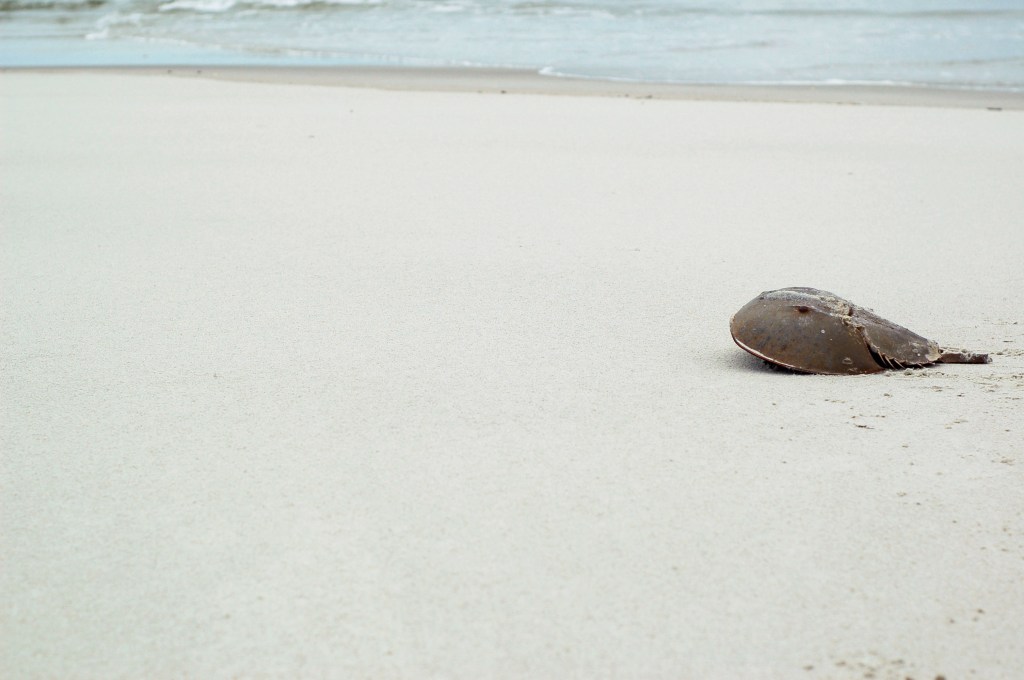
We went to the sandbar a couple of years ago, and the excitement that summer was the cannonball jellies washed up on the sand. This year it was horseshoe crabs.
“Mom! I saved a horseshoe crab!” Our daughter ran across the beach to fetch me so I could see. “I flipped it over — it was on its back — and now it can get back to water.”
Rescued horseshoe crab
We watched as it made its slow, prehistoric trek across the sand. Then the kids were off again, splashing first through ankle-deep shallows that quickly deepened as the tide came in, then swimming in the steeper drop-off over by the boat on the river side of the sandbar, then finally moving to their favorite spot: the ocean side, where the waves are. I watched ships come and go at the mouth of the Savannah River. The tide was right for them, too, to enter and exit the port.
Ship coming into port
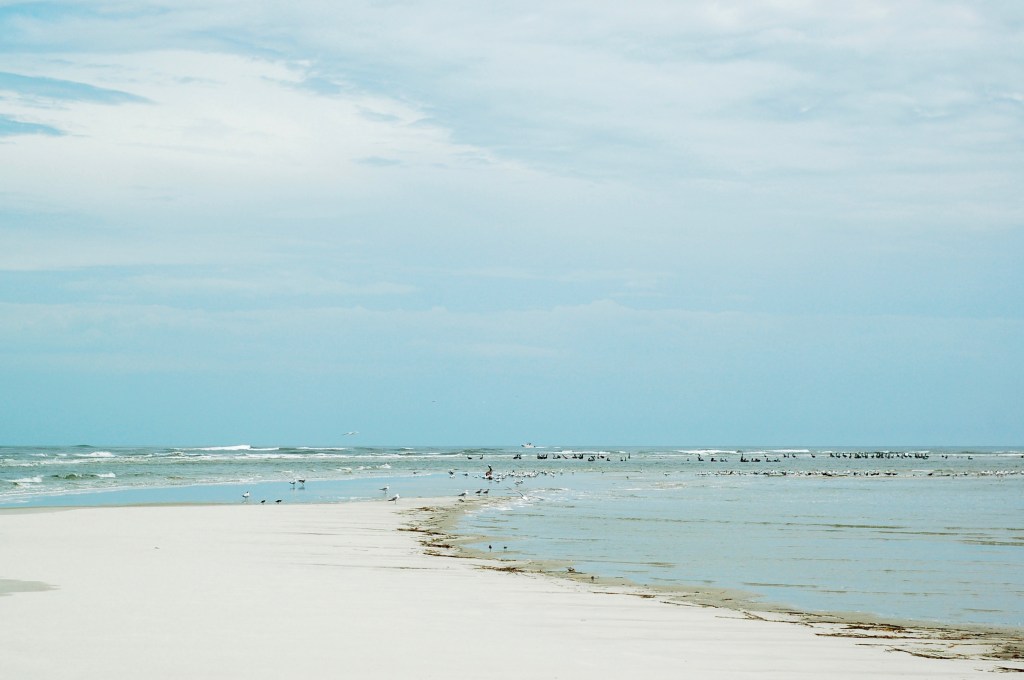
My favorite part of the trip to the sandbar, besides the kids’ joy, the warm sand, and the isolation, besides views in every direction of islands and water, the clearing sky, and the sound of the waves, my favorite part of the trip was watching the tide rise over the sandbar.
On the eastern edge of the bar, the part facing no island, only the open ocean, was a spit of land drenched in shore birds: pelicans on the oceanfront reach, their feet in the water; sand pipers in the splash zone facing north, towards Tybee and the shipping channel, chasing receding waves to dip their bills in the wet sand and catch coquinas, being chased by incoming waves back up onto the shore; seagulls on the dry land of the isthmus, all facing south, towards uninhabited Little Tybee; terns flying, black skimmers mingling with seagulls, willets hanging around the sand pipers.
Water coming over the spit
Sandpipers catching coquinas
Water is getting higher
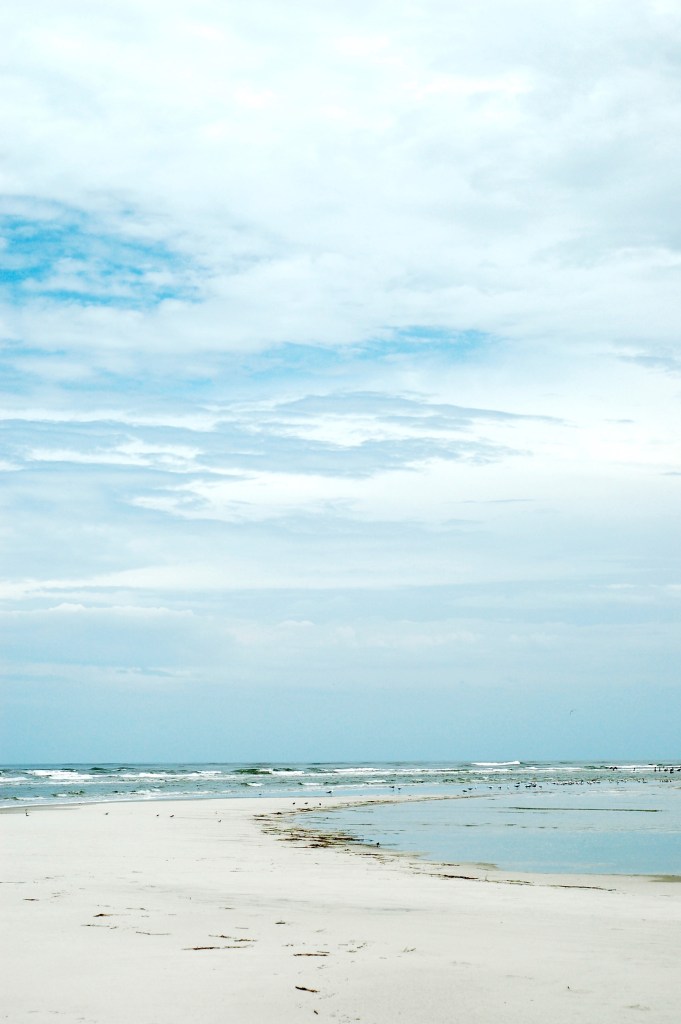
During the couple of hours we were on the sandbar, I watched the dry spit gradually become submerged by the incoming tide. Where the birds were spread over a large amount of land when we first arrived, the gradually clumped closer together as the land beneath their feet disappeared.
Spit and sky
We left at high tide. There was still plenty of sandbar left, but my parent’s dog had worn herself out, and it was time to get her back home. We left the sandbar as empty as we found it, and we headed home for a dinner of blackened fish, dessert of caramel cake, and after-dinner entertainment of board games thanks to a post-boat-trip quest in Savannah for Trivial Pursuit.
Last night on the back deck1 was cool and breezy. Wind blew wisps of hair from behind my ears, and it brought the briny scent of salt marsh and air blown across the Atlantic ocean. This morning when I stepped out of my parents’ front door — the front door of my childhood home — the world was still and muggy.
On the empty street, surrounded by palmettos and palm trees, Lantana and azaleas, I started to put my ear buds in. I hate running, and the only way I can get through it is by listening to music.
But just as I began to muffle the sounds of the outside world as I slid the second white ear bud in, a cicada started up, then a hundred more joined in until my ears rattled with the buzz of cicadas in the still morning air. Island and marsh birds joined in with their morning calls. I pulled the ear buds out and stuck them in my sports bra.
Up by the bridge, a white-haired man in madras shorts and a plaid shirt walked along the edge of the black pavement, a lit cigarette dangling from his fingers. He moved with the agility of youth, but his face looked like he was 1000 years old, deeply wrinkled from a lifetime of wind in his eyes and of sun and smoke on his skin. He rasped out, “Good morning,” and I good-morning’ed him back. I don’t usually hear when people say good morning because of headphones; it was quite nice.
Near the highway, afer a mile of running on a narrow snake of land surrounded by Spartina grass, sea ox-eye daisies, marsh mud, and puddles of salt-water left behind at low tide, I saw a brassy-haired woman walking up ahead of me. Her hair was loose and yellow-orange. I remembered that color from a childhood on the coast, women and men both trying to lighten their hair. Lemon juice, peroxide, cheap home dye jobs. Natural blonde is not an easy color to recreate, and the southeast coast is filled with brassy blonde instead.
On my way home, I heard the scuttle of hundreds of toothpick-tip legs tapping green fronds: fiddler crabs scurried for cover on the dense palmettos when they heard my clomping approach. Listening to music, I’d never heard the scampering of fiddler crabs despite dozens of runs along this stretch of road.
Now I’m back on Mom and Dad’s deck, this time in the screened portion. I’m covered in salty sweat and mosquito bites, and the air is still not moving. The piling driver on the river, here to repair docks blown apart in Hurricane Matthew, has started its metallic ka-thunk, ka-thunk, ka-thunk of pounding pilings deep into marsh mud. The sound echos across the water. It might be time now to put the ear buds in.
I’m going on vacation today, and one of the things I’m most excited about is that I’ll have free time over the next few days to write, and to play with my blog(s). Before heading out of town, I opened my laptop to add my other sites to the menu here on Butterfly Mind, and as I added them, I realized I have five blogs. Five.
If you’re interested in sailing, gardening, words, or American literature, I’ve got blogs for you! While Butterfly Mind is the place where I share whatever thoughts alight on my screen or notebook pages, these other blogs chronicle journeys on the water, on the land, and in books:
Andrea Sails: these are the logs of our adventures on the water. The entries help me keep track of what I’m learning as I venture into this new-to-me world of wind- and human-powered boating.
Andrea’s Gardening Blog: this site is often the result of me blogging with dirt on my hands, from my phone, in the garden, right after I’ve put plants in the ground. I love having a searchable record as each month comes around where I can take a look to see what the garden was doing this time last year: what was blooming? How has everything grown since then? When did I sow those seeds?
Andrea’s Lexicon: these are words I collect that I think are cool. Sometimes I hear them in conversation, sometimes I find them in books. Most of them appeal to me because they’re fun to say. Haberdasher! See what I mean?
Andrea Reads America: this is the chronicle of my journey through the US in literature in three books per state. The three books must be set in the state and be written by an author who is from the state or who has lived in the state. For each state I am reading men, women, and non-Caucasian authors. I’m going in alphabetical order. I’m reading Michigan now, though I still need to write up my Massachusetts reads.
Alright, time for me to hit the road. I’m going to have a hard time deciding which one(s) of these to write for while I’m gone.




 Butterfly Mind