To those who have found Nora hard to like, Messud points out that she would seem extremely likable if you met her, “and that’s the point. It costs her a great deal to be a likable character … underneath that she feels she has had to hide, up to this point, her real thoughts, her real dreams, her real desires, because they would be in some way unseemly or perhaps offputting to people.” – Claire Messud interviewed by Alex Clark in The Guardian
Two weeks ago I would have told you that characters are critical to me enjoying a book, a story, a creative non fiction piece. And by good characters I would have meant likeable characters. I would have told you, I’m not going to get attached, I’m not going to get into their stories, I’m not going to keep reading if the characters are jerks. If I don’t like them, why would I care what happens to them?
Like my friend, for whom setting is critical – she wants to spend time in a place she wants to be – I read to spend time with people I want to hang out with. Augustus McCrae and Woodrow Call (Lonesome Dove) are probably my best friends in literature, and despite the fact that the story always ends the same way, no matter how many times I read it and hope that it won’t, I read and reread Lonesome Dove because I like to be with Gus and Call. With Gone With the Wind, I reread it over and over again because even though Scarlett O’Hara drives me bananas, I’ll spend all day and night with Rhett Butler, thank you very much.
But after three recent books I read, I’m reconsidering my position on characters. Until I read them, I would have argued that even if there are ugly or annoying characters in a book, their detestableness provides delicious tension when balanced against the protagonist (think Disney movies) – will my guy triumph? Will the nasty character amend his ways? But now, I’m not so sure.
The first of the game changers was The Woman Upstairs by Claire Messud. Messud’s novel has sent the literary world into a tizzy because the main character is, according to everyone else, unlikable. I’ll concede that she’s not sweet-natured, but unlikable? That’s a stretch for me. Either way, I’m not sure why this has caused such a fuss because personally, a) I found Nora to be quite relatable, and if not someone I’d want to be best friends with, I at least understood her, and b) she was WAY more likeable than either of the – protagonists? – in Gillian Flynn’s insanely popular Gone Girl. (Perhaps it is because Nora is an unlikable woman?) I question the term protagonist for Flynn’s characters because protagonist suggests the one you’re rooting for, and honestly, even though Amy and Nick are the lead characters, one of whom should technically be considered the protagonist, I wasn’t rooting for either of them. They are anti-heroes, antagonists, and they both made me snarl (and also laugh) as only a well-crafted villain can. Was there such a fuss about their unlikability as there was with Messud’s character Nora? I don’t know.
The third book that kept me turning pages, even though the characters repulsed me, was The People in the Trees by Hanya Yanagihara. Within the first five or ten pages, I didn’t trust or like the narrator nor his best friend, Norton, around whom the story revolves. The more I read, the more disgusted I was by both of them – their arrogance, their superiority – and yet I kept turning pages, all the way to the end, when I was so revolted that I took the book back to the library within minutes of finishing it. I wanted it out of my house.
I’m not generally a rubber-necker. I don’t enjoy train wrecks, neither the literal nor the figurative kind, and I don’t gape at gore – I turn away before I see it. And yet… With all three of these books, contrary to what I would have told you two weeks ago, I devoured them despite the unlikability, despite the train wreck stories, of the characters. I wouldn’t have wanted to hang out with or get close to any of these people, yet I did still care what happened to them. In fact, of all the books I’ve read this year, these were the three that I devoured, that I put writing and chores and sleep aside for. Why? I can’t figure it out. Perhaps it is because of these characters’ realness. These authors took human traits that all of us are prone to – anger (The Woman Upstairs), self aggrandizement (Gone Girl), entitlement (The People in the Trees) – and rather than push them down, they brought them to the surface. These authors showed us what goes on inside an unsympathetic character’s mind, granting us understanding (Gone Girl, The People in the Trees) and sometimes even compassion (The Woman Upstairs). They also showed what happens to a person when these traits become dominant, the types of sorry lives they lead when they don’t keep their meanness in check. They showed what could happen to us if we hide too deep and too long, or at the other end of the spectrum, if we think only of ourselves and let loose all our faults.
Maybe I was wrong, then, about needing characters to be my best friend if I am to enjoy a book. My gorging on these novels is testament to that. None of them even had good guys to balance the antagonistic “protagonists” against, and yet I ate them up. I do know, though, that in order for me to want to read it again, for me to willingly spend time in a story over and over, I’m going to need to love a novel’s players. I’ll hang out with ugly people once and listen to their tales, but if I’ve checked them out from the library, I can pretty much guarantee that they’ll be going right back, without me scooping up a copy for my own shelves. Because for me to want to buy a character’s story and keep it in our home, in our company, the characters not only have to be likable, they have to be my friends.
What about you? How do characters affect your enjoyment of a book, or your likelihood of re-reading it?
 I highly recommend The Woman Upstairs. The work is exquisitely crafted, and as I said, Nora wasn’t particularly unlikable to me. Her intelligence and articulation might merit a re-read, even if I don’t want us to be besties. For my immediate reactions to the three books mentioned, here are my reviews on Goodreads, written as soon as I finished reading: The Woman Upstairs by Claire Messud, Gone Girl by Gillian Flynn, The People in the Trees by Hanya Yanagihara (curiously, the book I liked least was also the most thought-provoking).


 ‘Salem’s Lot, by Stephen King: I was a young teenager when I went through my Stephen King phase. My family lived in a large house on a small island off the coast of Georgia. At the time there were only a few houses on the island, and our road was dirt, not asphalt. We were a twenty minute drive from the mainland (ie a hospital), if there was an emergency. We were isolated. My room was on the second floor, and I had a white day bed with brass knobs on the corner posts. My bed was pushed up against the window, so that when I propped my head against the pillows to read, my body lay inches from the glass, my face in the center of the single four-foot pane. On the other side of the glass, a few feet from the house, swayed a cabbage palm, its moppy head at eye level with my bed.
 Gone With the Wind, by Margaret Mitchell: I was once traveling and got delayed in Atlanta for several hours – maybe six or eight? I had brought with me the 32-pound hardcover of Gone With the Wind, and with so much time on my hands, rather than sit in the loud and bustling Atlanta airport, I decided to take the Marta train downtown to Centennial Olympic park. I lugged Mitchell’s tome with me and found an outdoor table at a café where I could watch kids chase bursts of water shooting up from the ground in the Centennial park fountain. As I read with my huge book splayed flat on a black iron café table, the moist Georgia heat pressed down on me. Condensation from my icy Coke trickled down the cup and pooled, then dripped onto the sidewalk below. I didn’t understand Atlanta, this city that seemed to be both South and not-South, with its messy tangle of inelegant roads and its fast pace and its strange mixture of old and new that I rarely experienced in coastal or rural Georgia. For four hours I sat with my dripping cup and I turned pages. I read the city – it’s pre-Sherman heyday, its burning, its invasion by outsiders, the fierce pride and dignity of its natives, reconstruction’s disregard of the South’s ways, of gentility, and Atlanta’s in-your-face rise from the ashes – on the pages of Mitchell’s book as in real life I breathed its air, drank its Coke, and listened to the laughter of its children, finally, through a work of fiction, understanding the history of this proud city that rose and fell, and then rose to what it is today.
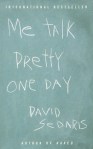 Me Talk Pretty One Day, by David Sedaris: (There are, um, a few F-bombs in this piece. Consider yourself warned.) Though it wasn’t the first time I read Me Talk Pretty One Day, my most memorable reading took place in Minnesota where, in the Mom circles I ran in, I never heard a single swear word (much to my dismay). I sat in the bleachers at the ice skating rink where my daughter wobbled back and forth in her lessons, the paperback in my lap, and I read “The Rooster,” a story about David’s brother, Paul, who “politely ma’ams and sirs all strangers but refers to friends and family, his father included, as either ‘bitch’ or ‘motherfucker.” Paul’s response to his father’s various lectures was, “‘Fuck it,’ or on one of his more articulate days, ‘Fuck it, motherfucker. That shit don’t mean fuck to me.”
 Butterfly Mind