Today I board a flight for my annual girls’ weekend, and I could not be more ready. I realized this morning that I haven’t taken more than a long weekend off from work since I returned from my sabbatical in July. I felt a huge release yesterday at the end of my work day, when I could finally turn my brain off. I probably shouldn’t have waited this long.
March is here, and I am ready for it. I started running again once it warmed up a little bit. I ran outside 3 or 4 times in the past couple of weeks, in short sleeves, and the warm sun on my arms has been glorious. Right now, our windows are open, and I sit in our living room in long sleeves, with a blanket and a cat on my lap, while I listen to birds twitter outside.
The snowdrops and purple crocuses are in bloom at the top of the hill, and I pruned the rose bushes last weekend. I’m not taking a full week off of work for my girls weekend, but at the end of March I will: I’ve put my annual gardening vacation on the calendar. As the days lengthen and the ground warms, I stand at the back door and plan.
Or, I try to plan. For five years, I’ve had a beautiful bed of echinacea in the back garden. Nothing bothered it: not rabbits, not deer. It filled in with broad green leaves by mid-summer, bloomed in magenta coneflowers in July and August, and dried down to spiky seed heads that goldfinches perch and preen on in September and October. Last year, a groundhog found my beautiful bountiful bed and trampled it. It ate all the leaves so that nothing was left but stems, then crushed the stems beneath its gallumping gait. I adore the groundhog, and also, I want my flowers. I don’t know how to solve this problem.
But as I mentioned at the top, my brain is currently off, so I’m not going to think about that now. Right now I’m going to make myself some snacks for the flight, pet the purring cat on my lap, and listen to the birds.
I can’t write in a notebook this morning. I used up my last page yesterday and didn’t have a new one lined up, so here I am at the keyboard. My journal entries are usually brain dumps of all the things running in circles in my mind, so sorry about that if that’s what this ends up being. I have no plan for this post, I just need to write as part of my daily hygiene, like brushing my teeth or combing my hair.
Life has been kinda stressful lately, which is where the lack of notebook paper becomes a real pity. I’d like to brain dump it all, but on a blog that brain dump would actually be read, whereas in my notebook, it would all flow out and never be read once, not even by me. When I’m journaling, the point isn’t to read it, the point is to write it.
I’ve written before about my 30 years of journals that I continue to hold onto because maybe one day I’ll wish I had them so I can go back and read them. I don’t know why I might ever do this. I’ve gone back and read some entries, and like looking at old photos, the act feels, I don’t know what the word is. Pointless? No, more than that, because the feeling feels dark in some way, like I’m immersing myself in something that is already done and gone, something that was once real and vital and important, but it is over now, and to cling to it feels like trying to catch smoke in my hands. Whatever is in the journal entry, or that I see in the photograph of my children or my young self, is part of my makeup, is inside of me, and it was real and happened once, but will never happen again. Hanging onto it or dipping into nostalgia is tempting and seems like it would feel good to sit with memories, but it ends up making me feel like cobwebs and dust that need to be swept from dark corners, even when the memories are good.
I read a short story recently, Tessa Hadley’s “The Quiet House” that pits these two modes against each other: one character spends all her time in memories and reflecting on the past while the other, Jane, is like, pffft, memories smemories, who needs that?
“When you’re having those experiences,” Jane said, “you think it’ll all matter so much later on, when you’re older. You imagine yourself reading old letters, looking at photographs, reminiscing with wistful tears, that sort of thing. But the truth is that you leave most of it behind you. The present is paramount. It’s always everything… Those old stories diminish and don’t matter anymore. It’s shocking, really. We believe we can keep everything and make it all add up.
The most striking memories I have, the ones that bring a jolt of pleasure or of thoughtfulness, are usually unplanned ones. They’re not ones I intentionally wrote about or preserved on film. That somehow makes them more special and real. There is no artifact; they are uncapturable. They are just a fizzy feeling that I enjoy in the moment, when I feel it, and then let it pass.
Anyway. I’ve got a cat on my arms as I type. She’s purring and I will never tire of cats purring on me. It’s one of the very best feelings. Through the sheer curtains, I see the sky pinking up. I want to move the fabric aside to expose the window and the sunrise, but to do that, I have to disturb the kitty. This is a dilemma.
I’m happy it’s Friday. It might be warm enough to go for a run today, and after work, I can let my mind rest. And go pick up a new notebook.
As much as I love fires in the fireplace, I think I’m ready for winter to be over. I don’t want to be in my office, with its cold blue walls, down in the cold basement.
Instead of standing on my anti-fatigue mat at my perfect height desk, or sitting in my perfectly adjusted desk chair, with all of my arm and shoulder and hip bends at exactly the right angles, I’ve been cross-legged on the couch, on the love seat, in the armchair by the window, where the room is warm and welcoming. I’ve been at the kitchen table. I took my laptop stand, portable keyboard, and portable trackpad into our son’s room, plugged in a lamp, and sat at his desk all last week, in the exact version of the chair I have down in my office, except that his desk is a different height and isn’t adjustable. But his room is cozy, and I’d rather be there than in my office.
At the end of last week, I had to lie down at lunch because I had a visual migraine. I’ve had these on occasion in the past, usually pain-free, mostly when I was going through menopause, but I hadn’t gotten one in a while. And this one came with pain. As did the one I got the next day, and the next, and the next. My husband rubbed my head for me one night to help relieve the pain, and as he worked his way up from my shoulders to my neck to my temples, I realized how much tension I had deep beneath my left shoulder blade (from reading or typing on the couch) and up the sides and back of my neck (from scrunching my shoulders at my son’s desk).
Reluctantly, I went back down to my office yesterday. I lit a candle and turned on the space heater, but that’s not enough to transform it to a snug space. The heat is stuffy and localized, and I’m over my office’s current vibe: it’s too electric and colorful. I want to tone it down. I’m going to have to repaint and redecorate to make it a place I want to be. Warmth and fresh air would be nice, too.
The older I get, the more I appreciate short stories. This weekend, I read “Bartleby, the Scrivener” for the first time. How did I miss out on this my whole life? In a neat little package of less than an hour of reading time, Herman Melville gifts us with a funny, rebellious, quietly absurd story that can be interpreted as many different ways as there are readers who read it. What a feat! I’m still thinking about Bartleby, and his flabbergasted boss, and his fellow scriveners Turkey and Nippers and Ginger Nut, and his unshakable, unmovable, “I would prefer not to.” Bartleby, the OG quiet quitter.
Over the past decade or so*, I’ve grown to crave a good short story. Novels are still my go-to — I want the immersiveness of a novel over a long period of reading time. But on the weekends, or sometimes in the evening, or on long walks at the beginning of the month, when the latest reading on the New Yorker Fiction podcast drops (like today!), I like to read a short story or two, similar to how people used to read the Sunday paper in the leisure time of the weekend.
After reading Bartleby, I started thinking about the short stories I’ve loved. Some I return to and read or listen to them again, like Elizabeth Taylor’s “The Letter Writers,” which is hilarious and sad and just as relevant in the time of texting and emailing as it was in the time it was published (1958), when people corresponded through paper letters sent in the mail. Some I remember scenes from that I will always remember for as long as I live, like the vampires in “Vampires in the Lemon Grove” sinking their teeth into lemons. Some I’ll remember the wonder they made me feel, or the horror, or the wow, this captures humanity in all our glory and terror.
Today is Sunday, and I have a new story next to me to read today. Weekends are the best.
*When I was about to publish this post, the “short-stories” tag autofilled when I started typing, and I thought, oh, I already have a tag for this? It looks like my conversion began in 2013.
So far, so good. The snow we thought would dump to our knees is only finger-deep. Sleet ticks against the window as I write. Nobody in the neighborhood has left their houses this morning, and the white outside is pristine. It stretches as far as I can see without tire tracks or footprints. Puffs of steam drift from rooftop ventpipes. Tiny homemade clouds.
The tree limbs are bare: no sodden snow sticks to them. No ice makes them sparkle. Sleet drops at a shallow angle: the wind is barely a breeze, nothing heavy whips in it. All of this is auspicious for us keeping power.
Even if we lose it later today, when the freezing rain sets in, I can sit by the window for light to read physical books. I’m currently making my way through Kafka’s complete stories. I have it in paperback so I can underline, and it’s going much better now that I’ve committed to pause and reflect after everything I read. I’d started these stories last year and other than The Metamorphosis, which really is a spectacular story, everything I read just left me like, huh? I had to text my son after each one: what the heck is going on here? Now that I stop and write, I’m getting a lot more out of the stories. They’re satisfying in that they make me think and question; nothing is tied up in a neat bow. Not a single thing.
In our storm prep, after charging our power banks, I charged my e-reader and my portable book light. So once the sun drops, I can still read a novel even if the power goes out. I downloaded two from the library. We’ve also started building up our bookshelves again, and I’ve got three on the shelf I’m eager to read.
The New Yorker did not arrive yesterday, alas. I had hoped to read it next to the window with my coffee on a snowy Sunday morning. It’s okay. I finished 33 Place Brugmann instead. At first I wasn’t sure about the book. I almost abandoned it, despite it seeming like something I’d really like: a WWII novel told by the residents of an apartment building in occupied Brussels. I had trouble keeping track of the characters at first. But given the leisure of the weekend, I stuck it out, and it paid off. It turned out to be a book about, among other things, the role of art and ideas in civilizations that last. Which I am into.
Now, I’ll read another Kafka story. Yesterday’s was “In the Penal Colony,” which is brutal, and eerily prescient. I would have thought it was written about Hitler and his regime, but it was not. The story predates WWII by 15 years. Today’s story is “The Village Schoolmaster.” There is no telling where this is going to go.
Daily writing prompt
What do you enjoy doing most in your leisure time?
Over the holidays, when I worked most days and my team encouraged me to take time off, I promised them and myself that I’d take a day off in January instead. Today is that day.
Today is also a day that an epic winter storm is bearing down on us, though you’d never know from the sunny sky. For my day off, I’d planned to swim at 7am instead of 5:30, and then to toodle around our tiny downtown. Get some coffee. Walk to the book store. Then go home and relax on the new love seat with a book, or maybe, if I’m lucky, thanks to our son who gave me a subscription for Christmas, with the latest issue of The New Yorker if it lands in our mailbox today. I hope I have it in hand when the weather arrives.
And I did all of those morning things. I just inserted a few other things as well. Like find all of our power banks and charge them. Dust off the camp stove, test if it still works, buy fuel. Stock up on cat food, bring in firewood, wash and dry clothes, grind coffee (I still need to do this one). Marvel at the line out the door at the hardware store for snow shovels, salt, and generators. Consider what’s sold out at the grocery store: water, tortilla chips, yogurt. Hope we have enough food and firewood if we lose power, and our whole region loses power, and we have to go several days with high temperatures in the teens and no heat or range or oven or hot water.
It’s strange knowing this storm is coming and then also just going about my regular day. It’s so pretty out! I added a couple of walking stops on my little morning jaunt from the coffee shop to the book store. Our CEO gave us homework this week to go to a museum. At first I thought, We don’t have a museum in town. How will I do this?
Then I remembered the performing arts center sometimes has exhibits, and there’s a historic house in town that’s been converted into a local history museum that sometimes has art.
After I drank my coffee with the paper — an actual newspaper! I pick them up sometimes now after reading Beth Macy’s Paper Girl — I bundled up and began my walk to the other side of town where the book store is. I stopped in the performing arts center, but it was between exhibits, so I just appreciated the architecture for a few minutes, and the airy space full of light.
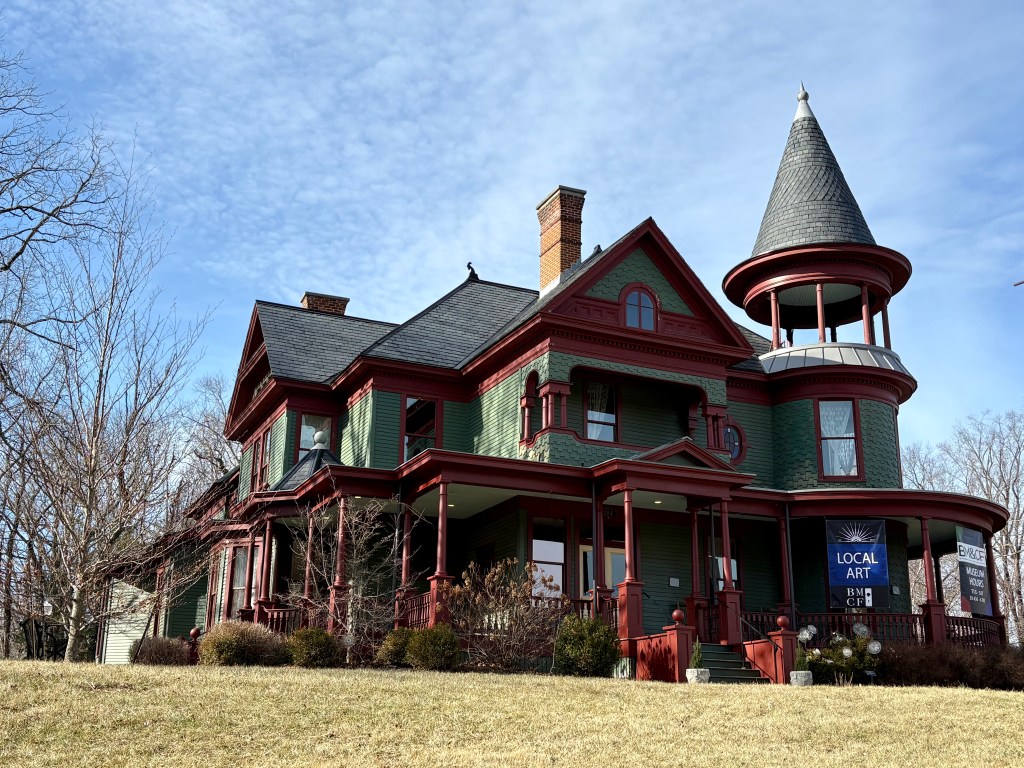
Next I stopped at the Alexander Black House. I’ve passed this building at least a thousand times in the however many years we’ve lived here.
14. That’s how many years.
Anyway, this house is unusual for this town — the architecture is unlike anything else here — and at least half of those thousand times that I’ve passed it, I’ve thought, I wonder what it’s like in there? Well today I found out because I went in.
Alexander Black House
Inside, a local high school exhibited artwork — photographs, block prints, paintings — and I loved putting the pieces together of “They must have had an assignment about eyes” and seeing the different interpretations from these creative minds.
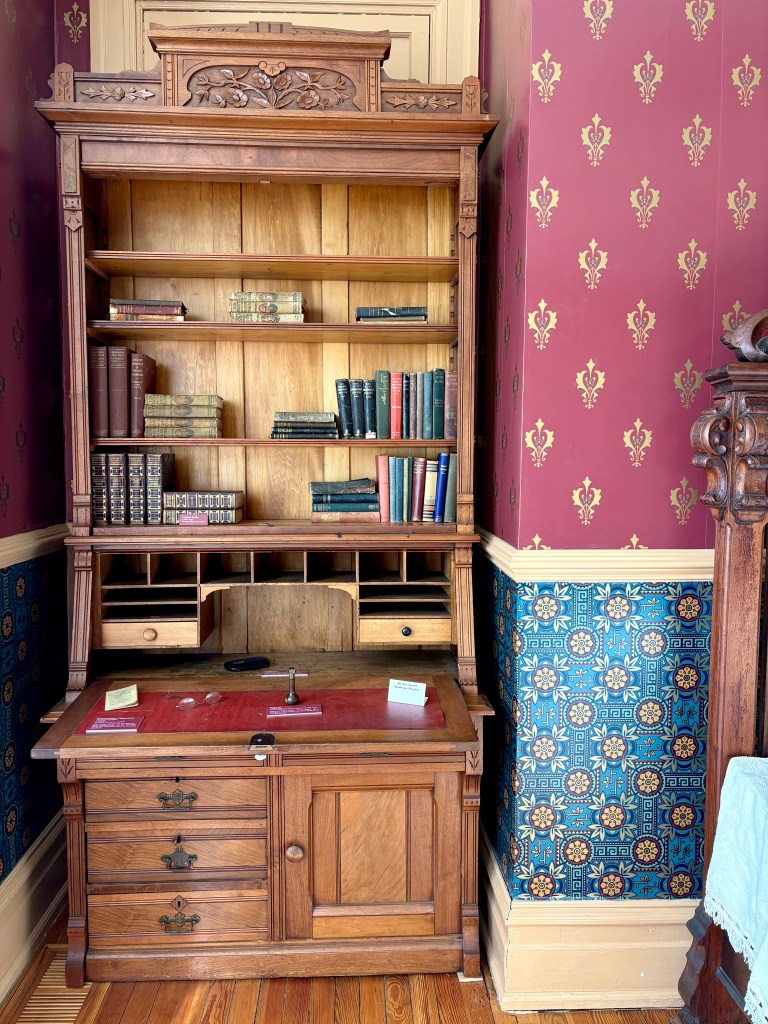
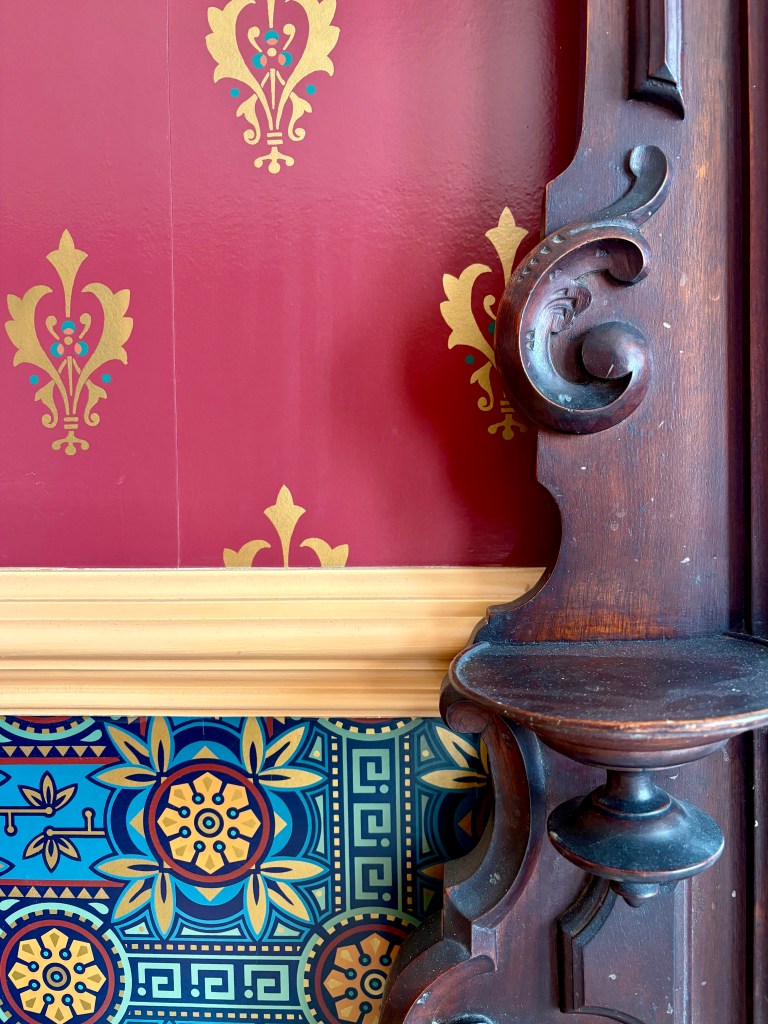
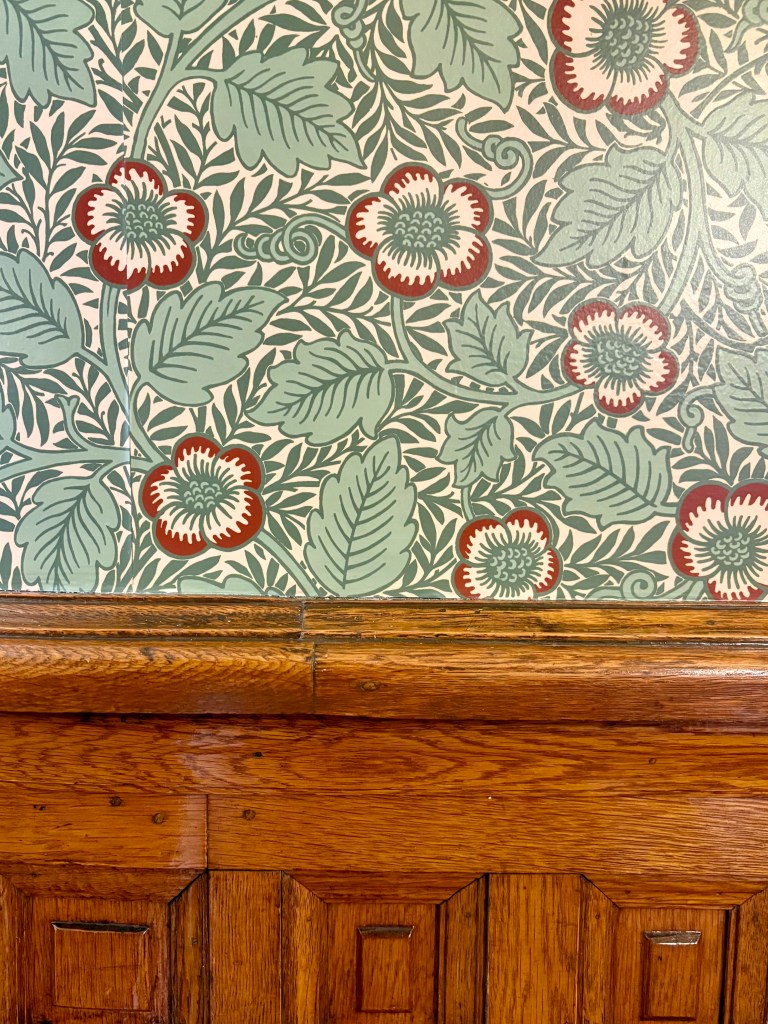
My favorite part of the museum was a room restored to look like it would have in the early 1900s when it was lived in. Look at the wallpaper! I just love it. Someone should bring wallpaper back.
Wallpaper, dado rail, and wainscoting
Now I’m back home with a blanket on my lap, a hot cup of orange tea, and the sun shining through the window. Our forecast has gone from a prediction of 2 feet of snow to now just 4-9 inches, but of snow, sleet, and ice. The latter will be heavy and treacherous. We don’t need to drive, thankfully, but the weight of ice is bad news for downed power lines.
I want to bring in just a little more firewood, then cover the woodpile with a tarp. I’m hoping all these preparations won’t been necessary. It’s really not fun to lose electricity in subarctic temperatures. My favorite part of every day in winter is climbing into our warm bed after turning on our heated mattress pad. It’s so luxurious to preheat the sheets! We can’t do that without power. We can pull camp mattresses and sleeping bags next to the fireplace though.
Daily writing prompt
Name an attraction or town close to home that you still haven’t got around to visiting.




 Butterfly Mind