The town was “between mountains so steep and irrational, they must have blocked most of the sun most of the day.” – Dennis Covington, Salvation on Sand Mountain
I know exactly the types of places Covington means. In our explorations of the Appalachians, my husband and I have been in those steep mountains that obliterate the horizon. You’re stuck down low, in a narrow crack between peaks, where you can’t see over, you can’s see around, and you feel penned in and claustrophobic. The sun seems to set at 2 in the afternoon because the horizon is so high.
The place we hiked this weekend was decidedly not like that.
Stand of firs from Wilburn Ridge on Appalachian Trail, hike to Mt. Rogers from Massie Gap, VA
View from Appalachian Trail along Wilburn Ridge, hike to Mt. Rogers from Massie Gap, VA
Kids on rock outcrop on Wilburn Ridge, Appalachian Trail, hike to Mt. Rogers from Massie Gap, VA
Wild ponies, colt, and view of Appalachians from Wilburn Ridge on AT, hike to Mt. Rogers from Massie Gap, VA
The views we saw on our hike to Mt. Rogers were not from the top of the mountain, they were from all but the top of the mountain. About 7 miles of the 9 mile round trip hike, from the trailhead at Massie Gap to the summit of Mt. Rogers, the trail climbs gently through wide, open meadows, offering spectacular vistas of mountaintop grasslands, marshmallow cloudscapes, stark rock outcrops, and panoramic views of the Appalachians. I felt like we were on the western frontier, that life was full of possibility.
Wild highland ponies along Appalachian trail on hike from Massie Gap to summit of Mt. Rogers, VA
Pink mountain laurel flowers in Massie Gap, along Rhododendron trail to Mt. Rogers, VA
View from Appalachian Trail, from Massie Gap to Mt. Rogers trail, VA
Wild Pony in sunlight along Appalachian Trail on Wilburn Ridge, hike to Mt. Rogers, VA
We originally thought the hike was going to be 11 miles round trip. Though our kids (7 and 9) had hiked Old Rag, a 9 mile hike with lots of technical bouldering, we thought 11 miles might be a little much. We bought them real hiking shoes, just in case, but I was prepared to turn back early with either or both of them so that their Dad could climb to the top of Mt. Rogers. At 5729 feet, it is the highest natural point in the state of Virginia, and I knew he wanted to see it.
When we realized the hike was only 9 miles, I got excited that maybe I’d be able to see it, too. “Hey guys, it’s actually only 9 miles, not 11,” my husband told the kids. “Do you think you’ll want to go to the top, to climb the highest mountain in Virginia?”
“I do!” our son said. Our daughter was less enthusiastic.
“There are ponies along the way…” my husband told her. “And the top is in a forest. A forest filled with Christmas trees…”
That got her. Within ten minutes, his first promise paid off. And continued to pay off. For nearly three miles, we shared the trail and the mountainsides with wild highland ponies.
Wild ponies under trees, Appalachian Trail to Mt. Rogers, VA
Wild ponies from Wilburn Ridge on Appalachian Trail, hike to Mt. Rogers, VA
Wild ponies from Wilburn Ridge on Appalachian Trail, hike to Mt. Rogers, VA
Wild pony from Wilburn Ridge on Appalachian Trail, hike to Mt. Rogers, VA
We stopped so much along the way to take in the views from rocky tops, and to hang out with the ponies, that we made slow progress. The day was perfect – partly cloudy and only 73 degrees – but the sun was hot on our necks, and our son wanted forest. We were surprised when we got to a mile marker and saw we had only hiked 2 miles, so we picked up the pace to get to the top. We passed through Rhododendron gap, a tunnel of rhododendrons that had just bloomed and dropped their petals, and that provided brief shelter in cool, damp shade. Then we were out in the meadows again before turning off onto the Mt. Rogers spur trail to finish the final half mile of climbing.
We ascended in dense forest as we neared the summit, where it was dark and wet and felt like rain forest. The air chilled our skin, and every rotting log, every mound of earth, every tree trunk was covered in emerald moss and peridot ferns. Our arms brushed red spruces and Fraser firs and released the scent of Christmas trees. Our daughter sang Jingle Bells.
New growth – ferns and evergreens along trail on hike to Mt. Rogers, VA
New foxtail growth on evergreen in forest at summit of Mt. Rogers, VA
Fraser firs along trail in forest at summit of Mt. Rogers, VA
Pink rhododendron flowers and fern, Rhododendron Gap, Appalachian Trail, hike to Mt. Rogers from Massie Gap, VA
Green forest at summit of Mt. Rogers, VA
Mushroom, moss, and fir at summit of Mt. Rogers, VA
Nobody turned back, and before we knew it, we were at the top of Virginia. We had hiked a trail unlike any we had ever traveled – wide open to the sky, above the world, sharing the trail with wild ponies – and we all made it. All four of us, hiking companions til the end.
One of the things I love most about Florida, that I miss when I’m away, and that I fall in love with all over again when I return, is the sky. More specifically, I love the clouds. Cloudscapes in Florida are dynamic and dependable. Nearly every afternoon in summer, formations build before your eyes in a blue sky, their faces to the brilliant Florida sun. The piles are clean and bright, like bleached cotton, and you can actually watch them grow, billowy cumulus clouds piling up like a massive mound of shaving cream in a crystalline sky. Variations of light on the clouds are dramatic, ranging from a blinding white on the uppermost billows to an ominous blue black on their low underbellies.
Every day, the clouds are different. Sometimes they are far away, and they move across the sky like giant jellyfish, trailing rain like dark gray tentacles. Other times you watch them grow, you feel the wind pick up as they become cumulonimbus storm clouds, sucking air into their growing system, and you wonder, is that coming our way?
And then that blue-black underbelly is right there,and it blots out the sun. The temperature drops. The menacing cloud is low, right above you. You can see details of its texture, and there is a sense of immediacy – the cloud isn’t over there, where I can watch it from afar. It is right here, like that tree and this lizard, and like me.
A bolt of lightning blinds you, and a clap of thunder cracks, and you feel the ground and your chest vibrate with the impact. Maybe you’ll get scared if you’re outside, and you’ll run for cover. If you’re inside you watch rain pelt hot asphalt and green palm fronds. The storm will crash violently, with thunder and lightning and rain so heavy you have to pull off the highway if you’re driving in it.
Ten minutes later, maybe twenty, it will all be over. The road will steam. The palm fronds will glisten. The sky will clear for sunset, leaving a few cloud remnants, maybe some high cirrus feathers, to reflect pinks and oranges of the sun’s fiery farewell as it drops below the horizon.
And then, you forget about clouds for a while. At least until the next day, when you see a couple of white puffs here and there in the morning. And at 2 o’clock you look inland, and you see a curve of white above palm trees, a great dollop of cloud that grows before your eyes, and you pause in what you’re doing to watch the show.
Egg casings, shells, and turtle grass: storm surge deposits on beach after Tropical Storm Andrea
The morning after Tropical Storm Andrea blew through, we rushed out to see what the Gulf of Mexico had deposited on the beach where we are vacationing. An ecological disturbance like that provides a rare, fleeting opportunity to find a bounty of sea life and new shells washed ashore. We got out early because we knew the beach would be crawling with other explorers picking over the seashells, just like we planned to do.
Mother of pearl inside pen shell
Dead Man’s Finger (orange sponge) washed ashore on Anna Maria Island after Tropical Storm Andrea
Variegated sea urchin on Holmes beach after Tropical Storm Andrea
Shells and waves on Anna Maria Island Gulf beach after Tropical Storm Andrea
Sea star washed ashore on Anna Maria Island after Tropical Storm Andrea
Lightning Whelk egg casing and purple sea urchin on Gulf beach after Tropical Storm Andrea
Horse conch egg casing on Gulf beach at Anna Maria Island after Tropical Storm Andrea
Sea pork (orange speckled blob) washed ashore on Southwest Florida beach after Tropical Storm Andrea
Sea pens, shells, and turtle grass on Gulf beach after Tropical Storm Andrea
Sea weed and shells on Anna Maria Island Florida Gulf beach after Tropical Storm Andrea
Tiny white starfish on pen shell, found on beach after Tropical Storm Andrea
Yesterday, and most days here at Anna Maria, the beach is a smooth expanse of white sand dotted with coquina shells, calico scallops, jingles, and venus clams. But this morning when we stepped onto the wet sand, purple plastic beach bucket in hand, the shells on the beach were so abundant, they hurt our feet to walk on them. They glistened, wet with sea water, like pale pink pearls and polished ivory. Barnacle-encrusted pen shells – intact bivalve husks eight inches long and shaped like mussels, brown on the outside, but deep pearly purple on the inside where the mollusk once lived – were as plentiful as calico scallops usually are. Racks of turtle grass clumped in piles where the Gulf pushed them ashore. We saw a family, each child with a starfish in one hand and a stick in the other. They squatted on their haunches and used the sticks to pull piles of turtle grass apart, searching for tiny treasures in the rich mats. We followed their lead and grabbed pen shells to pick through the grass. We found sea urchins, sea whips (soft corals in purple and red), Sargassum weed, seas sponges, sea pork, tiny crabs, and egg casings of whelks and conchs. And scallop,s and cockles, and hermit crabs, and some kind of lavender-gray blob that looked like a snail who had lost her shell.
Every two steps on our walk one of us would exclaim, “Look at that shell!” or “What is that thing?” Our daughter counted 41 sea urchins on our quarter mile walk, and she was too overwhelmed by the abundance of sea shells to pick many out for collection. Vibrant orange shards of calico crab shell, spotted like leopard skin, jumped out in the sea of soft pink, and so she collected several crab carapaces. The beach crawled with curious collectors and kids with fists full of shells.
A field of seashells on Anna Maria Island after Tropical Storm Andrea
Ripples and bubbles in tidal pool on Anna Maria Island
Little girl shelling under blue sky on Anna Maria Island after Tropical Storm Andrea
Blue Sky over Anna Maria Island after Tropical Storm Andrea
Blue sky over Gulf of Mexico after Tropical Storm Andrea
Lightning whelk and silver-white jingle shell on Anna Maria Island after Tropical Storm Andrea
Our shell haul. Includes calico crab carapace, skate egg case (“devil’s purse), pen shell with barnacles, cockles, whelk, jingles, scallops
I’m not sure what the beach will look like tomorrow. The waves have gone down. Whereas the landscape yesterday was painted in gray and whiteand jade green, with hardly a shell to be found because waves washed all the way up to the dunes, the scene today is one of a sunny, subtropical, Florida Gulf beach. The sky is cornflower blue, the clouds are cotton white. The Gulf is a milky jade, the land is palm green, and the beach stretches in white, tan, sea grass, and a thousand shades of shell pink. Tomorrow, the scene may be completely different. The Gulf may recapture all its treasures with the next high tide, or shore birds may devour the urchins and sea stars and crabs, or perhaps there will be a fresh crop of sea life tossed ashore. Whatever tomorrow brings, we will be there with our buckets to explore it, in all its fleeting glory.
This is my entry for the WordPress Weekly Photo Challenge: Fleeting. I apologize if the photo quality is lower than usual. I forgot my real camera, so these photos were taken with my phone. My laptop screen is also not great, so I couldn’t see the color very well when I edited. Hopefully I don’t get home and see that these are terrible.
“Oh my God, a lady’s slipper!” I pulled the camera out of my pack as I raced to the side of the road. I crouched down and snapped pictures as our nine year old son giggled.
“I guess Mom likes lady slippers,” he said.
I looked up and saw two more lady’s slippers, and then another one across the street. I zigzagged back and forth and shot 20 frames in the first five minutes of our hike. We hadn’t even made it to the trailhead yet.
Pink Lady’s Slipper on Old Rag Mountain, Shenandoah National Forest, Virginia
Bridge over Broken Back Run at trailhead of Old Rag Mountain, Shenandoah National Park
White wildflowers on Old Rag Mountain, Shenandoah National Park
The forest at the bottom of Old Rag Mountain was lush with the apple green of spring. Every shrub, every tree, had leafed out, and in their newness, no matter the species – oak, birch, maple – the leaves were identical shades of peridot. It was mid May, and we had hit Shenandoah at the peak of spring’s grandeur. Everywhere we looked, the forest floor was sprinkled with wildflowers.
My husband paused on the trail as I shot a close up. He looked out into the sea of green, then at me, photographing yet another tiny detail – a flower, a stone, a mound of moss. “Can you get a picture of the whole forest?”
“Sure,” I said. “It’s kind of hard to get a clear shot, though.” I usually can’t see the forest for the trees.
“I don’t care.” He gazed into the green. “I just like the forest here.”
Spring green forest on Old Rag Mountain, Shenandoah National Park, Virginia
We continued up, and up, and up, stepping over millipedes, pressing our palms to boulders, burying our faces in mountain azaleas to inhale their honeysuckle scent.
“Dad, can we climb this rock?” We had been on the trail for an hour, but we still had a long way to go. The hike was going to be about six miles round trip, which would be the longest distance our kids had ever done. More than that, the final ascent was going to be extremely technical, with lots of bouldering. My husband looked worried. He checked the sky for the thunderclouds that were expected to roll in. The exposed rock scramble at the top would be a treacherous place in a storm.
“I think we should keep moving,” he said. “You guys need to save your energy. This is going to be the hardest hike you’ve ever done.” He checked the sky again. “There are going to be plenty of rocks to climb at the top.”
We had gotten an early start – we woke with the sun and were out of our tent by 6:30 am, boiling water for oatmeal and coffee. At 8 o’clock we were already on Skyline Drive, on our way to the trailhead. So other than the threat of storms, I wasn’t too concerned about time. I hiked at the back and stopped frequently to snap pictures. The diversity on the trail was irresistible, and I wanted to photograph it all.
“Andrea, is it okay if we don’t wait each time you stop? I don’t want to ruin everyone’s fun, but I really think we should get to the top, and then we can take our time on the descent.”
I shot one more closeup then put my camera away, “No, you’re right. I can take pictures on the way down.” I vowed to keep my camera stowed, and started hiking at the front, a little ahead of the family so that if I wanted to stop for a photograph, they could catch up while I shot. Not ten minutes later, I had my camera out again.
“Look at these flowers! They look like bells!” My son, then husband, then daughter hiked by. I passed them a few minutes later when they stopped for water, hiked ahead, then had my camera out again. “Look at all this trillium! There’s a whole hillside of it!”
My son laughed as he passed me. “You’re not doing a very good job of keeping your camera put away, Mom.”
Bell flowers on Old Rag Mountain, Shenandoah National Park, Virginia
Hillside of trillium on Old Rag Mountain, Shenandoah National Park, Virginia
Violet growing out of stone on Old Rag Mountain, Shenandoah National Park, Virginia
When we arrived at (what I now realize is) the famous rock scramble, I was glad for my husband’s prodding. I was blissfully ignorant about the hike – I hadn’t looked at the map or read anything about it – and as we lowered our kids into crevasses and watched them clamber over stones that curved toward a 3000 foot drop, I realized it was probably a good thing that I hadn’t. I would have seen things like this, from the National Park Service website:
Old Rag is Shenandoah’s most popular and most dangerous hike. The number of blogs and websites about this hike attests to its popularity. The number of search and rescue missions each year attests to its danger.
Our seven year old daughter was a natural on the rocks. She found her own hand and foot holds, and her tiredness (read: boredom) from the three mile (so far) hike vanished as she scrambled over gray granite. Our son accepted our help more often, and said it was “a little freaky” as he squeezed between 8 inch cracks in mountain stone, or jumped from one car sized boulder to another. The further we climbed on the stone, the more nervous I got about our descent. Getting up the rocks was hard enough – getting down them could be perilous. My husband and son were concerned about the descent too. Yet we continued to climb.
Rock scramble with view of summit on Old Rag Mountain in Shenandoah National Park
Rock staircase with levitating stone on Old Rag Mountain in Shenandoah National Park
Cool hanging boulder on rock scramble of Old Rag Mountain in Shenandoah National Park
Rock scramble on Old Rag Mountain in Shenandoah National Park
Rock scramble on Old Rag Mountain in Shenandoah National Park
Despite our height (and my nerves), the rock scramble was a grounding experience. I was connected to the earth up there, dependent on it, with my bare hands on rough granite, my hip against a boulder, my heart pressed to stone. When we finally reached the peak, after several false summits, I was exhilarated by the mountain under my feet and the big sky above, by boulders perched at the top of the world, by gentle rain falling from a blue sky. There were no thunderclouds in sight, and we had made it to the top. I surveyed a 360 degree view of the vibrant green of Appalachia in sunlight, an unmarred view of spring’s progression up the mountain sides – a profusion of apple green in the valleys thinning to brown bare branches at 3000 feet. And there wasn’t a building in sight. Just forest and rocks and mountains.
We high-fived the kids, and hugged them, and told them, “You are the coolest kids EVER. Look what you just did!” My husband told them, “You can have as many s’mores as you want tonight. You can eat them til you puke if you want to.” Our son shouted “YEAH!” and jumped from one boulder to another at the top of the mountain, while my heart jumped into my throat.
Boulder on false summit of Old Rag Mountain in Shenandoah National Park
View from summit of Old Rag Mountain in Shenandoah National Park
View from Old Rag Mountain Rock Scramble in Shenandoah National Park
View from Old Rag Mountain in Shenandoa National Park
Their dad and I discussed our options while the kids ate granola bars and the wind whipped our windbreakers against our skin.
“Is there another way off the mountain?” I asked. “That scramble is going to be really tricky on the way back down.” Our son had been pretty freaked out on the descent off of only one rock at Dragon’s Tooth in Blacksburg. There were scores of boulders to navigate here. And to be fair, I wasn’t excited about descending the scramble either.
“There’s another way down, but it’s five miles,” he said. Crap. That would add up to nine miles. Double the distance the kids are accustomed to doing.
“I want to go the long way,” I said.
“Me too,” said our son.
And so we did.
Near the bottom, our daughter took my hand and said, “We saw a lot on this hike today.”
Pink Wild Geranium on Old Rag Mountain in Shenandoah National Park
Dandelion on Old Rag Mountain in Shenandoah National Park
Spring forest with mountain azaleas on Old Rag Mountain in Shenandoah National Park
“Yeah, we saw lady’s slippers, and mountain azaleas, a hillside of trillium, and those wild geraniums you like,” I said. She had one of those tucked into her pig tail.
“And dandelions,” she said. “And a waterfall.”
“And those cute little white flowers, and the violets, and boulders perched on mountain tops, and spring climbing the forest. It’s amazing how pretty it can be when we don’t build all over everything. When we just allow nature to be nature.”
Our son nodded, a happy smile on his face. “I like it when nature is allowed to be nature.” And after nine miles that were supposed to be five, after climbing to an elevation of 3291 feet under his own power, after five hours of hiking, he ran off down the trail.
View of Old Rag Mountain from overlook on Skyline Drive in Shenandoah National ParK
Portraiture is possibly my favorite form of photography. Faces show character in every laugh line, every weathered wrinkle, in tan lines left by always-worn sunglasses, in the trickle of sweat through trail dust. In the scraggly beards of men who have walked the woods for weeks.
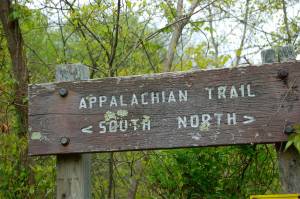
On our drive through Catawba valley, my husband said, “It’s getting close to peak thru-hiker season.” We were headed to Sawtooth Ridge, a portion of the Appalachian Trail between McAfee Knob and Dragon’s Tooth, near our home in Blacksburg, Virginia.
“It is?” I asked, my wheels turning. I had just checked my email and seen that the theme of this week’s WordPress photo challenge was culture, and I thought, oooh, maybe I can cover A.T. culture. Shoot portraits of rugged hikers.
“Yeah, if they left Springer Mountain [Georgia] on March 1, they’d start getting here near the end of April and in May.”
A local friend of ours said she gives away her chocolate snacks when she encounters thru-hikers on the trail. I thought of when my husband was thru-hiking, back when we were boyfriend and girlfriend, and how he would put an entire stick of butter in his ramen noodles at night. “I wish I would have brought more food,” I said.
In the McAfee Knob parking lot, I fingered my camera as large groups of hikers clustered around car trunks and tailgates, stuffing water bottles in daypacks, eating pre-hike sandwiches from Subway, mixing formula in bottles for the baby a dad would carry on his back. I wasn’t brave enough to ask to take their pictures. On the trail, I told myself. I’ll ask hikers on the trail.
We headed south while the crowds headed north towards McAfee Knob. For twenty minutes, we saw no-one. No day hikers. No thru-hikers. The only evidence of humans we found, besides the trail, was a “Home Sweet Home” sign nailed above a squirrel hole. “Kids! Look at this!” I crouched down and snapped shots.
“Do you think a squirrel made that?” Our son asked.
“Or maybe fairies?” said our daughter.
I wondered about whoever had made this miniature sign, who had brought a screwdriver onto the trail to attach it to this little spot. A local day hiker? A Virginia Tech student? Whoever it was, they made me smile with this little surprise in the woods.
We rounded a bend and met a young man and his dog headed north on the trail. The man carried a full pack, with a pair of dusty gray Crocs tied on the side. His hands were red and raw as he gave his dog a treat for sitting obediently as our kids approached.
“Hey, how’s it going?” we said.
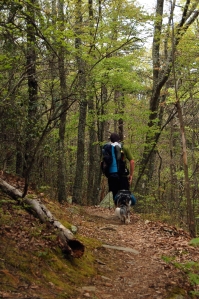
Hiker and his dog on the Appalachian Trail
“Good, good. I just picked this guy up in Pearisburg,” and he pointed at his dog. “I’m trying to train him.” The black and white mottled dog carried his own saddlebag pack and was calm and sweet as he sniffed my hand. His nose was speckled pink and black. The man gave him another treat.
“Well, y’all have a good day!” And he continued north as we continued south. I’m not sure if he was hiking from Georgia to Maine, or if he was just out for a weekend backpacking trip. I did not ask his story, and I did not take his picture, except from the back.
The next hikers we encountered were obviously thru-hikers. We sat on fallen trees in a clearing, munching trail mix and baby carrots, when two women powered through the glade. They carried full packs, wore quick-dry nylon hiking pants in olive green and pewter grey, and their strides were long and purposeful. I wondered where they were from, when they had started, how many miles they were doing that day. Had they mailed boxes to themselves, filled with fresh food supplies, and cash, and lightweight spring clothing? Were they in a hurry to get to a post office and bury their faces in fresh tee-shirts? Clean socks? They said a quick “Hello,” which we returned, and then they were gone. I did not photograph them, or ask them their story. “The next one,” I told myself. “I’ll talk to the next one.”
On our way back to the car, we passed a scruffy young man smoking a cigarette on a slab of rock on the side of the trail. He sat atop a bulging backpack, stuffed full like a giant army-green sausage . He was backpacking, not day hiking. Carrying cigarettes and wearing New Balance sneakers, I didn’t think he was a thru-hiker, but he could have been. I’m sure he had a story. He was lounging, I could have easily asked. But he wore headphones, and I didn’t want to intrude, so I hiked by with a nod and a smile.
By the time we arrived at our car, where five dusty, bearded twenty-something men lay draped over their backpacks, or sat on them as chairs, or propped their backs up against them in the white gravel parking lot, I knew that I would not talk to these hikers, nor photograph their faces. I am fascinated by journalists – by their grit, by their ability to shove in and get the story, by their speed in turning stories out – but I realized on the trail that that is not the stuff I’m made of.
Instead of shooting photographs of “the next one,” or of those prone hikers reclining not 20 yards from our car, I knew I’d bring their images home in my mind, and l’d write their portraits with words. I’d hole up at home, in retreat like many hikers seek, contemplating solitude, and the Appalachian Trail, and a culture that includes those who would nail a tiny sign over a tiny hole, in the wilderness, for smiles they’ll never see, but that they’ll know, quietly.
White daisy-like wildflowers on the Appalachian Trail, VA
Appalachian trail, Sawtooth Ridge near Blacksburg, VA
Pink mountain azaleas in bloom on Appalachian Trail in April, Sawtooth Ridge, VA
Tiny green succlents on Appalachian Trail in spring, Sawtooth Ridge, VA near Blacksburg
View from rock outcrop on Sawtooth Ridge hike near McAfee knob, VA on Appalachian Trail in April
Pink mountain azalea buds on Sawtooth Ridge on Appalachian Trail, VA
Tiny blue feather on Appalachian Trail in April, Sawtooth Ridge, VA
Fern unfurling in spring on Appalachian Trail, Sawtooth Ridge, VA
Lichen covered log and white wildflowers on Appalachian Trail in April, Sawtooth Ridge, VA
Summer, fall, winter. We’ve spent one of each here in the Appalachian mountains of Blacksburg, Virginia. And finally, we get to see spring. We took a walk at the Falls Ridge Preserve on Sunday, a 655 acre plot of land owned and maintained by The Nature Conservancy. It’s only about 15 minutes from our home, with an easy half mile trail packed with a lime kiln, shallow caverns that provided at least an hour of entertainment for our kids, a stream, a waterfall, and of course, wildflowers.
White Anemone Appalachian wildflower at Falls Ridge Nature Preserve
Yellow spicebush flower buds at Falls Ridge
Lime Kiln at Falls Ridge Nature Preserve
Pink anemone flower at Falls Ridge in Appalachia
Buds on a bush in Falls Ridge Nature Conservancy Preserve
Spring fed waterfall at Falls Ridge Nature Conservancy Preserve Blacksburg, VA Appalachia
Funky green Applachian bud (or flower?) at Falls Ridge Nature Preserve
Redbud tree buds at Falls Ridge Nature Preserve
White Trillium wildflower at Falls Ridge Nature Preserve
Buds on a bush in Falls Ridge Nature Preserve in Blacksburg, VA
Spring fed stream at Falls Ridge Preserve Blacksburg, Virginia
I know it is totally cliché to post photographs of spring for an April “Change” photo challenge. While this photo essay does embrace all the conventional themes of spring transition – new life, hope, color, potential – the type of change these photographs signify to me is one of having roots, being established, and consequently, being able to bloom. For the first time in our married life, my husband and I aim to stop wandering. This is unprecedented for us, to stay put in one place, possibly for the rest of our lives. It seems significant somehow, to wrap up our first year with the season of spring, the season of new life, hope, color, and potential. To put down roots while we watch our new world blossom.
Directions to Falls Ridge Preserve from Blacksburg: From South Main Street, just north of 460, turn onto Ellet Rd. (which becomes Cedar Run Rd.). Follow Cedar Run Rd. to the end and turn left on Jennelle Rd. at the railroad tracks. Follow Jennelle to the Food Time store (you’ll pass another Ellet Rd) and turn right on Den Hill Rd. Turn left on North Fork Rd and drive about three miles. On your right you will see a super rickety bridge on your right, with red railings and a sign that says “Use at your own risk.” Turn right and cross that bridge. Cross the railroad tracks and make an immediate left on a dirt/gravel road. Follow about .25 miles and you will see a parking lot on the left. There is a Nature Conservancy Kiosk in the grassy meadow. Follow the meadow to the woods and you will see the caves, kiln, and waterfall.




 Butterfly Mind