I sat outside most of the afternoon yesterday. Wind rustled the leaves in the trees, the sun shone bright in a crystal blue sky, and goldfinches entertained me throughout.
On my lunch break, I sat on the deck and watched a sunshine yellow finch bob on the seedhead of a spent echinacea flower. The spiky cone swayed on a long brown stem; the little bird swayed with it, unconcerned with the motion as it feasted on coneflower seeds.
After I ate, I needed more time outside to soak up the spectacular day. I don’t know how many more warm days are left to work outside. I made coffee and took it out to the garden along with my laptop and water bottle. I hadn’t sat out there in a couple of weeks, and the birdbath was green with pond scum. I dumped the basin, scrubbed it, rinsed it, and filled it with clean water from the hose before I sat down and opened my laptop.
The bird pool sparkled in the afternoon September light. I watched it from my chair under the dogwood tree, which is beginning to turn red as we approach October. Within minutes, two goldfinches lit on the edge of the bath, barely a body length away from me. I love these little birds. They’re small and bright and never fail to make me stop whatever I’m doing to watch them. They don’t have to do much; I just watch them exist as pretty little feathered creatures that flit and sing. The two finches looked at each other, then dipped their tiny beaks in the clear water to drink. They shook their whole bodies after drinking, like a dog does, from beak to tail, then fluttered their wings and flew away. I listened to the wind in the trees and then got back to work.
I bought a used Fujifilm X-T30 a couple of weeks ago. It will take some time for me to learn a new setup after 15 years with my previous camera. A friend advised me to put it in full manual mode to get used to the settings, light meter, and the shape and weight of the camera in my hand. I did that, and I’m starting to get a feel for it. I’m still not there with exposure and white balance, but I’ll keep practicing.
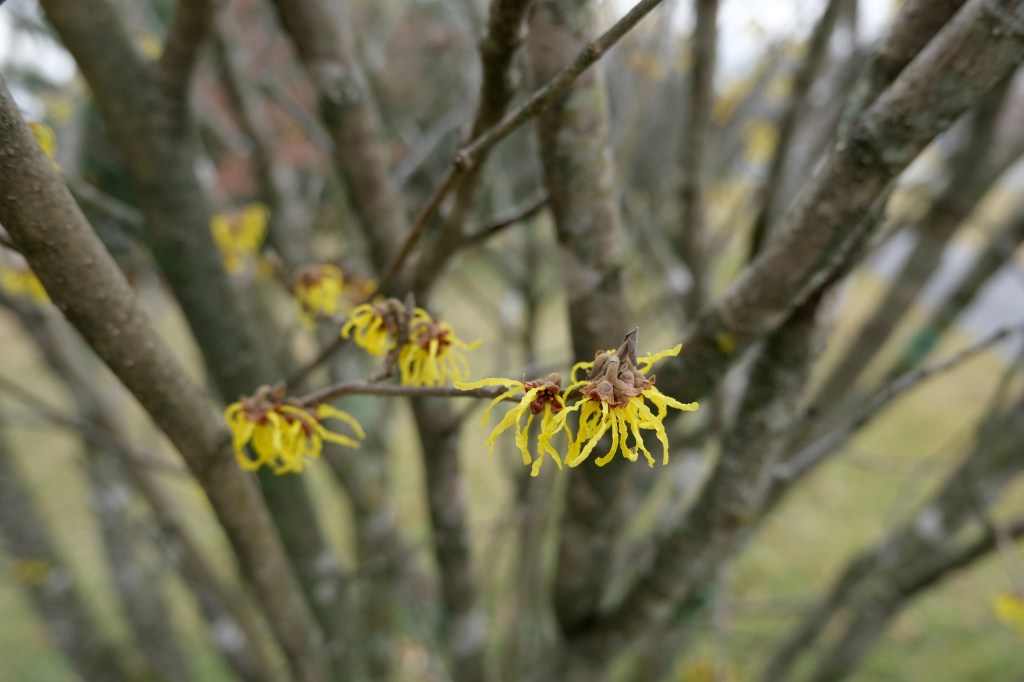
I carry my little camera with me more frequently when I go places now, way more than with my previous camera, and I go out of my way to be able to photograph stuff. Like the first flowering trees I saw on my route to and from the aquatic center where our daughter has swim practice. In a landscape of nothing by gray twiggy branches, I saw something — a large shrub or a small tree — with yellow on it. I couldn’t see what this blooming tree was from the road, so today I pulled into a parking lot and trudged over spongy wet ground to get a closer look: witch hazel.
I adore my new Fuji. Now I just need days with sunshine for decent light. Either that or I need to learn how to best use the light of overcast days. I’d rather have sunshine, though. I’m still working with the 15-45mm kit lens that came with the camera, which I love for wide shots, and which works well for closeups, like the bee butt below, but I want a wider aperture. I’m saving for the lens I really want (a 35mm f 1.4), and I’m hopeful I’ll have it for spring’s full arrival.
First pollinator of the season on the first flower: bee in crocus. With sunshine! XC15-45mmF3.5-5.6 lens on Fuji X-T30. 15mm – ISO 160 – 1/200 – f/3.5
First flowering shrub: witch hazel. XC15-45mmF3.5-5.6 lens on Fuji X-T30. 20mm – ISO 200 – 1/280 – f/4.0
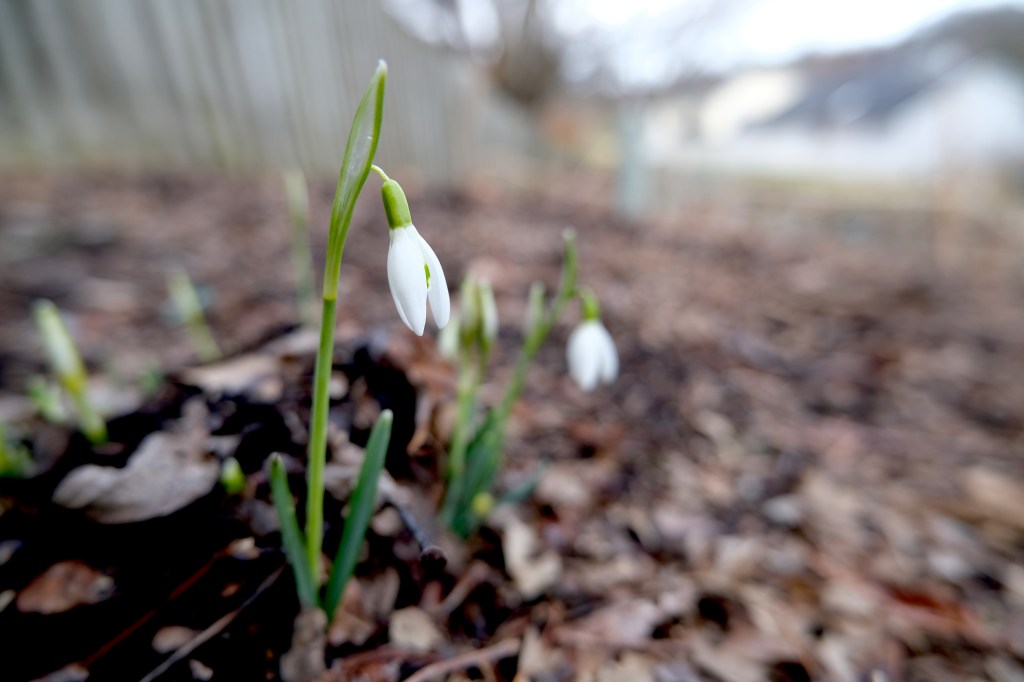
First flowers (along with crocuses): snow drops. XC15-45mmF3.5-5.6 lens on Fuji X-T30. 15mm – ISO 200 – 1/210 – f/3.5
In addition to my new camera, I’m also excited to try a new (to me) open source photo editing software, Darktable. Thanks to Donncha for that tip in our photography channel at work, to Paolo for talking to me about his Fuji, and to Brie for helping me through my first days of a camera I had no familiarity with. I’m lucky to work with a lot of talented photographers.
I love Sunday mornings. They’re the one morning of the week I sleep in, with no chores or errands awaiting me. Today I slept until 8 am; I got a ten-hour night of sleep. After I made coffee, I sat at the kitchen table and watched the bird feeder that hangs in the oak tree. I watched wings flutter, branches dip and sway under bird weight, and the feeder spin as birds lit on it, then dashed for the cover of bare branches after nipping a seed or two.
I refilled the feeder with black oil sunflower seed Saturday afternoon but saw no birds. Bird visits are inconsistent during the afternoon; you can’t really count on them after lunch. But morning when the sun is shining, like today, is like brunch at a fancy cafe on Mother’s Day. The feeder is all atwitter. Right now a blush-headed house finch perches on the disc tray beneath the column of seed. Up on the hill, a blue jay flutters from the wooden platform feeder. After he leaves, a mourning dove hops up and bobs around in the seed. A red cardinal sits on the wood fence and watches.
In the time I ate my oatmeal, the hanging feeder swung with tufted titmice, black-capped chickadees, little brown birds that I never know what they are — maybe sparrows? -, a female cardinal, a small yellow-brown bird that may have been a pine sisken, or it may have been a goldfinch. Now a blue jay hangs sideways from the cylinder of seed. It gleams brilliant blue in the morning light, its wings an iridescent teal, its back shiny cadet. The jay is chased off by a red-bellied woodpecker with its red crown and stark zebra striped back.
I want my gardening journal and new inks to arrive so I can sketch. I ordered a bright green Leuchtturm hardcover notebook along with several new ink samples. I’ll need to load pens with brown, grey, and cardinal red. I’ll need to keep one loaded with teal for the jays.
I spent most of the day today in wonder of the birds, soaking up sunlight on a walk, feeling giddy anticipation of the arrival of my seed catalog, and researching a new camera for when the world comes alive again. Appreciating beauty fills me up. It makes me feel bright inside.
My inks should arrive tomorrow. I’m taking Friday off, so I’ll be able to play. Is it Friday yet? I can’t wait to spend another day with the birds, garden dreams, fountain pens, and new color.
When our daughter is at her evening swim practice, I drop her off then drive over to a nearby trail, the Huckleberry, where I pop my headphones on and either go for a run or a walk. It used to be that I could go for an hour walk, then drive over to the aquatic center and sit in the parking lot in daylight all the way until practice was over.
Now, the sun sets before 6:30, and I’m lucky if I can get a 30 minute walk in. Next week, after the time changes this weekend, the sun will have already set when I drop our daughter off.
Last night was my final evening walk on the Huckleberry, and it was a spectacular one. The clouds pinked at sunset, and starlings flew in morphing clouds in the cool autumn air.
The air is cool and heavy, the sky overcast. A crow caws, and I hear it through the open window. This morning when I sat here, I watched a V of Canada geese fly through the flat grey sky. Their honks echoed off the mountains in the fog.
On Saturdays, our daughter has swim practice about 20 minutes from our house. I used to go to a coffee shop or read on the bleachers at the aquatic center while she swam, but those aren’t options during the pandemic. So today I loaded my phone with a short story, pulled on a baseball cap to keep my glasses dry in the drizzle, and walked along the Huckleberry Trail, a local 7-mile paved trail for cyclists and pedestrians.
I listened to Tommy Orange read Louise Erdrich’s “The Years of My Birth.” The story was a perfect accompaniment to a cool misty stroll in Appalachia. Erdrich’s writing is organic. It is both humic and crisp, and she weaves together nature and spirit and the human soul. I’ve read a few of her novels, but my favorite work of hers is a short story, “The Stone,” published earlier this year. It’s mysterious and potent and feels like it comes from the belly of the earth.
Under the canopy of oaks and pines, a spray of goldenrod hugged a damp tree stump. The trees are still green — they have not started bronzing yet — but as I walked, a single yellow leaf drifted down onto the path. I crunched through a smattering of fallen leaves, and their musty forest scent curled into my nose.
In the wet air, when I crossed the railroad tracks, I smelled the tarry odor of creosote. Where the trail was open to the sky, goldenrod and ironweed lined the path in sprays of pollen yellow and grape juice purple. Pale violet asters collected mist at their knees.
But the thing that got me was the acorn. When I crossed the railroad track, I felt something the size of a marble crunch underfoot. I looked down and saw several smashed nuts, ground to bursts of yellow dust on the paved trail. A squirrel scrambled across the path. A couple of steps later, I saw an intact green acorn, complete with its jaunty stemmed cap, and I knew fall would be here soon.
Now I’m back home, in jeans and bare feet. Our windows are open, and through the back screen door, black-eyed Susans wave in a mass of 3-inch suns on stems. The mums are thigh-high now, and their once green mounds are now masses of deep red blooms. Tangerine zinnias pop bright orange on this grey day, and our own sprays of goldenrod burst like fireworks down the hill.
The Joe Pye weed and sedum and echinacea blush pink but will soon fade to brown. When the echinacea drop their petals, the goldfinches will come and perch on the dried seed cones. Small bright bundles of yellow, the little birds will sway on long stems. I don’t want summer to end. But the goldfinches on the echinacea are one of my favorite things about my garden. If summer has to end, seeing them bob on spindly coneflower stems makes it a tiny bit easier to bear.
On Father’s Day this year, the kids and I didn’t want to give their dad stuff. It was day 101 of the lockdown, and he’d already had a pandemic birthday shuttered up inside. We wanted to give him an experience, to leave the house, to do something together as a family instead of just spending money on physical doo-dads he may or may not want or need.
We found a state park nearby whose boat rental shop was open: Fairy Stone Lake. Our son, who was learning to drive at the time, drove the hour and a half drive on winding mountain roads. We thought about renting canoes, but then decided we all wanted to try paddleboards.
We loved everything about paddleboarding: the portability of the boards, how easy it is to swim off of them, their versatility — you can sit, stand, kneel, or even lie down to paddle. We loved that when you want to hang out, you can sit on the board and dangle your feet in the water, or you can lie back and chill out with your hat over your face.
Shortly after that trip, my husband and I bought paddleboards. They get us out of the house without having to get near other people, and they complement sailing perfectly because they’re better for days when there’s no wind.
We’ve paddled several times on Claytor Lake, a nearby lake we also sail on. But Claytor Lake is busy with power boats and jetskis. It can be loud, and there are lots of boat wakes to navigate when you’re standing on a floating board.
On Labor day we decided to try a new place to paddle: the New River. We’d tubed down the New River before, but we’d never paddled on it. A friend told us about a good place to put in where the current’s not too strong and there’s plenty of depth so you don’t have to worry about crashing your board over rocks and rapids.
Paddle on the New River
I loved it. When we paddled upstream, the sun was behind my right shoulder, and when I looked into the water on my left, the sunlight streamed in golden rays into the topaz depths. Sometimes the rays converged at my crown’s shadow, as if my shadow self were radiating sunlight from beneath the river’s surface.
The air temperature was in the low 80s. Not too terribly hot. On the river, though, standing on my board in a long-sleeved sun-protective rash guard and a life-vest that covered my torso and back, and the sun beating down on me at 2 o’clock in the afternoon, I was hot. I put in a few good strong pulls with the paddle to get me going into the current so I could jump in quickly to cool off, and the water was crisp and chilled. It was colder than the lake, and it made me think of my favorite scene in The Sun Also Rises, when the characters go fishing in France and chill their wine in an alpine stream.
But my favorite part was the light in the water. September is beautiful for light. When we paddled into the shallows of an island in the middle of the river, the water was crystal clear. Looking out over the nose of my board, the shallows rippled golden in the light. When we stopped in shin deep water to hang out, the pebbles beneath us shone gold and bronze and copper. The colors are so beautiful, it’s no wonder those metals are precious.
But the pebbles through the clear, rippling water were even more awe-inspiring than precious metals because their beauty included light and water, two things that are uncaptureable. You can’t hold light and water in your hands. You can’t hold golden ripples. I think that’s why I love them.