Mom’s red and white checked cookbook was falling apart even when I was a child. Every time she pulled it off the shelf, which was nearly every day, tattered pages would spill out, their binder holes torn, and she’d shove the sheets back in before thumbing to the recipe she wanted. The gingham cover was spattered with brown stains, the once-white checks were now yellowed, and the corners of the book were split and frayed like the corners of a burst couch cushion. She pulled one of my favorite childhood dinners, Chicken Divan, from that cookbook’s pages, along with all of our Christmas confections: fudge, divinity, peanut butter blossoms, and bourbon balls.
When I married, Mom gave me my own copy of that cookbook. The white checks were pristine, like fresh milk, and the red were bright and cheery like cherries. It was one of my first cookbooks, and its gingham cover, like a hopeful picnic cloth, was a happy addition to our kitchen.
Until my mom gave me that cookbook, I didn’t realize how ubiquitous it is. But once I had my own, on my own kitchen shelf, I started noticing it at others’ houses. The shelves of my mother’s generation all held tattered stained copies like Mom’s, pages dog-eared and stuck together, ripped or falling out, while the copies on their daughter’s shelves were fresh, neatly shellacked, and bright red-and-white like mine.
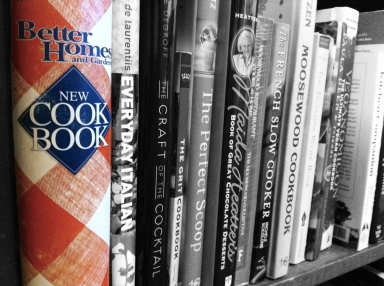
That was fifteen years ago, when my copy was smooth and unblemished, the lone reference in our newlywed kitchen. Now, we have two rows of instructionals, and that red and white checked volume occupies the most accessible spot on the shelves: the top left corner, first of all the cookbooks. The muffin page is spattered with batter, the frosting page is sticky with sugar, and the praline page is building up its own layer of history, including notes on past failures flecked with specks of caramel candy. When my husband craves his mom’s bread stuffing from Thanksgiving, I find it in my book. When I want my mom’s biscuits, I look them up in my book.
It is not the most sophisticated of foodie references. It does not have the name recognition of The Joy of Cooking. But it has the basics, the classics, the food from our childhoods. It is the quiet cookbook that nobody makes a fuss over, but nearly every family owns. And it has that cover, that red and white checked cover, that we all recognize, even if we don’t know the book’s name. That cover that evokes cozy kitchens, and home cooking, and tradition that can be thumbed through the generations, whether on tattered yellow or crisp white pages.
This is my entry for the photo challenge: community, for our community of cookbooks that began with our red and white checked copy of the Better Homes and Gardens New Cook Book.
I have to tell you, I was really excited when I realized my Andrea Reads America tour would have me reading Alaska in winter. I love cozying up with icy books when it is cold outside – I reread The Shipping News nearly every winter – and Alaska literature has not disappointed. I’ve gone back and forth between shivering, swearing “I’m reading a warm book after this!” and succumbing to the wild brutality of Alaskan winter, my thirst for its realness and its close-to-the-earthness unquenchable. Reading books populated with marten and wolverine, bear and fox, glaciers and tundra, I’m learning a new vocabulary: breakup (aka Spring, when the ice breaks up and avalanches downstream), ptarmigan (grouse), and babiche (rawhide strips used for cording, as in making snowshoes). I am scribbling descriptions of ice and snow and the piercing cold because the frosty words paint pictures of a place that is exotic, full of a wonder and wildness I will never experience here in Virginia.
While my Alabama reads dealt with social themes – racism, community, and doing the right thing – my Alaska reads contend with themes of wilderness, survival, legend, and the strong pull of the natural world. The landscape is as much a character in each book as the humans are, and I was pleased to find books set not only in isolation in the far north of Alaska and inland on a homestead, but also one set in more populated areas, on the raw coast. I’m a sucker for coasts.
Novel: The Snow Child
Author: Eowyn Ivey, raised in Alaska
Setting: 1920s Alaska homestead
Categories: Literary fiction, Pulitzer Prize finalist
I didn’t think I liked magical realism, but it turns out I just hadn’t found the right book to pull me in, ground me in a reality, then sprinkle magic in a way that is wondrous and enchanting, and leaves you puzzling throughout – is it magic or is it real? The Snow Child was this book for me.
Set in the wilderness of 1920s interior Alaska on the Wolverine River, The Snow Child is the story of a aging couple who have moved west from Pennsylvania to homestead in Alaska in an effort to escape the emptiness left by their stillborn child. A two hour horse ride to the nearest “town” and then a train ride away from Anchorage, Mabel and Jack become isolated even from each other, grieving while they labor separately to make workable land from wilderness. One night, they succumb to the magic of a snowfall, and in laughter and joy, they build a child from snow. The next morning, the snow figure is gone, and a wildling girl appears in the forest.
The Snow Child chronicles the growing affection between Faina (the wildling) and the elderly couple, who over the years grow to think of her as their own, though she comes and goes without notice, and though they live with opposing stories of her flesh-and-blood father who Jack buried and the idea that Faina is a snow maiden of their creation, as Mabel read about in a Russian Fairy Tale. A tale that never ends well.
The magic in this book isn’t just the obvious fairy tale quality of it. The magic is in the crystalline descriptions of Alaska in winter. Author Eowyn Ivey may not be Eskimo, but I would argue she has a thousand words for snow. Her descriptions are like snowflakes on the tongue – delicate, feathery crystals that sting in their loveliness:
“The December days had a certain luminosity and sparkle, like frost on bare branches, alight in the morning just before it melts.”
“Dawn broke silver over the snowdrifts and spruce trees.”
“The child was dusted in crystals of ice, as if she had just walked through a snowstorm or spent a brilliantly cold night outdoors.”
“The cranberries were tiny red rubies against the white snow.”
“Around the curve the valley opened up, and in the distance spires of blue ice glowed.”
This is a biting and beautiful book of love: love for neighbors, of husband and wife, for children, and love for the wild pull of the land, the forest, the snow, and the wilderness. It is one I will come back to when I want the magic of winter.
Two Old Women, a tale of Athabascan Indians written by Velma Wallis, a native Athabascan author, takes place north of the Arctic Circle in the interior of Alaska. It tells a tribal legend passed orally to Wallis by her mother, of two elders who were abandoned one lean and brutal winter by their tribe.
“That day the women went back in time to recall the skills and knowledge they had been taught from early childhood. They began by making snowshoes.”
At the time they were abandoned, the old women depended on the youth of the tribe to care for them. Because of this dependence, with The People on the brink of starvation, the Chief determined the women were holding the tribe back, threatening the survival of the many for the demands of the few, and he left them to die, old, crippled, and alone on the open tundra. The two women could barely walk, even with canes, when they were left behind, but the taste for survival was sharp in their mouths, and they gathered their strength and elder-wisdom to stay alive. They made snowshoes from babiche a grandson had left them, and used the shoes to trek to a safe winter-over spot; they caught rabbits in snares; they slept in snow pits they dug with gnarled hands and lined with spruce boughs for bedding.
What I love about this story, aside from a portrayal of the very real struggle for survival for indiginous people living without permanant shelter – nomads north of the Arctic Circle – was the focus it places on elders. The elders in our communities have seen much more than the youth have. They know more, they have lived more, they are wiser. It is easy for young ones, in their arrogance and vigor, to toss the old aside, thinking they are outdated, their knowledge obsolete, their presence a hindrance holding the young ones back rather than a source of wisdom that could propel them forward. Wisdom that could nourish and equip them for the unknown that lies ahead.
I imagine this story would be powerful as an audiobook, told with native Athabaskan inflection and in its traditional, oral story form.
My head is a cup left out on a stormy autumn night; half full of water, and a spider.
The fact is, I can’t. Especially when the novel is a murder mystery set in October in the port town of Sitka, off the raw southeastern coast of Alaska. Unlike the previous Alaska books I read, which were set in isolation in the interior of the state, Staley’s novel portrays peopled coastal regions in Alaska: cities with pubs and coffee shops, police departments and wharfs. Eskimos and other natives populate scenes in diners, bars, and airplanes, always reminding the reader you’re in Alaska.
Since it’s a mystery novel, I won’t go too much into the plot, except that it involves a murder (duh), Tinglit Indian legend, and Cecil Young, an alcoholic private investigator with a penchant for poetic thought
“Her skin was as white as a sea anemone, and as soft as the pool of warm air you pass through while rowing across the bay.”
and a knack for nailing scenes
“As the bottle got lighter our gestures became wilder, our eyes widened and we imagined were were expanding into our own stories.”
“The landscape seemed to press in and make Juneau seem like a smaller, less sophisticated town than it really was.”
“The water boiled with little silvery fish dense on the surface like a trillion dollars in quarters spilling onto a sidewalk… There was a massive exploding breath and the damp smell of fish and tideflat… Whale. Humpback whale, feeding on herring.”
I read this as winter descended on Blacksburg, Virginia, and it was a perfect curl-up-on-the-couch cozy mystery read. The language in this book is beautiful, enough so that I was intrigued by a mystery writer who wrote so poetically, and I discovered that Straley has studied poetry and was the Alaska State Writer Laureate from 2006 to 2008.
The Woman Who Married a Bear is the first in a series of Cecil Young mysteries.
For further reading in Alaska
Books I’ve read and recommend: Ordinary Wolves by Seth Kantner Into the Wild by Jon Krakauer (nonfiction)
Books that have been recommended to me but I have not yet read: The Raven’s Gift by Don Reardon Two in the Far North by Margaret E. and Olaus Johan Murie (nonfiction) Drop City by T.C. Boyle The Only Kayak by Kim Heacox (nonfiction) Journey to a Dream by Mary Lovel (nonfiction) My Name is Not Easy by Debbie Dahl Edwardson Don’t Use a Chainsaw in the Kitchen by Rosalyn Stowell
I am reading America: 3 books from each state in the US with the following authorships represented – women, men, and non-Caucasian writers. To follow along, please visit me at andreareadsamerica.com.
In the summer of 2013, my parents packed up their RV and took the adventure of their lifetime: the two of them and their yellow lab, Blondie, drove from Georgia to Alaska and back again. Mom wrote and photographed their journey on her blog, Wandering Dawgs.
“At first (when she was not yet Miss Tee but Auntee) she was mostly the one who always came to cuddle, kiss, and oopdedoopdedoodle you saying some brown sugarboy lips and some sugarboy brownskin cheekbones and some brown sugarboy foreheadbone and some sugarboy brown righthand knockout knucklebone…” – Albert Murray
Until I really got into the cadence of Train Whistle Guitar, I felt like whitey out on the dance floor, unable to keep time, incapable of following Albert Murray’s rhythm. Like his characters, guitar player Luzana Cholly and pianist Stagolee Dupas, Murray beats and bobs with his prose, tapping out struts and riffs and tempos and rhythms that left me flailing, out of sync and out of time.
As I struggled through those first fifty pages or so, I pictured a brown-skinned, white-whiskered man, eyes closed, shaking his head to an internal beat that I could not hear. He extemporized, improvised, riffed rhymes and repetitions to a foot tapping, knee-slapping beat, and while I could feel a pulse there, I got lost in phrases I could not decipher:
“Me my name is Jack the Rabbit also because my home is also in the also and also of the briarpatch.”
What does that mean?! I puzzled over that sentence. I came back to it again and again. I worked at dissecting the “also in the also and also of” until my brain hurt. Finally I gave up on it, quit trying to figure its meaning, and surrendered to the rhythm of Murray’s phrasing. Once I did that, once I stopped trying so hard, once I stopped trying to be so cerebral, the tempo took me and I enjoyed the book for its purcussive pacing and delicious depictions. I savored his sentences, his descriptions of making love to a girl in the woods,
“What she mostly smelled like was green moss. But that first time it was willow branches then fig branches, then plum leaves. Sometimes it was sweetgum leaves plus sweetgum sap. And sometimes it was green pine needles plus pine trunk bark plus terpentine-box resin. But mainly it was live oak twigs which she chewed plus Spanish moss which she used to make a ground pallet.”
of parts of speech,
“A preposition is a relationship; and conjunction is membership; and interjection is the spirit of energy.” (!!)
of the coastal forest,
“You could smell the mid-May woods up the slope behind us then, the late late dogwoods, the early honey-suckles, and the warm earth-plus-green smell of the pre-summer undergrowth.”
and the bayou,
“We were still in the bayou country, and beyond the train-smell there was the sour-sweet snakey smell of the swamp-land.”
of woodpeckers,
“Woodpeckers always sounded as if they were out in the open in the very brightest of the sunshine.”
and of course, the jook joint as young Scooter saw it from his hidden perch in a tree:
“The light near the piano was bright enough for you to see them dancing and see Claiborne Williams at the keyboard with his hat cocked to the left and his wide silk four-in-hand tie flipped back over his right shoulder, spanking and tickling his kind of blues.”
When I finished reading Train Whistle Guitar, I felt flustered by my initial inability to jibe with Murray’s swing, and I didn’t think I liked the book all that well. Despite two index card bookmarks I filled with quotes, I only gave it three stars on Goodreads, writing in my review that I couldn’t get over our rhythmic differences. Train Whistle Guitar is one of those books – you know the kind – that when I first finished it, I only thought it was okay. But it has caught me, like a complex tune that you’re not sure you like the first time you hear it, and my mind keeps coming back to it.
And the more my mind comes back to it, the more I remember his beautiful descriptions of brown skin –
honey brown finelegged frizzly headed woman
sugarboy brownskin
chocolate brown dimples
as cinnamon-bark brown as was the cinnamon-brown bark she was forever chewing and smelling like
May your Anne Tee have some pretty please help herself to some of all this yum yum sugar and all this yum yum honey plus all this buster brownskin pudding and pie.
– and my toe taps, til I feel like I could close my eyes, and shake my head, and groove in a smoky jook joint, “doing the shimmieshewobble and the messaround.” The more I hear Murray’s phrases, the more I relish them, just like those complex tunes that grow on you even if you’re not sure you liked them the first time, and I’ll turn him up and sing even if I don’t know all the words, and dance even if I look like whitey out on the dance floor.
I have since upgraded my Goodreads review to 4 stars. I keep thinking of things I loved about this book. Another favorite aspect was Murray’s deep respect for his characters, revealed through his tender descriptions of brown skin. For more on Train Whistle Guitar and other fiction set in Alabama, see Andrea Reads America: Alabama.
I am reading America: 3 books from each state in the US with the following authorships represented – women, men, and non-Caucasian writers. To follow along, please visit me at andreareadsamerica.com.
The grown-ups stood at the front window sipping spiked coffee and doctored hot cocoa. Our entertainment that day was watching Ed, the mail man, bend into the blizzard as he trudged through thigh deep snow to get to our across-the-street neighbor’s wall-mounted mailbox. All the kids entertained themselves by – well, I don’t remember how they occupied themselves. All that mattered was that they were entertained.
That was three years ago. Today, as the sky spits wet ice that coats cars and roads in slick sheets of slippery sleet, our son plays his Wii U instead of kicking the soccer ball with boys he invited over for his birthday. Once again, winter weather has thwarted his birthday plans.
Three years ago, when we lived in Minnesota, when our kids were still young enough to combine their birthday parties (their birthdays are two weeks apart in the middle of holiday season. Fun.), we planned a Saturday party at the bowling alley. It was December 11, 2010, a celebration of our son’s seventh birthday and our daughter’s fifth. In Minnesota, things don’t get cancelled for snow. In three winters, our children did not get a single snow day from school, despite several blizzards and a foot-thick perma-layer of white.
That Saturday, as we watched the inches pile up, as we watched the ground disappear beneath a thickening blanket of white, we bit our cuticles and wondered, do we cancel? We kept checking the bowling alley website, checking the forecast, checking the depth of snow in the street. Four inches. Six inches. Eight inches. A foot.
Finally, with only two hours til the party’s start time, when our street wasn’t plowed and we knew our soon-to-be salt-crusted Passat wagon wouldn’t be able to push through the accumulation, I looked at the cookie cake I had already baked, the snacks I had already packed in totes, and I picked up the phone.
“Hey Stace. I don’t think we can get to the bowling alley. We’re going to have to cancel the party.”
“Oh no! The kids will be so disappointed.” She had three of her own, all with Swiss and Germanic names peppered with Ks and Vs and Zs, who had been excited about the party all week. Now they would be cooped up in her house, full of pre-party excitement that would not get bowled out.
“Well, I was thinking, if you and Ben want to still get out of the house, we do have this cookie cake.” Her family lived around the corner, a block or two away. “Y’all want to come over here?”
We extended the same invitation to other guests, most of whom also lived nearby. Two hours later, at the bowling party’s start time, my husband and I looked out our front window into the blowing snow and saw two parka-clad grown-ups bent into the gale, each pulling a sled laden with brightly colored puff-balls of children. The snow was deep – almost to Ben and Stacy’s knees – and they pushed through it like my brother and I pushed through marsh mud as children. The sleds sank under the weight of a seven-year old, a five-year old, and a toddler, and Ben and Stacy made their way towards our house lumbering step after lumbering step.
The storm picked up as they brushed off snow and stomped their boots in the mudroom. We could no longer see the street corner they had rounded. Our friends’ noses and eyes burned red. Snowflakes melted in their eyelashes, and I immediately offered them coffee and hot cocoa.
The kids disappeared into the living room, and the grown-ups stood at the back window. We blew steam from mugs and watched snow squall. A figure materialized from the whiteout – our neighbor, Matthew, with his four-year old daughter on his shoulders. A wake of snow pushed in front of his knees like water before a ship’s bow.
“Matthew, come in! Come in! We need to run a rope between our houses like Pa Ingalls ran between the cabin and the barn.”
I put a cup of coffee in his hands and offered a shot of whiskey in it. His blonde eyebrows shot up and he smiled a Nordic smile.
Once the third family emerged from the other blowing corner of the back yard and made it safely to our door – our Lutheran neighbor who sang in a gospel choir – the children disappeared into kid rooms. The adults moved to the living room. Some of us stood at the front window and watched snow pile.
“I bet it’s up to 16 inches now.”
“Hard to tell with the drifts”
We warmed our hands on earthenware mugs. Blew steam. Sipped coffee.
“Oh my God, is that Ed?” Our friends who had been lounging on the sofa jumped up and padded over to the window. We all shared Ed, the neighborhood mail carrier. We stared openmouthed as he bent into the blizzard. The flaps of his fur-lined USPS-issued hat were pulled over his ears and tied under his chin, and his blue postal parka with the reflective stripe was flecked with white. He trudged through thigh deep snow to get to the wall-mounted mailbox on our neighbor’s front stoop.
We watched, entranced, as if we were watching a movie. “I better put another pot of coffee on.” I took my time – Ed wasn’t getting anywhere fast in that blowing mess, and he still had to tramp to two more houses before he’d get to ours.
When he slogged his way onto our stoop, I opened the door and told him, “Come inside Ed! This is crazy that you’re out delivering mail.” Even the Minnesotans thought it wild. He pulled his snow mittens off and stuffed them into the mail bag slung over his shoulder. I put a cup of black coffee in his hands. Threads of blood vessels reddened his nose and cheeks, and his eyes watered.
“I had to leave my truck over on Roselawn,” he said. “Couldn’t get it down the street.” He wrapped his chapped hands around the mug and gulped large sips while the coffee was hot.
“It’s really blowing,” he said, and finished off the cup before it had a chance to cool. He handed the mug to me and smiled, “Thank you very much for the coffee.” He pulled his mittens back on, and we all patted him on the back before sending him back out into the storm.
“Thanks Ed, be safe out there.” He bent his head and plowed through the knee high drifts in our front yard. When we dug out the next day, after the storm had blown through and the sky was a crystalline blue, we made sure to dig out the postman’s path.
“We need to give him a nice tip this Christmas,” my husband said.
I don’t think the kids cared that year that their bowling party was cancelled. I certainly didn’t. We ate cake and fed Ed and drank whiskied coffee in the early afternoon, and the kids played warm inside together while the world outside blew white and cold. We were all happy.
View of house from plowed street
Snow piled up to windows
Compost bin peaking out from snow
Digging the postman’s path
This year, our daughter was able to have her party (Saturday), but our son’s was supposed to be today. I don’t have a cake or snacks because he wanted it to be low-key. He doesn’t like to be the center of attention. He didn’t even want his friends to know it was a birthday celebration. He just wanted to play soccer, 3 on 3 with his five friends. Without cake, or parents carrying children through blowing snow, or drinking hot spiked drinks before five o’clock, or children tinkering in kid rooms, what will our memories of this cancelled party be?
I guess they will be whatever I make them here: my husband and son wrapping black railings in white lights while icy rain sleets down; our son exclaiming, “My snow globe!” and beaming as if he’d rediscovered a lost friend when I unwrapped the Christmas decorations; me lighting holiday candles in the middle of the day. Today’s memory will not be of Ed trudging through a blizzard to deliver our mail, but of our son, who cracks windows to listen to rain, who loves the delicacy of snow, who delights in bad weather because he likes to be cozy inside.
The memories of this thwarted soccer day will be of our son who is happy as a clam, snuggled in the poofy chair next to the Christmas tree, reading a Hardy Boys book and smiling in contentment for his favorite kind of day: the lazy ones.
I am devouring the final pages of my third Alaska novel for the Andrea Reads America project (3 books set in each state of the US) and will soon be moving south to Arizona, which means I am spending a lot of time on the couch, cup of coffee by my side, feet propped on the table and laptop on my lap, browsing bookish websites. Sleuthing titles from each state has already become one of my favorite pastimes. I love sorting through book lists, reading synopses, receiving recommendations, organizing titles and authors, getting that tingly “Oooh, I have to read that one!” feeling, and most importantly, lining up my book queue so that I always know what I’m going to read next.
I’ve only selected books for three states so far (Alabama, Alaska, and Arizona) because I’m winging this as I go. My process has been to assemble the next state’s book list when I begin reading the final pick of my current state. I start with a call for recommendations from you and from Twitter. I enter your recommendations into my spreadsheet (yes, a spreadsheet of book titles. How geeky can you get, right? I know you want to see it though. I’ll give you a taste in a minute.) and then start running through my list of reading-by-geography resources:
1. LitMap Project
Screenshot of LitMap Project North America map
I heard about LitMap on one of the early episodes of the BookRiot podcast and put it in my pocket for my reading road trip. Though the screenshot above only shows North America, on the LitMap Project website you can search locations all over the world. And even better? You can submit titles too. So if you know books set in specific states, please submit titles. I think this is a really cool idea and would love to see it get lots of action. Navigating the map took a little getting used to at first, but I think that might have more to do with my mouse than the website. I have registered and will be litmapping all of my reads for this project. (And I just saw that I am in the Litmappers Hall of Fame! Awesome.)
2. Business Insider’s map of the Most Famous Books Set in Every State
Most Famous Book Set in Every State from Business Insider
I wrote about this map in my introductory post about the project, It’s official: I am reading America, so I won’t go into a lot of detail about it here. I won’t necessarily be reading all the books from this map, but it gives me a good jumping off point and reminds me not just of titles I love, but titles that have long been on my TBR list and I will now get to thanks to this project.
3. The Readers podcast
On The Readers episode 85, recorded in October 2013, hosts Simon (UK) and Thomas (USA) each chose and described 10 (or 11) books that represented the different regions of their respective countries. I had already started my US tour in Alabama, and I think I may have squealed when I heard the show’s topic. I scribbled down most of the titles Thomas suggested for various regions of our country. It’s a great list by an avid, thoughtful reader, and Simon has me wanting to take a British tour as well. Maybe when my current project is done, I’ll hop across the pond.
4. Pulitzer and National Book Award lists
After reading the Science paper linking literary fiction and empathy, I plan to read a lot of literary award winners set in various states around the US. I wrote down every title from the Pulitzer Prize for Fiction list, plus the finalists, read synopses of all the works, and marked the titles that were set in a particular state. I did the same with the National Book Award list. I am in the process of entering all the titles in my spreadsheet, but what I’d really like to do is create a map that plots the winners by setting. I’m no graphic artist, though, and I’ll have to think a while on how to make it pretty, and how to deal with the huge cluster of titles set in New York.
5. Goodreads
Thank heavens for Goodreads lists, and for reviewers who tag books based on geographic setting. I found many of my Alaska titles on the Goodreads Best Books on Alaska list. I’m still learning how to navigate Goodreads (e.g. I don’t know how to tag books), but I have a feeling I’ll be an expert by the time this is all over.
6. Google search
After I’ve gone through steps 1 through 5, I do a basic google search. For Alabama, I searched “books set in Alabama by Alabama authors” and found this great list, 10 favorite novels by Alabama authors set in Alabama. For Arizona, I found an exhaustive list, Reading Arizona: The Literary Landscape, which even includes the specific region in Arizona the book is set in.
The Spreadsheet
It did not take long before I realized I had some serious data management issues when all I was doing was scribbling notes in my yellow composition book. When your recommendations started pouring in as comments on blog posts, I decided to set up a spreadsheet to organize titles. As I run through the resources above, and when you all are so kind as to give me recommendations, I enter the information in my spreadsheet:
Andrea Reads America: screenshot of title and author spreadsheet, organized by state
Since part of my project is to read men, women, and non-Caucasian authors, I often have to dig deep to find a minority author to flesh out my list (although in Arizona I’ve got several Native American authors to choose from – very exciting). I mark the titles I am most excited to explore based on recommendations, book blurbs, and literary awards, then go through my short list to make sure all three authorships are represented. Twice my short list was comprised of three women (an exciting problem), and so I went back in and adjusted til my list of three was well rounded.
Then? I read.
I am reading America: 3 books from each state in the US with the following authorships represented – women, men, and non-Caucasian writers. To follow along, please visit me at andreareadsamerica.com.
*Edited December 13, 2013 to include TripFiction.com, a website where you can search by location to find books set in a particular area. The TripFiction tagline is “See a location through an author’s eyes.”
It is the Sunday after Thanksgiving and everyone is home, in the house, while I write. I’m in the basement at our Ikea secretary, writing 15 minutes on the here and now, in the same spot, every day for 30 days. I hear it may get tedious after a while.
The heater rumbles on. It blows dry air, flaking our skin, chapping our lips. Our son plays his new WiiU behind me. He sits cross-legged on the black futon, staring at the TV screen, a red velveteen throw blanket over his lap.
Morning light shines through the sliding glass door on my left. There are ice chips strewn about the brick patio from the crystal spear the kids found yesterday. They laughed as they threw it down on the red bricks until it shattered into a thousand pieces. The patio furniture my husband made – white Adirondack chairs and a hunter green lemonade table – is covered for winter with a mint green tarp. I swept leaves off the brickwork a couple of weeks ago, and our fenced patio is still relatively leafless. I think the trees have shed the last of their garments.
Inside, at my desk, the heater still blows. I smell lotion and the metallic tang of ball point ink. I hear the soft bloop bleep bloop of Mario Brothers behind me as our son clicks buttons and conquers mushroom worlds. Before I started I told him, “I’m setting a timer for 15 minutes so I can write – I won’t be able to answer questions. If you talk to me while my timer is ticking, I probably won’t respond.” I haven’t written in four days, and I’m twitchy.
“Okay,” he said. “I’ll turn the Wii down so it won’t bother you.”
My composition book, its indigo lines crisp against white paper, is tilted on the honey wood. The lines are the color of my favorite Crayola crayon, midnight blue, which I have not found in any of the dozens of crayon boxes we’ve bought for our daughter over the past six years. I always went straight for that deep, mystic color when I got a new box of crayons. I’m sad they discontinued it.
My phone, encased in a grey and white Otter box, is at the top left corner of my page, acting as my timer. My coffee is next to the phone, getting cold in its too big black mug that lets heat escape in ways my perfect green mug did not. At the top right of my book, the corner pointing away from me, is the once white keyboard of our computer. In this slanting light, which seems to shine pointedly on the contours of grime on the space bar, I can see how badly our keyboard needs cleaning. The 0 on the number pad, the 5, and the 9, all look grungy enough that I feel dirty just looking at them. I might need to wear gloves before I touch them again.
Day 2
It is late morning on the Monday after Thanksgiving and the house is quiet. Our kids are at school, my husband is at work. The dryer squeaks and rattles, turning over wet clothes. The washing machine fills with water – sqrsshhh, dribble, sqrsshhhh – then rumbles as the tub spins back and forth, water sloshing, agitator agitating.
The light outside is muted. Out the sliding glass door on my left I see a flat overcast sky through the bare limbs of trees. The few paper leaves remaining on branches are still. There is no breeze.
My head feels cool – my hair is still damp from the shower. I have too much to do today. I did not have time to dry it. The wet clumps smell like shampoo – Brilliant Brunette – spicy and clean.
On the walnut filing cabinet to the left of my desk are a stack of notebooks: my journal from France, sepia colored with an antiqued photo of the Eiffel tower; the plastic-covered library copy of Two Old Women, the index card that doubled as a bookmark and favorite quote notepad sticking out from between pages; and my yellow composition book titled “Andrea Reads America.” This is my to-do pile for the day. I must write a synopsis of Two Old Women before it all leaves my head.
On my computer screen are photographs from the streets of Seoul from Cheri Lucas Rowlands’ blog, Writing Through the Fog. A sign outside a Seoul shop says “Free Robot.” My desk is messy – a receipt from Food Lion is stacked on top of the checkbook, reminding me to enter transactions into our budget software; the house phone is tossed on top of them, reminding me to call the property manager in Florida. My yellow notepad reminds me to write my to-do list, and the mouse sits on top of a white business envelope with “Nana and Papa” written in tiny ten-year-old-hand, reminding me to address and stamp our son’s Christmas wish list for his grandparents.
Our desk is the color of honey, with ribbons of dark amber and pitted gouges of blonde. The surface is scratched and has a dribble of wax on it, and the place the mouse rolls over looks speckled and gummy. I run my fingers over the dirty spots that look raised in the slanting light, but the wood is smooth. It does not feel tacky. There are no bumps. The hinges that lift the desk portion of the secretary are dark bronze, a gold black, and are shaped like anime butterflies with semicircle wings.
The keyboard is still grimy.
Day 3
Six-oh-nine AM. The coffee maker clicks and bubbles behind me. Fluid trickles and steams into a glass carafe. The blinds are closed over the sliding glass door on my left. Vertical slats of fake-brocade cloth in a café au lait color. Only not as rich as the real thing. More of a dull, blah, rental color. It is black on the other side of those blinds. The sun has not yet risen.
My notebook is in shadow. I see my hand’s dark shade move across the page. I’ve turned on the overhead light today, the one attached to the ceiling fan, and it shines behind me. My body blocks the light, throwing the page in front of me into darkness. Our desk faces the wall. Another light – a college-type paper lantern that I think hung in the kids’ room in Tampa when they were babies – hangs from the ceiling on my right. It throws another set of shadows to the left of my moving hand.
The navy cushion underneath me is compressed and hard. It covers the seat of our wooden chair, but it removes little of the discomfort from the unyielding pine board. I’d love a real office chair, with contours and a seat that gives and swivels, and feet that roll.
To my right is a dark waist-high bookshelf. A tiny green statue of Buddha holding an umbrella sits on top, along with a black framed photograph of neon Spartina grass that our friend Dorothy gave us. The green is striking against the black mat and frame. She signed it in white ink: “1/100 Marsh Grass.” She gave us the first print because a story I wrote inspired her.
Also on the shelf are the folded red velveteen throw blanket and a coil pottery bowl I made in high school. The bowl is glazed in red and purple, and it is filled with stones we collected from beaches in Maine. The cobbles are smooth, worn by waves that clanked them against cliffs off the frigid northeast coast.
Day 4
Here I am again at the desk. Day four. Twenty-six more to go. The shadows are the same as yesterday – it is early and dark, and the light behind me throws my paper into obscurity. My desk is a mess. To-do lists on yellow-lined paper lay scattered, and pens, pencils and scissor handles needle out of a glittery blue cup like sharps shoved into a pin cushion. A binder clip is wrapped in my phone’s white USB cord. My notebook lays open on top of it. Today is cleaning day. I will need to straighten this up to dust.
It is warmer this morning. I’m wearing sweats, and I may need to pull my hair into a pony tail to keep from overheating. The coffee maker just sighed its completion, and the basement room is rich with its dark aroma. When my timer dings I will pour a cup over the teaspoon of sugar and two tablespoons of half and half I measured into the bottom of my earthenware mug.
The blinds are closed next to me. I don’t like having them closed. It makes me feel penned in. But when it’s dark out I don’t liking sitting next to a huge plate of glass with blackness on the other side. A blackness I can’t see into, but anyone out there could see me, hunched over my notebook, illuminated by the blaze of my writing lights.
I can still see the grimy buildup on the keys. I really need to clean that.
As part of my writing group practice I am spending 15 minutes a day for 30 days describing the same space. This practice fits perfectly with this week’s writing challenge: to create snapshots in words instead of with a camera. Transcribing from my journal was a fascinating practice in seeing what I focus on with my descriptive writing, and where there are gaps. There is a lot of room here for senses besides sight.